Websites often appear perfect to visitors, with smooth animations, clean design, fast interactions, yet remain partially or completely unreadable to Google and AI answer engines. The reason is not bad content or weak backlinks. It is how HTML is delivered and rendered before a single visitor ever arrives.
Google indexes in two waves. Wave 1 reads raw HTML immediately. Wave 2 executes JavaScript, but that second wave sits in a queue that can take hours, days, or weeks to reach your pages. Anything that only exists after JavaScript runs is absent from Google’s index until that queue clears.
AI crawlers do not queue. GPTBot, PerplexityBot, and ClaudeBot read the initial HTML and move on. No second pass, no patience for JavaScript. A page Google eventually indexes may still appear completely blank to every AI system citing content today.
98.8% of websites use JavaScript as a client-side language, but not all of them pay the same SEO and AEO price for it. The ones that do not are using SSR, CSR, or SSG correctly.
This guide covers Server-Side Rendering (SSR), Client-Side Rendering (CSR), and Static Site Generation (SSG), what each does, and how they affect indexing speed, AI visibility, structured data reliability, and search performance. The goal is direct: content that is fully readable, indexed, and cited.
How Rendering Decides What Google and AI Systems See
| Quick Note: What Rendering Means
When a browser receives a website’s files, it assembles them into the visible page you see. Rendering defines where and when this assembly happens: on the server before sending the page (SSR), on the visitor’s browser (CSR), or pre-built at deployment (SSG). Your rendering strategy directly affects what search engines and AI crawlers actually see. |
The way a page is rendered determines what crawlers can see and index, making the choice of rendering method critical for visibility:
- SSR (Server-Side Rendering): The server builds the complete HTML before sending anything. The browser receives a fully assembled page and displays it immediately, no waiting, no dependency on JavaScript.
- CSR (Client-Side Rendering): The server sends a near-empty HTML shell. The browser downloads JavaScript, executes it, fetches data, and builds the page. All the assembly happens on the user’s device.
- SSG (Static Site Generation): Pages are built into complete HTML files at deployment time. Every visitor and every crawler receives a pre-built file served from a CDN, with zero server-side processing per request.
Google and AI crawlers do not wait for JavaScript to load. They work with what is in the initial HTML response, and that single fact is what makes your rendering choice an SEO and AEO decision, rather than just a technical one.
How Google Actually Crawls and Indexes Your Pages
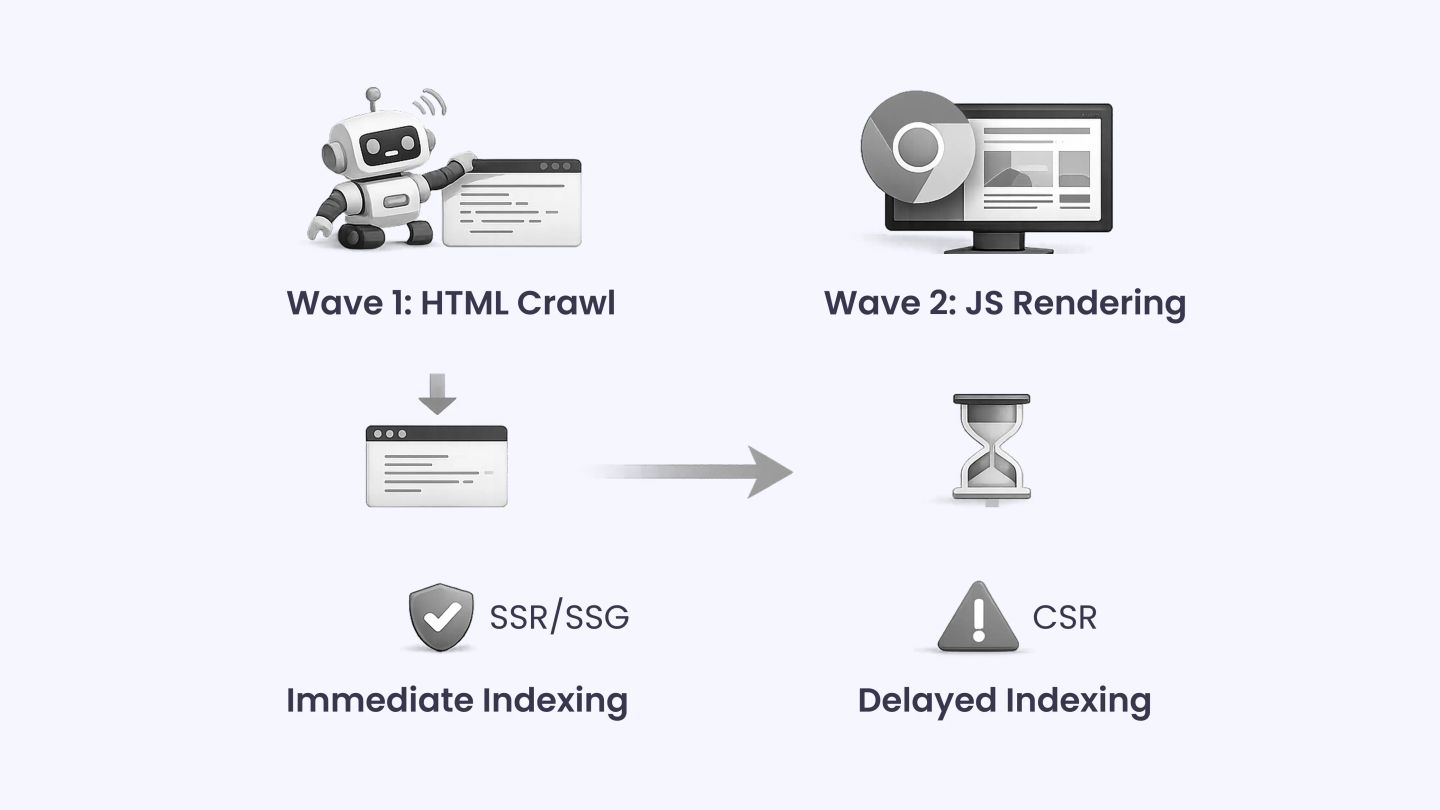
Google uses a two-wave indexing process for JavaScript-dependent pages:
Wave 1: Immediate HTML Crawl
- Googlebot fetches your raw HTML and indexes the content it finds.
- With SSR or SSG, all text, headings, internal links, and schema markup are immediately visible.
- Indexed content is queued for further processing.
Wave 2: JavaScript Rendering (Delayed)
- Google sends JavaScript-heavy pages to a rendering queue.
- A headless version of Chrome executes scripts and generates the fully rendered page.
- Timing varies, from hours to days to weeks, depending on crawl budget and site authority.
Effect on Crawling and Indexing
- Any content that only appears after JavaScript execution does not exist in Google’s index until Wave 2 completes.
- Fresh articles, product launches, or time-sensitive updates may be delayed, affecting visibility.
Takeaway:
|
CSR: Great for Apps, a Liability for Organic Pages
Client-Side Rendering (CSR) is the default output of modern JavaScript frameworks like React, Vue, Angular, and Svelte. It excels at interactive experiences, but for public-facing pages, it presents clear SEO and AEO limitations.
SEO & AEO Implications:
- Empty Initial Content: The initial HTML often contains only placeholders, such as <div id=”root”></div>. Googlebot’s Wave 1 crawl and AI crawlers see no content until JavaScript executes.
- Missed Structured Data: JSON-LD or schema injected via client-side scripts may not be visible on the first crawl, limiting indexing and AEO.
- Performance Penalty: Large JavaScript bundles delay LCP, affecting Core Web Vitals and search performance.
Best Use Cases:
- Authenticated dashboards
- Admin panels and SaaS interfaces
- Internal tools where SEO/AEO is irrelevant
SSR: The Reliable Choice for Dynamic, Indexable Content
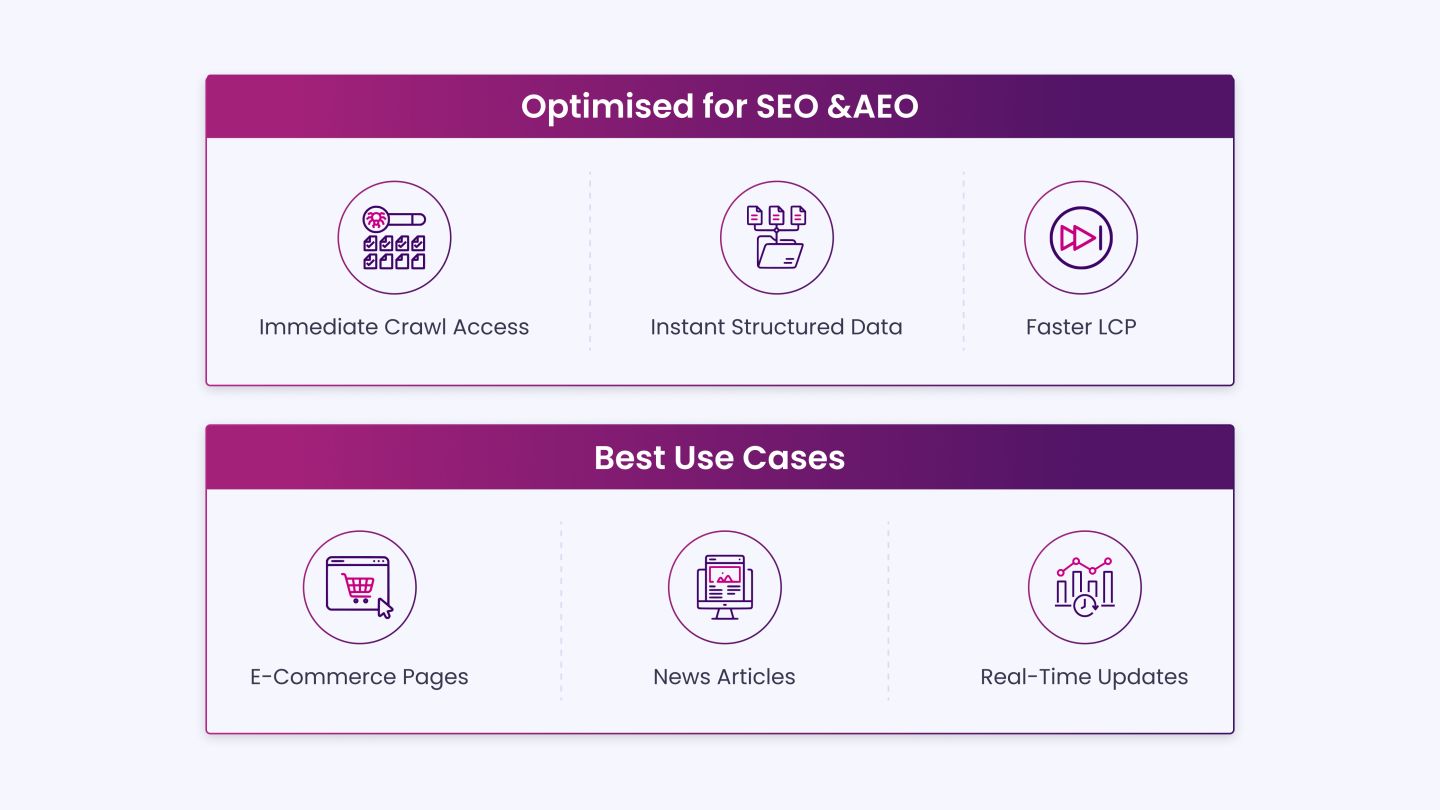
Server-Side Rendering (SSR) generates the complete HTML on the server before sending it to the browser. Crawlers and users receive the fully rendered page immediately.
SEO & AEO Implications:
- Immediate Crawl Access: Googlebot and AI crawlers read your full content, text, headings, links, and schema on the first request.
- Reliable Structured Data: JSON-LD in server-rendered HTML is picked up instantly for both SEO and AEO.
- Improved LCP: Fully rendered HTML avoids delays caused by client-side JavaScript.
Considerations:
- Server load increases with each page request; caching and infrastructure planning are required. Frameworks like Next.js and Nuxt.js help mitigate overhead.
Best Use Cases:
- E-commerce product pages with dynamic inventory
- News articles and time-sensitive content
- Personalized pages requiring real-time updates
SSG: Pre-Built at Deployment, Instant for Every Crawler
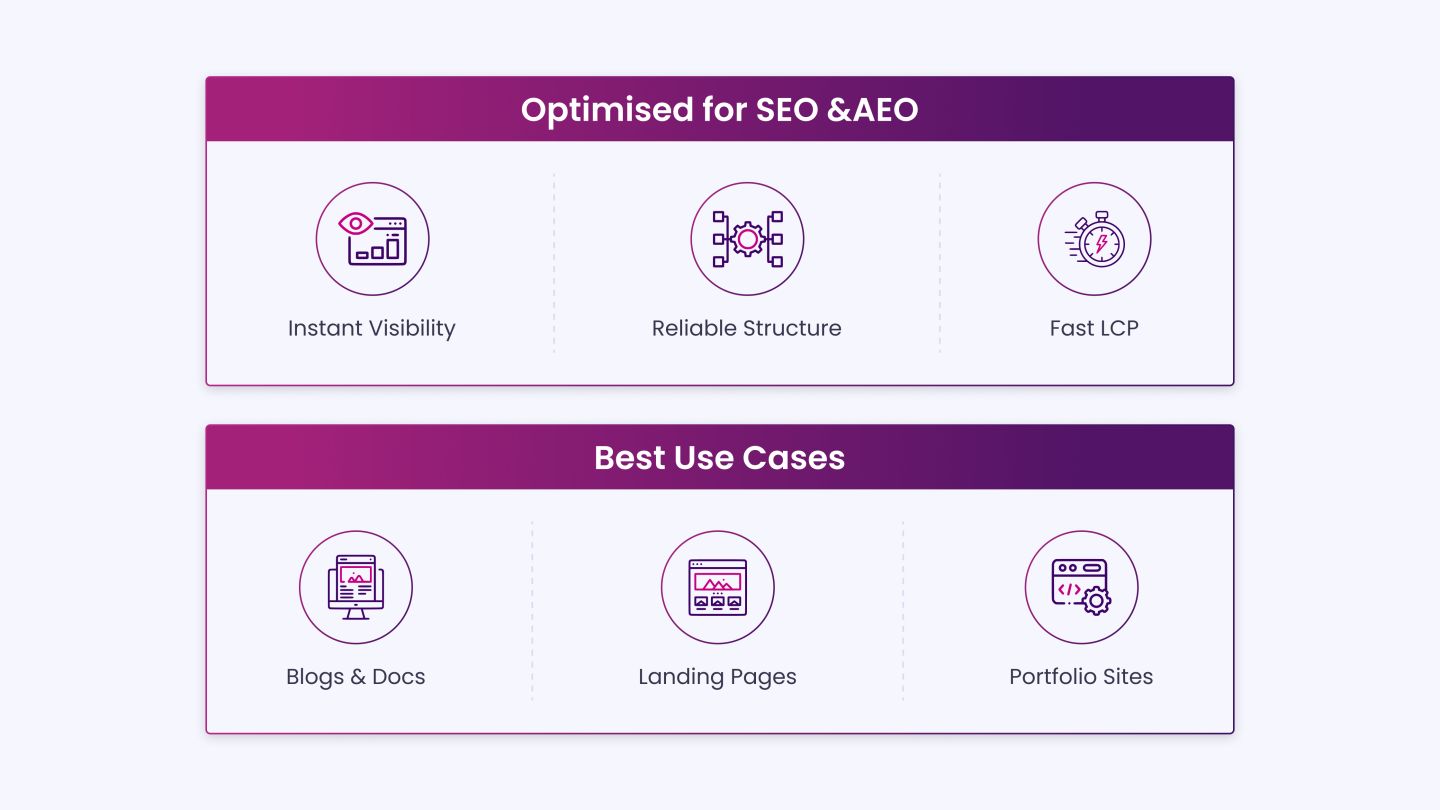
Static Site Generation (SSG) pre-builds pages at deployment. Crawlers and users receive a complete HTML file via CDN without server-side rendering or JavaScript dependency.
SEO & AEO Implications:
- Immediate Visibility: Googlebot and AI crawlers receive fully rendered pages instantly.
- Reliable Schema and Structure: All headings, links, and JSON-LD are available from the first request.
- Fast LCP: Serving pre-built HTML ensures optimal performance.
Considerations:
- Content updates require new builds or tools such as Incremental Static Regeneration (ISR) to enable automatic partial updates.
Best Use Cases:
- Blogs, documentation, and knowledge bases
- Marketing landing pages
- Portfolio sites and other static content
How Your Rendering Choice Directly Affects AEO
Answer Engine Optimization (AEO) is the practice of structuring content so AI systems, such as ChatGPT, Perplexity, Google AI Overviews, and Bing Copilot, can extract, attribute, and cite it as a reliable answer.
Rendering strategy is not a secondary consideration here. It is a primary one, for one specific reason: many AI crawlers do not execute client-side JavaScript.
Googlebot is patient. It queues JavaScript-dependent pages and returns for a second wave. AI crawlers like GPTBot, PerplexityBot, and ClaudeBot operate on tighter time budgets. If your content requires JavaScript to appear, they may simply leave, having seen nothing, and your page ends up invisible in AI-generated answers, even if Google eventually indexes it fine.
For AEO to work, three things must be present in the initial HTML response:

- Your content, in the HTML from the first server response, is not loaded by a script.
- Schema markup, JSON-LD defining your content type, author, and entities, server-rendered, not injected client-side.
- Semantic HTML structure, proper use of H1, H2, H3, article, section, and nav so AI systems can interpret how content areas relate to each other.
SSR and SSG deliver all three reliably. CSR delivers none of them consistently.
SSR vs CSR vs SSG: Side-by-Side Comparison
Compare SSR, CSR, and SSG to understand how each rendering method impacts SEO, AEO, and content visibility for crawlers:
| Factor | CSR | SSR | SSG |
| Googlebot Wave 1 visibility | Empty shell | Full content | Full content |
| AI crawler visibility | Likely blank | Full content | Full content |
| LCP performance | Typically slower | Good | Best |
| Content freshness | Real-time | Real-time | Stale until rebuild |
| Server load | Low | Higher per request | Minimal (CDN) |
| Schema markup reliability | Unreliable | Reliable | Reliable |
| AEO readiness | Poor | Strong | Strong |
| Best for | Dashboards, apps | News, e-commerce | Blogs, landing pages |
Select the Right Rendering Per Page
No single strategy fits every page on a site. The practical architecture in 2026 is hybrid rendering: SSR or SSG for public-facing pages, CSR only for sections that do not need to rank.
Modern frameworks make this direct.
Next.js lets you define a rendering strategy at the route level, not the application level. Nuxt.js does the same for Vue. SvelteKit supports per-route rendering decisions natively.
| Page Type | Recommended Rendering | Reason |
| Blog posts and articles | SSG or SSR | Full HTML for crawlers, fast load |
| Product pages with live inventory | SSR | Real-time data, immediate indexing |
| Product pages with stable data | SSG + ISR | Fast CDN delivery, periodic revalidation |
| Marketing landing pages | SSG | No dynamic data, maximum performance |
| User account dashboard | CSR | No SEO needed, complex interactivity |
| Search results within the app | SSR | Must reflect real-time results |
| Admin and internal tools | CSR | Not public, no indexing needed |
Rendering Audit Checklist for Full Crawl and AI Visibility
Before changing your architecture, audit what crawlers currently see on your pages.
Pre-Change Audit
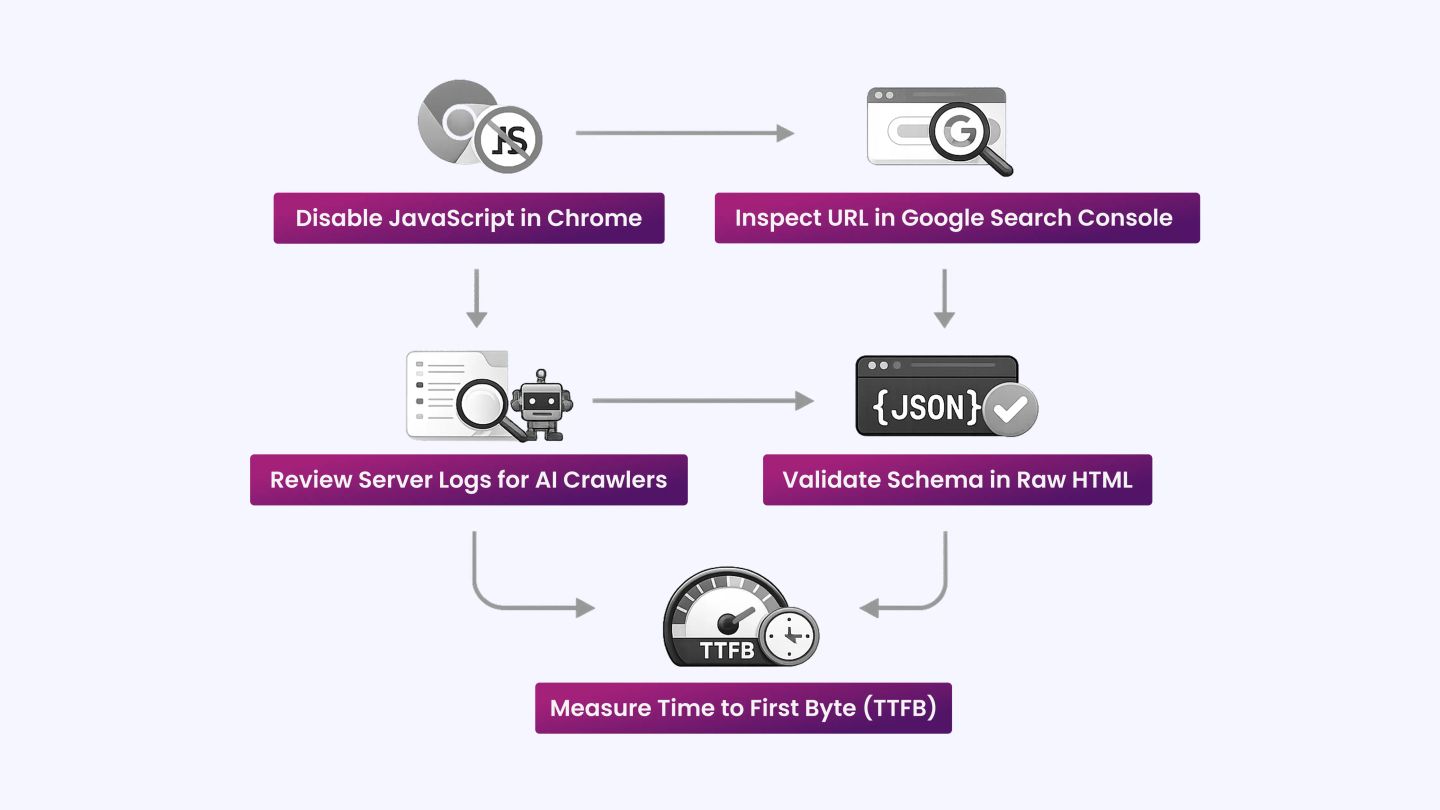
Before updating your site’s rendering, verify what search engines and AI crawlers currently see with this pre-change audit.
Test 1: Disable JavaScript in Chrome
Open DevTools → Cmd+Shift+P (Mac) or Ctrl+Shift+P (Windows) → type “Disable JavaScript” → reload. If your content disappears, that is exactly what Googlebot sees in Wave 1 and what AI crawlers see on every visit.
Test 2: Google Search Console URL Inspection
Submit your URL and compare the HTML tab against the Rendered HTML tab. Any content that exists only in the rendered version is at risk of delayed or incomplete indexing.
Test 3: Check Server Logs for AI Crawler Visits
GPTBot, PerplexityBot, and ClaudeBot leave records in your server logs. If they are hitting pages that require JavaScript to surface content, those pages are almost certainly missing from AI-generated answers.
Test 4: Validate Schema in Raw HTML
Use Google’s Rich Results Test and view the page source. If your JSON-LD only appears after JavaScript runs, AI crawlers will not see it. Schema must be server-rendered.
Test 5: Check Time to First Byte
Use PageSpeed Insights or WebPageTest. If TTFB exceeds 600ms on your main pages, fix server response time before anything else; AI crawlers abandon slow pages faster than Googlebot does.
Post-Change Verification
Once SSR or SSG is in place, run through this checklist to confirm the fix worked:
- JavaScript disabled in Chrome: All content, headings, links, and schema remain visible
- Search Console URL Inspection: Content now present in the HTML tab, not just the Rendered tab
- Server logs: Confirm GPTBot and PerplexityBot are reading full content and structured data
- Rich Results Test: Confirms JSON-LD is in raw HTML, not injected client-side
- TTFB: Under 600ms and LCP improved in PageSpeed Insights
- ISR Pages: Revalidating correctly and serving fully rendered HTML immediately after deployment
Adding SSR and SSG on CSR Frameworks
If your site runs on a CSR-first framework like React, Vue, or Svelte, you don’t need to rebuild from scratch. You can enable Server-Side Rendering (SSR) or Static Site Generation (SSG) for specific routes to make content fully accessible to search engines and AI crawlers.
- Next.js wraps React with SSR and SSG support configurable at the route level.
- Nuxt.js provides the same capabilities for Vue.
- SvelteKit allows per-route rendering decisions for Svelte applications.
In most cases, you can migrate individual routes to SSR or SSG without touching the rest of the CSR application. Prioritize pages that drive organic traffic or that you want AI systems to cite. Keep authenticated, non-indexed sections in CSR.
Hydration ensures smooth integration: the server sends fully rendered HTML immediately, and the browser then activates interactivity with JavaScript. Users see content right away, and crawlers access complete HTML without delay.
Control What Search Engines and AI Systems Can See
Rendering determines whether your content is accessible the moment a crawler arrives. If it is not present in the initial HTML response, it is delayed, misinterpreted, or missed entirely by both search engines and AI systems.
The practical path is clear: use Static Site Generation for content-heavy pages, apply Server-Side Rendering where real-time data is required, and limit Client-Side Rendering to areas where search visibility does not apply. This combination defines whether your content gets crawled, indexed, and cited.
INSIDEA
Ready to get found by people and AI?
Search and answer-engine visibility that compounds, built to be cited.



 How INSIDEA works