When you’re stuck on a decision or trying to understand something quickly, Quora is still one of the first places people check for real, experience-based answers.
Answer Engine Optimization is the practice of structuring content so that AI-powered systems and search engines can pull it directly as a response to user queries.
In 2024, Semrush data placed Quora as the leading source cited in Google’s AI Overviews, signaling its strong presence in AI-driven search results.
Quora attracts over 400 million monthly visitors and carries strong domain authority, making it one of the most heavily crawled Q&A platforms on the web. Writing on Quora with AEO in mind is no longer just about answering users directly. It also means shaping content so AI systems can interpret, extract, and reuse it at scale.
This blog breaks down how to build a Quora-based AEO approach to improve the likelihood that your answers are cited, surfaced, and attributed in AI-generated responses.
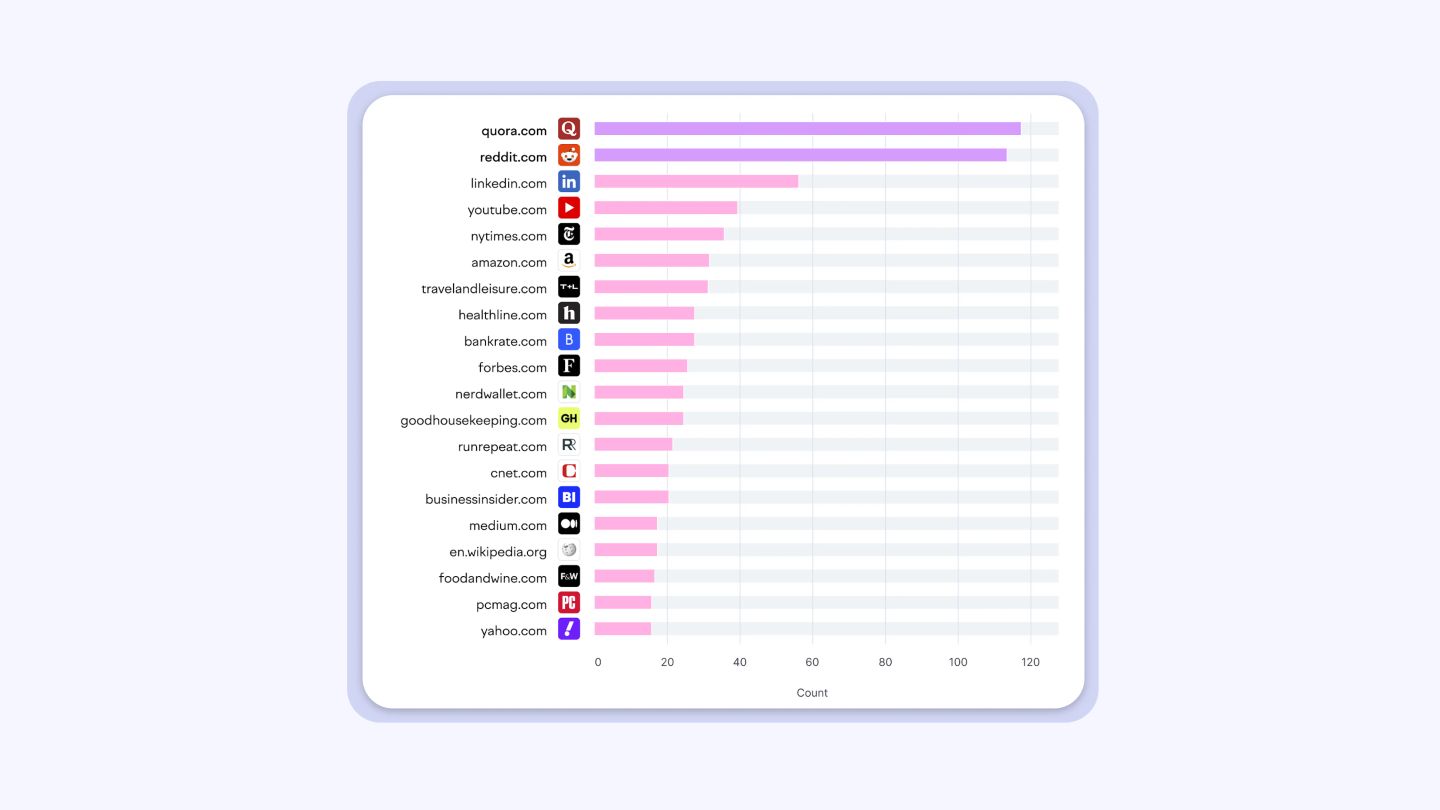
How AI Reads Quora Answers?
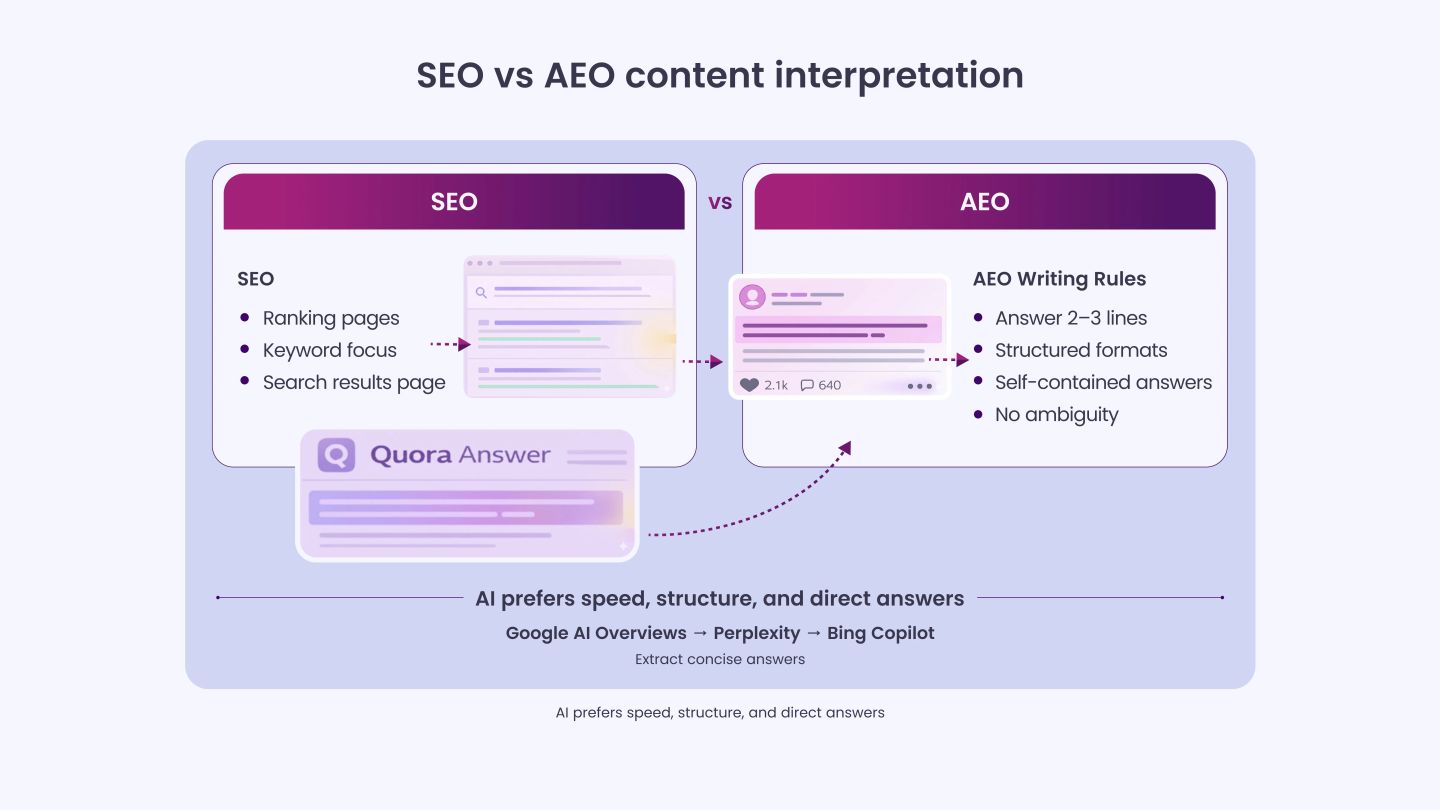
Standard SEO optimizes for ranking on a results page. AEO optimizes for being the answer itself. The distinction is significant.
On Quora, AEO means writing answers that:
- Directly address the question in the first 2-3 sentences
- Use a structure that AI can parse and extract (definitions, lists, steps, comparisons)
- Contain sufficient context so the answer is self-contained without needing the full thread
AI systems that power features like Google’s AI Overviews, Perplexity, and Bing’s Copilot are trained to look for content that answers a question completely, concisely, and with minimal ambiguity.
A Quora answer that rambles for six paragraphs before reaching the point will almost never be cited.
How to Choose the Right Questions?
Not every Quora question has AEO potential. The ones that do share certain characteristics.
Look for questions that are:
- Phrased as direct queries (“What is…”, “How does…”, “Why do…”)
- Already indexed on Google (paste the question into Google search and check)
- Returning a featured snippet or an AI Overview in results
- In a topic area where you have genuine knowledge or verified experience
Avoid questions that are:
- Highly opinionated with no clear factual basis
- Too niche to attract AI crawling or significant search volume
- Already dominated by medical, legal, or financial experts (AI tools are conservative about these)
| A practical method: search your topic area on Google with “site:quora.com” and observe which questions are ranking. These are the questions worth targeting because Google has already decided they carry search intent worth satisfying. |
How to Structure Your Quora Answer for AEO
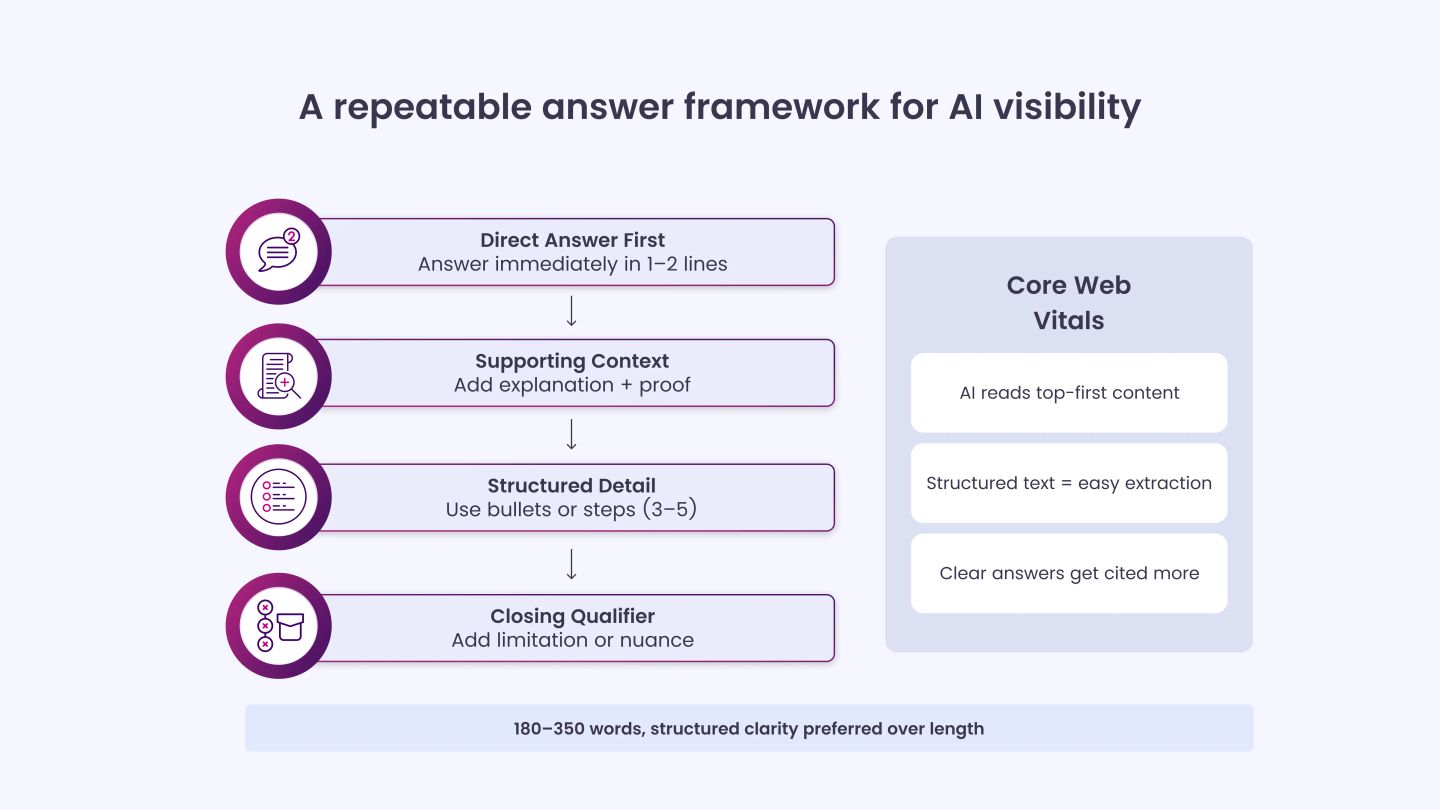
Structure is the most controllable variable in Quora AEO. Follow this framework consistently.
1. Direct Answer First (Sentences 1-2): State the answer immediately. No preamble, no biography, no context about why the question is interesting. AI systems scan for the first clear, declarative response to the question.
Example format: “X is [definition]. It works by [mechanism]. The main reason people use it is [reason].”
2. Supporting Context (Sentences 3-6): Provide the evidence, explanation, or nuance that validates your opening answer. Include a data point or example if available.
3. Structured Detail (Bullet list or numbered steps): Break down complex parts of the answer into scannable items. AI systems extract lists well. Three to five bullets is the ideal range.
4. Closing Qualifier: One sentence that acknowledges limitations, variations, or context-dependence. This signals precision and reduces the likelihood that your answer will be flagged as overly absolute.
Keep the total answer length between 180 and 350 words for most questions. Longer answers are appropriate only when the question requires depth (e.g., “How does X work end-to-end?”).
Credibility Signals That Affect AI Sourcing
Quora’s own algorithm and external AI systems both factor in credibility when deciding which answers to surface. These are not abstract signals; they are specific, observable factors:
Profile completeness: A complete Quora bio with a real name, professional background, and topic expertise listed in credentials directly affects how the platform weights your answers. AI tools that scrape Quora also pick up author metadata.
Topic consistency: Answering across 15 unrelated topics reduces your perceived authority in any one area. Focus on 2-4 topic clusters. Quora’s internal ranking system rewards consistent contributors in specific spaces.
Upvote velocity: A high upvote count in the first 48 hours of posting signals quality to both Quora’s algorithm and external crawlers. Share answers selectively in relevant communities or newsletters to generate early engagement.
Answer history: Accounts with a history of well-received answers in a topic area are more likely to have new answers indexed quickly. Consistency over time matters more than sporadic high-performing posts.
The AEO Content Calendar for Quora
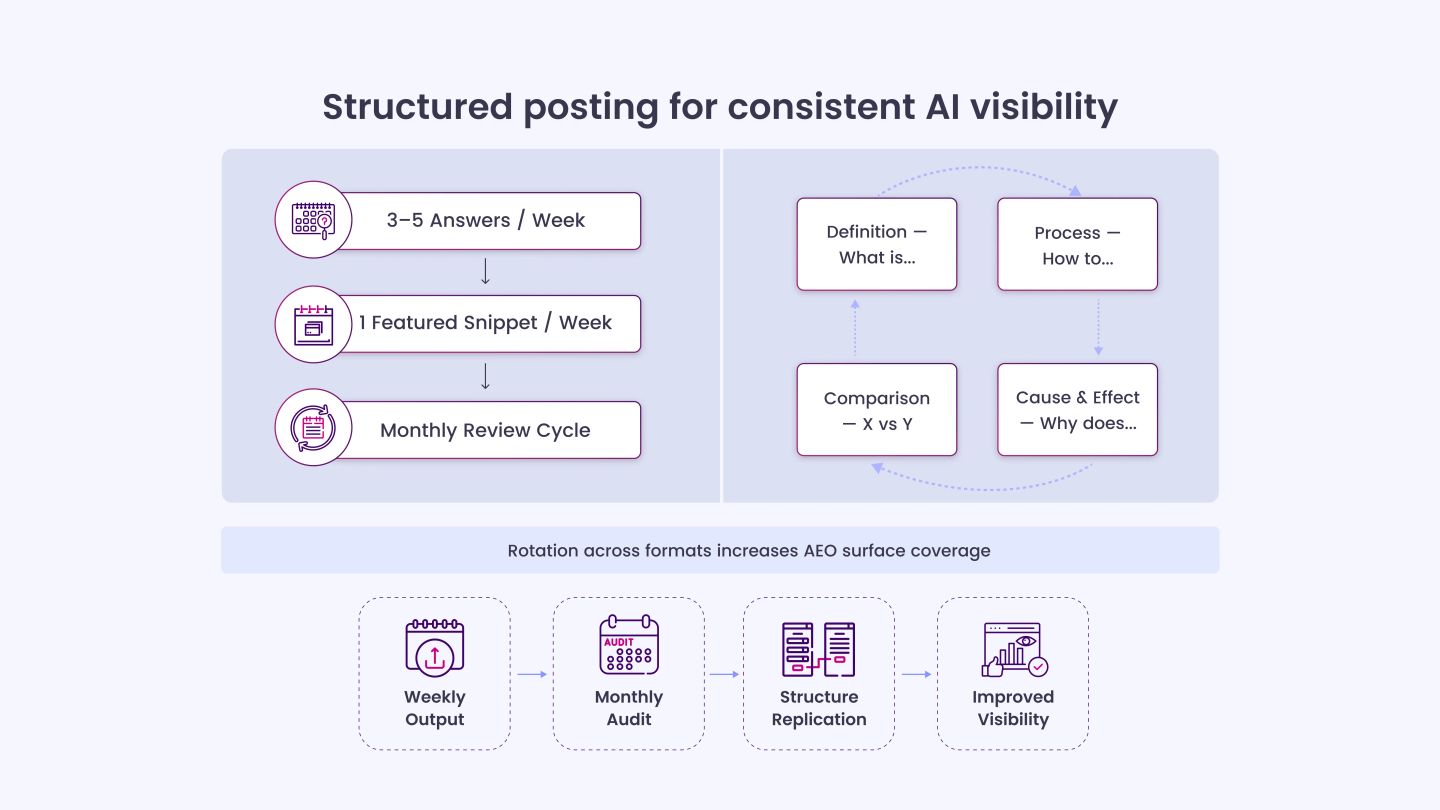
Posting randomly produces inconsistent results. A repeatable schedule looks like this:
Weekly rhythm:
- 3-5 new answers per week in your chosen topic clusters
- 1 answer per week targeting a question already showing a Google featured snippet (your answer competes directly for that position)
- Monthly audit: review which of your answers appear in Google results, note their structure, and replicate that structure for new answers
Content types to rotate:
- Definition answers (“What is…”)
- Process answers (“How to…”)
- Comparison answers (“X vs Y”)
- Cause-and-effect answers (“Why does…”)
Each type maps to a different query structure used in voice search and AI assistants. Rotating across them builds a broader surface area for AEO visibility.
Common Mistakes That Block AEO Visibility on Quora
These are the most frequent errors on Quora that prevent AI systems from citing answers.
- Starting with context instead of the answer:“Great question. I’ve worked in this field for ten years…” is immediately skipped by AI parsing.
- No structure: A wall of text without bullets or numbered steps is harder for AI to extract cleanly.
- Answering questions that have no search demand: If no one is searching for the question on Google, AI tools will not surface it.
- Over-qualifying everything: One caveat is useful. Four caveats make an answer too vague to cite.
- Ignoring the profile: An anonymous or incomplete profile reduces the credibility signal attached to even well-written answers.
Final View on Quora’s Role in AEO
Quora remains one of the few public platforms where individual contributors can realistically influence what AI systems surface as answers to common questions.
The process is not complicated: pick questions with verified search demand, answer directly and with structure, maintain credibility through consistency, and track which answers gain traction in Google results.
The strategy works because AI systems reward clarity and precision, the same qualities that make any good answer worth reading.
INSIDEA
Ready to get found by people and AI?
Search and answer-engine visibility that compounds, built to be cited.



 How INSIDEA works