Vibe coding is the practice of building websites and web apps using AI tools through natural language prompts, often with minimal or no manual code review. Platforms like Cursor, Bolt, and Lovable have made it possible to go from idea to a live product in a fraction of the time it takes in traditional development.
As a result, both developers and non-developers are now shipping functional websites faster than ever. But the speed of creation is not the same as search performance. Google’s crawlers, Bing’s index systems, and AI answer engines like Perplexity or Google’s AI Overviews do not evaluate how quickly a site was built. They evaluate what the site is built with: structure, semantic clarity, and technical precision.
This is where most vibe-coded sites face friction. What looks complete visually is not always readable, indexable, or extractable in a way that supports SEO and AEO performance.
This blog explains how vibe-coded websites meet those requirements, where they fall short, and what needs to be fixed for real search visibility.
The Hidden Gaps in Vibe Coded Websites
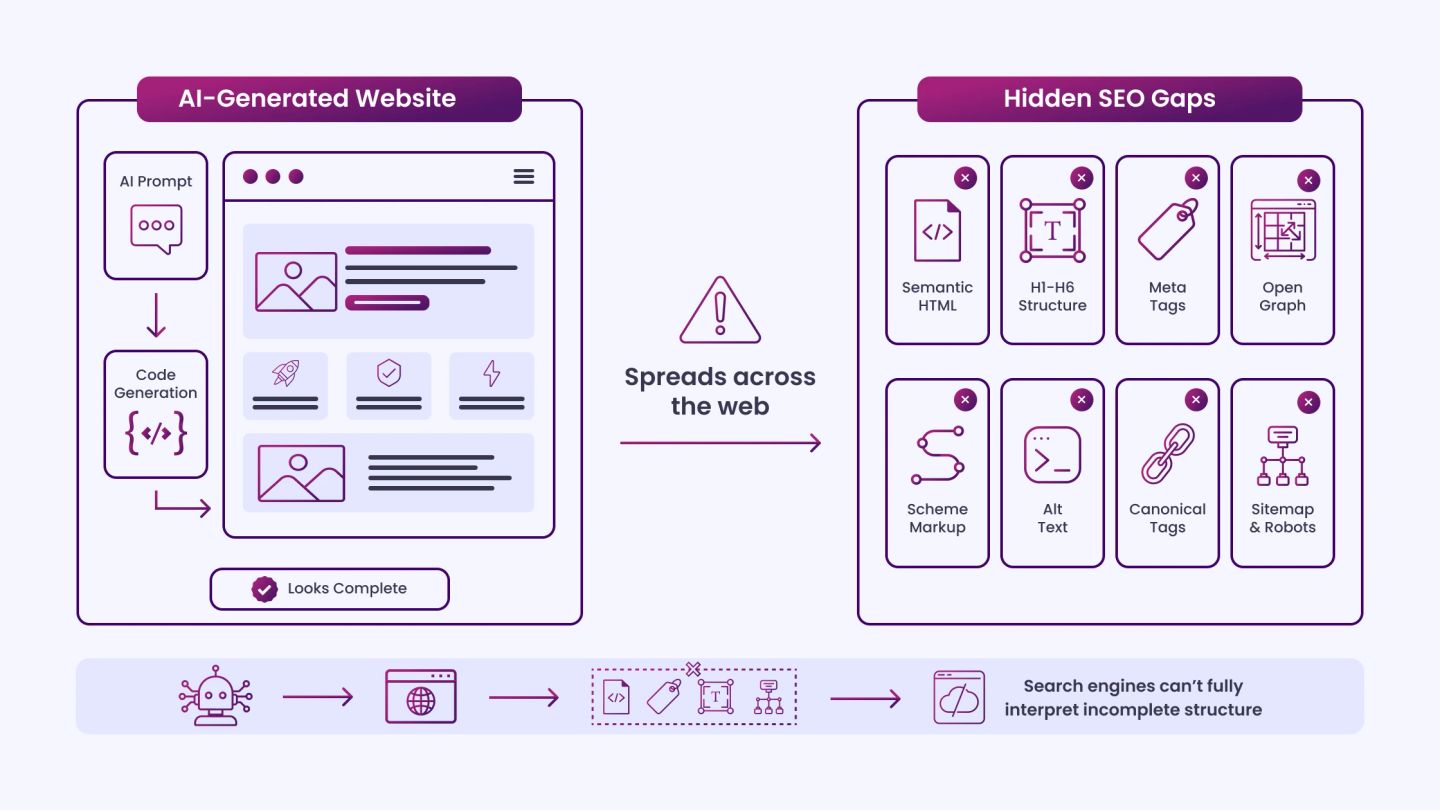
Vibe-coded sites are generated from prompts. The AI writes the HTML, CSS, and JavaScript based on a described layout or function. The output is often visually complete and works in the browser.
What it typically skips:
- Semantic HTML structure (proper use of <article>, <section>, <main>, <nav>)
- Heading hierarchy (<h1> through <h6> used logically, not decoratively)
- <title> and <meta description> tags with keyword-relevant content
- Open Graph and Twitter Card metadata
- Schema markup (JSON-LD for FAQs, articles, products, etc.)
- Alt text on images
- Canonical tags
- Sitemap and robots.txt configuration
These are not optional additions in SEO. They form the foundation of how search engines parse and classify a page. If the AI does not include them, and most do not by default, the site goes live with significant technical gaps.
Why Vibe Coded Sites Struggle with AEO Requirements?
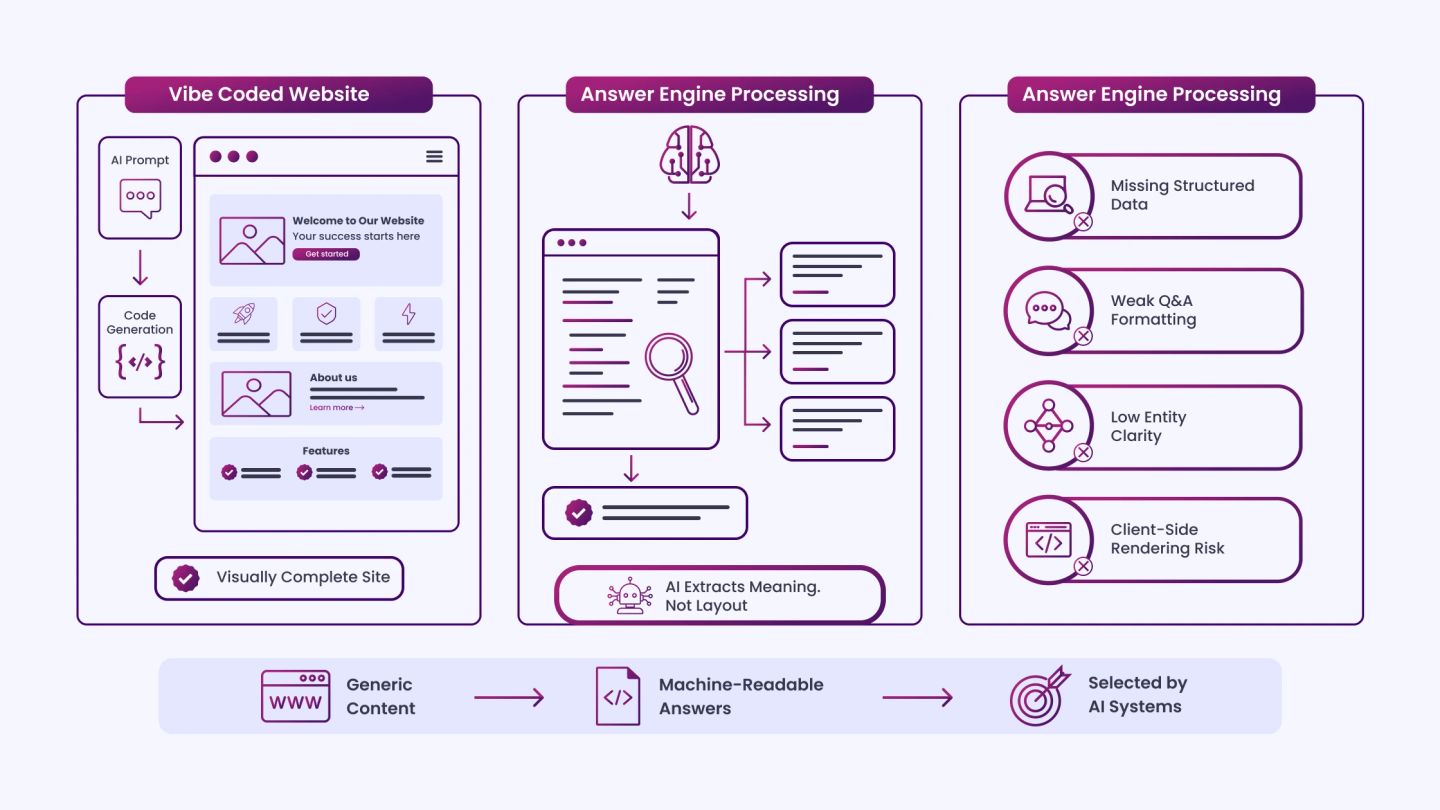
Answer Engine Optimization focuses on getting content selected as a direct answer by AI-powered search tools. This includes featured snippets, Google’s AI Overviews, and responses from tools like Perplexity or ChatGPT’s browsing mode.
AEO works differently from traditional SEO in one critical way: it requires content to be unambiguously machine-readable. An answer engine does not just crawl a page. It parses it, extracts meaning, and selects a response based on how clearly that meaning is expressed.
For a vibe-coded site to perform in AEO, it needs:
Structured data (Schema.org markup): FAQPage, HowTo, Article, and Product schemas help answer engines extract direct answers. Most AI-generated sites include none of this.
Clear question-answer formatting: Content needs to mirror how users ask questions. A heading like “What is AEO?” followed by a concise two-sentence answer has a far better chance of being selected than a paragraph that buries the definition.
Content depth and entity clarity: Answer engines prioritize pages that clearly define entities, connect concepts, and demonstrate subject authority. Thin or generic content produced by AI tools without editorial oversight performs poorly here.
Crawlability: If JavaScript renders the content client-side without server-side rendering or static generation, crawlers may not see the text at all. Many vibe-coded React and Next.js outputs default to client-side rendering without explicit SSR configuration.
Core Web Vitals and Page Speed in AI-Generated Code
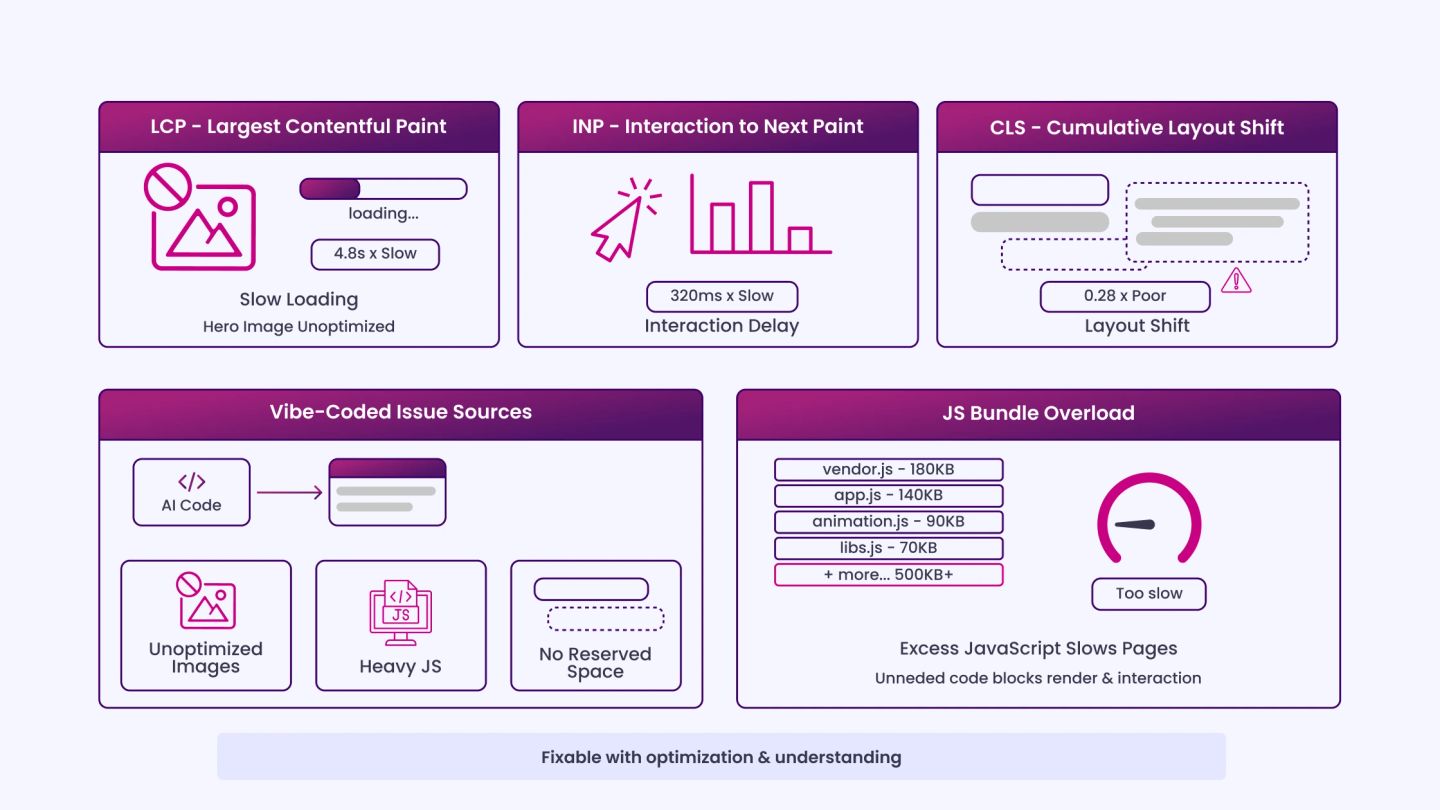
Google uses Core Web Vitals as a ranking signal. The three primary metrics are Largest Contentful Paint (LCP), Interaction to Next Paint (INP), and Cumulative Layout Shift (CLS).
Vibe-coded sites frequently struggle with:
- LCP: AI-generated layouts often load large hero images without lazy loading, width/height attributes, or WebP formats.
- CLS: Dynamic content injected via JavaScript without reserved space causes layout shifts.
- INP: Unoptimized event listeners or excessive JavaScript from third-party libraries can increase response latency.
Pages with over 500KB of JavaScript have significantly lower LCP scores than lighter pages. Vibe-coded sites that import full UI libraries for simple pages often include unnecessary performance overhead.
These are fixable problems. But fixing them requires understanding what the AI produced, which many vibe coders skip.
Strengths of Vibe Coded Websites in SEO Contexts
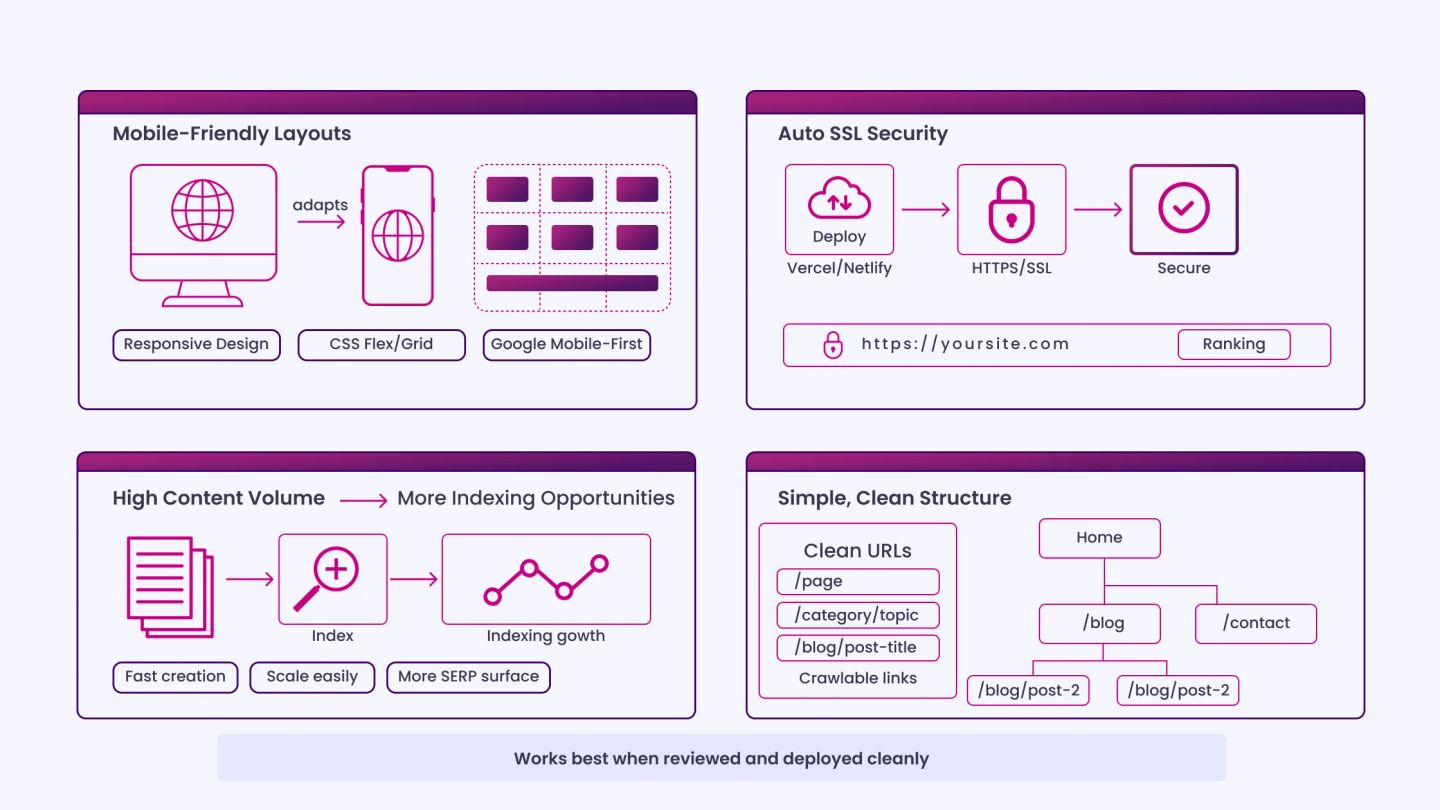
Not everything about vibe coding is a liability for SEO. There are areas where AI-generated sites perform adequately or even well.
Mobile responsiveness: Most modern AI coding tools default to responsive layouts using Flexbox or CSS Grid. This removes one common SEO failure point.
HTTPS and basic security: Platforms like Vercel, Netlify, and similar deployment hosts handle SSL automatically. Secure connections are a baseline ranking requirement, and vibe-coded sites deployed on these platforms automatically meet it.
Content volume: When vibe coding is used to generate content-heavy pages quickly (product descriptions, location pages, documentation), the sheer volume of indexed content can produce long-tail ranking opportunities, provided the content is non-duplicate and relevant.
Site structure for small projects: A simple landing page or portfolio built with a vibe coding tool can achieve a clean URL structure and fast load time if the tool does not over-engineer the output.
The pattern is consistent: vibe-coded sites perform better in SEO when the project is simple, the deployment platform is modern, and a developer reviews the output before publishing.
Pre-Launch Audit Checklist for Vibe Coded Sites
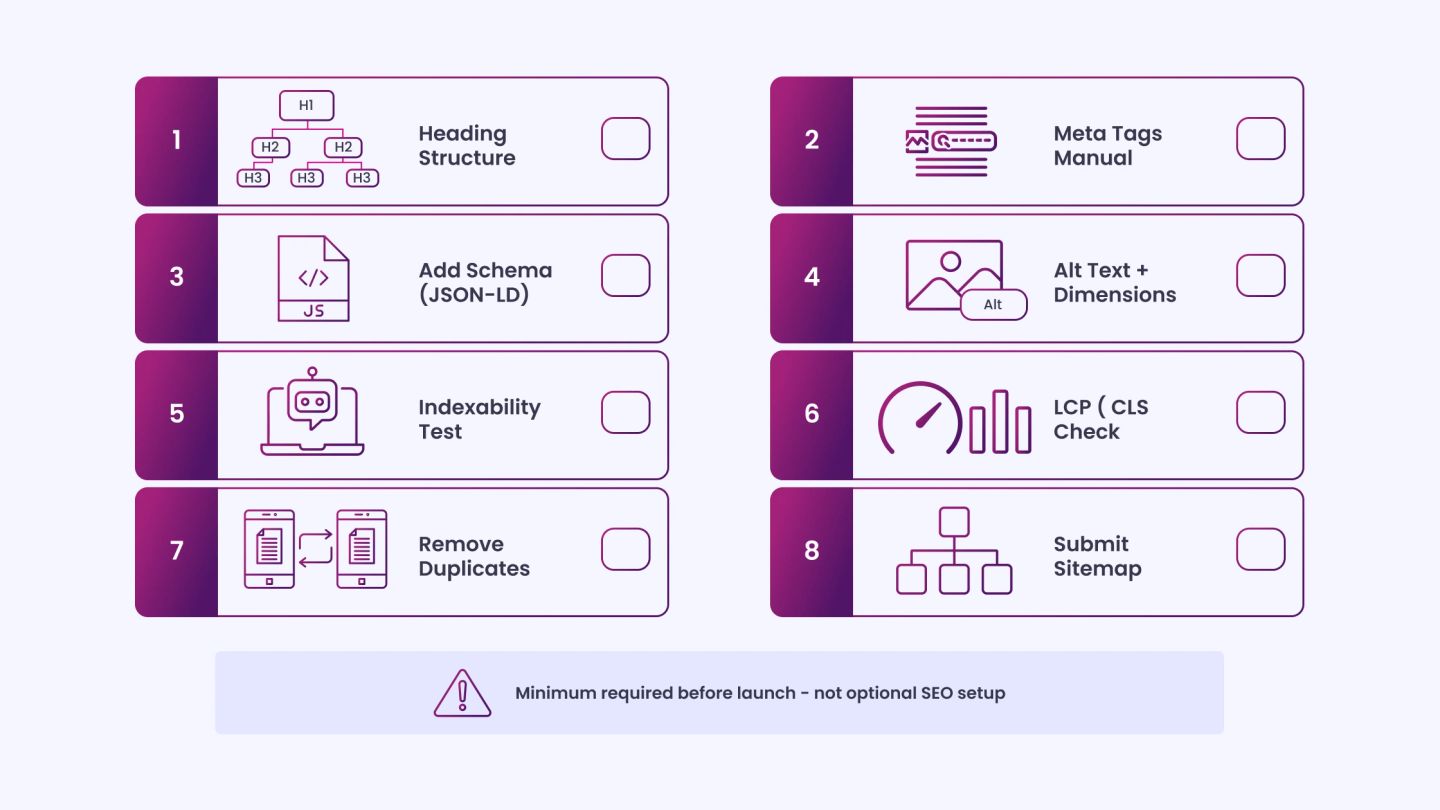
If you are publishing a vibe-coded site and care about search performance, run this checklist manually:
- Check heading structure: Confirm one <h1> per page, logical <h2> through <h4> order.
- Write meta titles and descriptions: Do not rely on the AI to generate these correctly.
- Add JSON-LD schema: At a minimum, add the Organization or Website schema on the homepage. Add the FAQPage schema to any FAQ section.
- Audit image attributes: Every <img> tag needs descriptive alt text and explicit dimensions.
- Verify crawlability: Use Google Search Console’s URL Inspection tool or a crawler like Screaming Frog to confirm pages are indexable.
- Test Core Web Vitals: Run the URL through PageSpeed Insights and address LCP and CLS issues before launch.
- Check for duplicate content: If AI-generated similar content appears across multiple pages, consolidate or differentiate before indexing.
- Submit a sitemap: Most vibe coding platforms do not auto-generate or submit sitemaps. Do this manually through Google Search Console.
This is not an exhaustive SEO audit. It is the minimum a vibe-coded site needs to avoid active technical penalties.
Post-Launch SEO & AEO Audit Checklist
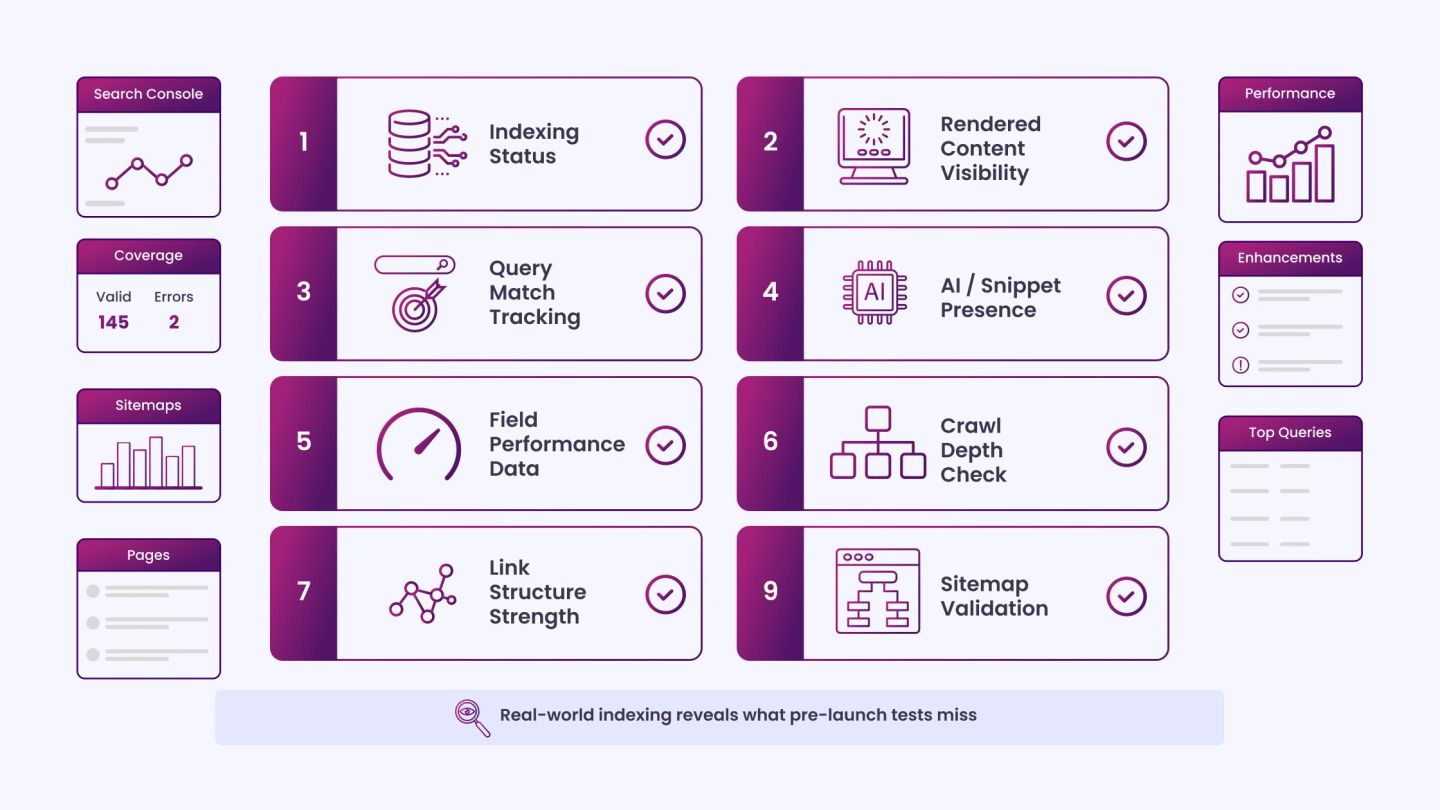
Once a vibe-coded site is live, real search behavior exposes issues that pre-launch checks cannot fully predict. This is where indexing, rendering, and answer extraction either work or break.
- Check indexing status in Google Search Console: Confirm pages are actually indexed and not excluded due to rendering or quality signals.
- Validate rendered content: Use URL Inspection to ensure Google sees the full page, not a partial or empty client-side render.
- Monitor query alignment: Track which search queries trigger impressions and whether they match the intended page topics.
- Check AI visibility signals: Look for appearances in featured snippets, People Also Ask, and AI Overview surfaces.
- Re-test Core Web Vitals in real conditions: Field data often differs from lab tests, especially for JS-heavy vibe-coded builds.
- Audit crawl depth: Ensure important pages are not buried due to weak internal linking or missing sitemap updates.
This step separates functional websites from those that are search-visible. In most vibe-coded projects, this is where the real gaps show up.
What Determines SEO & AEO Success in Vibe-Coded Websites
Vibe-coded websites are a production tool, not a search optimization tool. They can produce functional, visually complete sites in hours, but they consistently skip the technical requirements that search engines and answer engines use to evaluate, classify, and rank pages.
SEO and AEO are not features that get added automatically.
They require deliberate structure: correct HTML semantics, proper metadata, schema markup, optimized assets, and crawlable architecture. Vibe coding tools do not prioritize these by default, and many users do not know to check for them.
Sites ranked by vibe coding workflows are almost always those where a developer reviewed the output and applied technical corrections before launch. The ones that do not rank are typically published as-is, with broken heading hierarchies, missing schema, and unoptimized images.
Build fast if the tools allow it. But treat the output as a draft, not a finished product, if search visibility is a priority.
INSIDEA
Ready to get found by people and AI?
Search and answer-engine visibility that compounds, built to be cited.



 How INSIDEA works