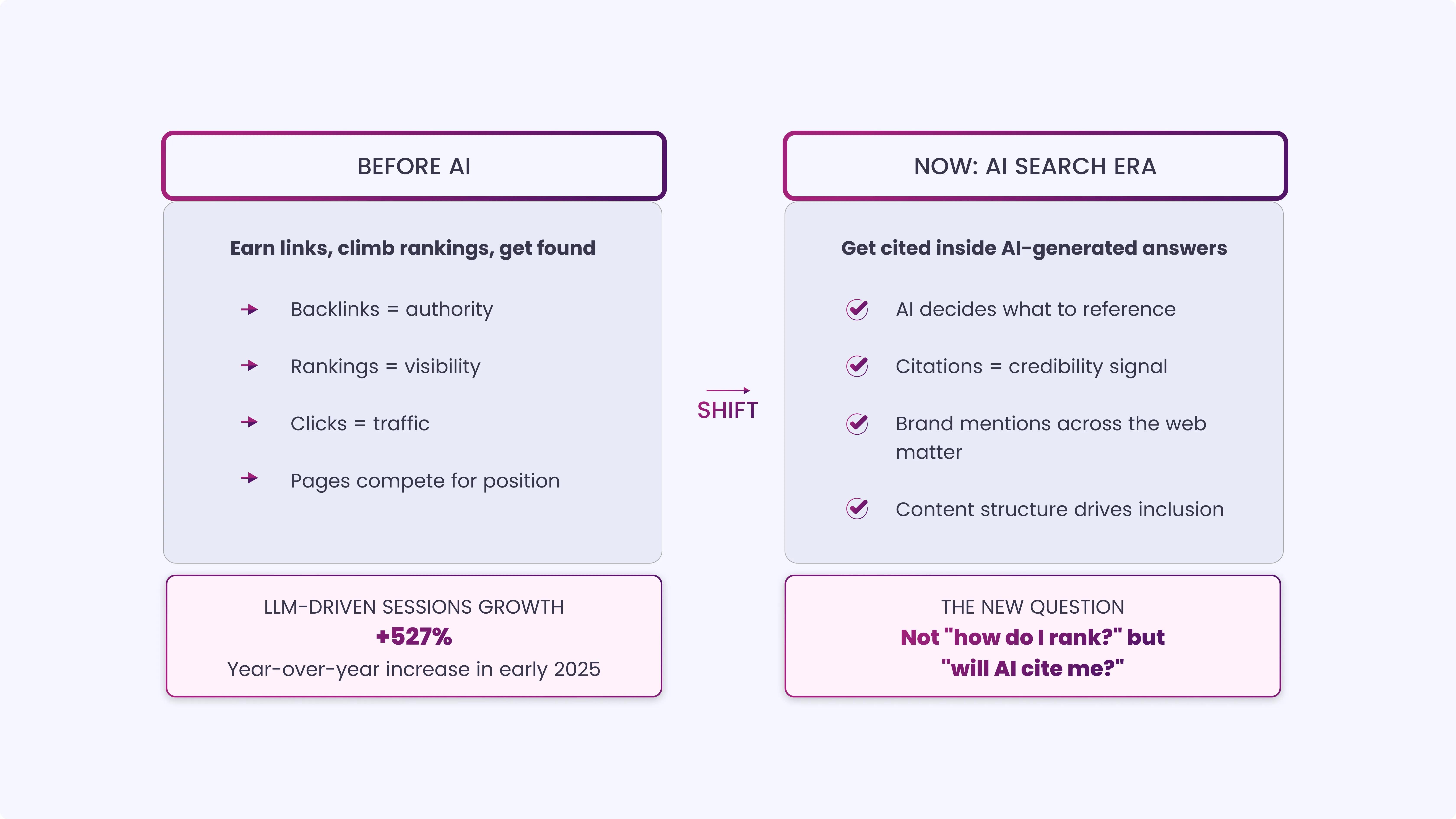
For more than two decades, backlinks were among the most trusted ways to assess a website’s credibility. You earned links, your pages started showing up higher in search results, and people found you. It was simple and fairly predictable.
That model doesn’t hold up the same way anymore.
Today, tools likeChatGPT,Perplexity, and Google’sAI Overviewsdon’t just list pages. They decide what to reference, what to ignore, and how to present it in a single answer. That change is where many brands are losing visibility without realizing it.
The shift is happening fast, with a significant rise in LLM-driven website sessions, which grew by about527%in early 2025 compared to 2024. People do not just search anymore. They useAIanswers. If your brand is not in those answers, you miss where people decide what to trust and choose.
The question is not limited to whether backlinks still count anymore. It’s what role they play when ranking is no longer the end goal, and being cited is.
This blog looks at that directly. It covers what current research shows, howLLMsselect sources, where backlinks still help, and what carries more weight now.
A Quick Guide to the Terms UsedBefore going further, a few terms used throughout this blog need clarification. Backlink: A link from one website to another. It signals that one source is referencing or recommending another source on the web. AI citation: An AI citation occurs when a tool like ChatGPT or Perplexity pulls information from a webpage and cites it as a source in its answer. It may include a link or a clear attribution to that page. LLM mention: An LLM mention is when a brand, product, or website appears inside an AI-generated answer, even without a link. It is a simple inclusion inside the response itself. In short: backlinks connect websites, citations point to sources inside AI answers, and mentions place your brand inside those answers. |
How LLMs Actually Retrieve and Cite Sources?
Before you can understand whether backlinks help, you need to know how AI systems pull information in the first place.
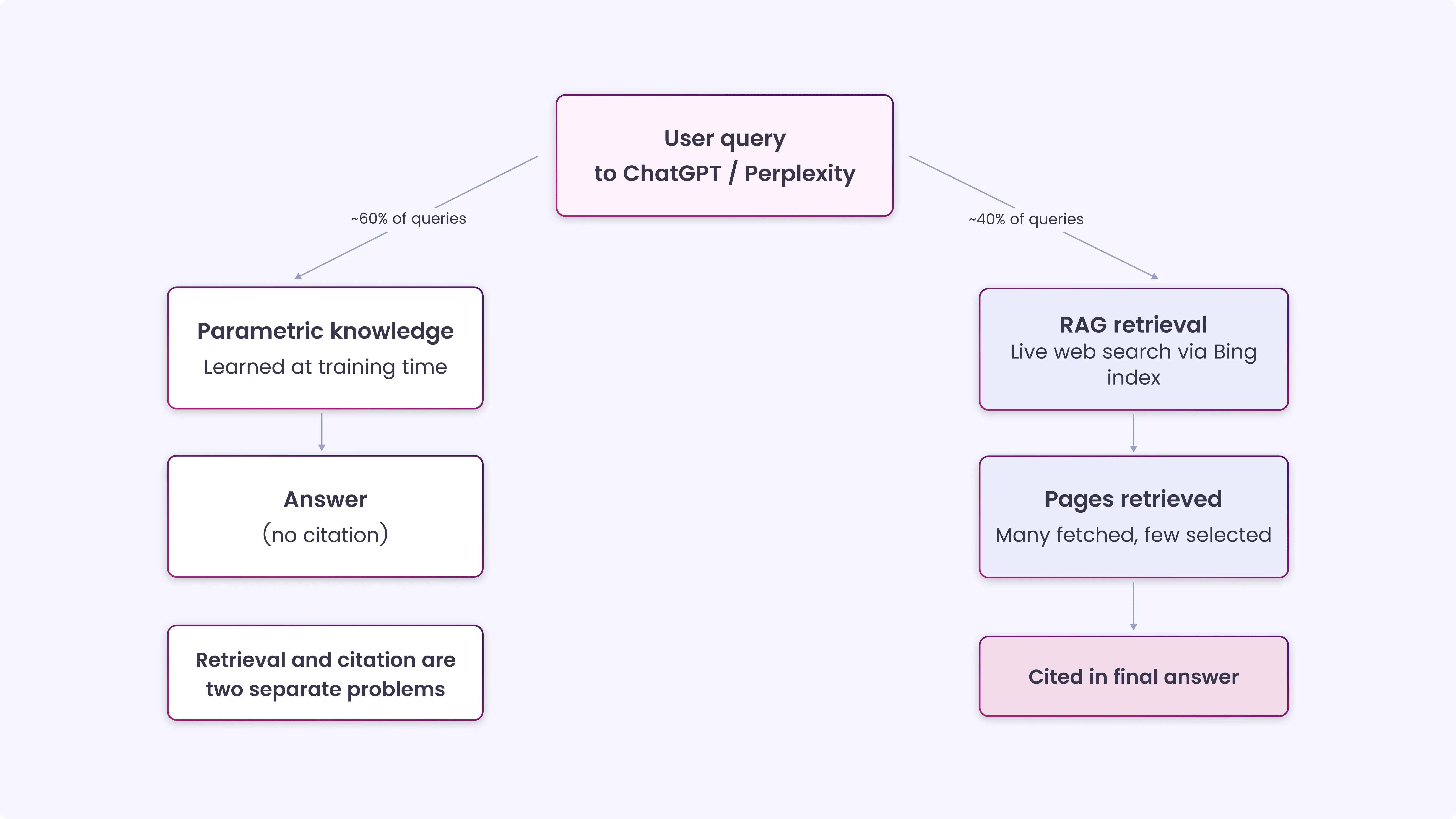
Most major LLMs use two separate processes:
- Parametric knowledge:Parametric knowledge is what the model learned during training. It’s baked in, static, and accessed without any live web retrieval. Around60%of ChatGPT queries are answered from parametric knowledge alone.
- Retrieval-Augmented Generation (RAG):RAG is a method in which the model searches the web in real time, pulls candidate pages, and then selects which sources to cite within its generated answer.
ChatGPT retrieves more pages than it cites. Only a small portion of the retrieved sources appear in the final response, while many are used for internal context and not referenced directly.
This matters because retrieval and citation are two separate problems. Your content first needs to be retrieved, then it needs to be structured well enough to actually get cited. Most discussions about AI visibility skip this distinction entirely.
For ChatGPT specifically, real-time retrieval goes through Bing’s index. ChatGPT’s retrieval layer uses Bing’s index but doesn’t mechanically follow Bing’s rankings. It gives additional weight to sources mentioned in community platforms.
The Direct vs. Indirect Role of Backlinks
This is where the picture gets less linear than most assumptions.
Backlinks do not directly drive LLM citations in a simple one-to-one way. Their role is more evident in the influence they exert on broader authority signals across search systems.
One clear pattern seen across multiple analyses is that backlink strength often improves overall domain visibility in search results. That visibility, in turn, increases the likelihood that content will be incorporated into AI-generated responses.
Pages that perform well in organic search tend to appear more frequently in AI citations compared to lower-ranking pages. This suggests that search visibility and AI visibility still overlap, even if they are not the same system.
So the relationship can be understood like this:
| Stronger backlink profile → Better search visibility → Higher likelihood of AI citations |
It is not a direct trigger. It is an indirect chain where each layer influences the next.
At the same time, domain-level authority influences how often content is selected. Backlinks contribute to that authority over time, but they function as one input among several, not the final deciding factor.
The Difference Between Referring Domains and Backlinks
There’s an important distinction here that often gets blurred: referring domains and raw backlink counts are not the same thing.
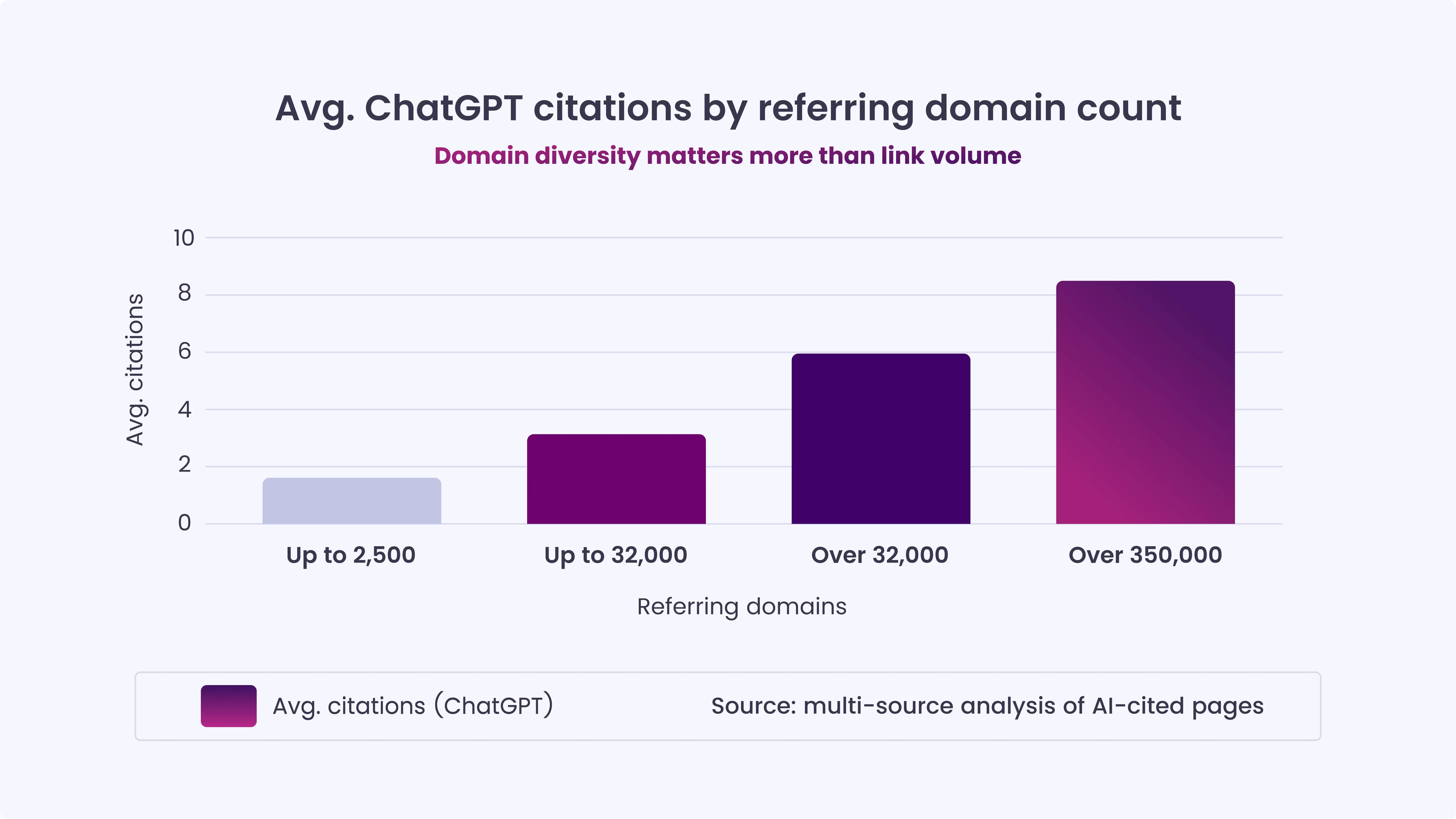
The number of referring domains ranked as the single strongest predictor of citation likelihood. Sites with up to2,500 referring domains averaged 1.6-1.8 citations. Those with over 350,000 referring domains averaged 8.4 citations.
This tells you that link diversity matters more than link volume. One thousand backlinks from ten domains is worth far less than links from a broad, varied network of credible sites.
Sites with over 32,000 referring domains are 3.5 times more likely to be cited by ChatGPT than those with up to 200 referring domains.
This doesn’t mean you should go out and aggressively acquire links. It means your content needs to be useful enough that many different sources naturally reference it over time. That kind of organic link diversity is exactly what AI systems appear to interpret as a sign of trustworthiness.
Brand Mentions and Their Role in AI Citations
Here’s something many SEO professionals weren’t expecting: unlinked brand mentions may carry more weight for AI visibility than the backlinks themselves.
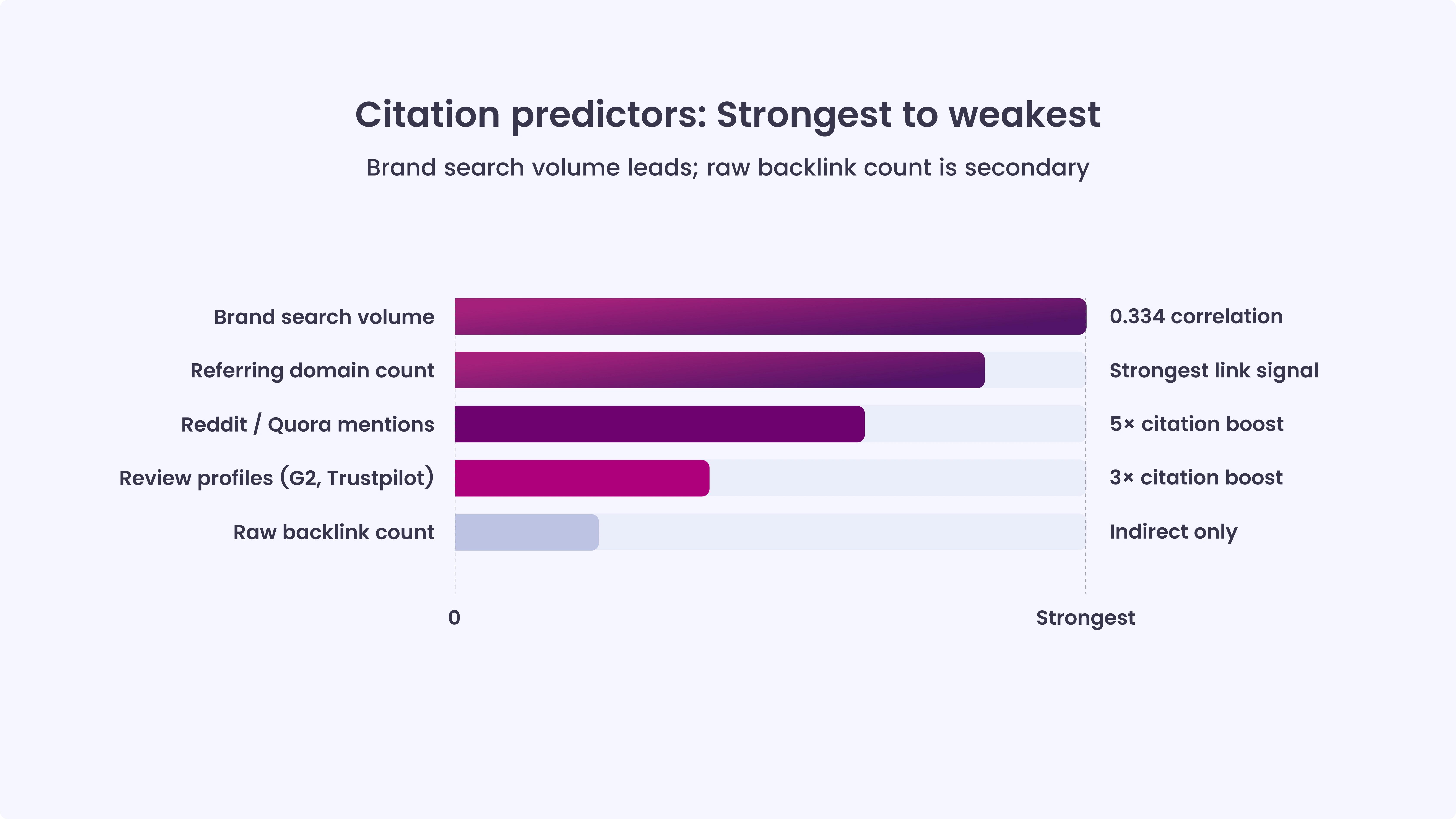
Research indicates that brand search volume is the strongest predictor of LLM citations, with a correlation of0.334, which outweighs the impact of traditional backlinks.
When people frequently search for your brand name, AI systems interpret that as a signal of relevance and trust. It tells the model that people actively seek you out, not just that other websites link to you.
Community presence reinforces this. Domains with millions of brand mentions onQuoraandReddithave roughly5 timeshigher chances of being cited than those with minimal activity.
Review platforms matter too.
Domains with profiles on platforms likeTrustpilot,G2,Capterra, andYelphave a3xhigher chance of being selected by ChatGPT as a source than sites without profiles on these platforms.
What these points point to is a shift in how authority is inferred. Backlinks are one signal among many. AI systems are building a picture of your brand credibility from multiple angles at once.
The Real Signal Behind LLM Brand Mentions
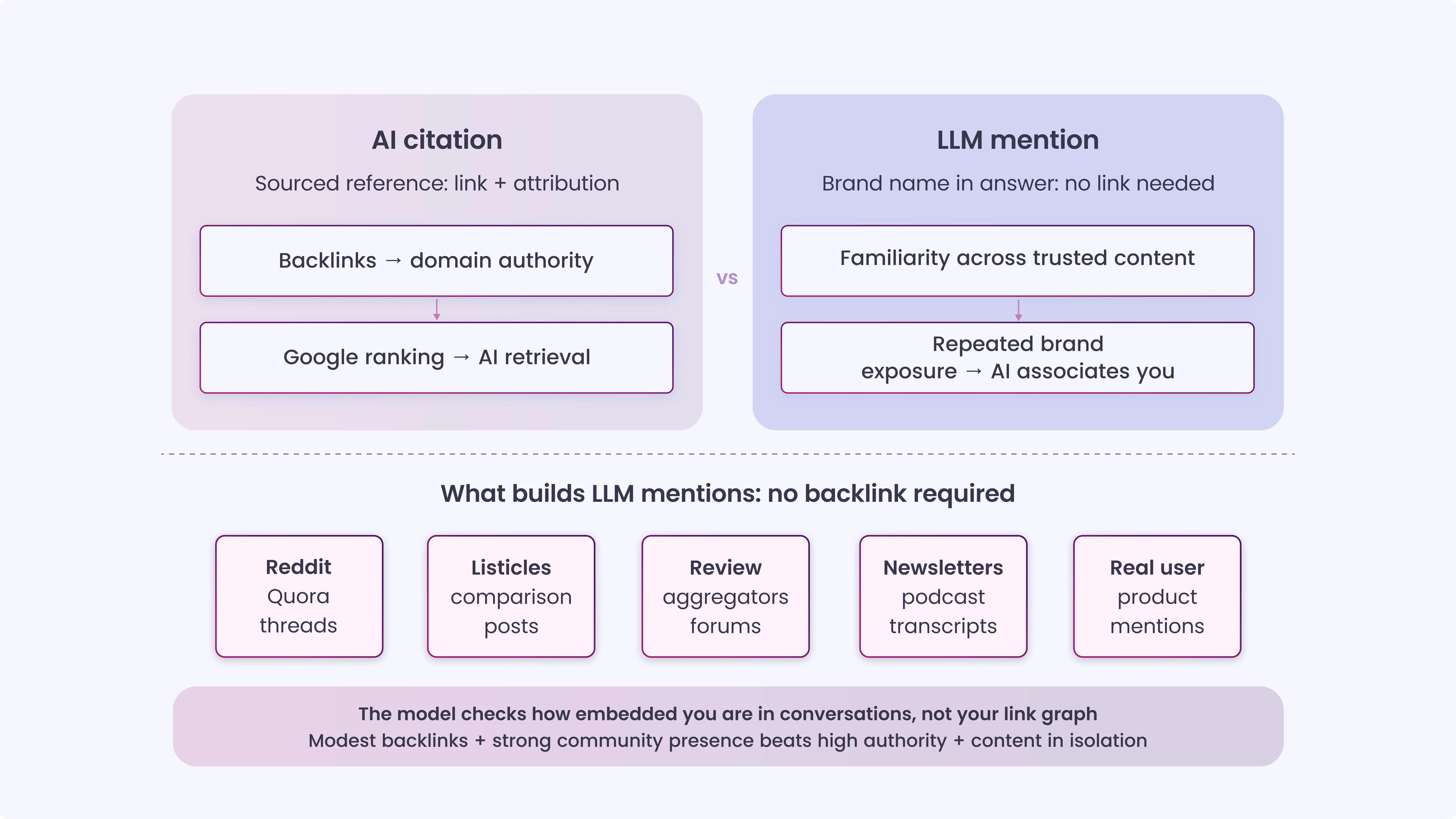
An AI citation and an LLM mention are not the same, and backlinks link to each differently.
- A citation is a sourced reference; the AI pulls from your page and attributes it.
- A mention is simpler: your brand name appears within the AI’s answer, with no link, no attribution, and no source tag. Just inclusion.
Many brands showing up in ChatGPT or Perplexity responses are appearing as mentions, not citations, and they have no idea the distinction exists.
Backlinks have almost no direct bearing on whether your brand gets mentioned this way.
What drives unlinked LLM mentions is something closer to familiarity, how consistently your brand appears across the kind of content LLMs train on and retrieve from:
- Forum threads
- Product comparisons
- Community discussions
- Review aggregators
- Editorial roundups
When a model has encountered your brand name repeatedly in relevant, trusted contexts, it begins to associate your brand with that topic and surfaces it in answers, even without a live source to point to.
This is why brands with modest backlink profiles but strong community presence often appear more frequently in AI-generated answers than high-authority domains that publish content in isolation.
The model is not checking your link graph.
It is assessing how embedded your brand is in the conversations already around your category.
To deliberately build LLM mentions, the levers differ from link building:
- Consistent presence on Reddit and Quora in relevant threads
- Getting named in third-party listicles and comparison posts
- Appearing in newsletters and podcast transcripts
- Earning genuine product mentions from real users
None of them require a hyperlink to work.
Content Signals That Directly Drive AI Citations
This is the part that most brands underinvest in, and it makes a measurable difference.
Content depth and length
Short articles under 800 words average 3.2 citations, while long-form pieces over 2,900 words earn 5.1 citations. The difference isn’t about word count for its own sake. It’s about whether your content covers a topic with enough depth that an AI can extract a complete, reliable answer.
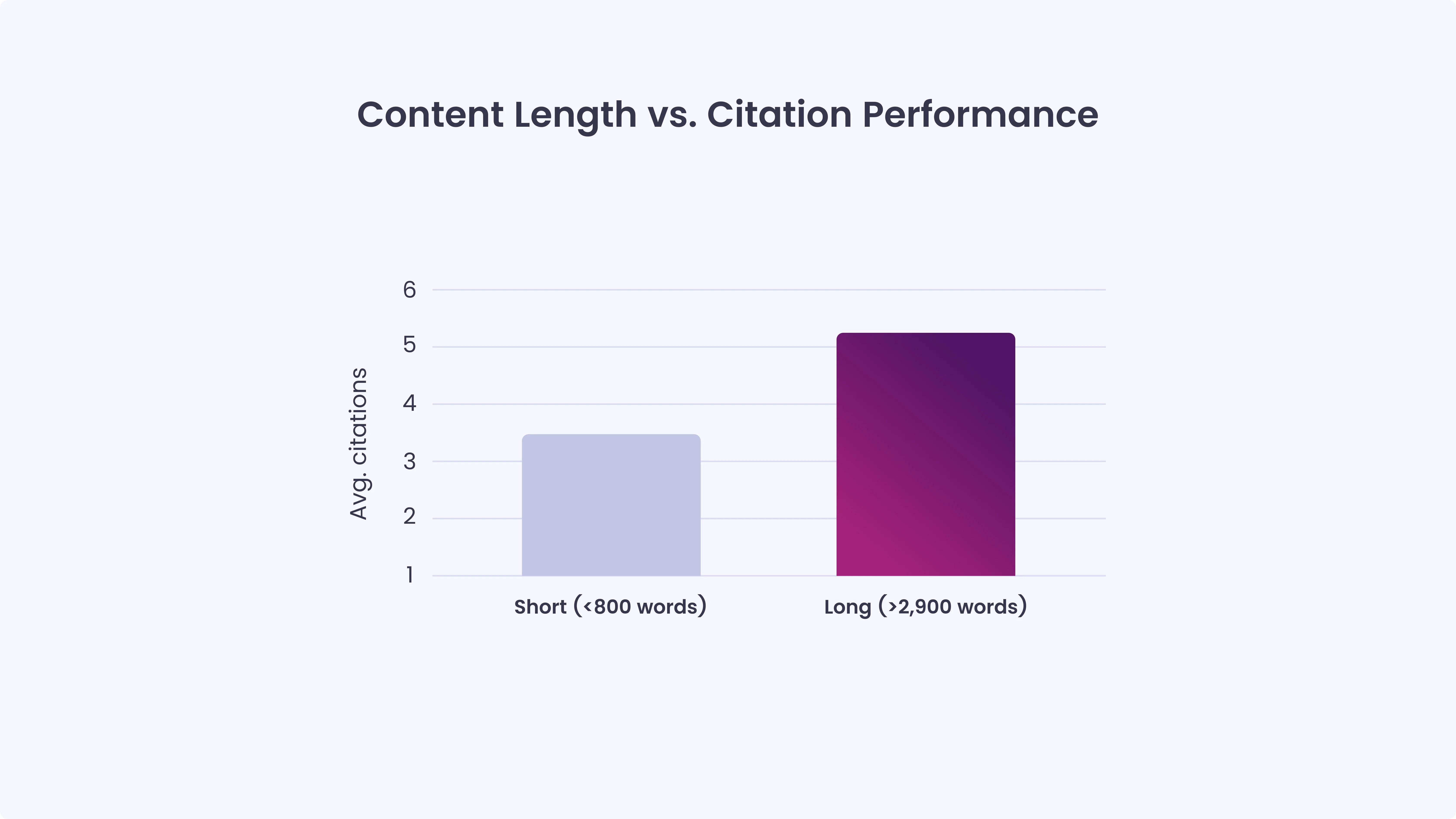
Content Length vs Citation Impact (Calculation)Based on our analysis of AI-cited pages across multiple queries, the following pattern was observed: 1. Citation increase between formats Short form (<800 words): 3.2 citations
2. Citation efficiency by word count Short form efficiency: Long form efficiency: Insight: Short-form content shows higher citation efficiency per word, while long-form content drives higher total citations due to greater depth and extractable sections. |
- Where your answer appears on the page:The first30%of a page accounts for 44.2% of all LLM citations. The middle section contributes 31.1%, and the final 30% accounts for 24.7%.Front-loading your most important information is not just a reader experience consideration. It’s how you get cited. If the core answer is buried three scrolls down, AI models are less likely to surface it.
- Data and Expert Inputs:Pages that include expert commentary and supporting data tend to perform better in AI citations than pages built solely on general explanations.Original research, proprietary insights, and named expert input give AI systems clearer material to extract and reference. Generic summaries tend to be deprioritized.
- Page Load Speed:Faster-loading pages tend to perform better in AI retrieval systems compared to slower pages with similar content depth. Speed affects how efficiently systems access and process content, which influences how often a page appears in AI-generated responses.
- Answer Structure:Pages that include clear, self-contained answer blocks tend to get cited more often by AI systems. These blocks work best when they directly address a question, are easy to isolate, and appear early in the content instead of being buried deep within long sections.
How AI Platforms Differ in Source Selection?
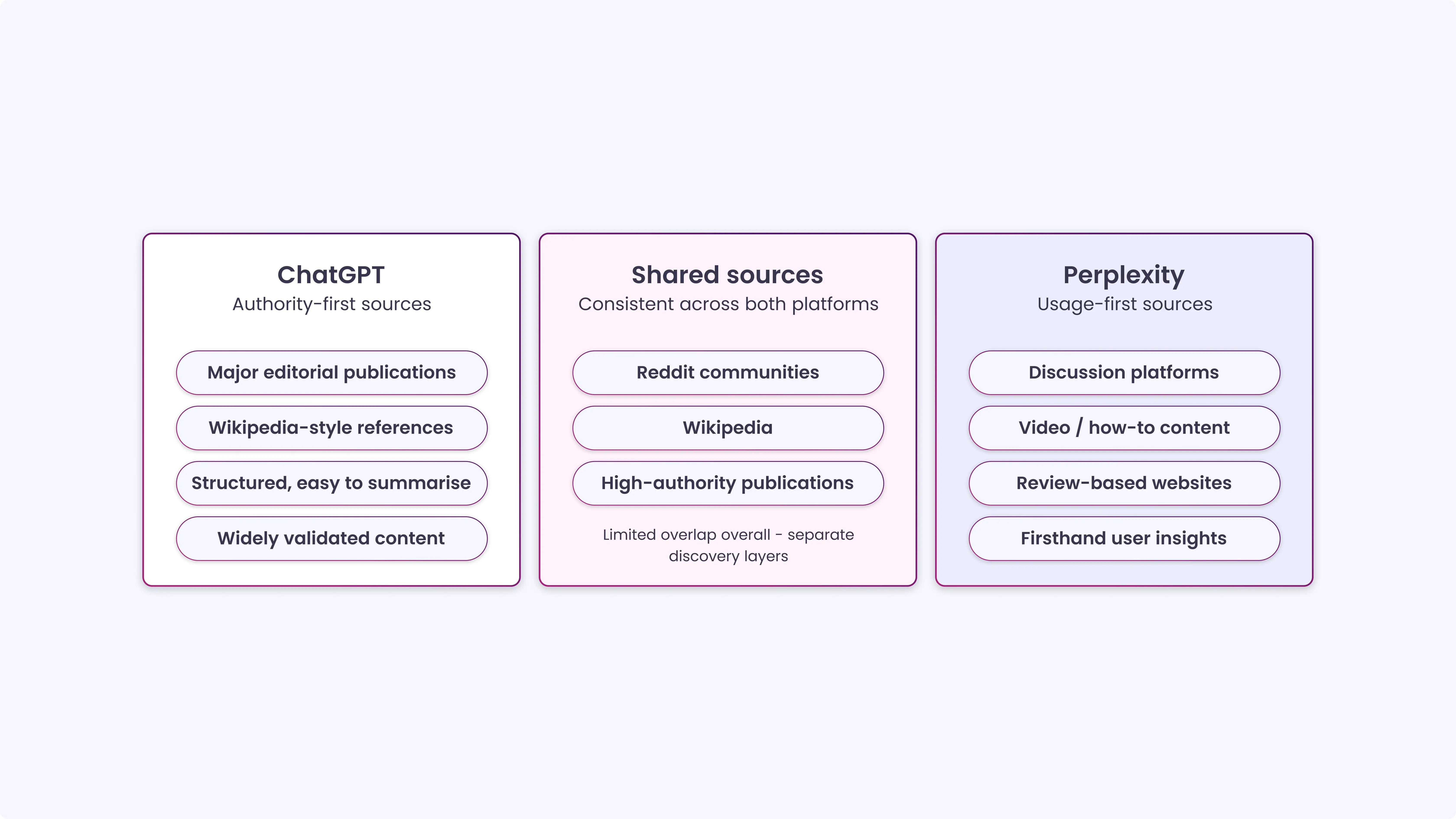
AI search systems do not rely on the same pool of sources. ChatGPT, Perplexity, andGoogle’s AI Overviewseach retrieve, filter, and prioritize information differently. Because of this, visibility in one system does not automatically translate into visibility in another.
Across observed AI search behavior, only a limited overlap is observed in the domains referenced across multiple tools. This suggests that each platform builds its own version of trusted sources based on how it retrieves information and what it is trained or configured to prioritize.
ChatGPT tends to rely more on established authority sources. These include major editorial publications, reference-style platforms such as Wikipedia, and widely referenced community sources like Reddit. The emphasis is usually on structured, widely validated, and easy-to-summarise information.
Perplexity shows a stronger tilt toward real-world usage content. This includes discussion platforms, video content, and review-based websites where practical experience and user-driven insights are more visible. The focus here is less on editorial authority and more on firsthand relevance and context.
What remains consistent across both systems is the recurring presence of a small set of widely trusted sources such as Reddit and Wikipedia, along with high-authority publications. However, the balance between them shifts depending on the platform and the type of query being answered.
This creates separate discovery environments rather than a single unified system.
This is why visibility across AI platforms cannot be treated as a single-channel effort. Each system represents a different layer of discovery.
How Can You Strengthen AI Search Visibility?
The research points to a clear conclusion: backlinks are still part of the picture, but they’re not the whole picture. Treating link building as your primary lever for AI visibility is likely to underperform.
Here’s where to focus:
- Build referring domain diversity:100 referring domains from varied, credible sources are more valuable than thousands of links from a narrow set of sites.
- Invest in brand presence across platforms:Being active on Reddit, Quora, review platforms, and third-party industry publications creates a web of mentions that AI systems interpret as trust.
- Structure your content for extraction:Answer the question directly at the top. Use clear headings, concise sections of 120 to 180 words, and avoid burying key insights deep in the page.
- Publish original data when you can:Unique findings, studies, and first-party statistics give AI models something distinct to cite. Rehashed summaries of existing content rarely earn citations.
- Keep content updated:A large share of AI bot traffic goes to recently published or recently updated pages. Fresh content signals that the information is still accurate and worth referencing.
- Make your pages load fast:Page speed is a meaningful citation factor. If your pages load slowly, you’re leaving citations on the table regardless of content quality.
The One Thing to Remember Here
Backlinks aren’t irrelevant. They contribute to the domain authority that AI systems use as a trust filter when selecting sources. But the research is clear that raw link counts and even referring domain volume are indirect signals, not the primary drivers of LLM citations.
What actually determines whether ChatGPT or another AI cites you is a combination of factors: domain-level trust, content structure, brand presence across the web, content freshness, and how cleanly your page answers a specific question.
A brand with moderate backlinks but strong community presence, original data, and well-structured content can realistically outperform a high-authority site that publishes dense, poorly organized pages.
The shift happening right now is that visibility is about whether an AI system considers your content credible and extractable enough to include in its answer. That’s a different problem from traditional SEO, and it requires a broader approach to building authority online.
Take Control of How AI Tools Cite Your Brand With INSIDEA
AI search is no longer passive. It decides what to reference, what to ignore, and which brands deserve visibility inside answers. If your brand is not being cited, your competitors are filling that space by default.
INSIDEAhelps brands move from being absent from AI-generated answers to consistently being referenced across ChatGPT, Perplexity, and Google AI Overviews. We focus on building the signals AI systems rely on, so your brand shows up when users ask questions in your category.
Here is how we help:
- AI Citation & Visibility Audit:We analyze how your brand appears across AI tools and identify where you are missing from AI-generated answers, summaries, and recommendations.
- Content Structure Optimization for AI Extraction:We refine how your content is written and structured so AI systems can easily extract and reference it in responses.
- Digital PR & Authority Building:We position your brand across trusted publications, review platforms, and external sources that AI systems frequently reference while generating answers.
- Brand Mention Expansion Strategy:We help increase consistent brand mentions across relevant platforms so AI systems associate your brand more strongly with your category.

 How INSIDEA works