Your rankings did not drop. Your traffic did. That is not a coincidence; that is Google AI Overviews doing exactly what they were built to do. About 50% of all searches now surface an AI-generated summary before a single blue link, and if your brand is not cited inside that summary, you are losing ground you cannot even see in your analytics. This guide shows you how to track, measure, and fix it.
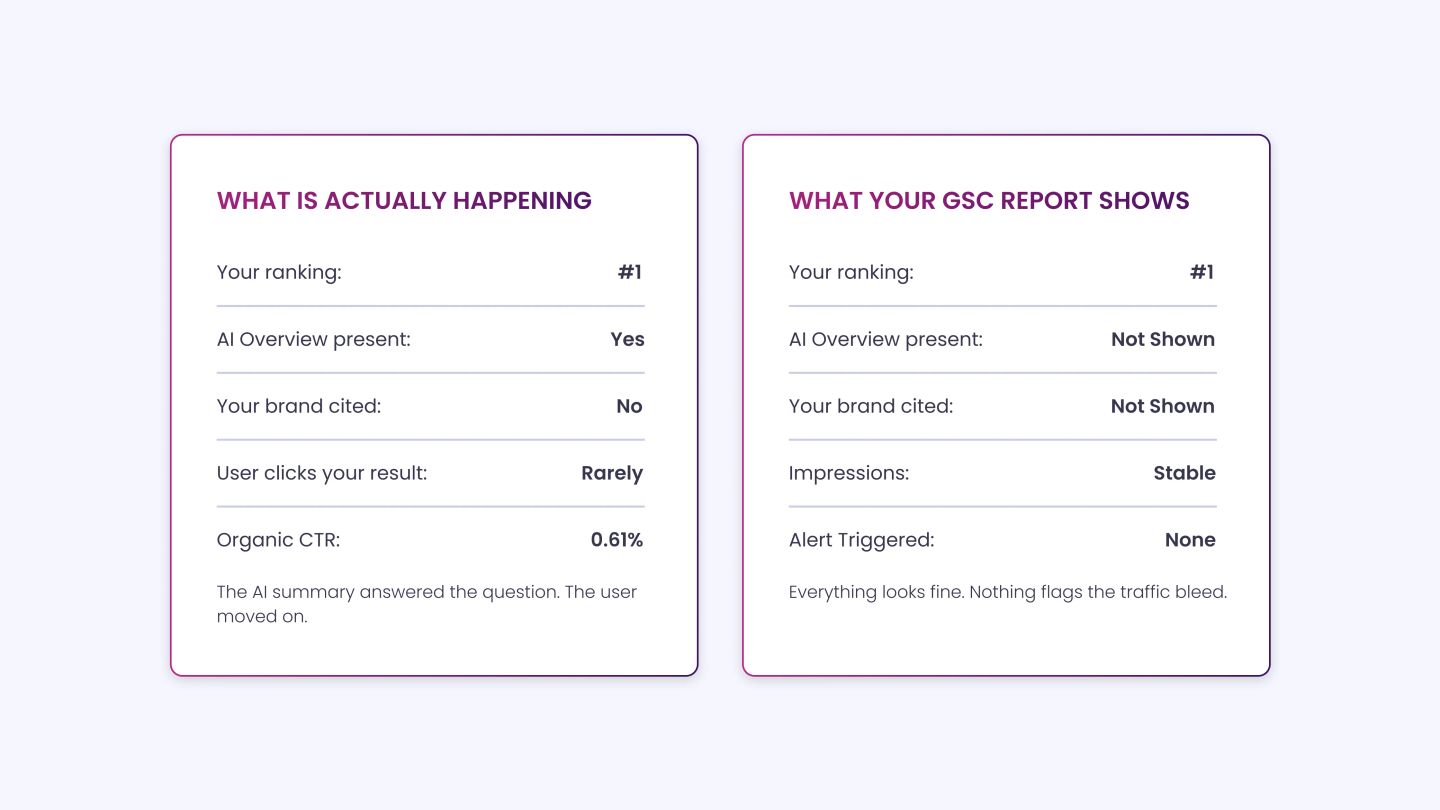
The tricky part is that nothing in your standard reporting will flag this. Your rank tracker still shows a position of 1. Your Search Console impressions look stable. But clicks are quietly going elsewhere, to the AI summary sitting above your result, answering the question your page was supposed to answer.
The brands that spotted this early did one thing differently: they stopped tracking only their rankings and started tracking whether they were cited. That single shift in measurement changed how they built content, which queries they prioritized, and ultimately how much of their search traffic they actually kept.
That is exactly what this guide walks you through.
Where Rankings Fall Short in AI-Driven Search?
Here is the shift that happened in 2025. For years, ranking number one meant you were the most visible result. That is no longer true.
| Did you know?
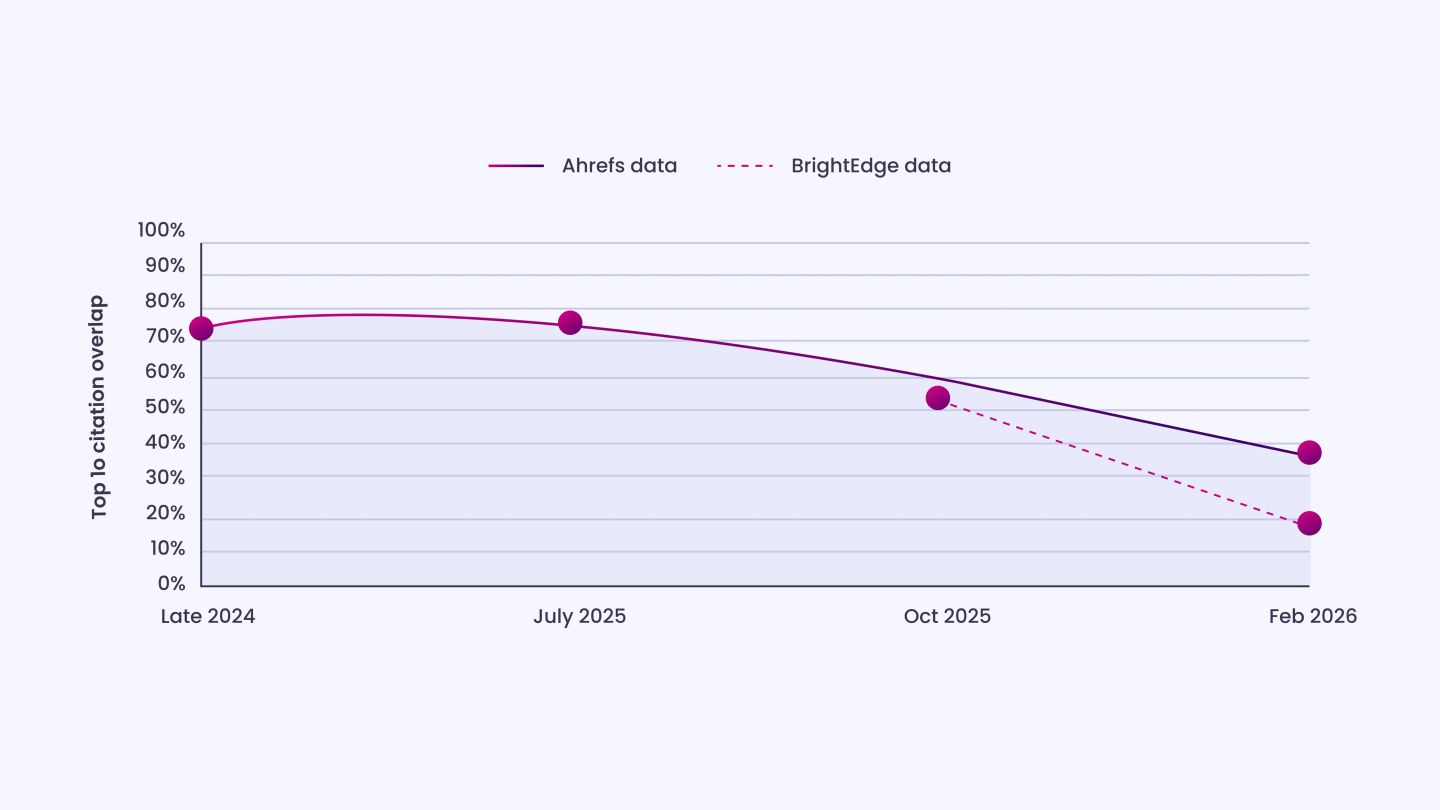
In mid-2025, approximately three out of four pages cited in an AI Overview also ranked in the top 10 organic results for the same keyword. By early 2026, that figure stands at roughly one in three, or possibly as low as one in six, depending on the data source. |
Ahrefs examined 863,000 keywords and 4 million AI Overview URLs and found that 38% of cited pages also appeared in the top 10 results for the same query, down from 76% in their previous study from July 2025.
The remaining citations are split almost evenly between results appearing in positions 11-100 and beyond position 100.
The timeline of that collapse looks like this:
| Period | Top-10 citation overlap | Source |
| Late 2024 | ~75% | Multiple studies |
| July 2025 | 76% | Ahrefs, 1.9M citations |
| October 2025 | 54% | BrightEdge |
| February 2026 | 38% | Ahrefs, 863K keywords |
| February 2026 | ~17% | BrightEdge (separate methodology) |
| The tracking gap
When an AI Overview answers the query, your #1 result still logs an impression in GSC, but gets zero clicks. You see visibility, not loss. There’s no evidence that your traffic was captured by the AI summary. Ranking for one keyword is no longer enough. Google evaluates content across related sub-queries, not just the primary term. Pages that cover the topic from multiple angles tend to be cited more often than pages built around a single keyword. |
The Metrics That Actually Reflect AI Visibility
Forget ranking positions as your primary scorecard. These are the numbers worth building a proper dashboard around:
- Citation Rate: Of all the AI Overviews that appear for queries relevant to your site, what percentage cite your domain? This is your baseline visibility number. Even when clicks are low, a high citation rate means your brand is shaping how AI summarizes your topic area.
- Competitive Share of Voice (GSOV): If a competitor appears in 60% of AI Overviews while you appear in 20%, you are losing mindshare even if your organic rankings look healthy. This is your benchmarking number; always track it relative to the two or three competitors who matter most.
- Link Prominence: When your site is cited, where does your link appear in the AI Overview? First citation versus last citation can significantly impact click-through. Google typically surfaces three to eight cited sources per response. Track position, not just presence.
- AI Traffic Share: What percentage of your total site traffic originates from AI Overview clicks? AI-referred traffic grew 527% year-over-year between January and May 2025, while most analytics platforms still misattribute it as direct traffic. This metric will grow every quarter and deserves its own tracking column.
- Citation Rotation Rate: Research shows that 40-60% of cited sources rotate month-to-month. A page appearing in an AI Overview today may be replaced within weeks, making continuous monitoring essential rather than relying on one-time audits.
| Quick Tip: Build a list of your 30–50 highest-value queries this week. These become your AI Overview monitoring targets. Nail this foundation before expanding to a larger set of keywords. |
Identify Missing Signals in Google Search Console
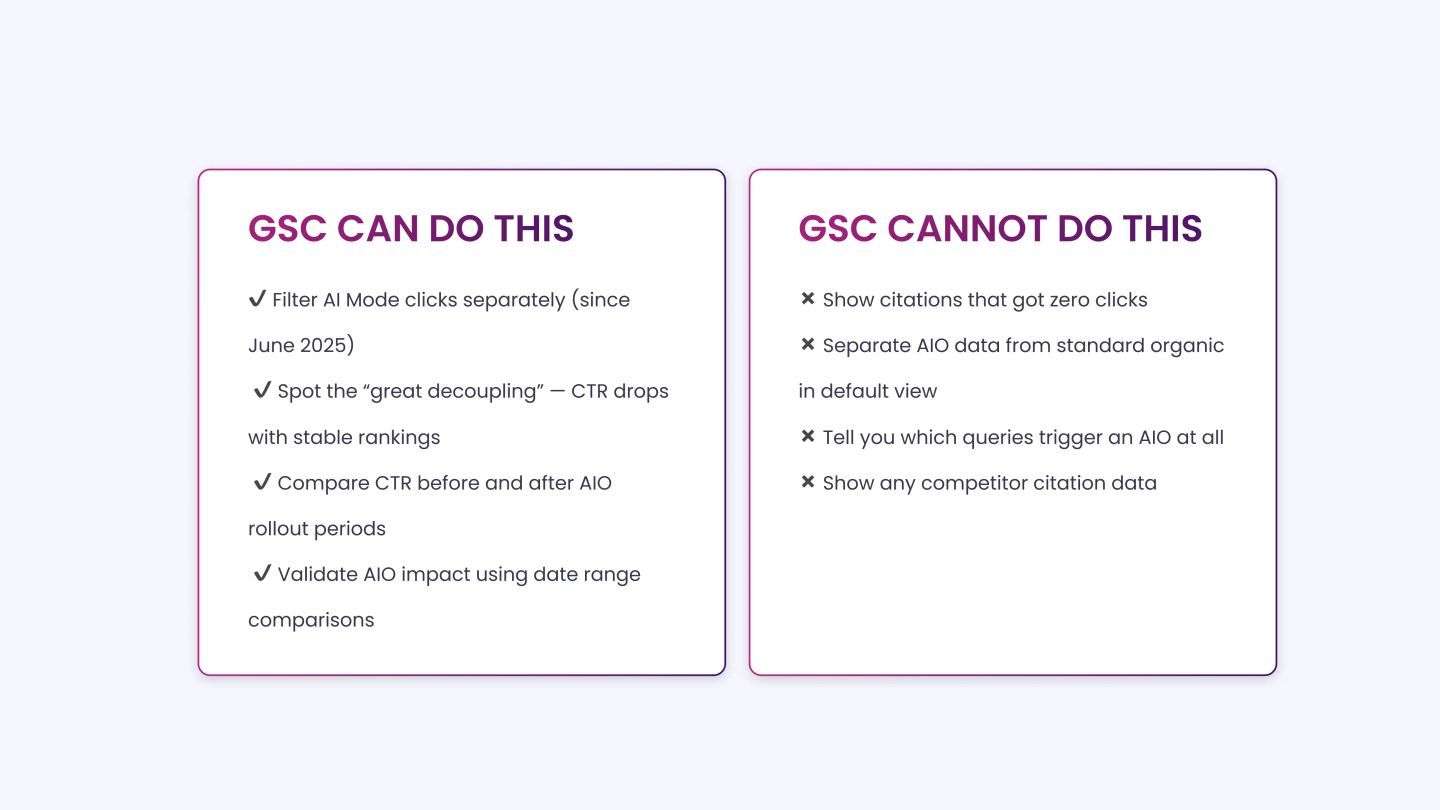
GSC is your free starting point. But it has a structural blind spot that matters enormously.
When your content is cited in an AI Overview, the impression inherits the rank of the AIO block, which is position 1.
However, the impression only registers once the user scrolls your citation into view. And GSC does not show when your content is cited within an AI Overview without receiving a click, the biggest blind spot in AIO tracking.
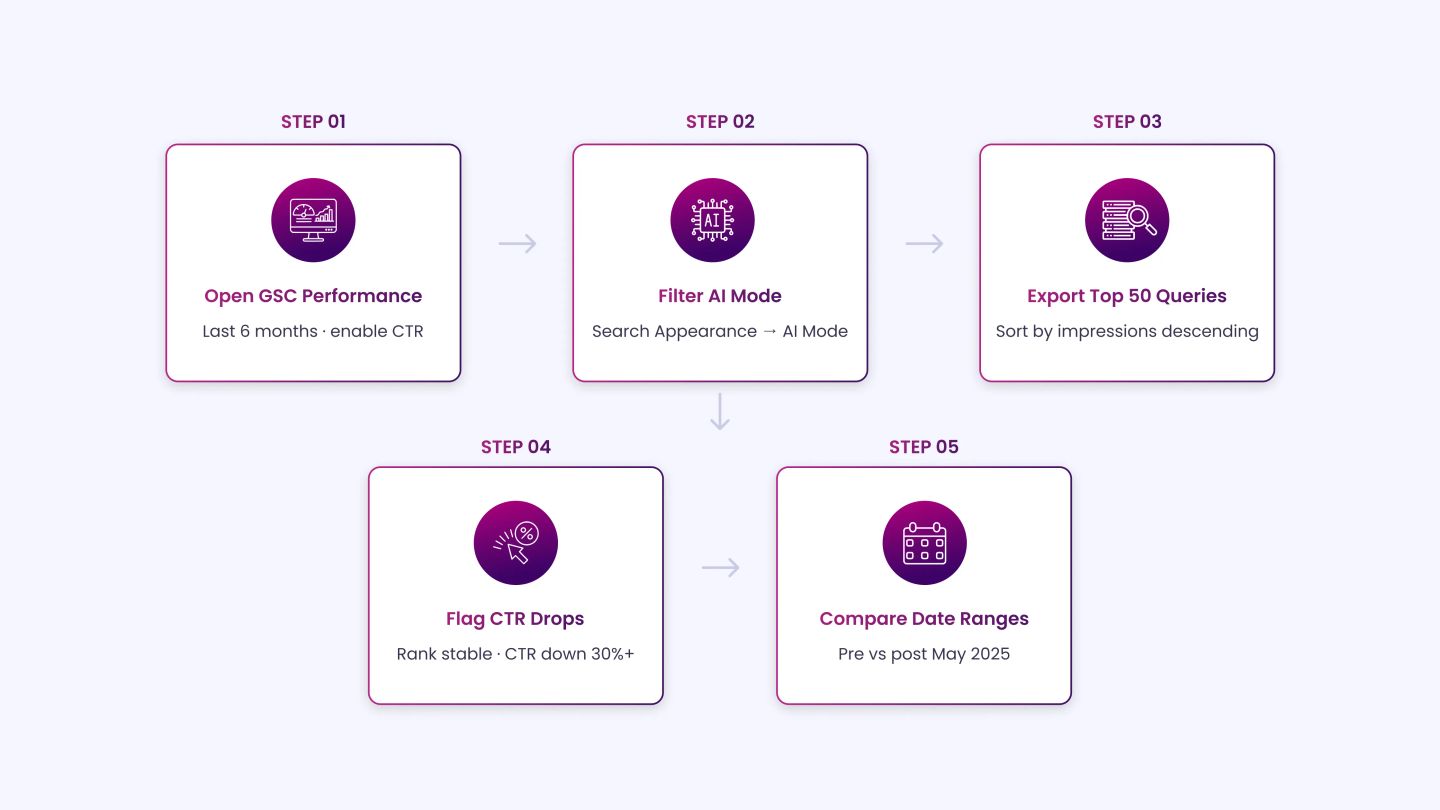
| Pro tip: Export your top 50 queries from GSC. Filter for any where CTR dropped more than 30% over the past six months without a corresponding ranking drop.
Those are your highest-probability AIO-impacted queries; earning a citation on even a handful of them could meaningfully recover lost traffic. |
Google Search Console 5-Step Tracking Process
The Best Tools for Tracking AI Overview Citations
Use an AI search monitoring tool like Otterly.ai, Semrush, or Ahrefs that includes AI Overview tracking. These tools automatically check whether your website is cited in AI Overviews for your target keywords and report changes over time.
Here is how the main options compare:
| Tool | Best for | Coverage | Starting price |
| Otterly AI | Multi-platform monitoring | Google AIOs + AI Mode + ChatGPT + Perplexity | ~$29/mo (10 prompts) |
| Semrush AI Toolkit | Teams already on Semrush; competitor benchmarking | Google AIOs, ChatGPT, Gemini | ~$99/mo per domain |
| SE Ranking | Agencies tracking high keyword volumes | Google AIOs + AI Mode | ~€99/mo (1,000 keywords) |
| Ahrefs Brand Radar | AIO data bundled with rank tracking | Google AIOs only | Bundled ($129/mo Lite) |
| Amplitude AI Visibility | Free starting point | Google AIOs, ChatGPT | Free tier available |
| Surfer AI Tracker | Existing Surfer users | Google AIOs/AI Mode, ChatGPT, Perplexity | ~$95/mo (25 prompts) |
According to OtterlyAI’s 2026 citation research, brand websites account for 59.8% of Google AI Overview citations, compared to 44.7% for ChatGPT.
This makes Google AI Overviews the most brand-friendly AI search surface currently available. Start tracking here before expanding to other platforms.
If you are also tracking visibility across ChatGPT, Perplexity, and other AI engines, a multi-platform monitoring solution like Otterly AI provides unified tracking across these platforms.
If your primary concern is Google-only AI features, a traditional SEO platform with AIO add-ons, such as SE Ranking, Semrush, or Ahrefs, may be sufficient.
Enterprise-Grade AEO Intelligence with Conductor
Enterprise teams often require more robust data than a standalone tool can provide. Conductor integrates AEO intelligence directly into its enterprise SEO platform, allowing brands to monitor their citation presence within Google AI Overviews at scale. By combining traditional rank tracking with AI visibility metrics, it helps organizations identify which content assets are being prioritized by LLMs. Using its suite of native LLM apps and developer tools, Conductor enables teams to measure Competitive Share of Voice (GSOV) across complex keyword sets, ensuring that high-value brand terms remain prominent as search interfaces shift toward AI-generated summaries.
Your Monthly Manual Audit Routine
Automated tools are worth the investment. But they miss edge cases, localized queries, device-specific AIO behavior, and niche topics with thin data coverage.
A 30 to 45-minute monthly manual check will catch what dashboards don’t.
Your manual audit checklist:
- Open a private or incognito browser window; this removes personalization from your results
- Search your top 30-50 target queries one by one and note which ones trigger an AI Overview
- For each AIO that appears, does your domain appear as a citation? If yes, at what position in the list?
- Log which competitors appear, how often, and in what position. A simple spreadsheet works fine
- Repeat two or three queries on mobile; AIO behavior can differ meaningfully between desktop and mobile
- Run this every month without fail. Cited sources rotate 40-60% month over month, so a quarterly cadence will miss significant shifts
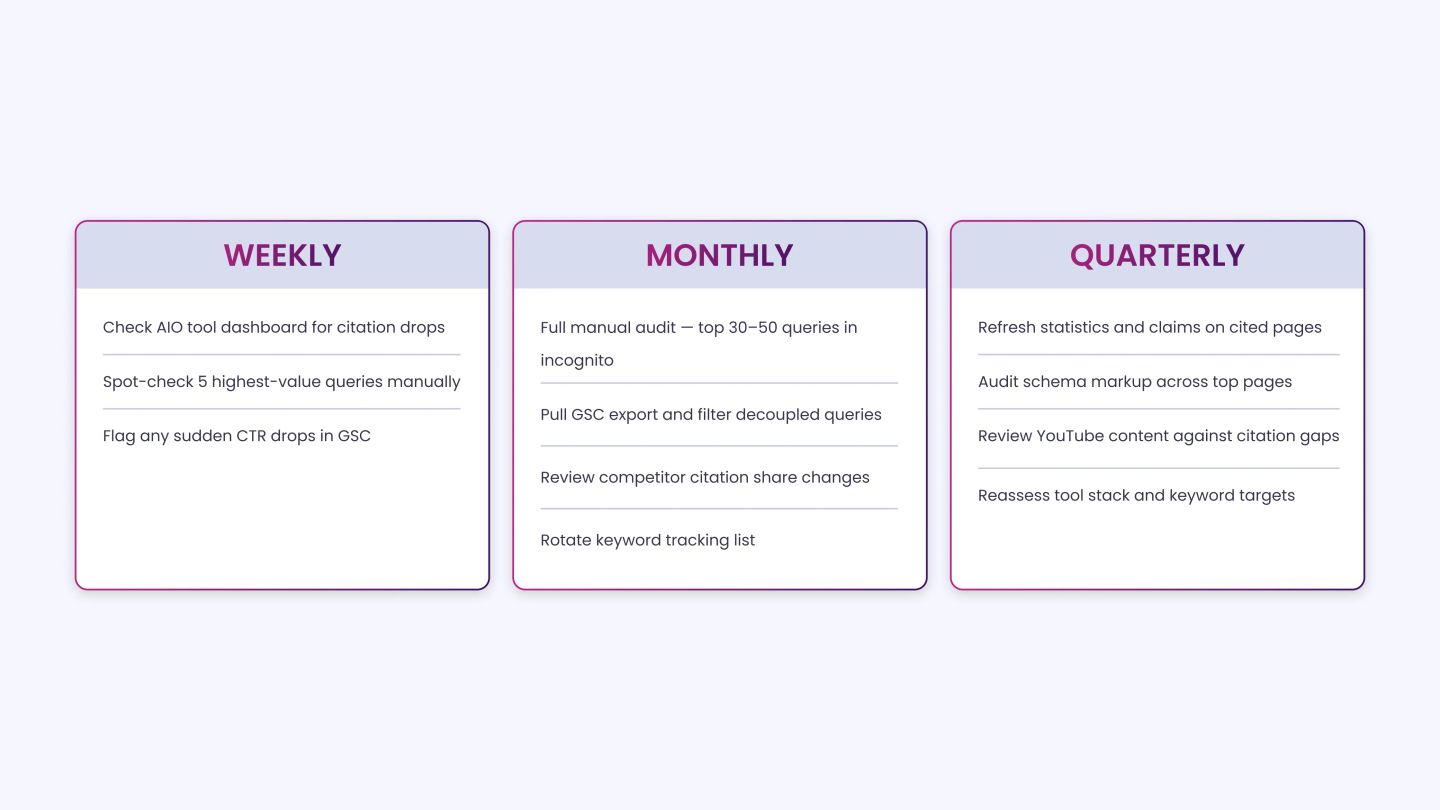
Here’s a weekly, monthly, and quarterly routine breakdown for the same:
During your manual audit, pay close attention to what types of content earn citations. Google’s AI Overviews consistently favor definitive answers in the first one to two sentences of a page, and structured lists with clear numbering or bullet points.
When you spot a competitor earning a citation you are missing, look at how they have structured the opening section of that specific page. That is your clearest and most actionable optimization signal.
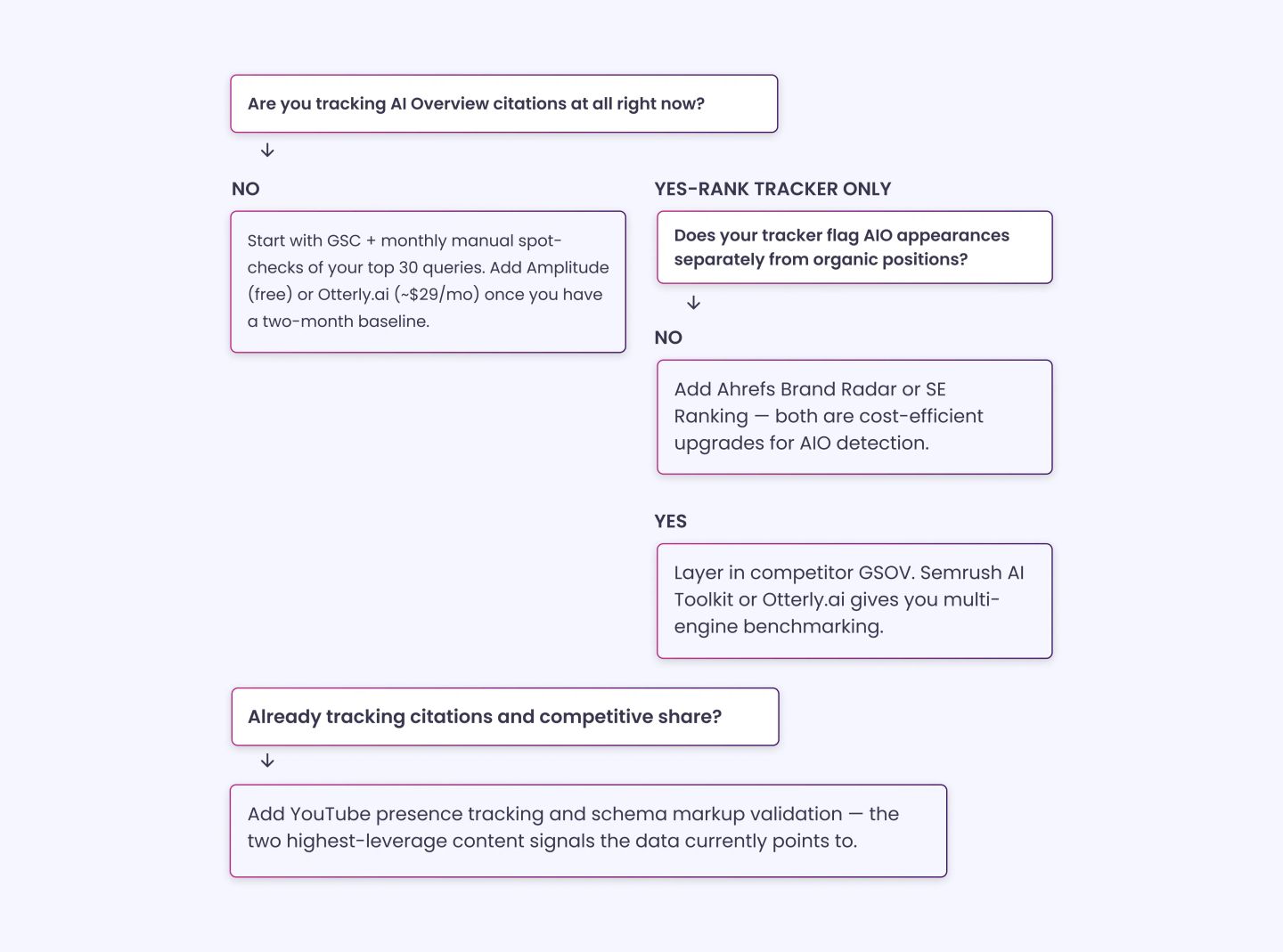
Choose the Right AI Citation Tracking Method
Follow this flow to determine which AI citation-tracking approach works best for your team:
How to Improve Your AI Citation Chances
Tracking your citations shows where you stand; these strategies tell you how to fill the gaps and get cited more often.
- Answer First, Context Later: Place your most important facts, statistics, and definitions in the first 200 words of each section. AI Overviews favor content that answers questions directly and early. If your main points are buried under multiple paragraphs of background, competitors can get cited instead of you.
- Cover the Topic Thoroughly: Google’s AI evaluates content against multiple sub-queries, not just the main keyword. Cover your topic across related angles and formats to maximize visibility. Think in terms of topic clusters rather than individual pages.
- Add Structured Data: Implement schema markup, Article, FAQPage, and HowTo to reduce ambiguity and improve AI understanding. Ensure structured data matches the visible content, and validate it using Google’s Rich Results Test before publishing.
- Keep Content Fresh and Verifiable: Real-time verification of facts boosts your AI citation probability. Pages with outdated statistics or unverified claims lose opportunities to fresher alternatives. Update your data at least annually.
- Build a YouTube Presence: Ahrefs research shows that YouTube mentions, as reflected in titles, transcripts, and descriptions, strongly correlate with AI Overview citations. An OtterlyAI study confirmed that YouTube was the second-most-cited social platform in AI search. Brands without YouTube content miss a measurable citation signal.
AI Citations Are the New Visibility Standard
AI-generated answers now influence nearly half of all search queries, and high rankings on Google alone no longer guarantee visibility. Brands that appear in AI summaries earn attention, clicks, and credibility. Tracking these citations reveals which pages are recognized, which competitors gain notice, and where your content is overlooked.
Ignoring this data leaves gaps that show up in revenue, even when traditional rankings look strong. Start by monitoring the queries that trigger AI summaries, add an AI citation tracking tool to your workflow, and optimize your top-performing content with structured data.
Regular monitoring and updates turn insights into measurable visibility, ensuring your brand is cited consistently where audiences are making decisions.
INSIDEA
Ready to get found by people and AI?
Search and answer-engine visibility that compounds, built to be cited.

 How INSIDEA works