Insurance is one of the highest-cost-per-click verticals in paid search. According to WordStream, insurance keywords regularly rank among the most expensive in Google Ads, with some terms exceeding$50 per click. That makes organic search not just useful, but financially significant for insurance companies of all sizes.
SEO for insurance companies poses specific challenges: high competition, Google’s YMYL (Your Money, Your Life) classification, strict E-E-A-T requirements, and a buyer journey that often starts months before a purchase decision.
This blog explains how insurance companies can build an SEO strategy that generates consistent, qualified organic traffic.
Marketing for insurance agencies
Rather have this done for you?
Book a 30-minute call with INSIDEA. We look at how customers find you today and send a proposal within 48 hours if we are a fit.
Book a strategy callThe Role of E-E-A-T in Insurance SEO
Google treats insurance content as YMYL, meaning it holds pages to a higher standard before ranking them. Sites in this category must demonstrate expertise, experience, authoritativeness, and trustworthiness (E-E-A-T) at both the content and domain level.
This matters in practice. A blog post about term life insurance written by an unnamed staff writer with no credentials will consistently underperform against content attributed to a licensed insurance professional or reviewed by one. Google’s Quality Raters Guidelines explicitly flag insurance as a domain requiring demonstrated expertise.
What this means for your site:
- Author bios with professional credentials on all content pages
- Clear About pages listing company licensing, history, and regulatory standing
- Policy pages (privacy, terms of service, disclaimers) that are current and accessible
- SSL certification and strong domain security signals
Keyword Research for Insurance Companies
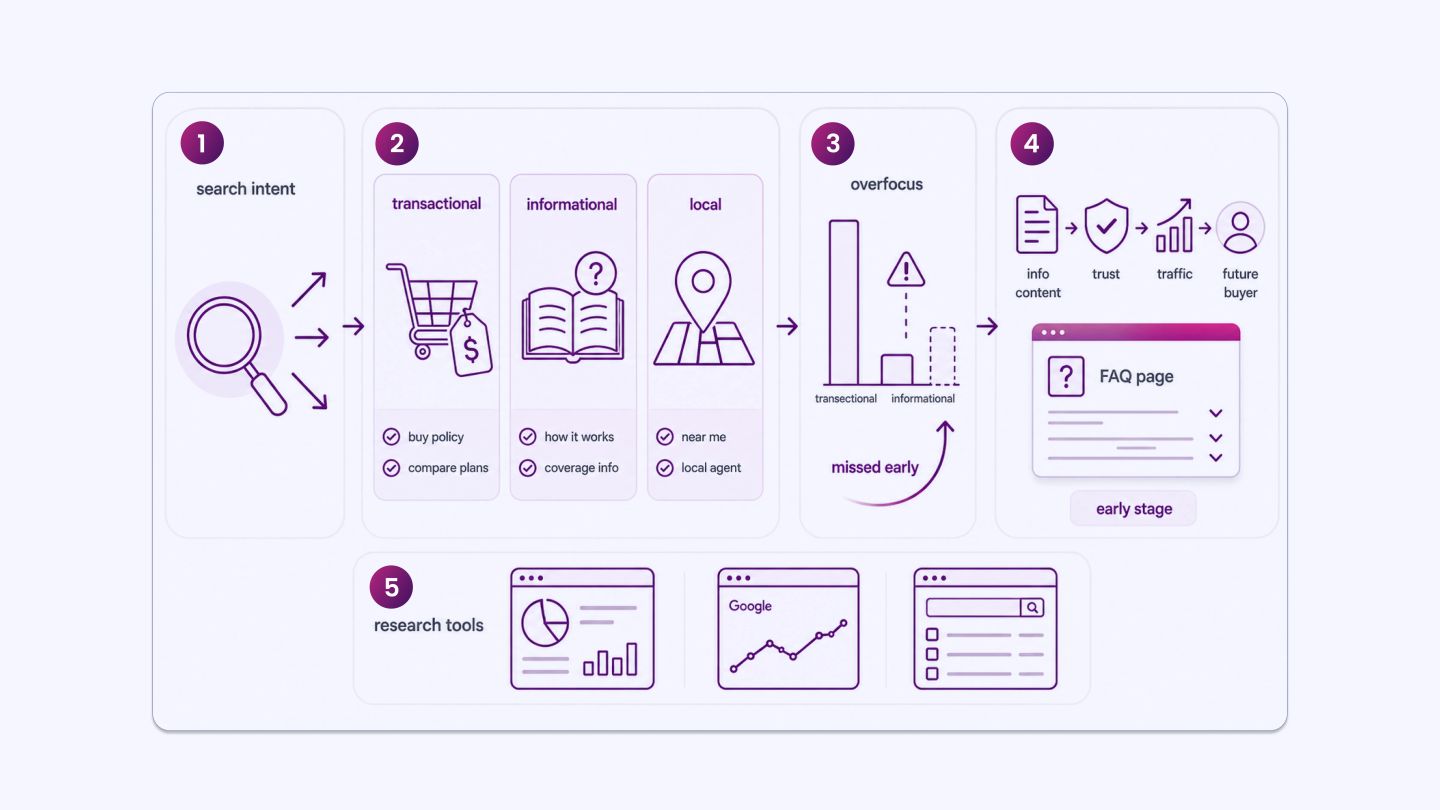
Insurance keyword research is not about finding low-competition shortcuts. It is about mapping search intent accurately across three categories:
- Transactional keywords: searchers ready to buy or compare. Examples: “car insurance quotes online,” “compare home insurance plans,” “get life insurance estimate.”
- Informational keywords: searchers researching before deciding. Examples: “how does whole life insurance work,” “what does renters insurance cover,” “term vs permanent life insurance.”
- Local keywords: searchers looking for providers in a specific area. Examples: “health insurance broker in Austin,” “small business insurance near me,” “auto insurance agents in Phoenix.”
Most insurance companies over-invest in transactional terms and ignore informational searches. That is a structural error. Informational content builds topical authority, earns backlinks, and reaches buyers earlier in the decision process.
A well-structured FAQ page on “what does liability insurance cover” can drive thousands of monthly visits from people who will need a policy within weeks.
Use tools like Ahrefs, Semrush, or Google Search Console to identify the exact questions your target audience asks. Prioritize specific, long-tail phrases over broad generic terms in the early stages.
Local SEO: The Most Underused Advantage
For independent agents and regional carriers, local SEO is where most gains are to be found. National insurers dominate branded and broad terms. Local businesses can compete on geography.
Google Business Profile (GBP) is the starting point. A complete, verified profile with accurate NAP (name, address, phone number), updated hours, services listed, and regular photo uploads improves local pack rankings. Reviews are a direct ranking factor, and responding to them signals trust.
Local citation consistency matters. Your business information should be identical across every directory: Yelp, Yellow Pages, Bing Places, local Chamber of Commerce listings, and insurance-specific directories like Insurify or the NAIC consumer portal.
Location pages for multi-location agencies should each have:
- Unique content specific to that city or region
- Local schema markup
- References to local regulations, coverage needs, or community context
- A Google map embed and local phone number
Avoid duplicating content across location pages by swapping only the city name. Google treats this as thin content.
Content Strategy for Insurance SEO
Content for insurance must be specific, accurate, and structured for both users and search engines.
Topic clusters are the most effective structure. Build a pillar page on a broad topic (e.g., “Small Business Insurance”) and link it to supporting articles that cover subtopics in depth (e.g., “What is general liability insurance,” “Does a sole proprietor need workers comp,” “How much does business insurance cost”).
Internal linking between these pages signals to Google that your site has comprehensive coverage of the topic.
Content types that perform well in insurance SEO:
- Coverage explainers: What specific policies cover and exclude
- Cost guides: What factors affect premiums for different insurance types
- Comparison pages: Term vs whole life, HMO vs PPO, etc.
- State-specific guides: Minimum coverage requirements by state, local regulations
- Case study formats: How a claim was handled, what documentation is required
Every page should answer a specific question a real user typed into Google. Avoid writing for word count. A 600-word page that fully answers one question outperforms a 2,000-word page that partially answers five.
Technical SEO for Insurance Websites
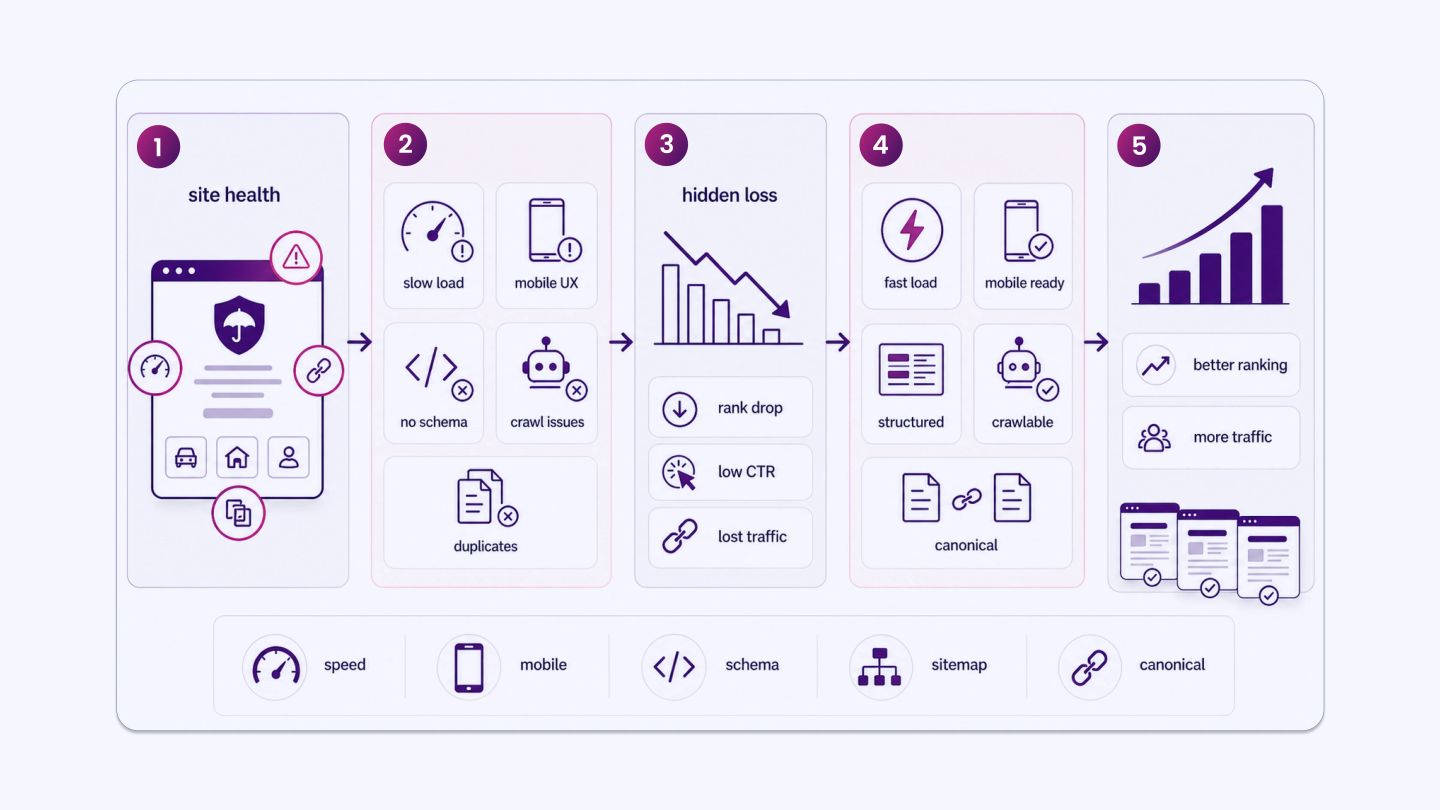
Technical issues silently suppress rankings. The most common problems on insurance sites include:
Page speed: Insurance sites frequently load slowly due to large image files, unoptimized code, and third-party scripts from quote calculators. Google’s Core Web Vitals are a confirmed ranking signal. Use PageSpeed Insights to identify and fix Largest Contentful Paint (LCP) and Cumulative Layout Shift (CLS) issues.
Mobile performance: Over 60% of insurance searches happen on mobile devices. A site that is not fully responsive with tap-friendly CTAs and readable text at mobile widths will lose rankings and conversions.
Schema markup: Use LocalBusiness, FAQPage, and InsuranceAgency schema where applicable. The FAQ schema can generate rich results in Google, increasing click-through rates without requiring higher rankings.
Crawlability: Ensure your XML sitemap is up to date, robots.txt does not block important pages, and there are no orphaned pages without internal links pointing to them.
Duplicate content: Quote calculator URLs often generate duplicate parameter-based URLs. Canonical tags and proper URL parameter handling prevent these from diluting page authority.
Link Building for Insurance Companies
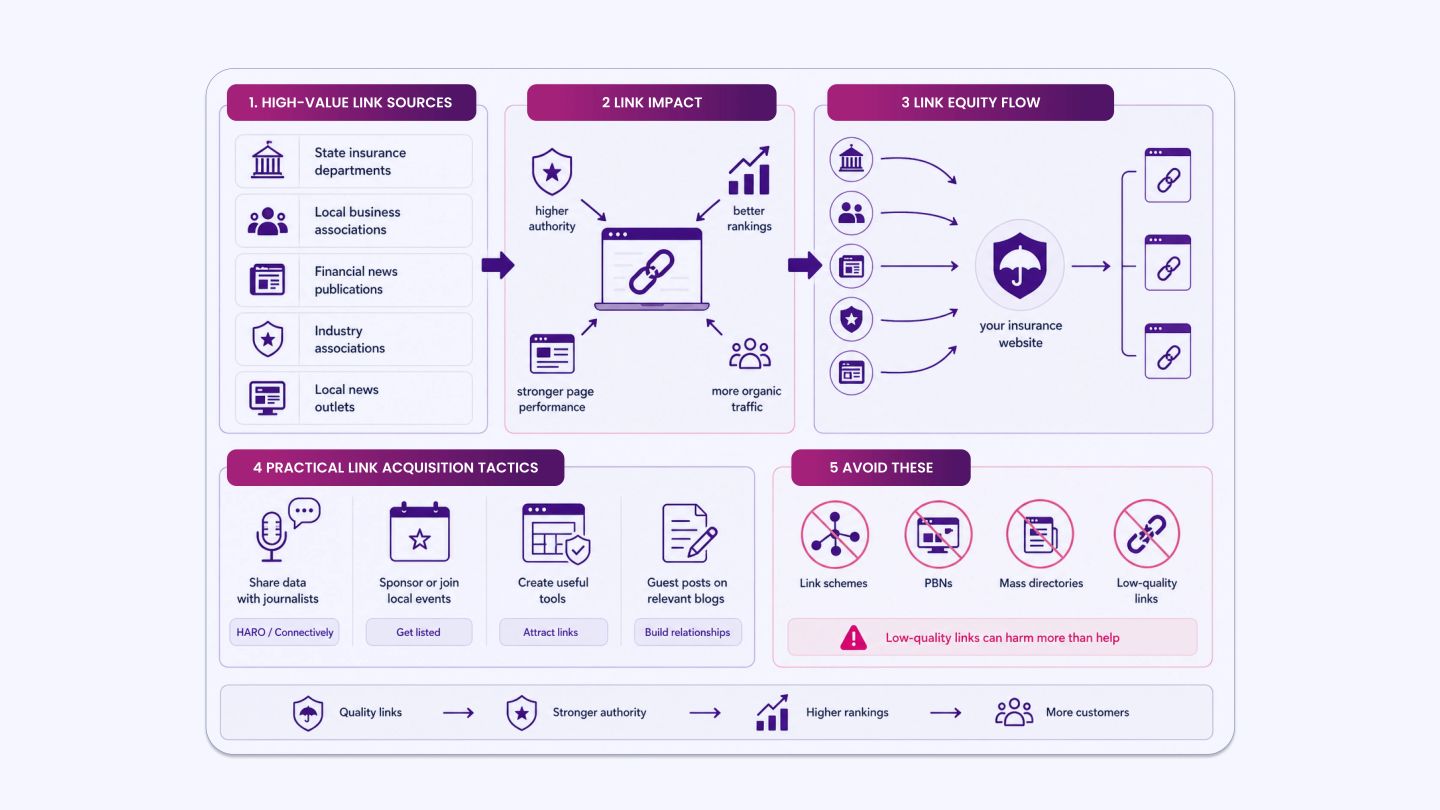
Backlinks from authoritative sources increase domain authority and improve rankings across all pages. In insurance, the highest-value links come from:
- State insurance department websites and regulatory bodies
- Local business associations and Chambers of Commerce
- Financial news publications (Forbes Advisor, NerdWallet, Bankrate)
- Industry associations (NAIC, IIABA, NAIFA)
- Local news outlets covering business or financial topics
Practical link acquisition tactics:
- Submit original research or claims data to journalists (HARO or Connectively)
- Sponsor or participate in local events with a website listing
- Create useful tools (premium calculators, coverage checklists) that attract organic links
- Guest contributions to financial planning or legal blogs with relevant audiences
Avoid link schemes, PBNs, or mass directory submissions. In YMYL categories, a low-quality link profile is more damaging than a small one.
Measuring SEO Performance
Vanity metrics like total traffic tell you little. Track these instead:
- Organic lead volume: Form fills, call tracking attributed to organic search
- Keyword rankings by category: Separate transactional, informational, and local
- Click-through rate from Search Console: Pages ranking well but not earning clicks need a title or meta description revision
- Conversion rate by landing page: High traffic pages with low conversions may have an intent mismatch
- Cost per organic acquisition: Compare against paid search CPA to quantify SEO ROI
Set a baseline in month one. Measure in 90-day intervals. SEO results in insurance typically appear 4 to 6 months after implementation for new content, and faster for technical fixes on existing high-traffic pages.
Build Long-Term Organic Growth Through SEO
SEO for insurance companies is not complicated, but it does require consistent execution across several areas simultaneously.
Local visibility, credible content, technical soundness, and a clean backlink profile each contribute to the overall ranking. Skipping one weakens the others.
Companies that treat SEO as an ongoing operational function, not a one-time project, will build compounding organic traffic that reduces dependence on paid acquisition over time.
INSIDEA
Ready to put this into practice?
INSIDEA is an Elite HubSpot Partner rated 4.99 across 500+ verified reviews. Let's map it to your goals.



 How INSIDEA works