A strong Google ranking no longer guarantees that your brand will be recommended when users turn to Perplexity for answers.
Perplexity now processes over 780 million queries per month and reached 22 million monthly active users by December 2025, a 50% year-over-year increase. Users are not browsing link lists. They are asking questions and receiving structured answers with a small set of cited sources. If your content is not included in those citations, it does not appear in that interaction.
The impact shows up in performance. According to Microsoft Clarity’s November 2025 study, traffic from AI platforms converts at 1.66% compared to 0.15% from traditional search. That is an 11x difference. As observed in independent analyses, a few hundred visits from AI sources can generate more leads than thousands from Google.
Standard SEO tools do not capture this shift. They report rankings on search engine results pages but do not show whether your pages are cited in Perplexity responses, whether your competitors are being recommended instead, or when your visibility drops.
This is the gap most teams are not measuring, and this blog addresses it.
What is Perplexity SEO rank tracking?
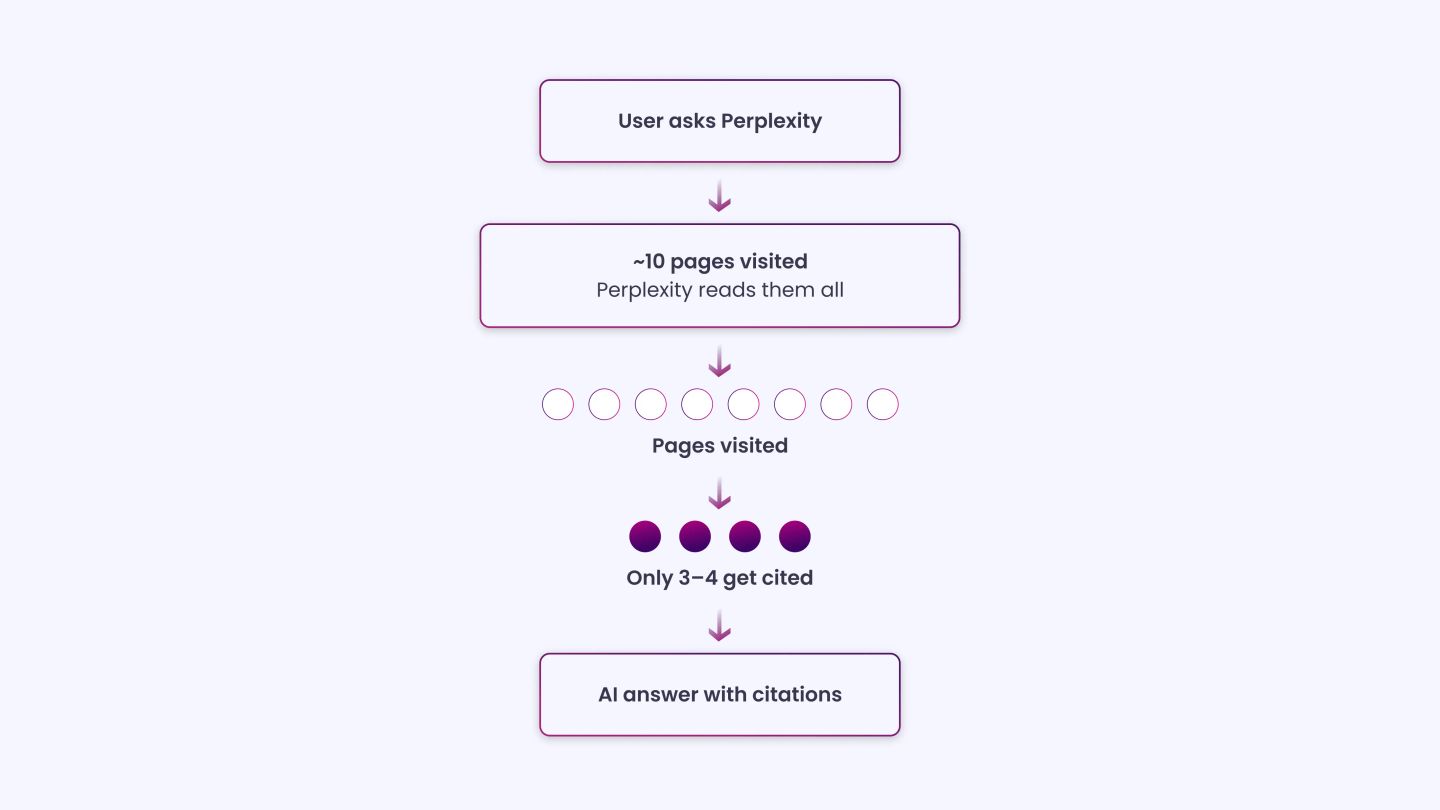
It is the practice of monitoring where your content, brand, and URLs appear within Perplexity’s AI-generated answers, not in traditional search results. Tools simulate the questions your audience asks Perplexity, then record which sources get cited.
Perplexity may visit around 10 pages per query, but it typically cites only 3 to 4. The focus isn’t just being crawled or considered, but actually showing up among the final cited sources.
How Does Perplexity Citation Work Differently from Google?
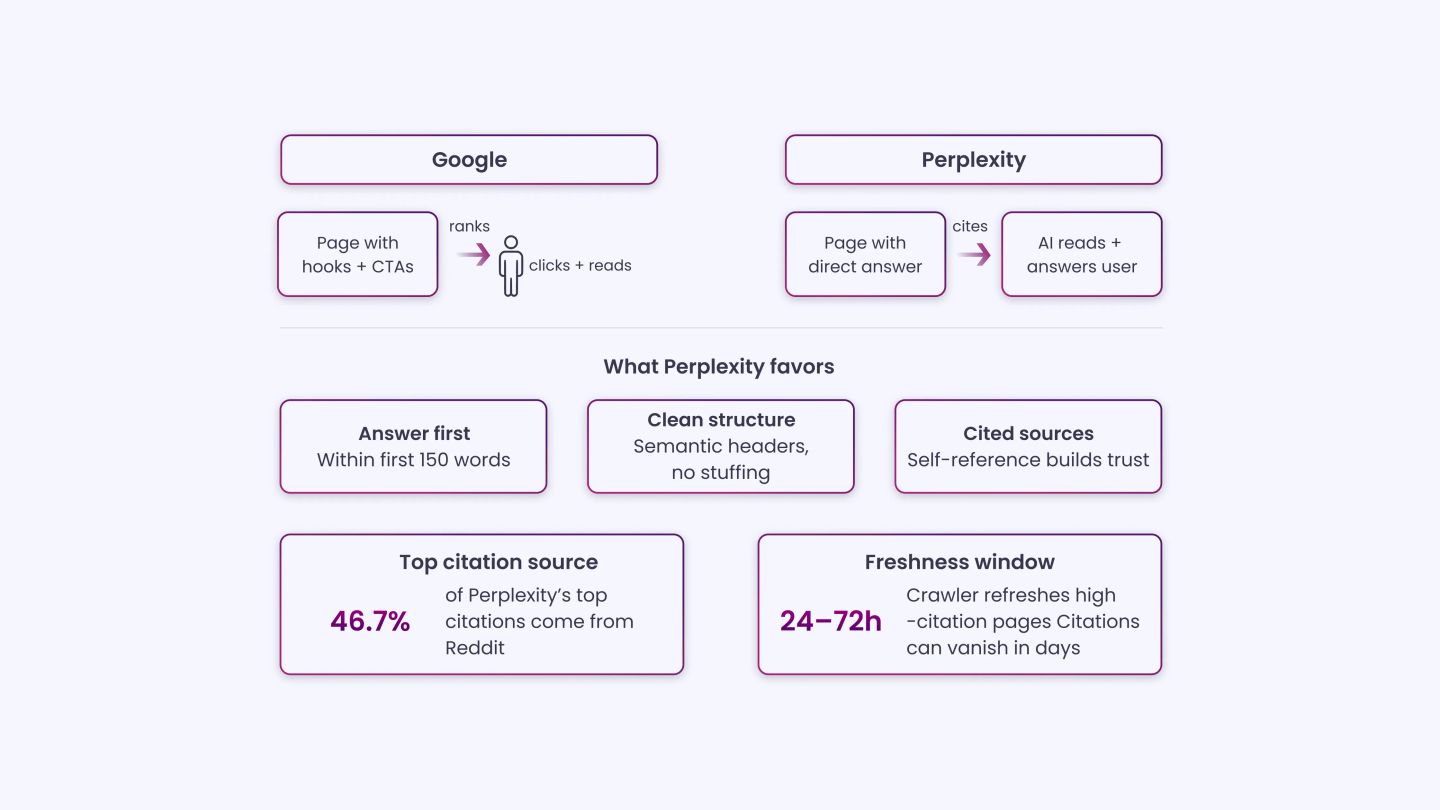
Google ranks pages for users who click and read. Perplexity selects pages for an AI to extract and cite directly in answers.
This difference changes what gets surfaced. Pages with strong hooks, multiple CTAs, or keyword-heavy structure can still rank well on Google but get ignored by Perplexity. Instead, it prioritizes content that leads with a direct answer in the first 150 words, uses clean semantic structure, and includes clear sourcing.
Reddit accounts for 46.7% of Perplexity’s top-cited sources, underscoring its heavy reliance on conversational and community-driven content.
Freshness also matters. Perplexity uses a custom crawler that refreshes high-citation pages every 24 to 72 hours, which means a page can lose visibility within days if a competitor publishes stronger content.
This is why Perplexity visibility needs dedicated tracking, and why these tools matter.
How These Tools Were Evaluated?
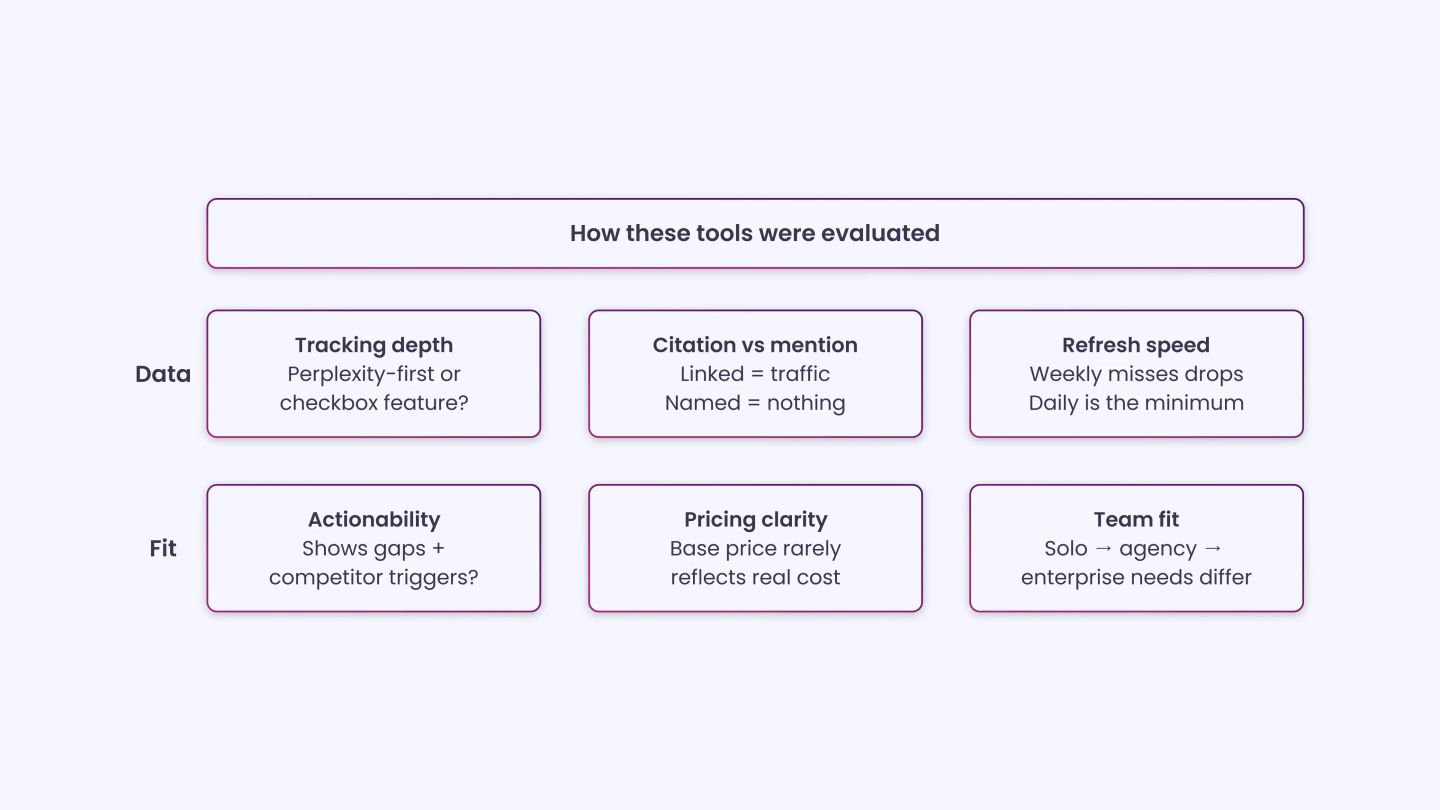
Each tool is reviewed using criteria specific to Perplexity.
- Perplexity tracking depth: Some tools make Perplexity a core focus, with dedicated tracking. Others include it as one item in a wider set of platforms, without deeper detail. The level of tracking depth changes how usable the data is.
- Citation vs mention tracking: Perplexity either links a source or only names it. Linked citations bring traffic. Mentions do not. Treating both the same hides this difference.
- Refresh speed: Perplexity output changes quickly. A citation today may be gone in a few days. Tools that update weekly or monthly miss those shifts.
- Actionability: Some tools stop at showing results. Others show which prompts pull in competitor citations and where your content is missing.
- Pricing clarity: Real cost often goes well past the listed pricing due to prompt limits, add-ons, or platform access fees. Base price rarely reflects actual usage.
- Team fit: Solo users need something simple. Agencies need client reporting. Larger teams need structure, access control, and consistent reporting across accounts.
7 Best Perplexity SEO Rank Tracking Software in 2026
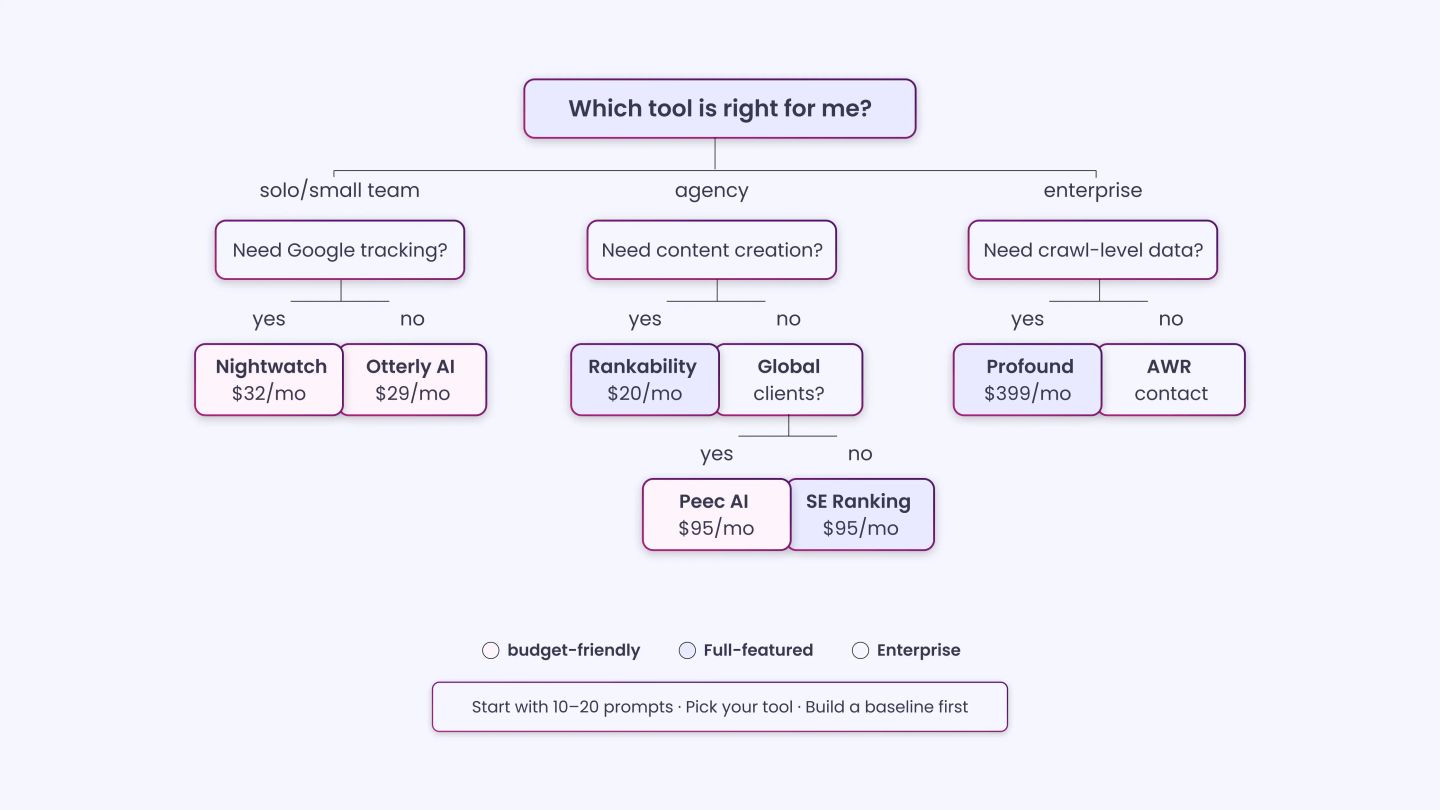
Before we get to the full list, here’s a quick decision guide to help you pick the tool that works best for your needs:
1. SE Ranking (SE Visible)
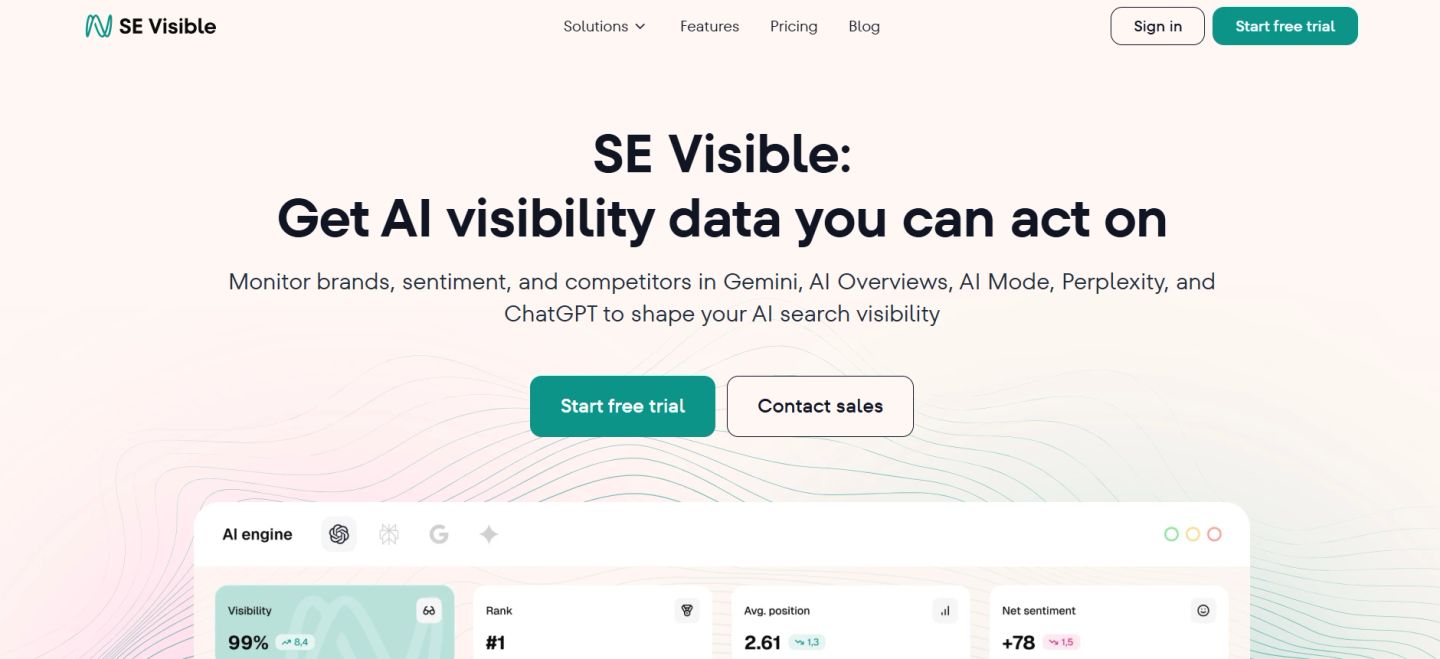
Pricing: From ~$95.20/month, Perplexity tracking included in Pro plan, no add-on fee
Best for: Agencies and SMBs that want dedicated Perplexity tracking combined with traditional SEO in one platform, without paying separately for AI visibility
SE Ranking has built one of the most Perplexity-committed products in this category. Its dedicated Perplexity Visibility Tracker, part of the SE Visible suite, monitors both brand mentions and URL citations simultaneously, with a daily refresh frequency. The platform extracts the full answer text from Perplexity responses and assigns average position scoring, so you know not just whether you appeared but where you appeared within the answer.
The “No cited” feature flags every prompt where competitors are cited but your brand is not, turning a visibility gap into a specific content action. For agencies, white-label reporting and unlimited user seats make it easier to present Perplexity data to clients alongside traditional rank reports.
Daily updates are particularly important here because SE Ranking’s own research found that Perplexity drives 15% of all AI referral traffic globally and 20% in the US, a number that warrants daily, not weekly, monitoring.
Pros
|
Cons
|
2. Otterly AI
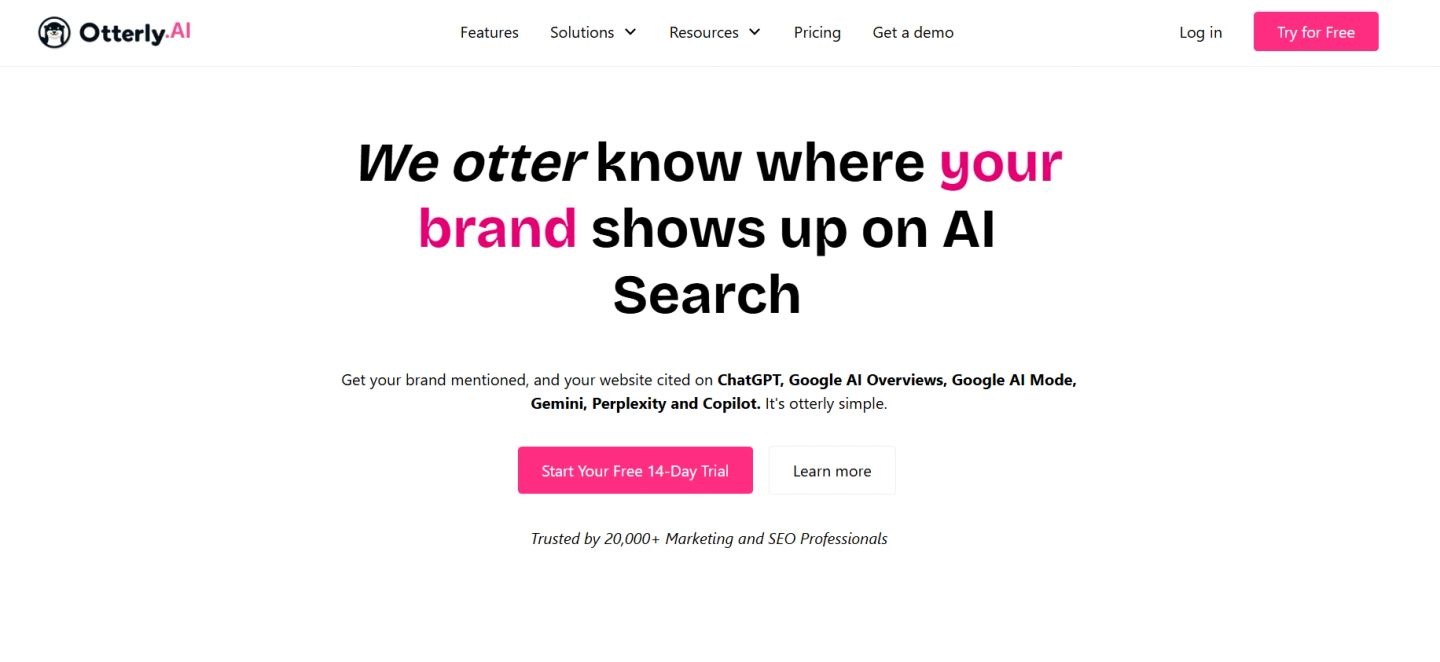
Pricing: Lite from $29/month (15 prompts) · Standard $189/month (100 prompts) · Premium $489/month (400 prompts) · 50-prompt free trial
Best for: Small teams and solo marketers who want affordable Perplexity monitoring across multiple AI platforms without a complex setup
Otterly AI is one of the few tools in this list with a accessible entry point and a 50-prompt free trial, the best trial terms in this category. It covers Perplexity alongside ChatGPT, Google AI Overviews, Gemini, Copilot, and Google AI Mode, capturing the full AI-generated response rather than a binary signal.
The Brand Visibility Index provides a single aggregated score across platforms, making it easy to spot trends without digging into prompt-level data. The Looker Studio integration allows agencies to build custom dashboards that combine Perplexity visibility with other reporting data.
Daily tracking across 50-plus countries distinguishes linked citations from text mentions, a detail that matters when you are trying to understand whether Perplexity is driving traffic or just naming your brand.
Google AI Mode and Gemini require add-ons on top of the base plan, so check the total cost for the platforms you actually need.
Pros
|
Cons
|
3. Peec AI
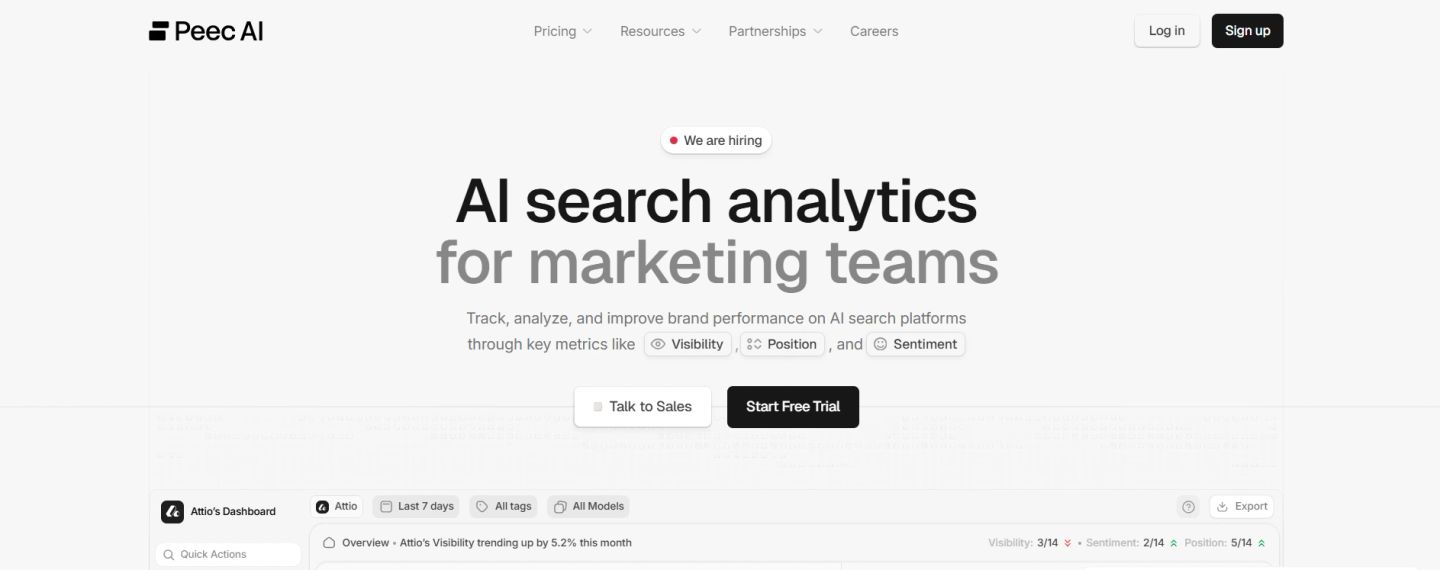
Pricing: Starter $95/month (50 prompts, 3 models) · Pro $245/month (150 prompts) · Advanced $495/month (GSC + Looker Studio integration)
Best for: Marketing and SEO teams that need daily competitive intelligence across multiple AI platforms with structured share-of-voice reporting
Peec AI was built from the ground up for AI search visibility, not retrofitted from a traditional SEO tool. It distinguishes between explicit brand mentions and silent source citations, cases where Perplexity synthesizes your content without naming your brand. That distinction is rarer than it sounds, and it gives Peec users a more complete picture of how the platform is using their content.
Share-of-voice analytics by prompt category show who wins on Perplexity versus ChatGPT, which is useful for allocating content effort. The platform supports 115-plus languages with daily tracking, making it one of the strongest options for global brands.
Unlimited seats across all plans means growing teams do not get penalized for adding users. The trade-off is that the Starter plan restricts tracking to three AI models, and Perplexity is not always included by default. Confirm which models are in your plan before purchasing.
Pros
|
Cons
|
4. Profound
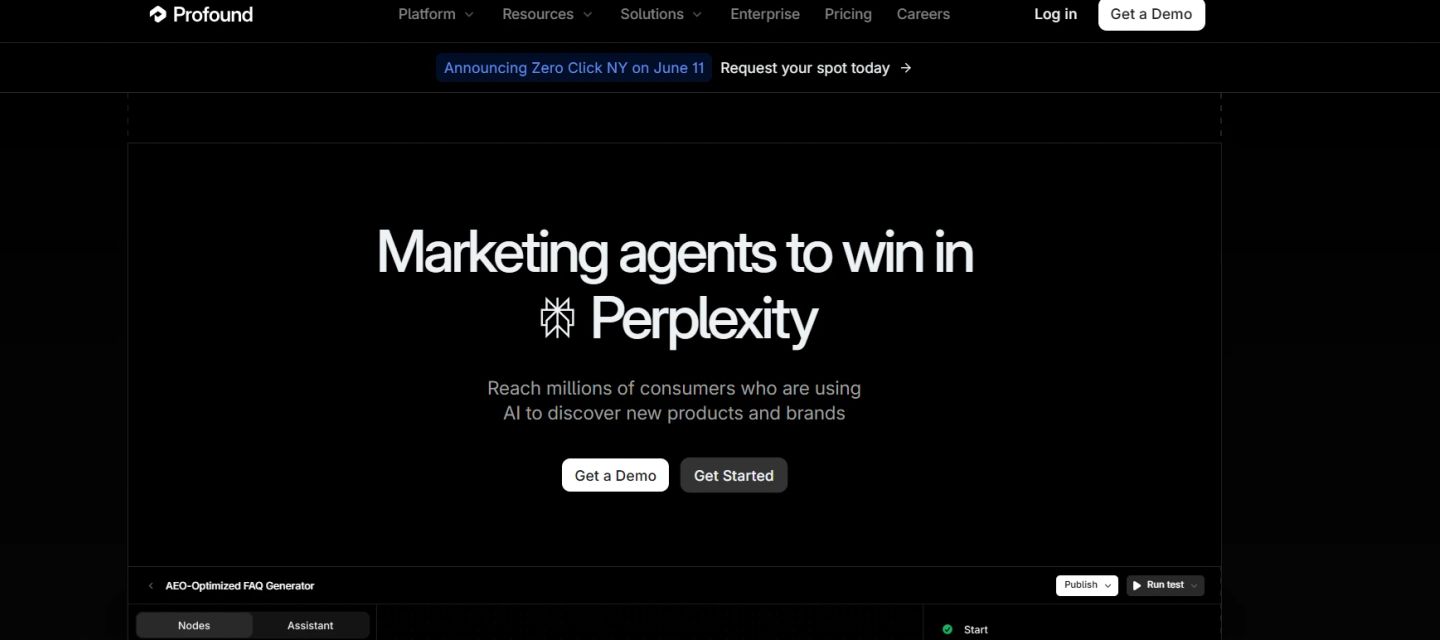
Pricing: Starter from ~$99/month (ChatGPT only) · Growth from $399/month (includes Perplexity and 10+ platforms) · Enterprise custom
Best for: Enterprise and Fortune 500 teams that need deep citation intelligence across 10-plus AI platforms with agent analytics and crawl-level insights
Profound is the G2 Winter 2026 AEO Leader and the most analytically deep tool in this list. At the Growth tier, it tracks Perplexity alongside nine other AI engines, including dark query data, the internal sub-queries Perplexity runs when processing a user’s question.
These are queries with zero Google search volume that no traditional keyword tool surfaces. Knowing which dark queries trigger citations in your category is a significant research advantage.
The Agent Analytics feature monitors how PerplexityBot interprets your site architecture, not just whether you appeared, but why, and what structural changes would help. SOC 2 Type II certification and SSO make it viable for enterprise procurement. The catch is cost and entry structure. The Starter plan is ChatGPT-only; Perplexity access requires the Growth plan at $399/month or above, which puts it out of reach for smaller teams.
Pros
|
Cons
|
5. Advanced Web Ranking (AWR)
Pricing: Contact for pricing, enterprise positioning
Best for: Established SEO teams that want Perplexity tracking consolidated into an existing enterprise SEO reporting infrastructure without adding a separate tool
AWR is the platform for teams that already have a mature SEO reporting stack and want to add Perplexity visibility to it rather than manage a second dashboard. It treats Perplexity as a search engine in the same reporting interface as Google and Bing, which is useful when stakeholders want traditional rank data and AI visibility in a single view.
AWR’s Perplexity tracking identifies which URLs the platform pulls as source citations, captures snapshots of actual Perplexity results pages, and runs market share comparisons across geographic markets, useful for multinational brands tracking visibility across regions.
Scheduled exports and enterprise-grade reporting automation make it fit for large teams with complex stakeholder needs. The trade-off is that Perplexity monitoring was added to an existing SEO platform rather than built for AI-first use, which means the feature depth is shallower than purpose-built tools like Peec AI or Profound.
Pros
|
Cons
|
6. Nightwatch
Pricing: From ~$32/month, scales by tracked keywords and locations
Best for: Freelancers and small agencies already using Nightwatch for Google rank tracking who want to add Perplexity monitoring without switching platforms
Nightwatch added Perplexity tracking as part of a broader move into AI search visibility. It uses dual-layer tracking that captures both the search queries AI platforms run internally and the final responses they generate, a distinction that matters for understanding how Perplexity constructs its answers.
At $32/month, it is the most affordable option on this list, which includes both traditional Google rank tracking and Perplexity monitoring in a single subscription.
The white-label reporting suite is among the most polished in this category, which matters for agencies presenting Perplexity data alongside standard rank reports to clients. For teams already managing local SEO campaigns in Nightwatch, adding Perplexity tracking does not require a workflow change.
The limitation is depth; Nightwatch’s Perplexity features are less developed than tools built specifically for AI visibility.
Pros
|
Cons
|
7. Rankability
Pricing: Plans from $20/month (Essential) up to $780/month (Enterprise)
Best for: SEO agencies and consultants who want Perplexity citation tracking integrated with content creation tools, so that finding a gap and filling it happens inside the same platform
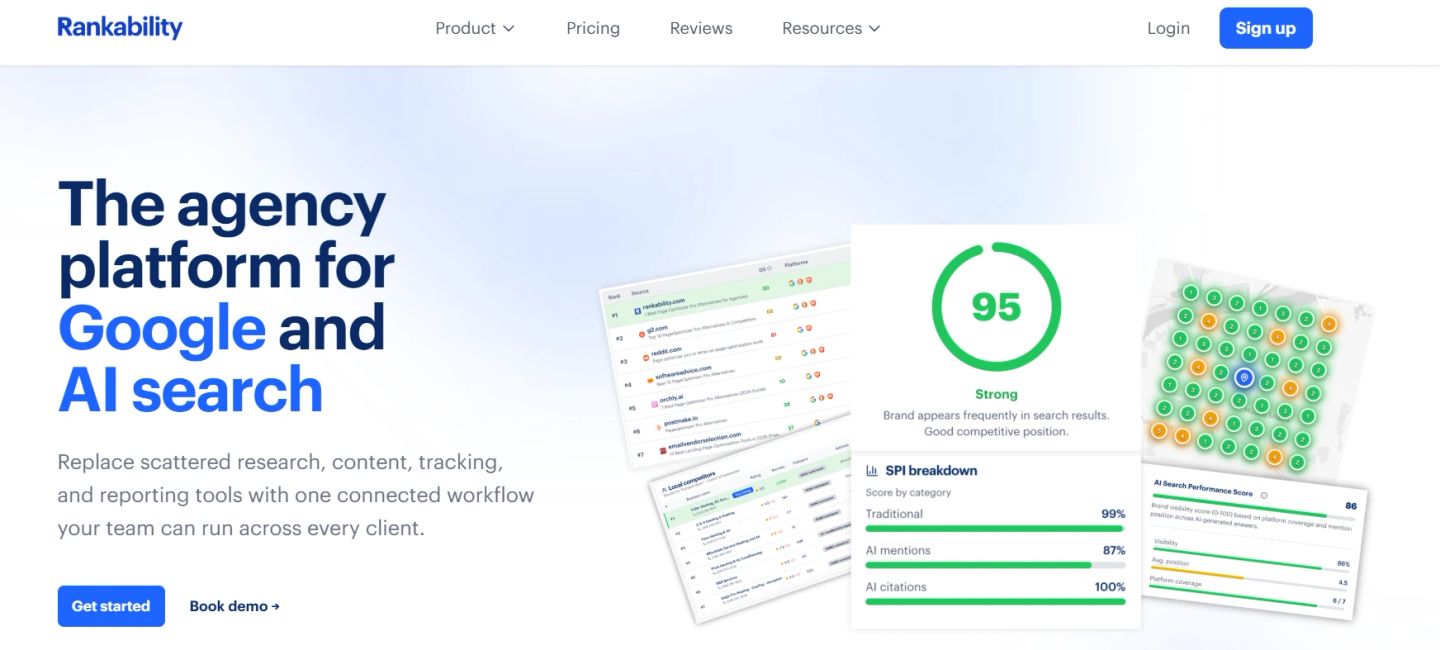
Rankability is the only tool in this list that packages Perplexity tracking inside a full AI SEO suite with an integrated content layer.
Its Rankability Reporter tracks citations across ChatGPT, Perplexity, and Google AI Overviews, then connects those findings directly to content briefs and optimization tools. When you find that a competitor is being cited in Perplexity for a query you should own, you can move to content production within the same platform.
Automated prompt execution logs every mention, citation, and link across competitors, removing the manual work of building and running prompt libraries. For agencies that need to both monitor Perplexity visibility and produce content to improve it, the all-in-one structure is a real efficiency gain.
The trade-off is pricing complexity: the credit-based model (120 credits at $20/month up to 12,000 credits at $780/month) requires careful planning before purchase to understand the actual volume of tracking you are buying.
Pros
|
Cons
|
Perplexity Visibility Is Not Automatic
Being cited in Perplexity is not a byproduct of ranking well on Google. The two systems select sources on different criteria. Perplexity favors content that leads with the direct answer, cites its own sources, uses clean structure without keyword stuffing, and comes from domains with strong trust signals.
A page built entirely around Google’s preferences can be invisible to Perplexity’s citation model. Citation patterns also shift faster than most teams realize. A competitor publishing a better-structured page on your topic can displace your citation within 2 to 3 days.
Without a tracking system, you find out weeks later, when the traffic drop shows up in analytics. The tools above give you the measurement layer that makes Perplexity visibility something you can actually manage, not just hope for.
Start with a prompt set of 10 to 20 questions that your buyers are already asking. Pick a tool that matches your budget and team. Build a baseline. Then act on what you find.
INSIDEA
Ready to get found by people and AI?
Search and answer-engine visibility that compounds, built to be cited.

 How INSIDEA works