

Today, no online search starts and ends with a list of blue links. When someone asks ChatGPT how to structure a product page or turns to Perplexity for content strategy guidance, the response comes from content that those systems have already processed, filtered, and selected for citation. That shift changes what visibility means online.
Ranking on Google still matters, but it no longer determines whether your content appears in AI-generated answers. What gets cited now depends on how clearly your content answers a question, how easily it can be extracted, and how much trust it signals to AI systems evaluating it in real time.
What’s already clear is that AI-driven search experiences are becoming a regular layer in how users access information, especially for informational and research-based queries, where direct answers are expected instead of link lists.
This checklist explains what needs to change in your content so it is structured for AI systems to read, extract, and cite without friction.
The 7 Pillars of AI Search Content Optimization
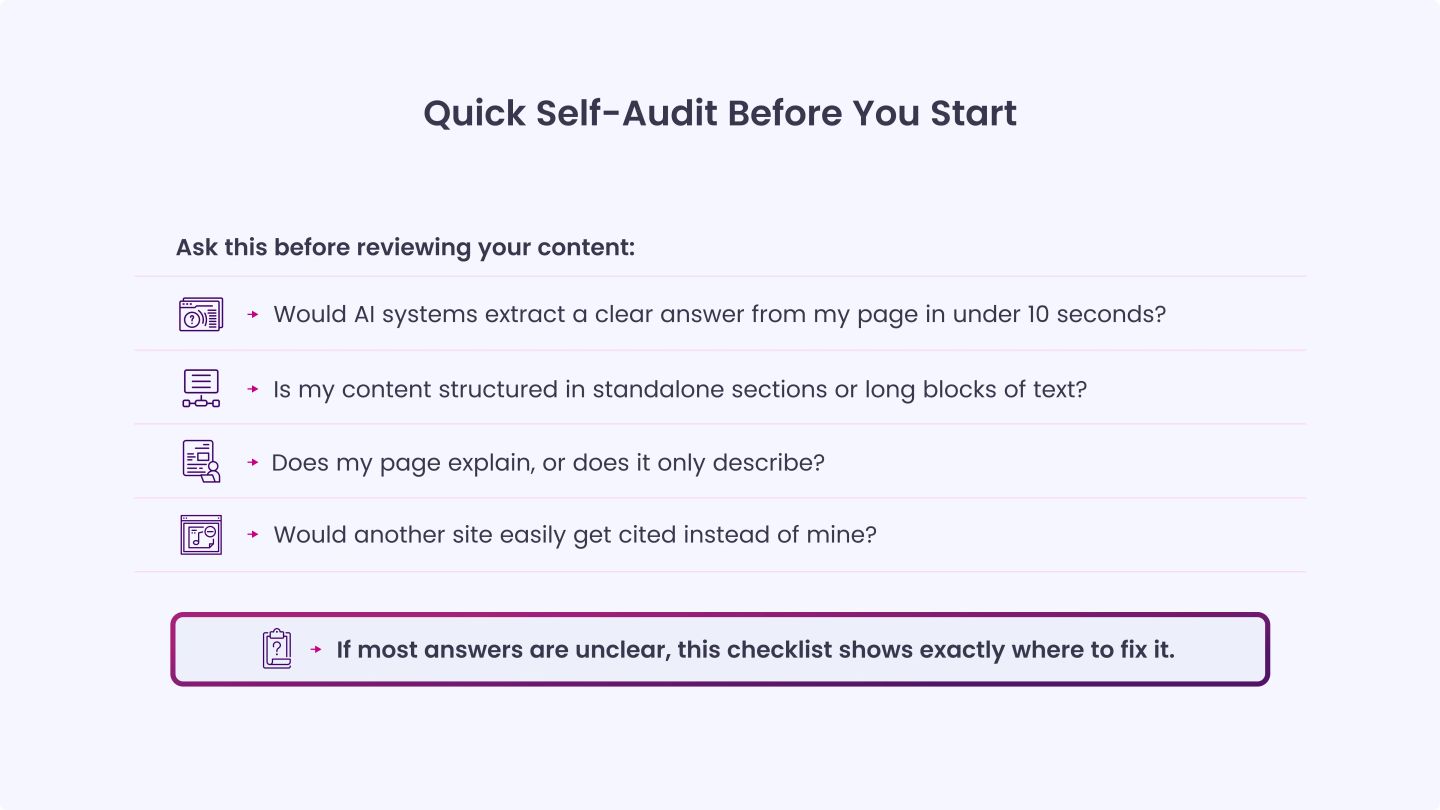
AI search does not evaluate content through a single signal. It looks at multiple layers together. The seven checkpoints below highlight exactly what affects whether your content gets cited or ignored:
1. How AI Search Engines Process Content
Before you optimize anything, you need to understand how these systems work.
AI search engines like ChatGPT (with web browsing), Perplexity, and Google AI Overviews don’t crawl and rank pages the way traditional search engines do.
They use a process called Retrieval-Augmented Generation (RAG), which means they search for relevant content in real time, extract the most useful passages, and then generate a response that cites those sources.
What this means for your content:
- AI cites answers, not articles: A well-written paragraph that directly answers a question will outperform a 3,000-word article with a buried answer.
- Structure is everything: AI systems extract meaning from clearly separated content blocks. A wall of text is much harder to parse.
- Freshness signals matter: Perplexity, in particular, heavily favors recently updated content. Adding the current year to your title tags and keeping content fresh increase the likelihood of citations.
- Domain authority is only one citation signal: One study found that only 12% of ChatGPT citations matched URLs on Google’s first page, meaning strong content on mid-authority sites can absolutely get cited.
2. Content Structure Checklist
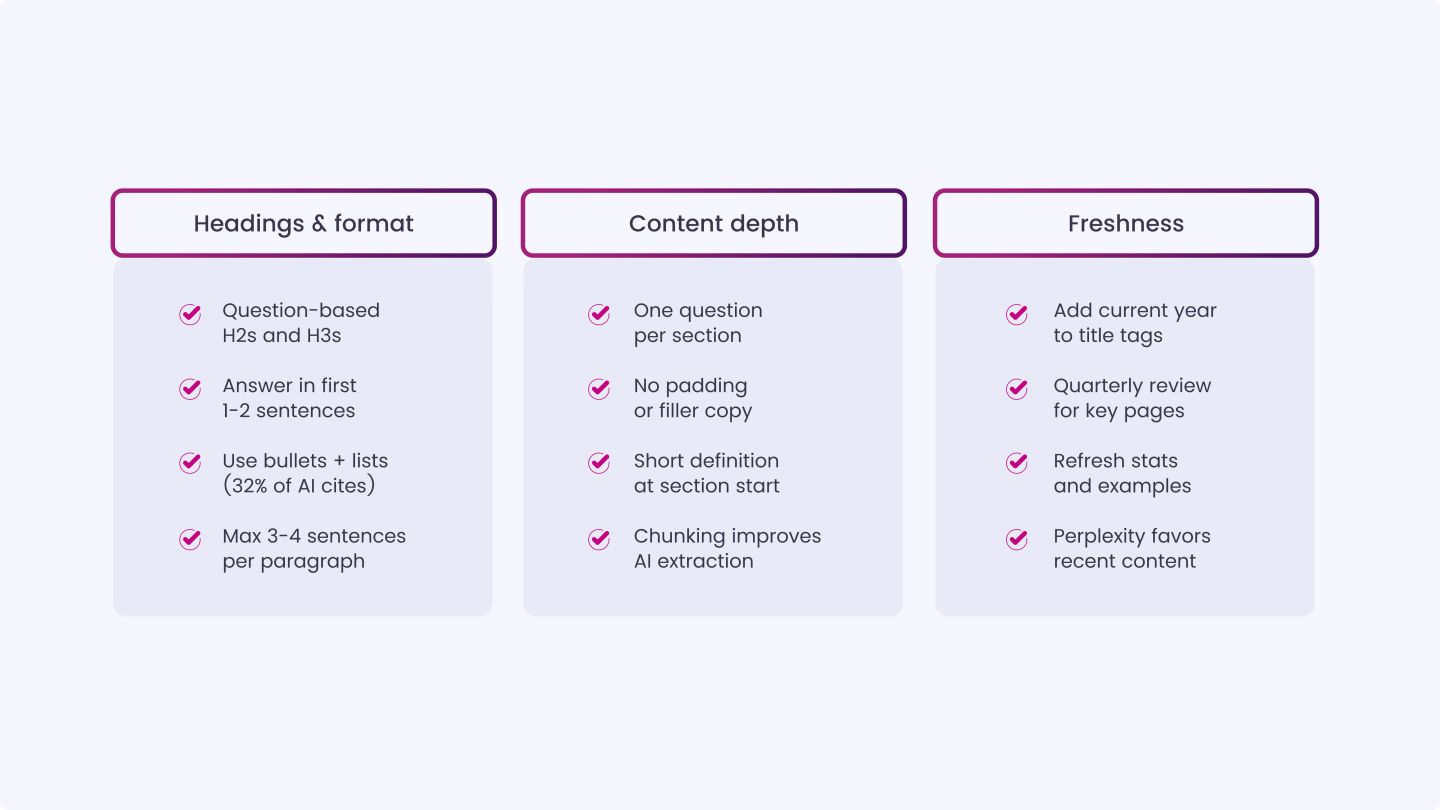
This is where most content falls short. AI systems need to be able to extract clean, self-contained answers from your pages.
Headings and format:
- Use question-based H2s and H3s (e.g., “How does schema markup help with AI search?”)
- Start each section with a 1-2 sentence direct answer before expanding
- Use bullet points and numbered lists wherever possible; listicles make up 32% of all AI citations.
- Keep paragraphs short, 3 to 4 sentences max per block
Content depth:
- Each section should answer one specific question or cover one idea (this is called “chunking,” and it directly improves AI extraction)
- Avoid padding sections with a background that doesn’t add to the answer
- Include a short summary or definition at the start of any complex topic
Freshness:
- Add the current year to titles, meta descriptions, and H1s where it’s natural
- Set a quarterly review schedule for cornerstone content
- Update stats, examples, and references regularly
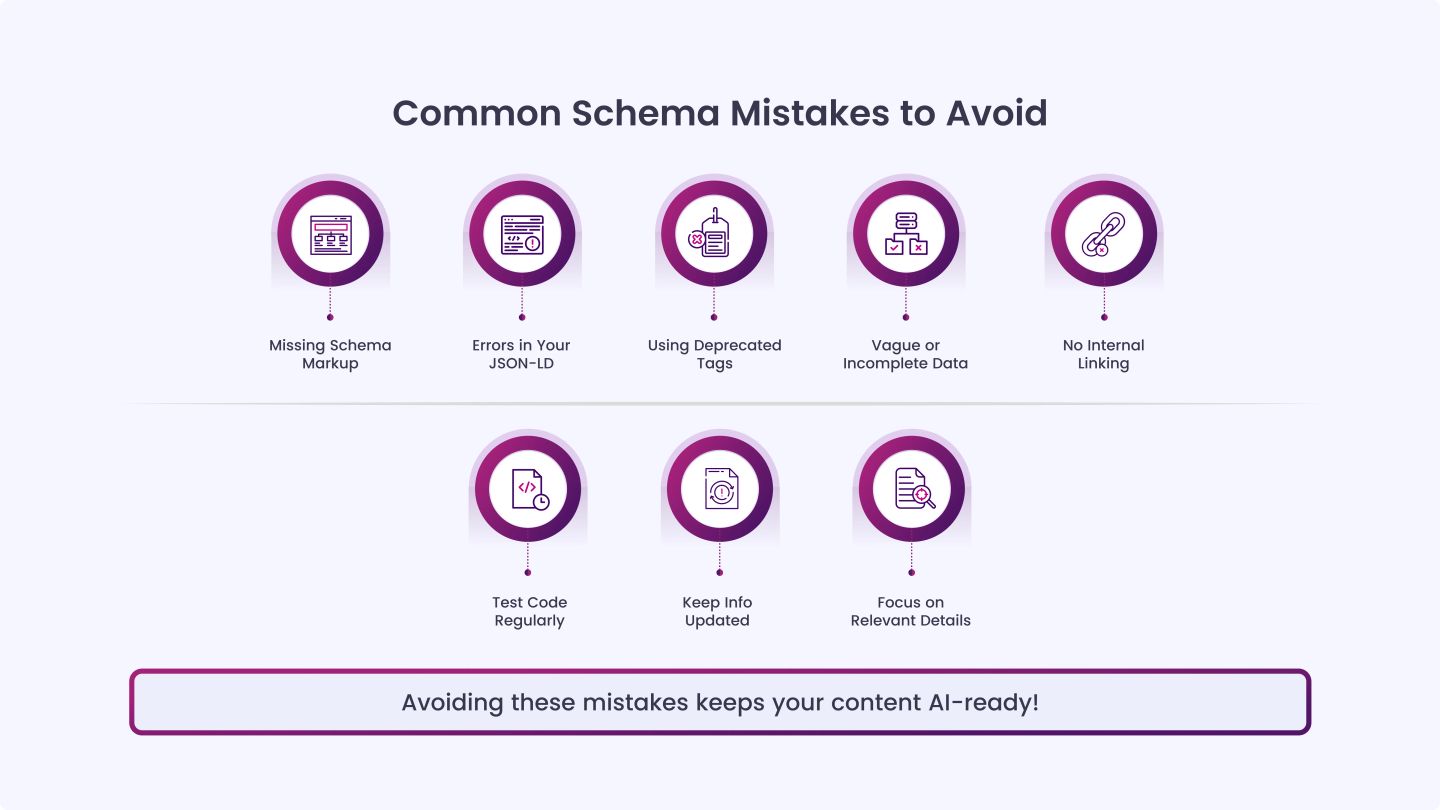
3. Schema Markup Checklist
Schema markup has moved well past being an SEO enhancement. It is now the primary way AI systems interpret what your content is about, who wrote it, and whether it’s trustworthy.
Content with proper schema markup is more likely to appear in AI-generated answers.
Must-have schema types for AI optimization:
- The Article or BlogPosting schema tells AI systems the content type, author, and publication date
- FAQPage schema, one of the highest-impact schema types for AI citations; keep individual answers between 40-60 words for best extraction
- HowTo schema, ideal for step-by-step instructional content
- Organization schema builds entity recognition and brand trust across AI platforms
- BreadcrumbList schema strengthens site structure understanding
Implementation notes:
- Use JSON-LD format (Google’s officially recommended format as of May 2025, and the format preferred by most AI engines)
- Validate your markup using Google’s Rich Results Test before publishing
- Use @graph and @id to build entity relationships between pages. This helps AI systems connect information across your site
Note: Schema doesn’t directly improve rankings, but it significantly improves how AI systems interpret and trust your content, which is what drives citations.
4. E-E-A-T and Authority Signals Checklist
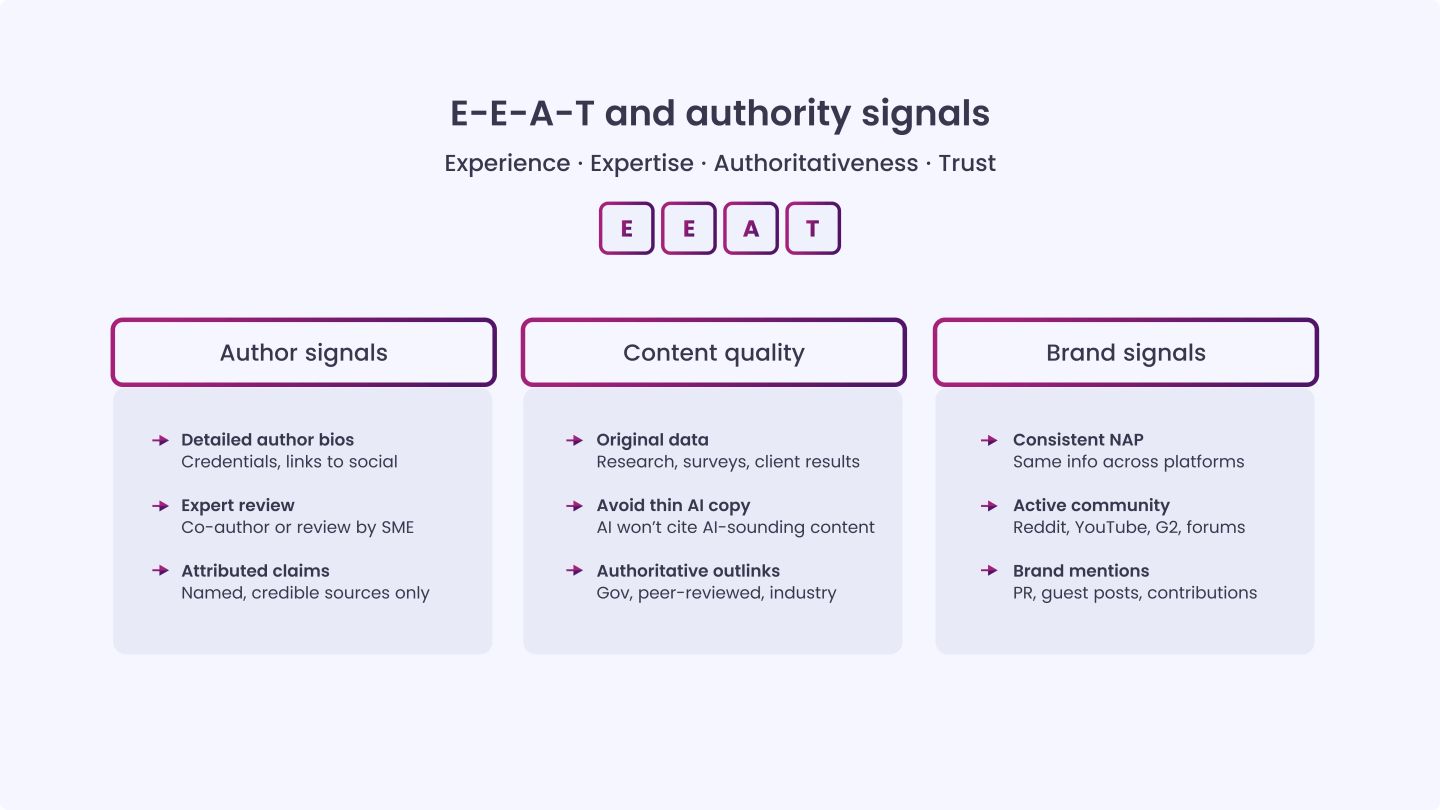
AI systems are trained to favor content from sources that demonstrate real expertise. Generic, surface-level content, even if it’s well-structured, won’t get cited if it lacks credibility signals.
Author and expertise signals:
- Include detailed author bios with credentials, relevant experience, and links to social profiles
- Where applicable, have content reviewed or co-authored by subject matter experts
- Attribute quotes, data, and claims to named, credible sources
Content quality signals:
- Use original data, proprietary research, or aggregated client/industry results; these are “citation magnets” for both Perplexity and ChatGPT
- Avoid publishing AI-generated content without significant human editing and added expertise; AI models recognize thin, generated content and are far less likely to cite it
- Link out to authoritative sources (government sites, peer-reviewed research, reputable industry publications)
Brand and entity signals:
- Keep your NAP (name, address, phone number) consistent across all platforms if relevant
- Maintain an active presence on platforms AI systems draw from: Reddit, YouTube, G2, and industry forums
- Build brand mentions through PR, guest posts, and community contributions; these act as trust signals that AI systems weigh heavily
5. Technical Optimization Checklist
AI crawlers need clean, fast, accessible pages to extract content effectively. Technical issues that slow down crawling or obscure content will reduce your AI visibility.
Crawlability:
- Ensure your robots.txt is not blocking AI crawlers (GPTBot for OpenAI, PerplexityBot, Google-Extended)
- Create and maintain an llms.txt file, a simple, emerging standard that signals to AI crawlers what content is available on your site and how it should be interpreted
- Submit an accurate XML sitemap and keep lastmod dates current
Page performance:
- Optimize Core Web Vitals, slow pages are less likely to be fully crawled by any bot
- Compress images, avoid unnecessary JavaScript delays, and keep Time to First Byte (TTFB) low
Mobile and accessibility:
- Ensure the page renders correctly on mobile, as AI crawlers often use mobile-first indexing
- Use descriptive alt text on all images
6. Answer-First Writing Checklist
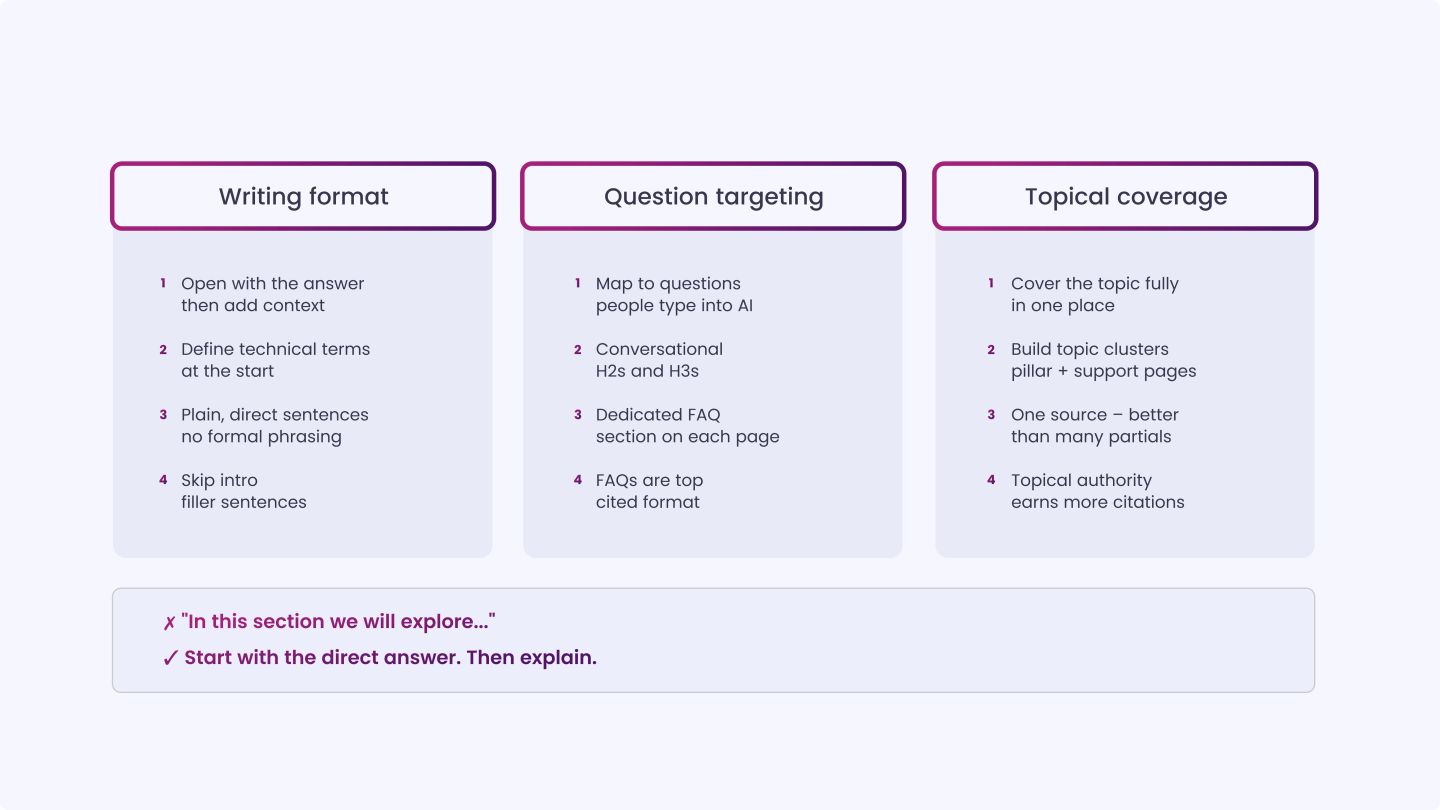
The single most effective change you can make to your content is writing answers before context. AI systems pull from the beginning of sections, not from the end.
Writing format:
- Open every section with the direct answer to the question, then expand with context
- Define technical terms immediately at first mention
- Use simple, direct sentences without academic buildup or long introductions
- Avoid filler openings like “In this section, we will explore…”
Passage-level clarity:
- Each section should work as a standalone extractable unit
- Avoid dependencies between paragraphs for meaning
- Keep one idea per paragraph to improve AI extraction accuracy
Content clarity control:
- Avoid repeating the same idea across multiple sections
- Keep definitions consistent throughout the page
- Remove sentences that do not add extraction value
Question targeting:
- Map content directly to the questions users ask AI tools
- Use conversational, natural phrasing in headings
- Include FAQ sections for high-value topics since they are frequently cited across AI systems
Topical coverage:
- Cover each topic fully enough so that AI systems do not need multiple sources to complete an answer
- Build structured topic clusters with supporting pages linked to core pages
Citation-ready formatting:
- Place direct answers immediately after headings
- Use short definition blocks at the top of sections
- Ensure sentences can be lifted independently without losing meaning
7. AI Visibility Tracking Checklist
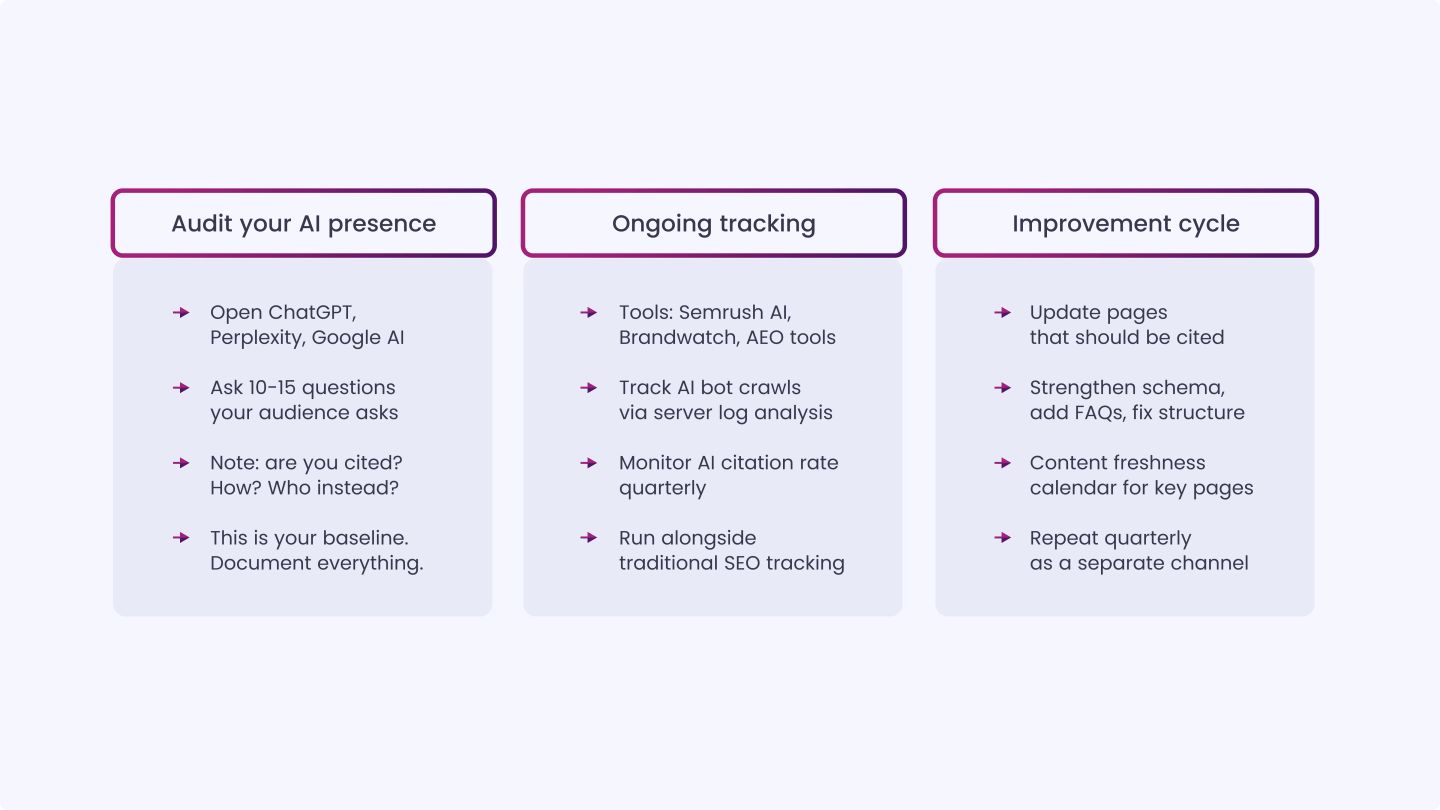
You can’t improve what you’re not measuring. Traditional rank tracking doesn’t capture AI citations, so you need a parallel measurement system.
Audit your current AI presence:
- Open ChatGPT, Perplexity, and Google AI Overviews
- Ask the 10-15 questions your target audience asks most frequently
- Note whether your brand is mentioned, how it’s characterized, and which competitors appear instead
Ongoing tracking:
- Use tools like Semrush’s AI Toolkit, Brandwatch, or dedicated AEO tools to monitor brand mentions in AI-generated answers
- Track which pages on your site are crawled most frequently by AI bots (via server log analysis)
- Monitor changes to AI citation rates quarterly alongside traditional organic traffic
Improvement cycle:
- Update content on pages that should be getting cited but aren’t
- Strengthen schema, add FAQs, and sharpen answer-first structure on underperforming pages
- Create a freshness calendar to schedule regular content reviews for your most important pages
Final Thoughts on AI Search Content Optimization
Getting cited by AI search engines is about making your content easy to read, trust, and extract. The checklist above covers every layer of that, from how you structure a paragraph to how your schema markup signals authority to a crawler.
Start with the areas where your content is weakest. For most sites, that’s structure and schema. Fix those first, then work through authority signals and technical improvements.
Track your AI visibility separately from traditional SEO and treat it as its own growth channel, because it is at this point.
INSIDEA
Ready to get found by people and AI?
Search and answer-engine visibility that compounds, built to be cited.

 How INSIDEA works




