Do you know that AI-powered answer engines do not browse pages? Instead, they retrieve information. Tools like Google AI Overviews, ChatGPT, Perplexity, and Microsoft Copilot pull from pages they can parse quickly and trust. If your content is not machine-readable, it does not get cited. It is that simple.
Gartner projects that regular search volume will drop by 25% by 2026, as search marketing loses share to AI chatbots and virtual agents. This is already happening. Ranking on page one is no longer enough. You need to be the source an AI system chooses when a user asks a direct question.
Schema markup fills that gap. This blog breaks down 12 schema types that support Answer Engine Optimization, what each one does, and how to implement them correctly.
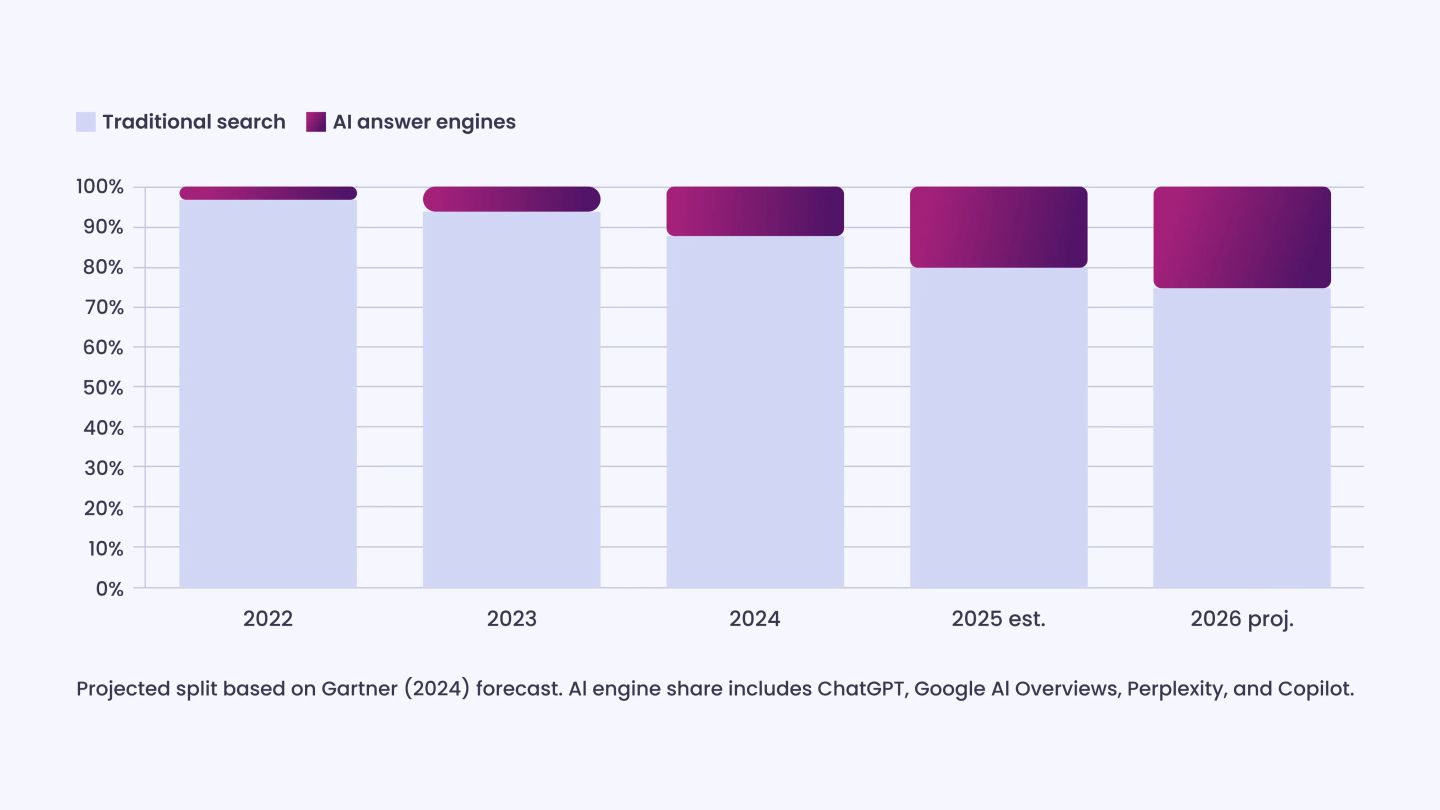
How Schema Markup Supports Answer Engine Optimization
AI-powered answer engines do not read pages the way humans do. They look for structured signals that show what your content covers, who created it, and how it connects to verified entities in their knowledge graph.
Without a schema, engines must infer this information from your HTML and text. That process is slow and often inaccurate. A schema lets you state it clearly. Explicit structured data is fast, reliable, and unambiguous.
Think of it like the difference between handing someone a book and handing them a version with an indexed table of contents. Both contain the same information, but one is much easier to extract answers from.
Pages with complete, well-implemented JSON-LD markup appear more often in AI-generated answers. Schema does not replace strong content; it ensures your content can be cited and used effectively by answer engines.
How Answer Engines Read and Use Schema
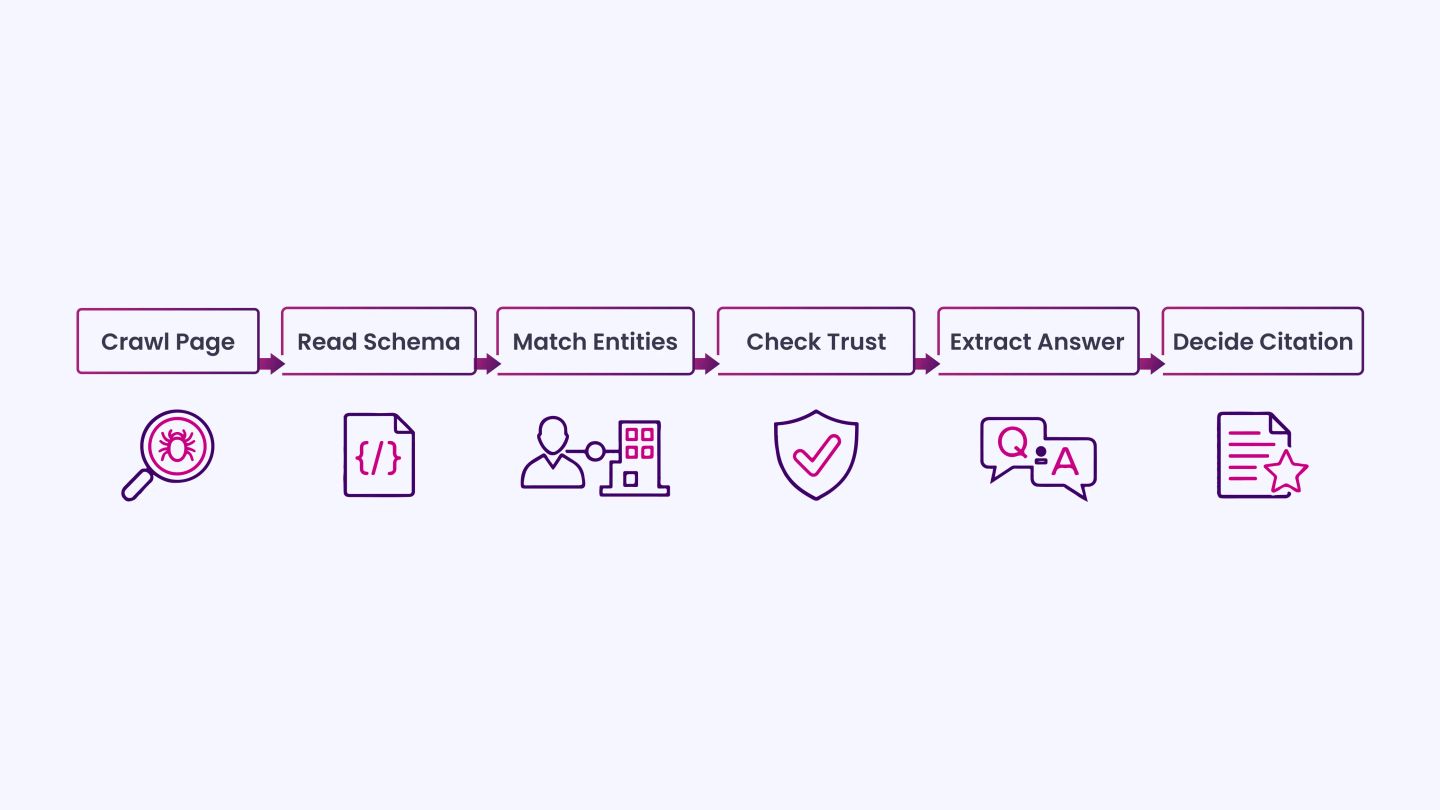
AI engines follow a structured process when deciding whether to use your content:
Step 1: Crawl
The engine’s crawler visits your page and checks if the content requires JavaScript to render. Pages that rely on client-side rendering may be missed entirely.
Step 2: Parse
The engine parses your JSON-LD markup and identifies the schema type, such as Article, FAQPage, Product, etc. This tells the engine exactly what kind of content it is handling.
Step 3:Entity Matching
Entities in your schema, such as organization name, author, or product, are matched against the engine’s knowledge graph. Strong sameAs links and stable @id identifiers improve recognition.
Step 4: Trust Scoring
The engine evaluates authorship, publication date, and alignment between schema and visible content. Named authors with verifiable profiles increase trust, while mismatches reduce it.
Step 5: Answer Extraction
For question-based queries, the engine looks for FAQPage, HowTo, or QAPage markup. It extracts structured answers directly and formats them for display.
Step 6: Citation Decision
If the content passes crawl, parsing, entity matching, and trust checks, it can be cited. Schema alone does not guarantee a citation, but missing or broken markup greatly reduces the chances of one.
10+ Schema Types That Help Your Content Get Noticed
Before we get into the full list of 12 schema markups, here’s a simple guide to help you quickly decide which ones are worth your time:
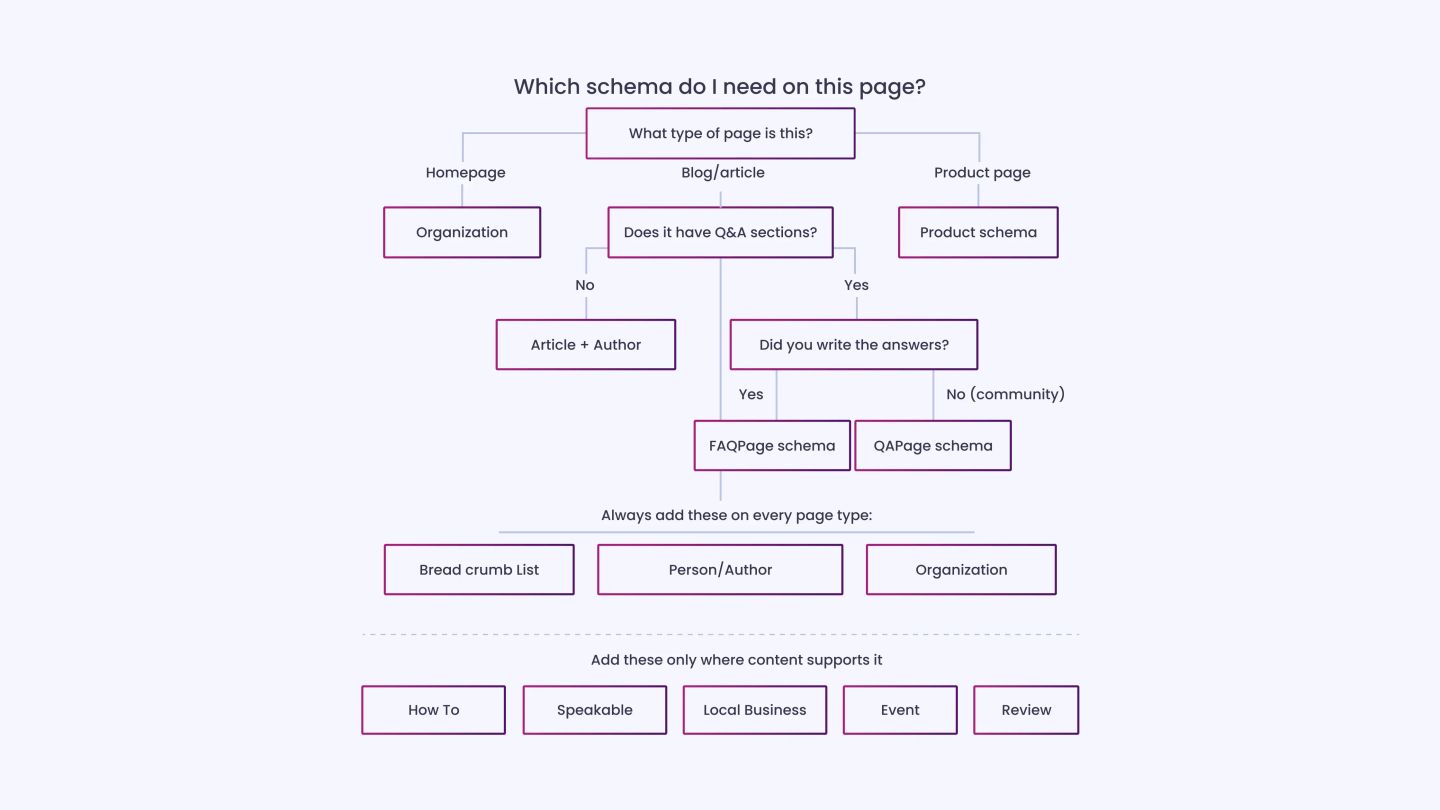
Let’s get started!
i) FAQPage Schema
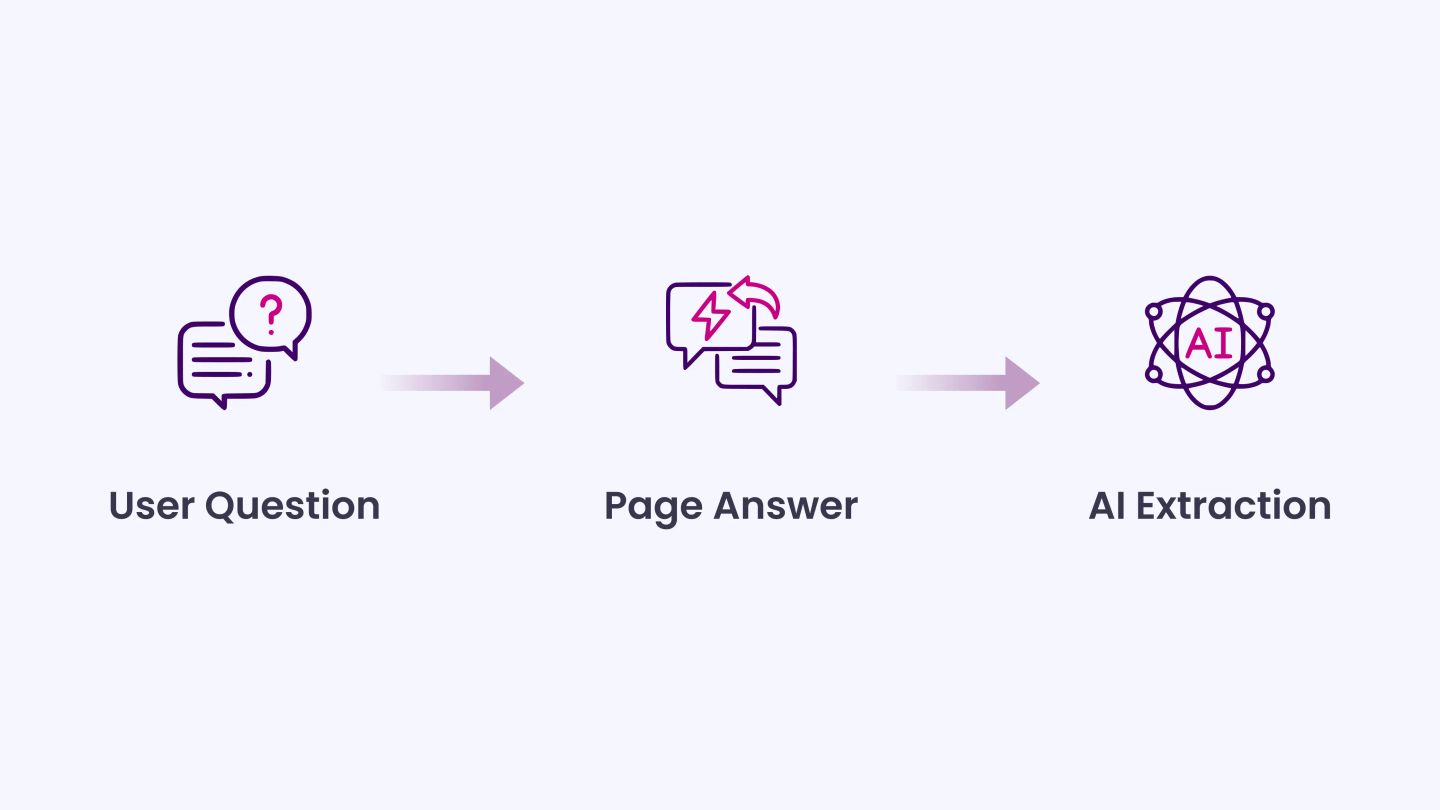
FAQPage markup tells AI engines exactly which questions your page answers and what those answers are. This is the most direct structural match to how answer engines retrieve conversational responses.
Use it only when your page contains real, user-facing Q&A content. Every question and answer must be fully visible to the user on the page, not hidden behind an accordion, tab, or any click interaction.
Do not replicate the same FAQ schema across multiple pages of your site.
| {
“@context”: “https://schema.org”, “@type”: “FAQPage”, “mainEntity”: [ { “@type”: “Question”, “name”: “What is AEO?”, “acceptedAnswer”: { “@type”: “Answer”, “text”: “AEO stands for Answer Engine Optimization. It is the practice of structuring content so AI-powered answer engines can extract, cite, and present it directly to users.” } } ] } |
ii) HowTo Schema
Procedural queries, “how do I,” “steps to,” “how does X work”, are among the most common questions AI engines handle. HowTo - Schema defines each step as a discrete action with a name and description. This gives the engine a clean, ordered structure for extraction and presentation.
Use HowTo only for content that walks a user through a process. Each step must be a specific action, not a paragraph of general advice. Include estimated time where relevant.
Generic “tips” content does not qualify.
| Quick Checklist Box: Each HowTo step should be actionable, match the visible page content, and include an estimated time if relevant. |
iii) Article Schema
Article schema identifies a page as editorial content and supplies the metadata that matters most to AI engines, including the headline, named author, publisher, publish date, and modification date.
AI engines have a strong recency bias. A page with no publication date or no named author carries far less weight. Article schema fixes both. It is the baseline for any blog post, guide, or editorial piece on your site.
Always include dateModified so engines know the content is up to date. Never leave the author field as “Admin” or “Team.” That provides a zero authority signal.
| {
“@context”: “https://schema.org”, “@type”: “Article”, “headline”: “10+ Schema Markups That Actually Matter for AEO in 2026”, “author”: { “@type”: “Person”, “name”: “Jane Smith”, “url”: “https://insidea.com/authors/jane-smith” }, “datePublished”: “2026-04-06”, “dateModified”: “2026-04-06”, “publisher”: { “@type”: “Organization”, “name”: “INSIDEA”, “url”: “https://insidea.com” } } |
iv) Organization Schema
The organization schema defines your brand as a verified entity, including name, URL, logo, contact details, and links to your external profiles. AI engines build their understanding of your brand from this data. Without it, they have to guess whether your site belongs to the referenced entity.
Place this on your homepage. Include every verified external profile in the sameAs array, LinkedIn, Crunchbase, Wikipedia, and industry directories, if applicable. Each sameAs link is a corroboration point that tells the engine your brand is real, consistent, and trustworthy.
v) Person / Author Schema
A person schema defines a real individual and links their identity across the web, including their name, credentials, employer, and professional profiles. This is the technical execution of E-E-A-T at the authorship level.
Pages authored by named experts with full bios were cited more frequently than pages with anonymous or generic authorship, according to Search Engine Land’s analysis of AI citation patterns. Give every author a stable @id and a dedicated bio page. Link every Article back to that author’s Person entity.
vi) Product Schema
Product schema marks up the details that matter for commercial queries, name, description, price, availability, SKU, and reviews. Shoppers ask AI engines specific product questions. “What does X cost?” “Is Y in stock?” “Does it come with a warranty?” The product schema provides the engine with a clean data source to pull from directly.
Always include offers with current price and availability. Add aggregateRating if you have verified reviews. Outdated pricing is one of the fastest ways to lose AI citations for any commercial query.
vii) LocalBusiness Schema
The LocalBusiness schema provides structured location data, including address, business hours, phone number, and business type. Voice assistants and map-integrated AI engines depend on this for location-based queries. “Digital marketing agency near me” or “open now” queries all favor pages with clean, verified local data.
Make sure your LocalBusiness schema matches your Google Business Profile exactly. Inconsistent NAP (Name, Address, Phone) across your site and third-party directories is one of the most common trust issues in local AEO. List each physical location separately.
viii) Speakable Schema
Speakable schema flags specific sections of your content as suitable for voice assistant text-to-speech output.
When Google Assistant or Alexa answers a spoken question, the engine needs a short, self-contained passage it can read aloud. Speakable schema tells it exactly where to find that passage on your page.
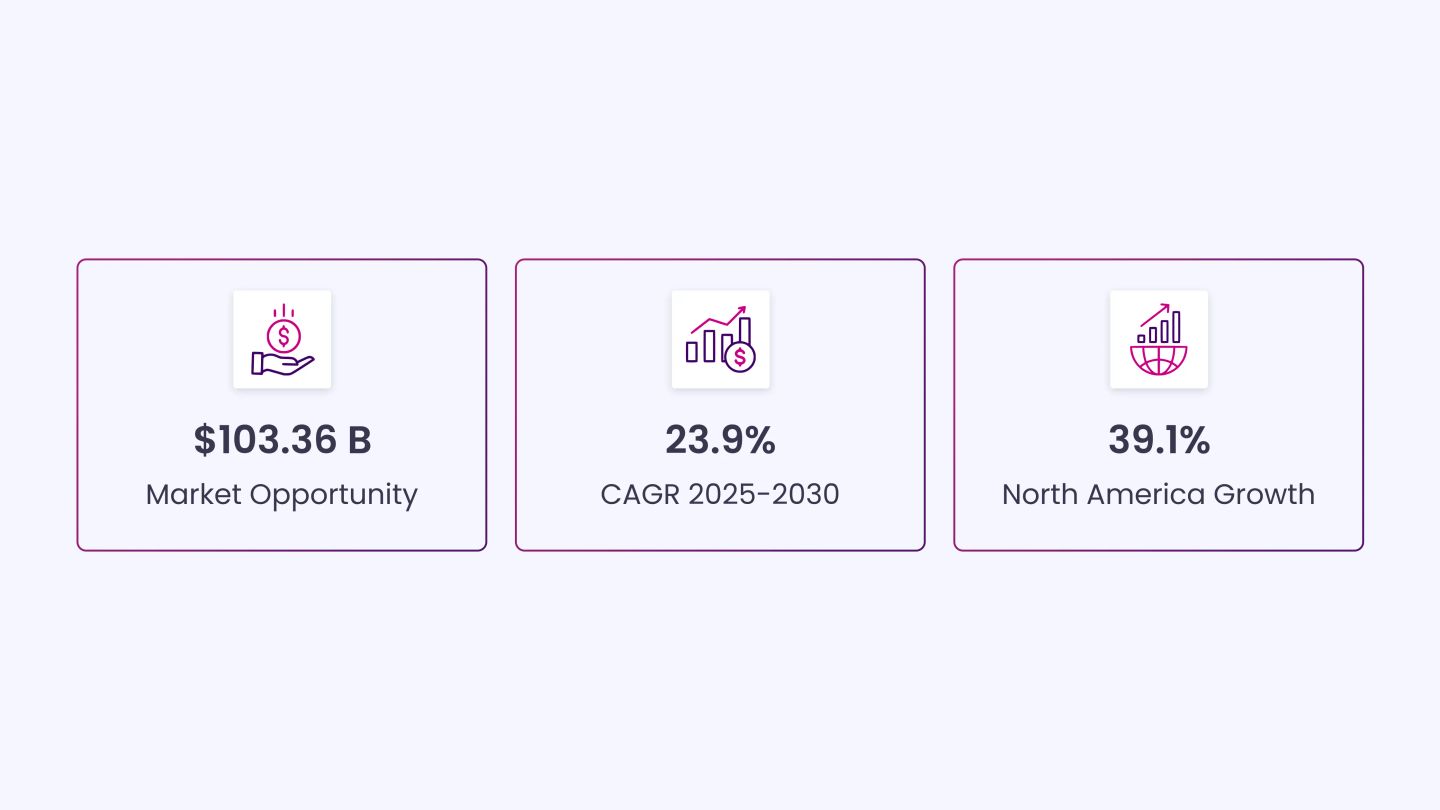
Voice commerce is rapidly growing, with the global market projected to reach $103.36 B by 2030. This makes the Speakable schema increasingly relevant for any brand selling products or services. Mark only your clearest, most concise sections, 40 to 60 words.
The content needs to sound natural when spoken, not like a paragraph pulled from a dense guide.
| Pro Tip: Focus on short, standalone passages that convey complete ideas. Avoid including tables, long lists, or complex stats in the marked-up text; these are better presented visually in your blog. |
ix) Review / AggregateRating Schema
The Review and AggregateRating schemas bring verified social proof into your structured data layer. It answers a category of user questions that plain text cannot: “Is this worth buying?”
“What do real customers say?”
AI engines factor in trust signals when selecting sources. A page with structured review data carries more weight than one without.
Only mark up reviews that are visible on the page. Do not aggregate ratings from third-party platforms without permission. Google has taken manual action against sites that misuse review markup. Keep it clean and accurate.
x) QAPage Schema
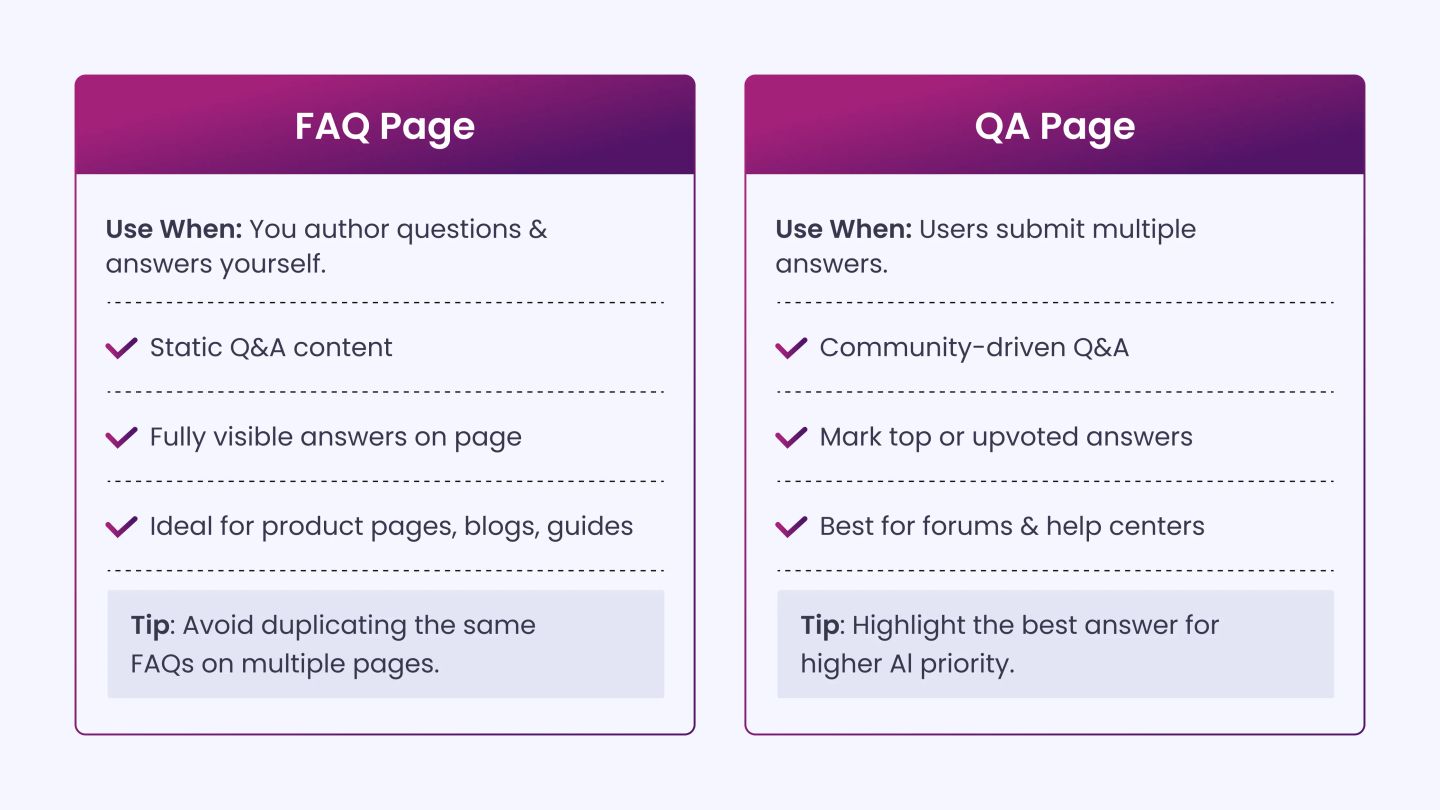
QAPage is often confused with FAQPage. The distinction matters. FAQPage is for pages where you author the questions and answers yourself. QAPage is for pages where a single question has multiple answers contributed by different users, think knowledge bases, community forums, and support threads.
If you run a help center or community Q&A section, QAPage is the correct schema type. Mark the highest-value or most-upvoted answer clearly. AI engines weigh that answer more heavily than the others on the page.
xi) BreadcrumbList Schema
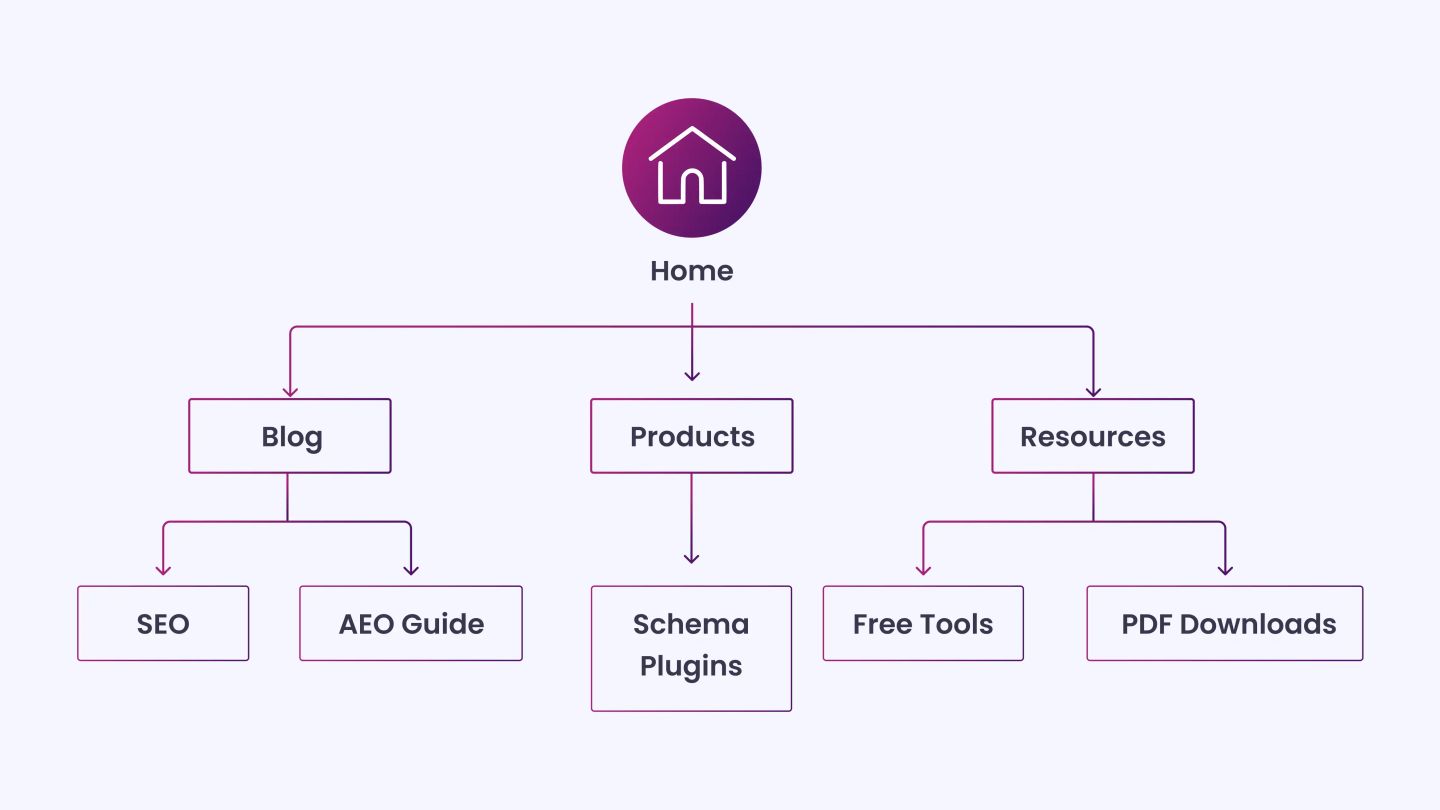
BreadcrumbList schema marks up the navigational path of a page within your site hierarchy. It tells AI engines where a page sits relative to the rest of your content, whether it is a top-level category, a subcategory, or a specific article within a topic cluster.
This context shapes how an engine categorizes and interprets your content. It also supports entity relationships within your schema graph, reinforcing topical structure across your entire site.
Keep breadcrumb paths accurate and consistent with your actual URL structure.
xii) Event Schema
Event schema provides structured data for scheduled events, virtual or in-person, including date, location, organizer, and registration details. AI engines surface event information in direct answers for queries like “upcoming marketing webinars” or “digital conferences in April 2026.”
Always include startDate, endDate, eventStatus, and location. For online events, use VirtualLocation. Remove or update expired events immediately. Stale event data undermines the credibility of your structured data across the entire page.
Common Schema Markup Implementation Mistakes
Here are the most common mistakes we see when implementing schema markup:
- Marking up content that is not visible: The schema must match what users can see. Content behind accordions, tabs, login walls, or JavaScript rendering does not count. If a user cannot see it, do not mark it up.
- Using the wrong schema type: FAQPage and QAPage serve different purposes. Product schema on a service page creates confusion, not clarity. The schema type must match the actual content format on that page.
- Anonymous authorship: Every article needs a named Person entity. An author with a verifiable professional profile provides a measurable authority signal. “The INSIDEA Team” does not.
- Skipping validation: Errors in JSON-LD syntax, missing brackets, incorrect property names, and mismatched types silently invalidate entire schema blocks. Use Google’s Rich Results Test and Schema Markup Validator after every implementation and after any site update that touches your templates.
- Not maintaining the schema over time: Schema.org evolves. Google updates which rich result types it supports. FAQ and HowTo rich results were scaled back in recent years; brands that did not audit their schema continued investing in formats that no longer delivered the same return. Review your structured data at least once per quarter.
The Role of Schema in Driving AI Recognition
Schema markup does not produce citations on its own. But without it, you are asking AI engines to work harder than necessary to understand your content, and they will simply choose a source that makes it easier to understand.
The 12 types covered here address the full range of what AI engines look for: question-and-answer structure, instructional content, entity identity, authorship, products, local presence, voice readiness, social proof, and events. Start with the Organization and Article schema on every page. Layer the FAQPage and HowTo with content that supports them. Build your entity graph outward from there.
The brands showing up in AI-generated answers right now are not necessarily the biggest or the most authoritative. They are the ones who made their content machine-readable first. That is still an open gap for most industries.
If you want INSIDEA to audit your current schema setup and identify where you are losing AEO ground, reach out to our team.
INSIDEA
Ready to get found by people and AI?
Search and answer-engine visibility that compounds, built to be cited.

 How INSIDEA works