

Choosing a HubSpot consultant for sales pipeline setup is not a branding decision. It is a revenue decision.
Many sales teams invest in CRM tools expecting visibility, predictable forecasting, and steady deal flow. What they often get instead is a cluttered pipeline, inconsistent stage movement, and opportunities that stall without clear ownership. The problem is rarely the platform. It is the way the sales process has been translated into the system.
Data from HireDNA shows that 90% of companies that use a formal, guided sales process rank among top performers, compared with organizations that lack a standardized approach to selling. This reinforces a simple reality: structure drives results. A CRM does not fix a broken process. It amplifies whatever process already exists.
This is where the right HubSpot consultant makes a measurable difference.
A capable HubSpot consultant evaluates qualification standards, defines clear stage entry and exit rules, aligns handoffs, and builds automation that supports real sales workflows. The wrong one may configure the system without improving conversion rates or forecast accuracy.
In this blog, we will examine why pipelines break down, how to structure HubSpot Sales Hub for predictable performance, what to assess before hiring a consultant, the warning signs to watch for, and the top HubSpot partner agencies to consider for sales pipeline setup.
What a HubSpot Consultant Does in Sales Pipeline Setup
A HubSpot consultant responsible for sales pipeline setup converts your real sales process into a structured system inside HubSpot.
Their job is to build clarity into how opportunities are created, qualified, progressed, and forecasted. The focus is on revenue movement.
Core Responsibilities in a Sales-Focused Engagement
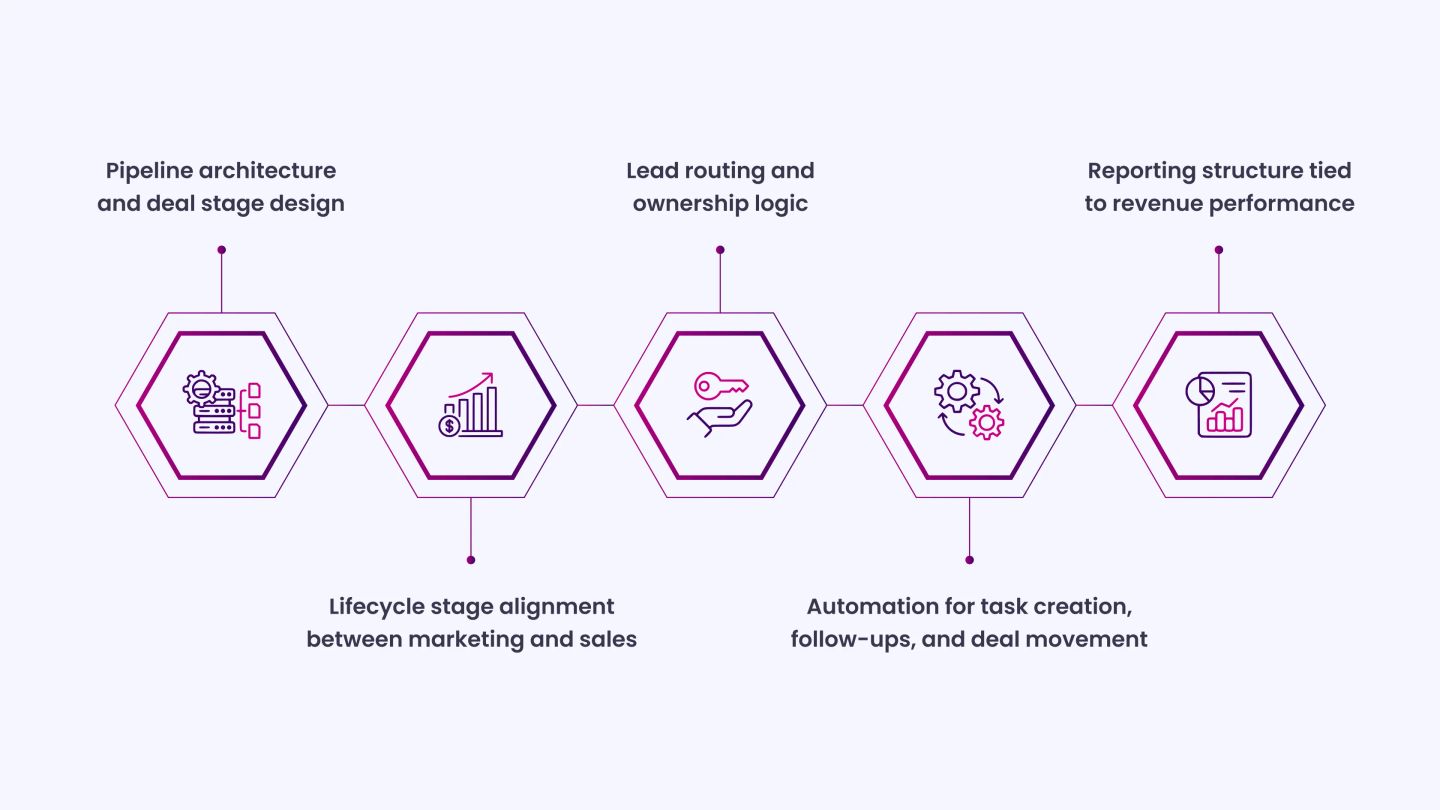
- Pipeline architecture and deal stage design: The consultant defines deal stalifges based on how your buyers move through the sales cycle. Each stage must represent a clear commitment or milestone. Entry and exit criteria are documented. Probabilities are assigned using historical win rates, not assumptions. Extra stages that distort reporting are removed.
- Lifecycle stage alignment between marketing and sales: Opportunities should enter the pipeline at the right time. A consultant reviews how contacts move from marketing-qualified to sales-qualified to opportunity. Misalignment here leads to inflated pipelines and low close rates. Clear definitions reduce internal friction and improve stage conversion accuracy.
- Lead routing and ownership logic: Leads must be assigned immediately. Routing rules are configured based on territory, segment, deal size, or account ownership. Ownership at every stage is defined, so there is no confusion about who advances the deal.
- Automation for task creation, follow-ups, and deal movement: Follow-ups cannot depend on memory. The consultant configures task triggers, reminders, and stage-based actions that support consistent rep execution. Automation supports discipline; it does not replace sales judgment.
- Reporting structure tied to revenue performance: Dashboards are built around stage conversion rates, deal velocity, forecast categories, and pipeline coverage. Reporting highlights where deals stall and whether projections are realistic. Activity counts alone are not sufficient.
Implementation Gaps That Damage Sales Pipeline Performance
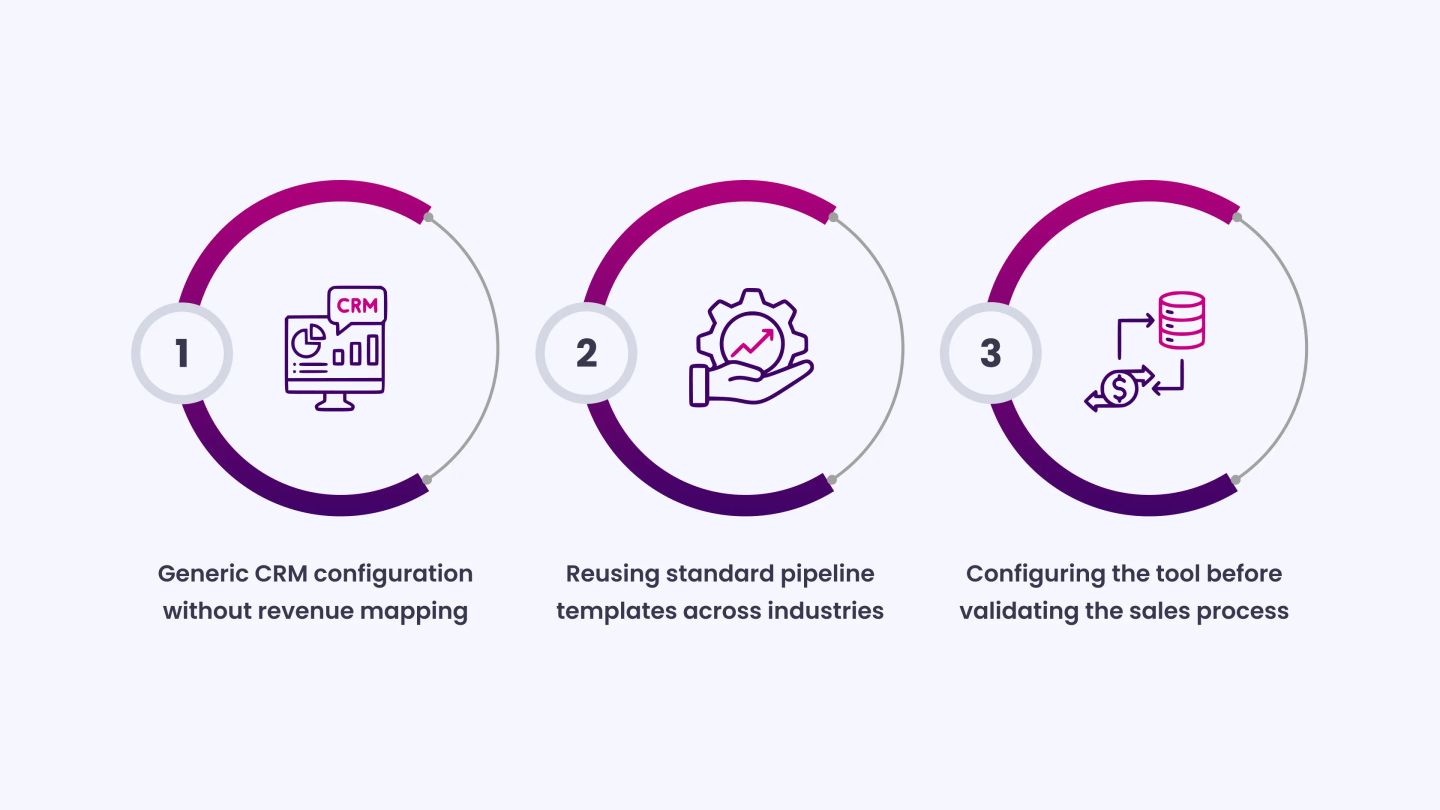
- Generic CRM configuration without revenue mapping: Setting up pipelines and properties without linking them to win rates, revenue targets, or conversion benchmarks adds complexity without improving results.
- Reusing standard pipeline templates across industries: Sales cycles vary by deal size, buyer type, and contract value. Applying a preset pipeline without reviewing your data often leads to inaccurate forecasting and bloated stages.
- Configuring the tool before validating the sales process: If qualification criteria, stage definitions, and handoff rules are unclear, building them into HubSpot will only formalize confusion. Process validation must come first.
A strong consultant builds a pipeline that reflects how revenue is generated and measured inside your organization.
Why Sales Teams Struggle to Keep the Pipeline Full
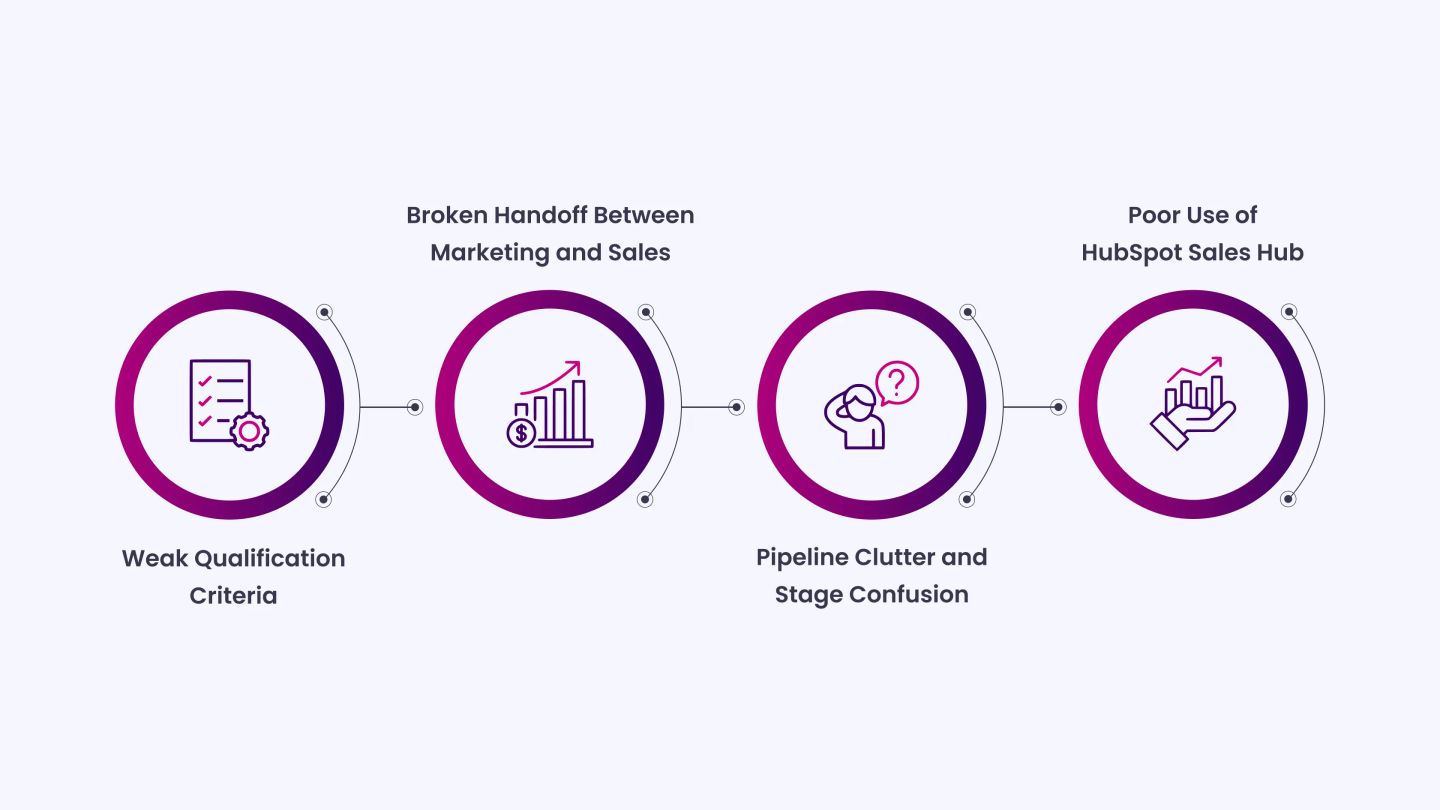
A pipeline weakens gradually due to structural gaps in qualification, handoffs, stage management, and system usage.
Most pipeline issues are process issues that appear in the CRM:
Weak Qualification Criteria
- No documented ICP: If the ideal customer profile is not clearly defined, sales teams pursue accounts that are unlikely to convert. Reps rely on instinct instead of criteria. This fills the pipeline with low-fit opportunities that inflate projections but do not close.
- No agreed lead-scoring model: Without a shared scoring framework, marketing may pass leads based on activity, while sales evaluates them based on budget or urgency. The result is disagreement over lead quality and inconsistent follow-up.
- MQL-to-SQL friction: When qualification standards differ between teams, leads stall during transition. Sales may reject leads that marketing considers ready, and marketing may continue nurturing contacts that sales are already working. This friction slows pipeline velocity.
Broken Handoff Between Marketing and Sales
- No lifecycle visibility: If lifecycle stages are not clearly defined and visible in HubSpot, neither team has a clear view of a contact’s lifecycle stage. Opportunities may be created too early or too late, distorting pipeline health.
- No SLA accountability: Without a documented service-level agreement, follow-up timelines become inconsistent. Some leads are contacted immediately, others days later. Response time directly affects conversion rates.
- Delayed follow-up windows: Speed influences win rates. If routing rules are unclear or manual assignment is required, high-intent leads lose momentum before a rep engages.
Pipeline Clutter and Stage Confusion
- Too many deal stages: Excessive stages create reporting noise. Reps move deals without meaningful progress, making it difficult to understand real conversion rates.
- Undefined exit criteria: When stages lack clear entry and exit rules, deals remain open without justification. Forecast accuracy declines because stage placement does not reflect buyer intent.
- Deals stuck without automation triggers: Without task reminders or inactivity alerts, deals sit untouched. Managers may not notice stagnation until quarter-end pressure rises.
Poor Use of HubSpot Sales Hub
- No task queues: Reps working from memory or scattered notes miss follow-ups. Task queues centralize daily execution and reduce reliance on manual tracking.
- No sequences mapped to buying stages: Sequences should reflect a buyer’s position in the decision cycle. Using generic outreach across all stages reduces response rates and slows deal movement.
- No forecasting discipline: If probabilities are not based on historical data or if forecast categories are loosely defined, revenue projections become unreliable. Leadership cannot make informed decisions from inconsistent data.
When these structural issues persist, the pipeline appears full but produces inconsistent revenue. Addressing them requires more than adding leads. It requires rebuilding the process that governs how opportunities enter, move, and close inside HubSpot.
Structuring Deal Stages in HubSpot Sales Hub for Better Conversion Tracking
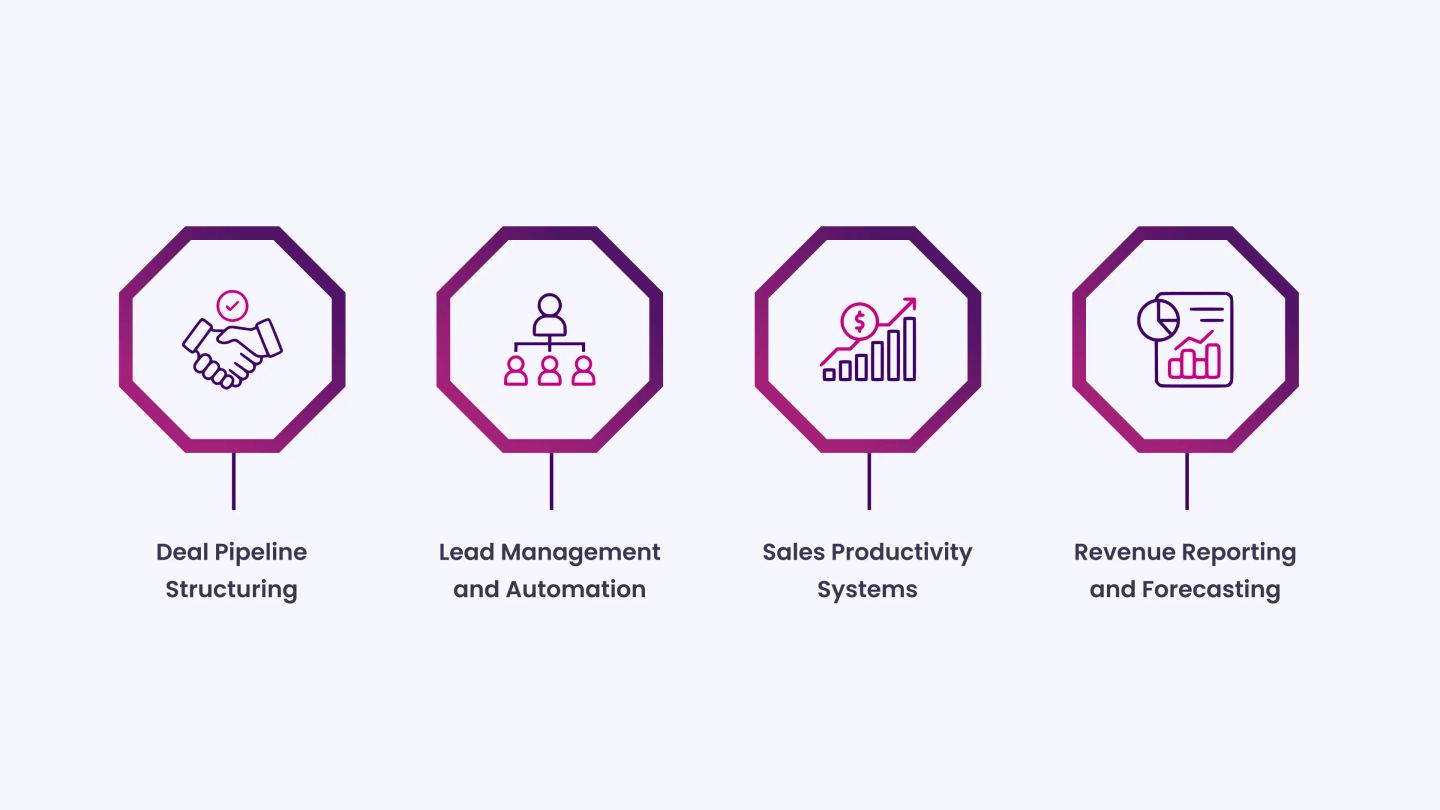
A sales pipeline is only as reliable as the structure behind it. Inside HubSpot Sales Hub, deal stages determine how conversion rates are calculated, how forecasts are generated, and how leadership evaluates pipeline health.
Poor stage design leads to inflated projections and inconsistent reporting. Strong stage design produces clarity.
Deal Pipeline Structuring
- Stage-by-stage probability mapping: Each deal stage should include a probability percentage based on historical close data. If 40% of deals entering “Proposal Sent” convert to closed-won, that stage should reflect that rate. Assigning arbitrary probabilities distorts forecasting and creates unrealistic revenue expectations.
- Clear entry and exit rules: Every stage requires documented criteria. A deal should not move to “Qualified” unless the budget, authority, need, and timeline are confirmed. It should not enter “Negotiation” without a formal proposal shared. These rules create consistency across reps and improve the accuracy of conversion tracking.
- Weighted forecasting: Weighted forecasting multiplies deal value by stage probability to estimate expected revenue. When probabilities are based on real data and stage movement reflects buyer intent, weighted forecasts become useful for planning hiring, inventory, or growth investments. Without structure, the numbers are misleading.
Lead Management and Automation
- Lead scoring rules tied to intent signals: prioritize behaviors that indicate buying intent, such as pricing page visits, demo requests, or repeated product engagement. Scores based only on email opens or generic website visits inflate lead quality and burden sales teams with low-conversion prospects.
- Automated lead rotation: Lead assignment must happen instantly and fairly. Rotation rules based on territory, deal size, or specialization reduce response time and balance rep workloads. Manual distribution creates delays and uneven pipeline distribution.
- Follow-up sequences with performance tracking: Sequences should reflect the lead’s buying stage. Early-stage prospects require educational outreach. Late-stage prospects require decision-oriented communication. Tracking open rates, reply rates, and booked meetings helps refine these sequences over time.
Sales Productivity Systems
- Task automation: Tasks triggered by stage movement prevent inactivity. When a deal moves to “Discovery Completed,” a follow-up task should be generated automatically. This reduces reliance on memory and keeps deals progressing.
- Meeting links and tracking: Standardized meeting links shorten scheduling cycles. Tracking meeting outcomes in the CRM provides visibility into how many discovery calls result in proposals and how many proposals result in closed deals.
- Email tracking and activity logging: Logged communication provides context for managers reviewing deals. Activity history allows teams to identify patterns, such as deals with long response gaps or repeated follow-ups without engagement.
Revenue Reporting and Forecasting
- Custom dashboards for leadership: Leadership dashboards should show stage conversion rates, average deal size, sales cycle length, and pipeline coverage ratio. These metrics indicate whether pipeline volume supports upcoming revenue targets.
- Forecast categories: Deals should be categorized by likelihood: pipeline, best case, commit, and closed. Clear definitions prevent overconfidence in late-stage deals that lack firm buyer commitment.
- Pipeline health reports: Reports should highlight aging deals, stalled opportunities, and stage-to-stage drop-offs. Regular review of these indicators helps managers intervene before revenue shortfalls occur.
Structured deal stages turn HubSpot Sales Hub into a performance tracking system rather than a static record of opportunities.
When stage definitions, probabilities, automation, and reporting are aligned, conversion tracking becomes reliable, and forecasting gains credibility.
How to Choose a HubSpot Consultant for Sales Pipeline Setup
Selecting a HubSpot consultant for pipeline setup requires more than reviewing certifications or partner tiers.
The evaluation should focus on how they think about revenue, process structure, and measurable outcomes. A well-built pipeline reflects disciplined diagnosis before configuration.
Assess How They Diagnose and Rebuild Sales Processes
A strong consultant begins with analysis, not implementation.
Do they ask about your sales cycle length?
Sales cycle length affects stage design, follow-up timing, and forecast expectations. A consultant should review average days to close, time spent in each stage, and variation by deal size. Without this context, stage structure becomes guesswork.
Do they audit win/loss data?
Win rates by stage reveal where deals stall. Reviewing lost reasons highlights qualification gaps or pricing issues. A consultant who does not request this data is unlikely to build a pipeline grounded in performance reality.
Do they redesign stages based on data?
Stage definitions should reflect measurable buyer actions. If conversion rates between two stages are consistently low, the structure may require consolidation or clearer criteria. Consultants should be willing to adjust existing pipelines rather than preserve flawed models.
Look for Experience in Revenue Operations
Pipeline setup affects more than sales. It impacts reporting, attribution, and cross-team accountability.
Cross-team alignment experience
Marketing and sales must agree on when a lead becomes an opportunity. A consultant with revenue operations experience understands how lifecycle stages affect both teams’ metrics and compensation structures.
Ability to define lifecycle stages
Lifecycle definitions determine how contacts move through the funnel. Clear definitions reduce disputes over lead quality and improve reporting consistency.
Understanding of attribution and reporting impact
Changes to pipeline structure influence revenue attribution and forecasting. A capable consultant considers how stage movement affects dashboards and executive reporting before making structural changes.
Ask for Pipeline-Specific Case Studies
General CRM experience is not enough. The proof should relate directly to pipeline performance.
Before and after pipeline metrics
Request measurable improvements in stage conversion rates, pipeline coverage, or deal velocity. Broad claims without numbers provide little insight.
Forecast accuracy improvements
Accurate forecasting reflects disciplined stage probabilities and clear exit rules. Consultants should demonstrate how their restructuring improved predictability.
Lead-to-close time reduction
Shorter sales cycles often result from better qualification and clearer stage progression. Ask for evidence tied to time-based performance metrics.
Assess Their Approach to HubSpot Sales Hub
Implementation quality depends on technical depth combined with process understanding.
Custom properties and deal scoring
Standard properties may not capture all required qualification signals. Consultants should design custom fields aligned with your sales criteria and, where appropriate, incorporate deal scoring models based on historical data.
Automation logic design
Automation should support stage progression and follow-up discipline. Ask how they design workflows that trigger tasks, update fields, or notify managers when deals stall.
Reporting framework buildout
A proper engagement includes dashboard creation tied to revenue metrics such as conversion rates, sales cycle length, and weighted pipeline value. Reporting should be structured before go-live, not treated as an afterthought.
Validate Their Onboarding and Post-Setup Support
Pipeline performance depends on adoption and ongoing refinement.
Documentation provided
Clear documentation of stage definitions, automation logic, and routing rules prevents confusion when team members change roles.
Sales team training Reps must understand how and why stages are structured. Training should cover qualification criteria, stage movement rules, and reporting usage.
Ongoing optimization cadence
Conversion rates change over time. A consultant should outline how stage probabilities and workflows will be reviewed and adjusted periodically to reflect new data.
Choosing a HubSpot consultant for sales pipeline setup requires examining how they diagnose issues, structure processes, configure the system, and support long-term performance.
The right evaluation criteria lead to a pipeline that reflects measurable sales behavior rather than assumptions.
Risks to Watch for Before Signing a HubSpot Consulting Contract
Hiring a HubSpot consultant without careful evaluation can create more problems than it solves. Even certified partners can leave gaps that affect pipeline performance, forecasting, and adoption.
Before signing a contract, it is important to identify the risks that indicate potential misalignment or incomplete implementation:
No structured discovery process
A consultant who jumps straight into setup without asking detailed questions about your sales process, team roles, or existing pipeline metrics is likely to implement generic solutions. Discovery is essential to understanding how your organization sells and what changes will have the most impact.
No documented implementation roadmap
Without a step-by-step plan, timelines, and responsibilities, the engagement can become reactive rather than purposeful. A roadmap ensures each stage of setup, from property creation to automation and reporting, is addressed systematically.
No measurable KPIs tied to revenue
Tracking activity alone is insufficient. If the consultant cannot define or report on metrics that directly connect to conversion rates, pipeline velocity, or forecast accuracy, it is difficult to evaluate the engagement’s effectiveness or justify the investment.
Heavy focus on features instead of outcomes
A consultant may highlight tool functionality, templates, or dashboards without tying them to pipeline performance. Features without context do not improve revenue; they only add administrative complexity.
No clarity on data migration and hygiene
Legacy data often contains duplicates, missing fields, or outdated contacts. If the consultant does not provide a clear plan for migration, cleaning, and validation, the pipeline will reflect inaccurate information, making forecasting unreliable.
Evaluating these risks before signing a contract protects your sales operations from wasted time, poor adoption, and pipelines that fail to reflect real opportunities. A thorough assessment ensures the consultant delivers measurable improvements rather than just a technical setup.
Top 5 HubSpot Partner Agencies for Sales Pipeline Setup
Selecting the right partner determines whether your pipeline drives predictable revenue or remains stalled.
These agencies were chosen for their proven ability to build structured, revenue-focused pipelines, implement automation, align teams, and provide ongoing sales support:
1. INSIDEA
INSIDEA
Ready to get more out of HubSpot?
We are an Elite HubSpot Partner rated 4.99 across 450+ verified reviews. Let's make your portal work harder.
At INSIDEA, we deliver practical, results-focused digital solutions that help businesses achieve measurable growth. As a HubSpot Elite Solutions Partner, we handle complete HubSpot implementation, management, and optimization, ensuring every client extracts maximum value from their platform.
Our team has worked with B2B companies, real estate firms, medspas, and other competitive industries, building systems and campaigns that generate qualified leads, improve conversions, and strengthen overall revenue performance.
We understand the common hurdles in HubSpot adoption, broken workflows, inconsistent conversions, disorganized data, misaligned teams, and unclear ROI.
We tackle these challenges by implementing structured processes, optimizing automation, organizing data, and aligning teams, turning HubSpot into a dependable engine for pipeline and revenue growth.
Our focus on measurable outcomes has earned INSIDEA global recognition, including ranking #6 on the Clutch 100 list of top B2B companies and placing within the top 1% of service providers worldwide.
Our Services:
- HubSpot Onboarding: Complete setup of users, permissions, lifecycle stages, and integration with email, calendars, and tools. Fully operational in 4-6 weeks with team training and regular check-ins.
- HubSpot Management: Audit and optimize workflows, structure automation, clean and organize data, and build dashboards that deliver actionable insights.
- HubSpot Migration: Conduct full CRM migrations with data mapping, deduplication, normalization, and historical activity transfer.
- HubSpot Consulting: Define lifecycle ownership, attribution, forecasting, executive dashboards, and cross-functional workshops to strengthen revenue operations.
- HubSpot White-Label Solutions: Ensure consistent processes, documentation, and execution under partner branding.
- Automation & AI Implementation: Deploy predictive lead scoring, task automation, AI-assisted content, and decision support to maximize HubSpot efficiency while maintaining data integrity.
In addition to HubSpot services, we support data migration, full-stack digital marketing, digital transformation, and custom API integrations to enhance CRM capabilities and overall business performance.
Our HubSpot Profile Snapshot:
|
2. Impulse Creative
Impulse Creative helps B2B teams turn HubSpot into an operational system that reflects real sales and marketing workflows rather than just a software license.
As a Diamond HubSpot Solutions Partner, they focus on creating clarity around buyer cycles, aligning operations across teams, and improving adoption so HubSpot supports predictable performance.
Clients often struggle with knowing where to begin or how to tie their CRM to revenue outcomes. Impulse starts by defining audience needs, mapping customer journeys, and connecting CRM workflows to measurable business logic.
From there, they build automation, refine internal processes, and provide ongoing support to ensure HubSpot drives value right from day one.
Services Offered:
- HubSpot Onboarding & CRM Implementation
- CRM Migration & Setup
- Inbound & Omni‑Channel Strategy
- Sales‑Marketing Alignment & Training
3. Kuno Creative

Kuno Creative has been a Diamond HubSpot partner for over two decades, helping organizations align HubSpot with long‑term operational needs. Their work begins by understanding business goals, workflows, and data structures, then building CRM configurations that support clean pipelines and predictable outcomes.
Kuno combines strategy and execution, so HubSpot supports reporting, conversions, and cross‑team alignment. In addition to setup, they help refine automation, reduce duplicate records, and train teams for consistency.
Their team brings deep experience in RevOps and technical implementation, ensuring pipelines accurately reflect sales realities.
Services Offered:
- CRM Implementation & Onboarding
- Data Configuration & Migration
- Workflow Automation
- Training & Adoption Support
4. Bryant Works

Bryant Works helps organizations make HubSpot operational for daily sales and marketing execution.
Their engagements typically start with discovery to understand current gaps, followed by a customized CRM setup, workflow automation, and reporting dashboards that teams can use confidently.
They emphasize streamlining processes, so HubSpot becomes a reliable system for lead routing, follow‑ups, and visibility rather than a tool that sits unused.
Their services extend to custom integrations, enablement resources, and hands‑on coaching to reduce troubleshooting and improve user effectiveness across revenue teams.
Services Offered:
- HubSpot Onboarding & CRM Implementation
- CRM Migration & Custom Integrations
- Workflow Automation & Reporting
- Training & Success Support
- Templates & Website Development
- HubSpot Account Audit
5. HIVE Strategy
HIVE Strategy goes well past the basic HubSpot setup to support complex implementations, integrations, and enterprise‑level use cases.
As a Diamond HubSpot Solutions Partner, they focus on making HubSpot the central operational platform for mid‑market and larger companies. Their work includes CRM onboarding, migrations from other systems, API integrations, and ongoing support that reflects real business needs.
HIVE also helps refine automation, build custom reporting, and ensure data flows accurately across systems. Their experience with advanced configuration and long‑term support makes them a strong fit for businesses with intricate processes or multi‑system environments.
Services Offered:
- HubSpot Onboarding & Implementation
- CRM Migration & API Integrations
- Inbound Marketing & Content Support
- Training & Ongoing Support
Select a Consultant Who Fixes Structural Gaps in Your Sales Process
The right HubSpot consultant understands your sales process and addresses the gaps that hold your pipeline back.
Certification or technical skill alone doesn’t guarantee results; what matters is how well the consultant aligns HubSpot with your team’s real workflows, deal stages, and handoffs between marketing and sales.
Ultimately, the best choice depends on your specific business needs, sales model, and growth goals.
A consultant who focuses on structural improvements, measurable outcomes, and ongoing support can turn HubSpot into a system that drives consistent revenue rather than just managing data.
Maximize HubSpot Value With Expert Support from INSIDEA
Selecting the right partner sets the foundation, but turning HubSpot into a system that generates results requires structured processes, clear workflows, and hands-on support.
INSIDEA helps businesses implement and optimize HubSpot to generate qualified leads, improve conversions, and align marketing, sales, and operations.
Here are the services we provide:
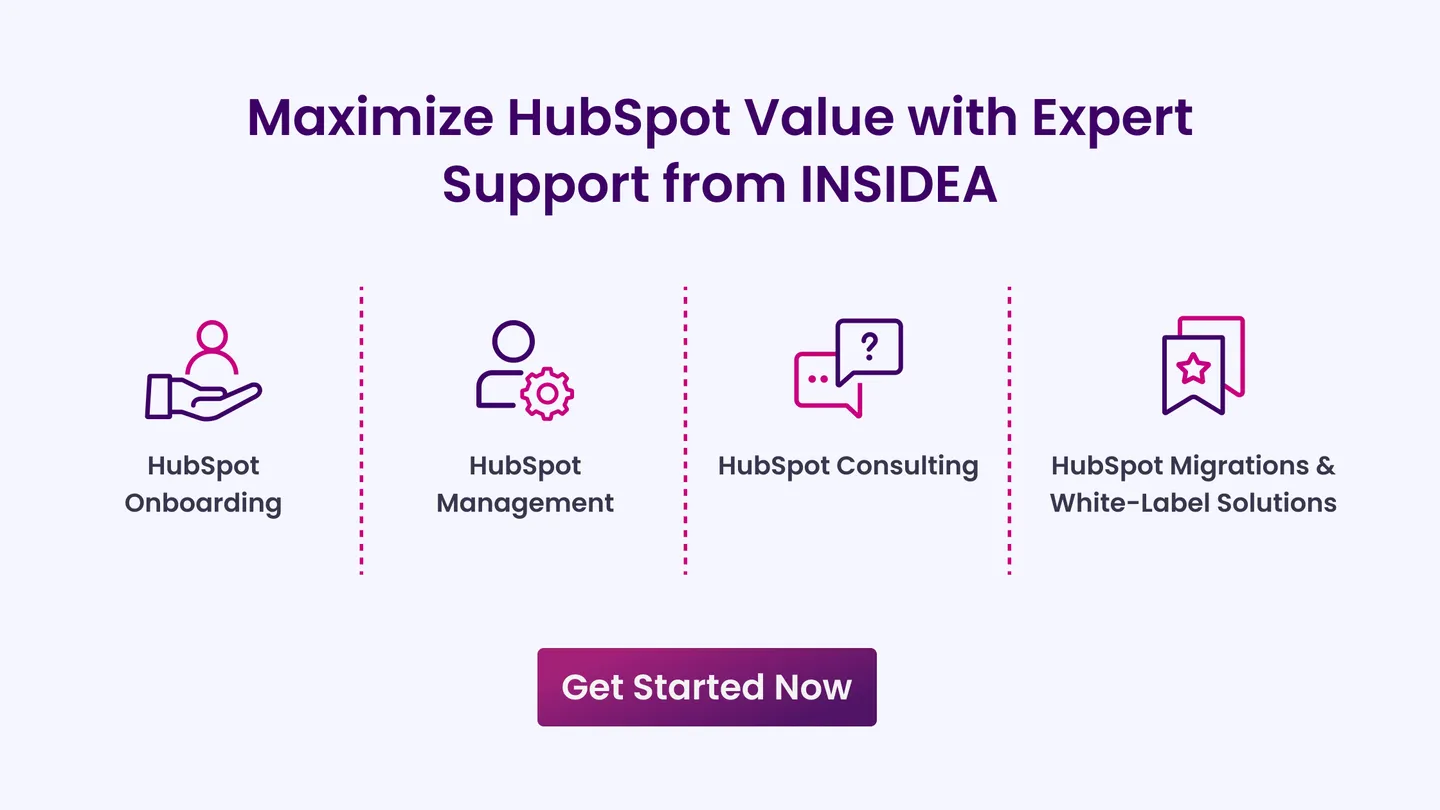
- HubSpot Onboarding: Set up users, permissions, lifecycle mapping, and integrations to get teams productive quickly.
- HubSpot Management: Ongoing support, workflow optimization, and dashboard reporting to maintain operational clarity.
- HubSpot Consulting: Lifecycle ownership, attribution frameworks, forecasting, and executive-level reporting for revenue alignment.
- HubSpot Migrations & White-Label Solutions: Clean data transfers, custom integrations, and partner-branded delivery for consistent execution.
When HubSpot is set up thoughtfully, teams can focus on growth, decision-making, and campaign execution with confidence.

 How INSIDEA works




