Buyers and sellers trust Google more than advertisements or yard signs. They search “best real estate agent near me” and call the first few names they see.
With Google controlling 87.34% of all search traffic, you’re missing out on clients if your business isn’t ranking locally. Meanwhile, agents who have mastered Local SEO get the leads and close deals, while others rely on referrals that don’t always come through.
Google ranks businesses based on who has the most substantial online presence, not experience or sales skills. If your competitors are outranking you, they’ve optimized their SEO strategy.
In This Blog of Local SEO Guide for Real Estate Agents, You’ll Learn:
- How to set up and optimize your Google Business Profile to get found.
- Why your website might hurt your rankings (and how to fix it).
- The role of reviews, citations, and backlinks in building authority.
- How social media supports your local SEO strategy.
The Must-Have Local SEO Elements for Real Estate Success
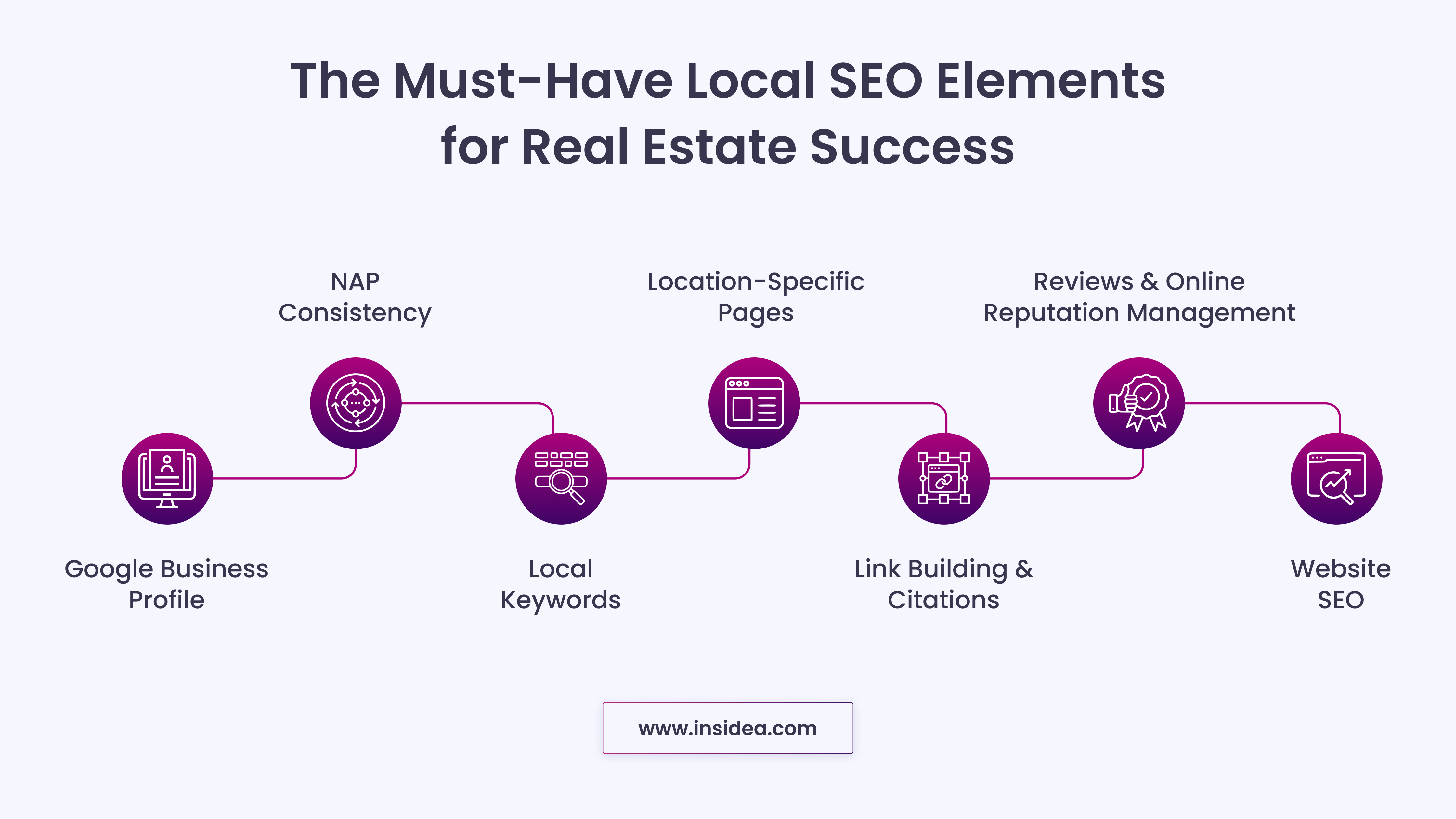
Before I begin, here’s a quick look at what’s covered in Local SEO for real estate agents:
1. Google Business Profile: Optimize your listing to rank higher in local searches.
2.NAP Consistency: Ensure your business name, address, and phone number are the same everywhere.
3.Local Keywords: Target the exact searches buyers and sellers use.
4. Location Pages: Create dedicated pages for the cities and neighborhoods you serve.
5.Reviews & Online Reputation Management: Get more client reviews to boost rankings.
6.Backlinks & Citations: Build authority with quality links from trusted sites.
7.Website Optimization: Make sure your site is mobile-friendly, fast, and optimized for search.
8. Social Media & Local SEO: Use platforms like Facebook and Instagram to strengthen your local presence.
Now, let’s get started!
1. Google Business Profile: The Foundation of Local SEO
When home buyers and sellers search for real estate services, Google decides who shows up first, and a fully optimized Google Business Profile (GBP) is what puts you in front of them.
If your GBP is incomplete, outdated, or inconsistent, you’re handing leads to your competitors. A well-maintained profile increases visibility, improves trust, and directly impacts your chances of appearing in Google’s Local Pack (the top three business listings displayed on a map).
Here’s how to make your profile work for you:
i) Use Your Exact Business Name: Google values accuracy. Your business name should match exactly as it appears on your website and in your legal documents. Avoid adding extra words like “Best Realtor in Miami” unless that’s your registered name. Google sees this as spam and may lower your ranking.
ii) Choose the Right Category: Selecting the correct category is not a minor detail, it helps Google understand what you do and where you should appear in searches. The primary category should be “Real Estate Agent” or “Real Estate Agency”. Add those as secondary categories if you also handle property management, appraisals, or rentals.
iii) Write a Business Description That Works:
Use this space wisely. Your description should:
- Explain your services (buying, selling, luxury real estate, investment properties).
- Mention the locations you serve (Miami, Fort Lauderdale, and surrounding areas).
- Highlight what makes you different (years of experience, personalized service, local expertise).
Example of a Strong Business Description: Helping buyers and sellers in Miami easily navigate the real estate market. Specializing in luxury homes, waterfront properties, and first-time homebuyers. Serving Miami, Coral Gables, and South Beach with expert guidance and top-tier service.
iv) Upload High-Quality Photos: Real estate is visual, and people judge businesses by their photos. A profile with blurry or generic images looks untrustworthy. Add:
- Professional headshots (clients want to see who they’re working with).
- Property photos (showcase recent listings, sold homes, or market snapshots).
- Office images (even if you work remotely, a branded setup adds credibility).
Upload at least 10-15 high-quality photos. Google favors profiles with frequent updates, so add new images regularly.
v) Post Weekly Updates to Stay Relevant: Most real estate agents set up their profile and never touch it again. That’s a mistake. Google rewards active businesses, and posting once a week boosts visibility.
What to post?
- New listings (with a short description and a link to your website).
- Market updates (“Miami home prices are up 5% this quarter, what does this mean for you?”).
- Client success stories (“Just closed on this beautiful 3-bed home in Coral Gables!”).
- Local real estate news (“New construction projects coming to Miami in 2026!”).
vi) Get More Reviews: The more reviews you have, the higher you rank. Period.
Google prioritizes real estate agents with a steady flow of positive reviews. If a buyer or seller chooses between two agents, the one with more 5-star reviews almost always wins.
- Ask for reviews after closing a deal (“It would mean a lot if you could share your experience on Google!”).
- Send a direct link to your review page (make it as easy as possible).
- Respond to every review (Google prefers businesses that engage).
2. NAP Consistency: Making Sure Google Trusts Your Information
Your name, address, and phone number (NAP) are Google’s trust signals. Inconsistent business information across the web leads to lower rankings.
When a potential client searches for a real estate agent, Google cross-checks your details across multiple platforms. If your business is listed one way on Google Business Profile, another way on Zillow, and differently on Yelp, it sends a red flag that your information isn’t reliable.
Where to List Your Business for Stronger Local Rankings?
To strengthen your local SEO, your NAP must be identical across:
- Real Estate Directories: Zillow, Realtor.com, Redfin, Homes.com
- Local Business Listings: Yelp, BBB, Chamber of Commerce websites
- Social Media: Facebook Business, Instagram, LinkedIn
How Inconsistent NAP Hurts Your Rankings?
- Confuses Google’s algorithm, making it harder to rank your business.
- Damages credibility, making potential clients question your professionalism.
- This leads to lost leads, as incorrect addresses or phone numbers frustrate customers.
3. Local Keywords: What Buyers & Sellers Are Searching For
When buyers and sellers turn to Google, they’re looking for someone in their area who can help them immediately. That’s why local keywords matter.
Google prioritizes search intent, ranking businesses that match exactly what a user is looking for in their location.
Types of Local Keywords Real Estate Agents Should Focus On
There are two main types of high-impact local keywords you need to use:
i) Transactional Searches (Lead-Generating Keywords)
These searches come from buyers and sellers who are ready to take action.
- Homes for sale in [City]
- Top real estate agent in [City]
- Luxury condos in [City]
- Best realtor for first-time homebuyers in [City]
ii) Informational Searches (Trust-Building Keywords)
These searches come from potential buyers and sellers who are researching before making a decision.
- Is 2026 a good time to buy a home in [City]?
- What is the home-buying process in [City]?
- How much does a real estate agent charge in [City]?
How to Find the Best Local Keywords for Real Estate SEO?
- Google Autocomplete & “People Also Ask”: Type your leading service into Google (“real estate agent in [City]”) and see what suggestions appear. These are accurate searches from actual users, so you should be targeting them.
- Google Keyword Planner: A free tool that shows search volume and competition levels for local real estate terms. Prioritize high-volume, low-competition keywords to rank faster.
- Check Competitor Websites: Look at top-ranking real estate agents in your area. What search terms appear in their page titles, blog posts, and headings? If they’re ranking for it, it’s worth targeting.
Tip: Use location-based variations for better visibility, like:
- Best real estate agent near me
- Luxury homes in [City]
- First-time homebuyer guide [City]
4. Location-Specific Pages: How to Rank in Multiple Areas
Having just one general real estate page won’t cut it if you serve multiple cities or neighborhoods. Google prioritizes pages that directly match a user’s location-based search, meaning you need dedicated location pages if you want to appear in searches across different areas.
Why One Page Per Location Works?
A well-optimized location-specific page increases your chances of ranking for searches like:
- Homes for sale in Miami
- Top realtor in Dallas
Each page gives Google clear signals that you provide services in that area, making it easier for buyers and sellers searching locally to find you.
How do you structure location pages for maximum impact?
Google penalizes sites that duplicate the same text across multiple pages. Here’s what makes a strong location page:
- Local Market Insights: Discuss current real estate trends, pricing, and buyer demand in that area.
- Client Testimonials: Share reviews from clients who bought or sold homes in that location.
- Area-Specific Listings: Feature available properties, recently sold homes or high-demand neighborhoods.
- Community Highlights: Mention nearby schools, amenities, and lifestyle perks to appeal to potential buyers.
Example URL Structures That Work
For each city or neighborhood you serve, your URLs should be clear and structured for both users and search engines:
5. Link Building & Citations: Strengthening Your Local Authority
Google ranks businesses higher when other trusted websites link to them. Backlinks and citations (mentions of your business name, address, and phone number) help build trust with potential clients. The more credible websites link you, the more buyers and sellers will see you as your area’s go-to real estate expert.
Where to Get High-Quality Local Backlinks?
Backlinks from reputable local sources tell Google you are a legitimate, established real estate professional in your area. Here’s where to start:
- Real Estate Blogs & Local News Sites: Get featured in market reports, expert roundups, or homebuyer/seller guides.
- Partner with Industry Professionals: Build relationships with mortgage brokers, home inspectors, and moving companies, many will link to your site as a trusted referral.
- Guest Posting on Local Real Estate Publications: Write articles for regional real estate websites, investor platforms, or community blogs to get your name and website in front of local buyers and sellers.
Best Local Citation Sources for Real Estate Agents
Make sure your business is listed consistently on:
- Real Estate Directories: Zillow, Trulia, Realtor.com, Homes.com
- Industry & MLS Directories: Local real estate associations, MLS websites
- Business Listings: Yelp, BBB, Chamber of Commerce, and local directories
6. Reviews & Online Reputation Management
For real estate agents, online reviews aren’t just about credibility, they directly impact rankings. Google favors highly rated businesses in local searches, meaning more positive reviews = more visibility = more leads.
How to Get More Real Estate Reviews?
- Ask Clients at the Right Time: The best time to request a review is right after closing a deal, while the experience is fresh.
- Make It Easy: Send a direct Google review link via email or text so clients don’t have to search for where to leave feedback.
- Offer a Small Incentive: Encourage participation by entering reviewers into a giveaway or offering a free home valuation report. (Just be mindful of platform rules regarding incentives.)
Where to Collect Reviews for Maximum Impact?
Your Google Business Profile is the most important platform for reviews, but don’t stop there:
- Google Business Profile: Boosts local SEO and trust.
- Zillow & Realtor.com: Real estate-specific platforms buyers and sellers check.
- Yelp & Facebook: Increases visibility beyond Google.
Businesses with 50+ reviews rank significantly higher than those with just a handful. Focus on building reviews consistently, not just when you need them.
7. Website SEO: Optimizing for Local Search Visibility
Your website should be your top lead generator. But if it’s slow, not mobile-friendly, or missing key optimizations, buyers and sellers won’t find you.
Your website must be fast, appropriately structured, and packed with the correct information to rank higher in local searches. Here’s how to make that happen:
Essential Website SEO for Real Estate Agents
Page Titles & Meta Descriptions with Local Keywords: Your title tags and meta descriptions should clearly state who you are, what you do, and where you serve.
- Example: Top Realtor in Miami | Buy & Sell Homes with [Your Name]
- Example: Luxury Homes for Sale in Austin - Expert Real Estate Services
These help Google understand your page and increase click-through rates from potential clients.
Fast-Loading Website: Slow websites lose traffic and rankings. Real estate sites often slow down due to large images and unoptimized code.
- Compress images - Use WebP format to reduce file size.
- Enable caching - Helps pages load faster for returning visitors.
- Use a fast hosting provider - Cheap hosting leads to slow speeds.
Mobile-Friendly Design: Most homebuyers search for properties on their phones, if your site doesn’t load properly, they’ll leave.
- Use a responsive design that adapts to all screen sizes.
- Keep buttons, menus, and forms easy to click on mobile.
- Test your site on Google’s Mobile-Friendly Test to check for issues.
Schema Markup for Real Estate: Schema markup helps Google display more details about your listings directly in search results, improving visibility.
- Use RealEstateListing schema to enhance property listings.
- Add LocalBusiness schema to highlight your agency details.
8. Social Media & Local SEO
Social media doesn’t directly impact local SEO rankings. Still, it plays a significant role in driving traffic, increasing visibility, and building credibility, all of which help real estate agents rank higher in local searches over time.
The more your content is shared, engaged with, and linked to, the more Google sees your business as a trusted source in the community.
How to Use Social Media to Boost Local SEO?
Share Local Market Updates & Insights: Buyers and sellers search for real estate trends, mortgage rates, and local market insights. Posting this content keeps your audience engaged and establishes you as a local expert.
Promote Listings with Location-Based Hashtags: When posting properties on Instagram, Facebook, or YouTube, use geo-targeted hashtags like:
- #HomesForSaleAustin
- #MiamiRealEstate
- #TopRealtorNYC
These help reach people searching for homes in those areas.
Engage with Local Businesses & Influencers: Partner with mortgage brokers, home stagers, moving companies, and local businesses to cross-promote each other.
Post Updates on Your Google Business Profile: Social media isn’t just about Instagram and Facebook, Google Business Profile allows posts, too. Share:
- New Listings
- Open house details
- Local real estate news
Social Media Platforms for Real Estate Agents
- Facebook & Instagram - Ideal for showcasing properties, sharing client success stories, and engaging with your local community.
- YouTube - Great for home tours, market analysis, and neighborhood guides, videos rank well in Google searches.
- LinkedIn - Perfect for networking with real estate professionals, investors, and business owners.
You’re Busy Selling Homes, Who’s Making Sure Buyers Can Find You?
You already juggle client meetings, negotiations, property showings, and closing deals, real estate is demanding enough as it is. Do you have time to stay on top of SEO, update listings, monitor rankings, and optimize your site monthly?
Your competitors invest in local SEO because they know where their leads come from. Buyers and sellers aren’t flipping through directories, they’re searching online, and whoever ranks highest wins the business.
So, you have two options:
1. Spend weekly hours trying to master SEO while running your real estate business.
2. Let the marketing pros handle it so you can focus on what you do best, closing deals and growing your brand.
If you’re ready to get found, get leads, and let someone else handle the heavy SEO, it’s time to take action.
Grow Faster and Smarter with INSIDEA’s Digital Marketing Subscription

At INSIDEA, we deliver powerful digital marketing strategies that elevate your brand’s presence, attract the right audience, and drive measurable growth. Our expert team is dedicated to creating top-tier marketing solutions to meet your unique business needs. With in-depth industry knowledge, we craft customized strategies that align perfectly with your goals, all within our all-in-one digital marketing subscription.
Our comprehensive subscription includes everything you need to succeed in the digital space.
From Search Engine Optimization (SEO) that boosts your search rankings and drives organic traffic to WordPress Management, ensuring your website is visually appealing, highly functional, and optimized for conversions.
Our content marketing services establish your authority with engaging, insightful content. Social media marketing builds your presence across platforms with interactive and authentic strategies. Our email marketing solutions connect directly with your audience, driving engagement and conversions.
With INSIDEA’s all-in-one subscription, you can access these services seamlessly, supported by our dedicated digital marketing experts committed to delivering measurable results for your business.
Book a meeting with our experts to explore how we can support your business goals.



 How INSIDEA works