Facebook and Instagram together reach over 3.2 billion daily active users, making Meta’s ad platform one of the highest-reach channels available to medical practices.
For plastic surgeons, this reach comes with a specific challenge: the audience is large, but advertising health and cosmetic procedures requires both technical precision and regulatory awareness.
Most plastic surgery practices that run Facebook Ads see inconsistent results, not because the platform is ineffective, but because campaigns are set up without a clear patient acquisition structure.
This blog explains how to build a Facebook Ads strategy for plastic surgery that generates qualified consultation requests while staying within Meta’s advertising guidelines.
Marketing for plastic surgeons
Rather have this done for you?
Book a 30-minute call with INSIDEA. We look at how customers find you today and send a proposal within 48 hours if we are a fit.
Book a callUnderstanding Meta’s Advertising Policies for Medical and Cosmetic Procedures
Before spending a single dollar, plastic surgeons need to understand what Meta allows and restricts in this category.
Meta classifies cosmetic surgery as a sensitive health topic. Ads promoting procedures like rhinoplasty, liposuction, or breast augmentation must not use targeting parameters that exploit personal health conditions or imply that someone has a specific medical concern.
Restrictions to know:
- Before-and-after photos are explicitly prohibited in Meta Ads for cosmetic surgery. This includes images that show body transformation in a way that could be seen as promoting an idealized body image.
- Ads must not target audiences based on implied health conditions, weight concerns, or body dissatisfaction.
- Claims must be factual and not misleading. Phrases like “guaranteed results” or “risk-free surgery” will trigger rejection or account suspension.
- HIPAA rules apply to how patient data is handled after the click. Using pixel tracking to capture identifiable health information without proper data-handling agreements creates legal exposure.
The practical solution is to build ads around education, procedure information, surgeon credentials, and consultation invitations rather than transformation promises.
Audience Targeting: Who to Reach and How
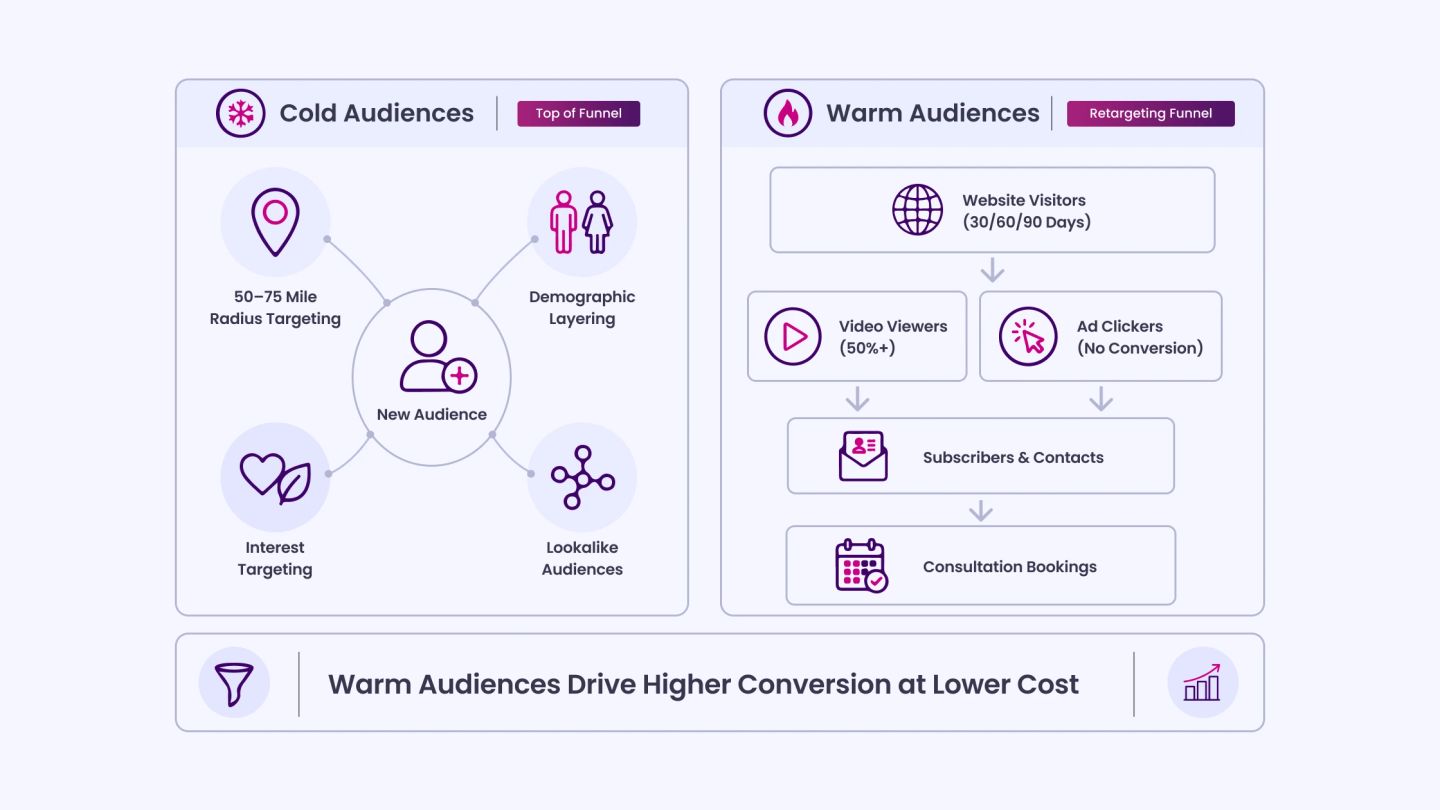
Facebook’s targeting tools are useful for plastic surgery when used correctly.
Cold audiences (top of funnel)
For reaching people who have never interacted with your practice, the most reliable targeting approaches are:
- Geographic targeting: Set a radius around your practice. Most patients travel no more than 50 to 75 miles for elective procedures.
- Age and gender layering: Adjust based on which procedures you want to promote. The demographic profile for rhinoplasty differs from that of facelift or body contouring.
- Interest-based targeting: Categories such as skincare, wellness, health and beauty, and related lifestyle interests help qualify the cold audience.
- Lookalike audiences: Upload a list of past consultation inquirers or patients (anonymized per HIPAA guidelines), and Meta builds an audience with similar behavioral profiles. This is consistently one of the higher-performing targeting types in this category.
Warm audiences (retargeting)
People who have already shown interest convert at a significantly lower cost. Retargeting pools to build:
- Website visitors in the last 30, 60, and 90 days
- People who watched at least 50% of a video ad
- People who clicked a previous ad but did not submit a form
- Existing email subscribers or CRM contacts
Warm retargeting campaigns often account for a small portion of total spend but a disproportionately large share of actual consultation bookings.
Creative Strategy: What to Show and Say
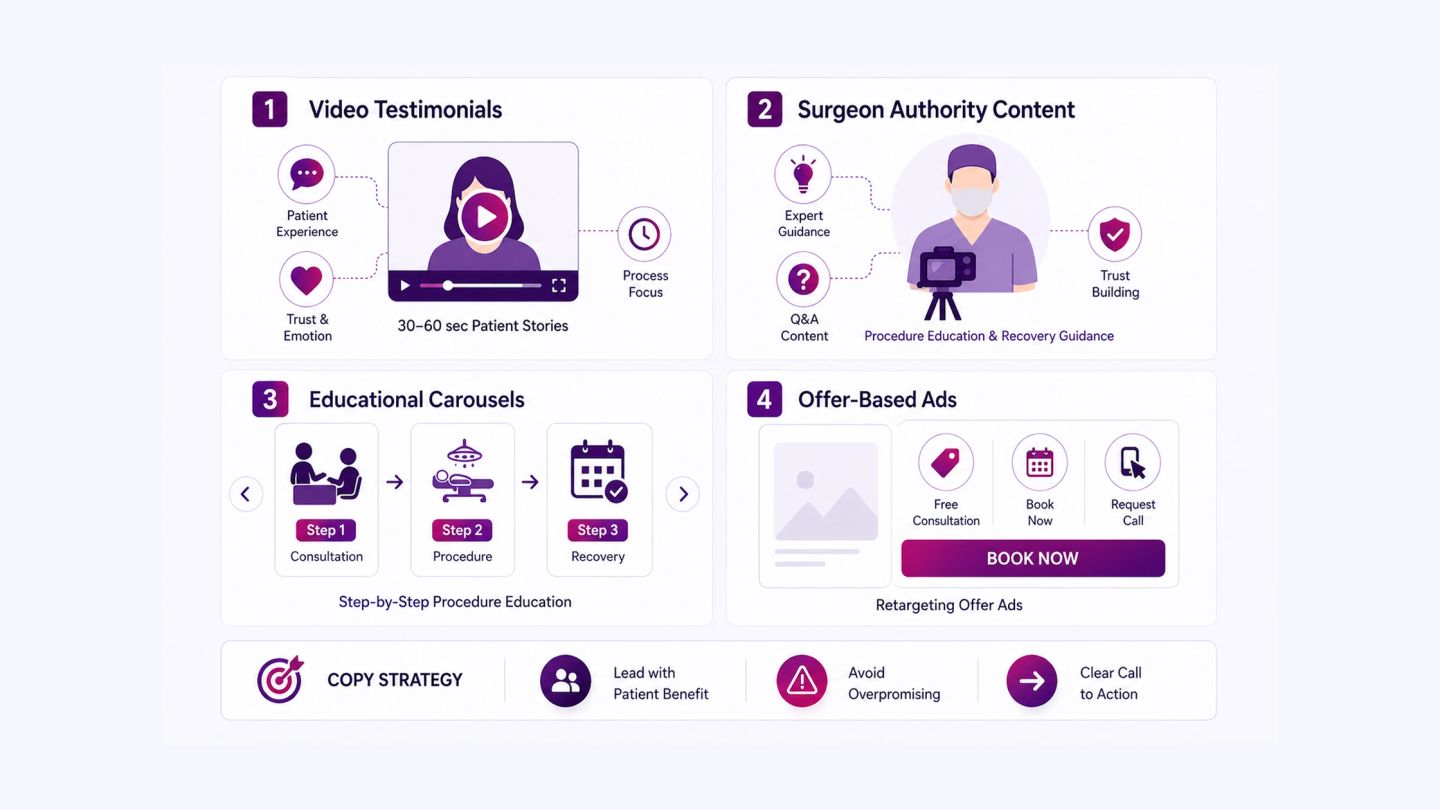
Creative is where most plastic surgery Facebook Ads fail. Either the ad is too clinical, or it overpromises in ways that Meta rejects.
Formats that work:
- Video testimonials: A 30 to 60 second patient talking about their experience, focusing on the process and how they felt, not on physical transformation. These perform well in both cold and retargeting placements.
- Surgeon authority content: Short videos of the surgeon explaining a procedure, what to expect during recovery, or answering common questions. This builds trust before someone ever visits the website.
- Educational carousels: Multiple images explaining a procedure step by step, from consultation to recovery timeline. These generate higher engagement than single-image ads for research-oriented buyers.
- Offer-based single image ads: Ads promoting a free or reduced-rate consultation with a clear call to action. These work well in retargeting, where the audience already has baseline familiarity.
Copy guidelines:
- Lead with what the patient gets, not what the procedure is. “Learn what a rhinoplasty consultation covers” performs better than “Get your nose fixed.”
- Avoid superlatives and comparative claims.
- Include the call to action clearly: “Book a consultation,” “Request a free call,” or “See if you are a candidate.”
Campaign Structure and Budget Allocation
A common mistake is running a single campaign without separating audience temperatures. A structured approach looks like this:
Three-campaign structure:
- Awareness campaign: Video or educational content targeting cold audiences. The goal is views, reach, or landing page visits. Budget: 30-40% of total.
- Consideration campaign: Retargeting video viewers and site visitors with more specific procedure content. The goal is lead form submissions or calls. Budget: 40 to 50% of total.
- Conversion campaign: Retargeting warm leads who clicked but did not convert. Goal is direct consultation booking. Budget: 15 to 20% of total.
For a practice new to Facebook Ads, a realistic starting budget is $2,000 to $4,000 per month. Below this threshold, it is difficult to generate enough data for the algorithm to optimize effectively.
High-volume practices in competitive markets typically spend $8,000 to $15,000 monthly across campaigns.
Lead Generation: Forms vs. Landing Pages
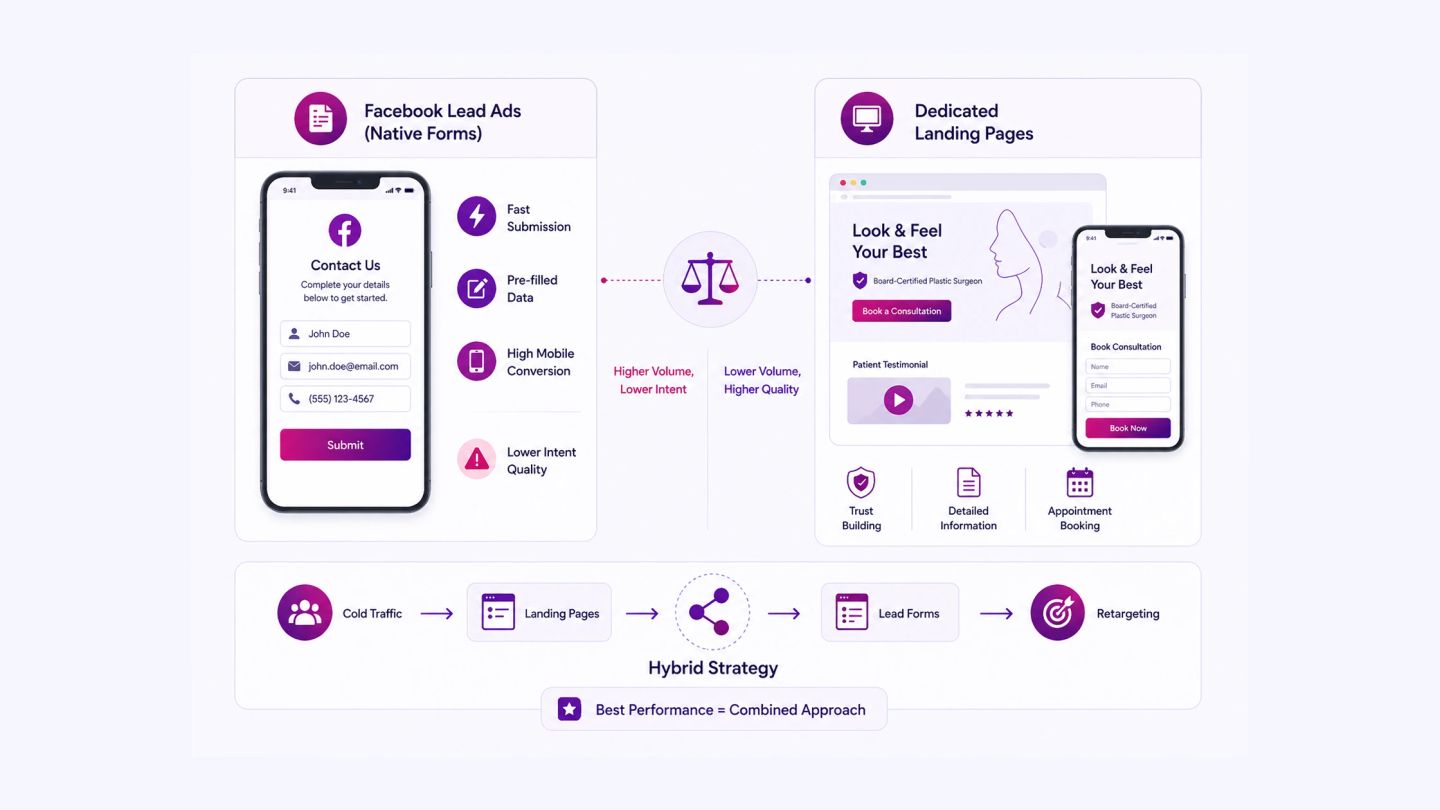
Meta offers two main paths for capturing consultation requests.
Native lead forms (Facebook Lead Ads) allow users to submit their name, phone number, email, and custom questions without leaving the app. The form pre-fills with their profile, significantly reducing friction. For mobile users especially, lead form conversion rates are typically 20 to 40% higher than click-to-website ads.
The drawback is lead quality. Because the process is so easy, some leads are low intent. Adding one or two qualifying questions to the form, such as “Which procedure are you considering?” or “When are you looking to schedule a consultation?”, filters out casual browsers.
Landing pages give you more control over the conversion experience. A well-built landing page can include detailed procedure information, surgeon credentials, patient video testimonials, and a booking form. This longer exposure typically results in higher-quality leads who arrive at the consultation better informed. The trade-off is a higher cost per lead due to the extra click required.
The recommended approach is to run both simultaneously, direct cold traffic to a landing page, and use lead forms for retargeting campaigns where trust is already partially established.
Tracking and Measuring Performance
Running ads without proper tracking produces misleading data. The metrics to focus on:
- Cost per lead (CPL): Average across procedures typically ranges from $35 to $120 in plastic surgery, depending on the market and targeting quality.
- Lead-to-consultation rate: How many submitted leads actually book a call? A healthy rate is 30-50%.
- Consultation-to-procedure rate: The final conversion that determines actual ROI. Practices typically see 20 to 40% of consultations result in a booked procedure.
- Cost per booked procedure: The metric that tells you whether the campaign is profitable.
Install the Meta Pixel on your website and set up custom conversion events for form submissions, appointment bookings, and visits to the consultation page.
If you use a CRM or practice management system, connect it to your Facebook Business Manager via a CRM integration or manual UTM tracking to trace leads through to revenue.
Final Word on Scaling Patient Acquisition with Ads
Facebook Ads can be a reliable acquisition channel for plastic surgery practices, but only when properly structured.
Policy compliance protects your account. Precise targeting reduces wasted spend. Educational and authority-driven creative builds trust before the consultation request.
And tracking from ad click to booked procedure is the only way to know what is working.
The practices that see consistent results treat their Facebook Ads account as an evolving system, not a set-it-and-forget-it tool. Regular creative refreshes, audience list updates, and performance reviews every two to four weeks keep campaigns relevant and efficient.
INSIDEA
Ready to put this into practice?
INSIDEA is an Elite HubSpot Partner rated 4.99 across 500+ verified reviews. Let's map it to your goals.



 How INSIDEA works