Most plastic surgery marketing guides just hand you a list of tactics, without any real context for your practice. That’s why so many ideas fail before they even get off the ground. Before you try the 10+ strategies below, there are two big shifts you need to understand.
The first is your patient base. They’ve changed a lot. The “pre-juvenation” trend, driven by Millennials and Gen Z, has shifted the focus from fixing issues to preventing them. Younger patients are showing up for non-invasive treatments earlier in life.
They live online, on TikTok and YouTube Shorts, and expect transparency, diversity, before-and-after galleries, and behind-the-scenes content that feels real. On top of that, the GLP-1 medication trend is reshaping demand: in 2024, over 800,000 aesthetic patients used drugs like semaglutide, creating a new pipeline of people seeking body contouring after major weight loss.
The second shift is patient lifetime value. A Botox patient might come in every four months for years. A happy breast augmentation patient could return five years later for a facelift and refer friends along the way. That $1,000 cost per acquisition suddenly looks reasonable when the same patient can bring in $40,000 over time. Every tactic you try should be measured against lifetime value, not just the first procedure.
Finally, a quick compliance reminder. Plastic surgery marketing sits in one of the most regulated spaces in healthcare. HIPAA violations can cost upto $50,000 per incident, and FTC missteps carry serious legal risk.
Every idea below includes notes on compliance to help you protect your practice while marketing effectively.
Marketing for plastic surgeons
Rather have this done for you?
Book a 30-minute call with INSIDEA. We look at how customers find you today and send a proposal within 48 hours if we are a fit.
Book a call1. SEO as the Most Effective Channel for Plastic Surgeons
SEO is the highest-converting digital channel for plastic surgeons, driven by patients actively researching procedures. This matters because the person arriving from organic search has already decided they want the procedure: they’re choosing between surgeons, not deciding whether to have surgery.
High-Converting Channel: Organic search brings patients who are already ready for procedures. They are comparing surgeons, not deciding whether to have surgery, making SEO the most effective digital channel.
What Effective SEO Requires: Focus on high-quality content, competitive keywords, internal linking, technical optimization, and geo-targeting. SEO and GEO work together to improve rankings and increase the likelihood of being cited in AI-generated summaries.
Procedure Pages and Full-Funnel Content: Top-of-funnel content works best as blogs, while middle- and bottom-of-funnel content should be on procedure and location pages. Each procedure, rhinoplasty, breast augmentation, tummy tuck, facelift, mommy makeover, needs its own page covering procedure details, candidate criteria, recovery, results, and regional costs. Audit pages under 800 words or missing FAQs to ensure depth and patient-focused information.
2. GEO Targeting to Reach Patients Where They Search
Patients no longer search in one place. They move between Google, AI platforms, YouTube, social media, and local listings. Today’s aesthetic patients are researching procedures not only through Google but also through AI tools that summarize and recommend providers.
Practices appearing consistently across search engines, AI-generated responses, local listings, and social platforms are significantly more likely to earn trust and convert prospective patients.
A proactive GEO strategy ensures your content is structured, authoritative, and easy for AI systems to interpret and reference. Clear formatting, comprehensive FAQs, medically accurate explanations, and strong credibility signals all increase the likelihood of appearing in AI-generated responses.
The practical implementation: Add a “Quick Answer” summary block at the top of every informational page that answers the core question in 60 words or fewer. Format H2 and H3 headings as the exact questions patients type into AI tools: “How long is recovery from a rhinoplasty?” “Is a mommy makeover worth it?” “What is the difference between a facelift and a mini facelift?” Implement the FAQPage schema on every procedure page. These are the structural signals AI systems use to decide which sources to cite.
3. Website as the Central Conversion Hub
Your website is where all marketing efforts come together, so it needs to deliver a seamless experience that turns visitors into booked consultations.
- Traffic Conversion Point: Every marketing channel drives visitors to your website. Either it converts them into consultations, or the effort is lost. A well-structured website is the core of your entire marketing system.
- High-Converting Features: Include detailed procedure pages, a filterable before-and-after gallery, a surgeon bio with board certification and affiliations, patient reviews, and a three-field consultation booking form. Ensure fast mobile performance for all users.
- Technical Essentials: Maintain LCP under 2.5 seconds, use HTTPS, implement schema markup (MedicalBusiness, Physician, FAQPage, SpeakableSpecification), and keep AI crawler access unblocked so your content can be cited.
4. Google Business Profile and Local SEO for Nearby Visibility
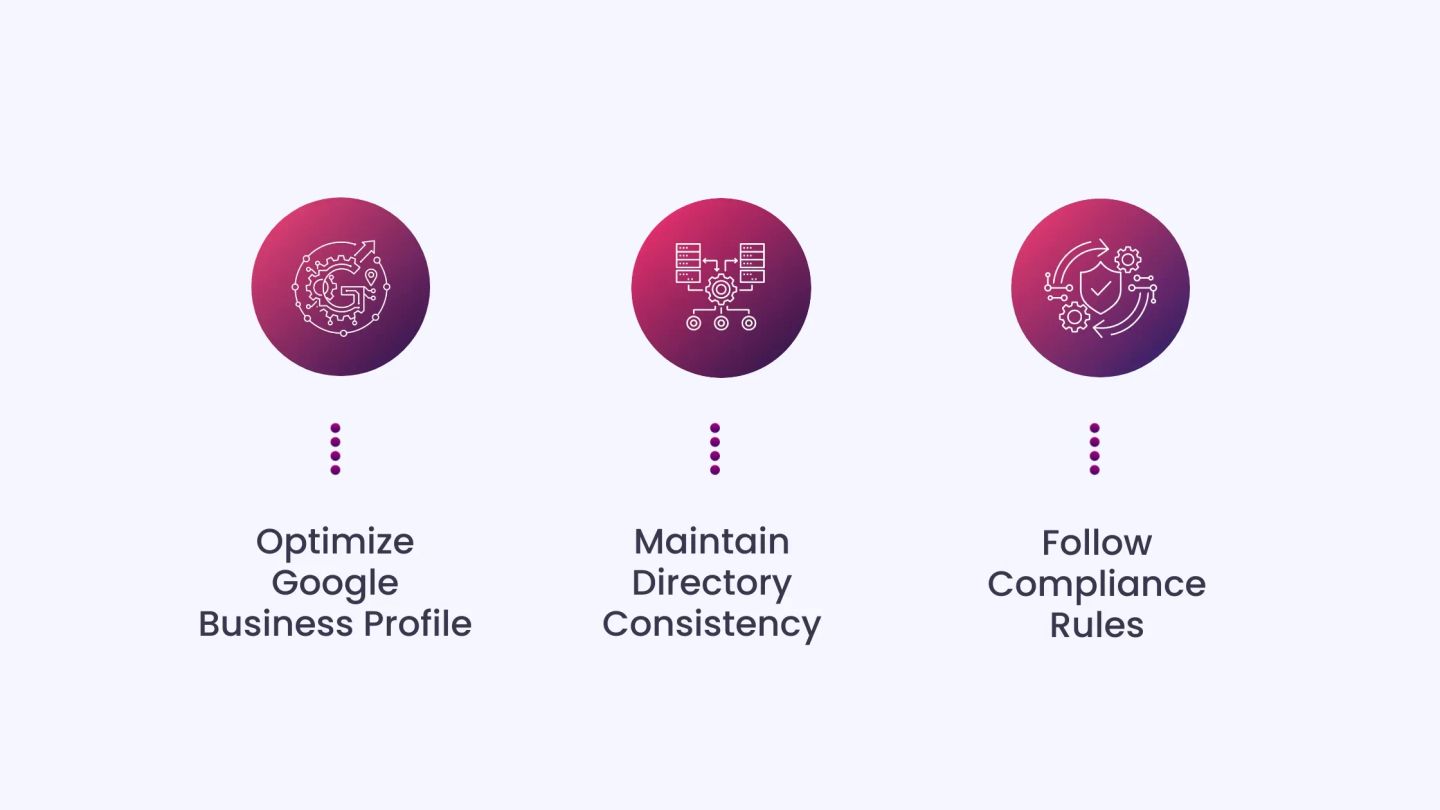
Most patients rely on search engines before booking, and location is the deciding factor for over half. Local visibility directly affects consultation volume.
Optimize Google Business Profile
Most practices claim their profile and stop there. To drive patient actions, ensure:
- Complete service listings for every procedure, not just “plastic surgery.”
- At least 20 high-quality photos of the office, operating suite, and team
- Weekly posts to keep the profile current
- Fully populated Q&A section, important for AI summaries that cite your profile
Maintain Directory Consistency
Your practice name, address, and phone number must be identical across Google, Healthgrades, RealSelf, Vitals, Yelp, and other directories. Any mismatch confuses search algorithms and patients. Get listed on all relevant local directories.
Follow Compliance Rules
When responding to reviews, never confirm the reviewer is a patient or reference procedure details. Doing so is a HIPAA violation, even if the response seems harmless.
5. Google Ads to Capture High-Intent Patients
Plastic and Cosmetic Surgery saw a year-over-year improvement in Google Ads conversion rate, the third-largest increase among healthcare subcategories. This improvement means you can now get more consultations from the same ad spend than you could 12 months ago if your campaigns are structured correctly.
The real cost of plastic surgery Google Ads: The average cost per lead is $102.51. Plastic surgery keyword CPC ranges from $15 to $50+ per click for competitive procedure terms. These are not cheap clicks. But framed against an average surgical fee of $15,000-$25,000 and a $40,000 patient lifetime value, a $100-$150 cost per consultation lead is justifiable if conversion rates are managed.
Campaign structure that actually converts: Sending patients to your homepage is like inviting them into your clinic and then walking away. Instead, create a focused landing page for each procedure. One procedure, one ad group, one landing page.
Compliance note: Every claim in ad copy must be substantiable. FTC requires you to substantiate every claim, from procedure outcomes to before-and-after images. Misleading claims about results, recovery times, or success rates can trigger investigations and fines.
6. Before-and-After Photos to Show Results
Before-and-after photos are the single highest-trust content asset in plastic surgery marketing. No headline, testimonial, or video replaces what a well-documented patient result communicates to a prospective patient.
Over 95% of cosmetic surgery patients consult online sources before their procedure. Only 19% of people verify surgeon credentials on social media, so your before-and-after gallery shows results and board certification, which provides credibility.
HIPAA applies; full-face images, tattoos, scars, birthmarks, or other identifiers are PHI. Even cropped images with distinctive features can link to a patient. FTC rules: no misleading edits; disclose if results are not typical or if the patient received free/discounted treatment.
Use consistent lighting and angles, and avoid manipulating body shape, skin tone, or blemishes. Label images as “Patient consented. No filters used.”
Storage compliance: Images must be stored in encrypted systems, not personal phones or unsecured cloud apps. Every step, from capture to publishing, must be documented and secure.
7. Social Media and the Right Platforms for Results
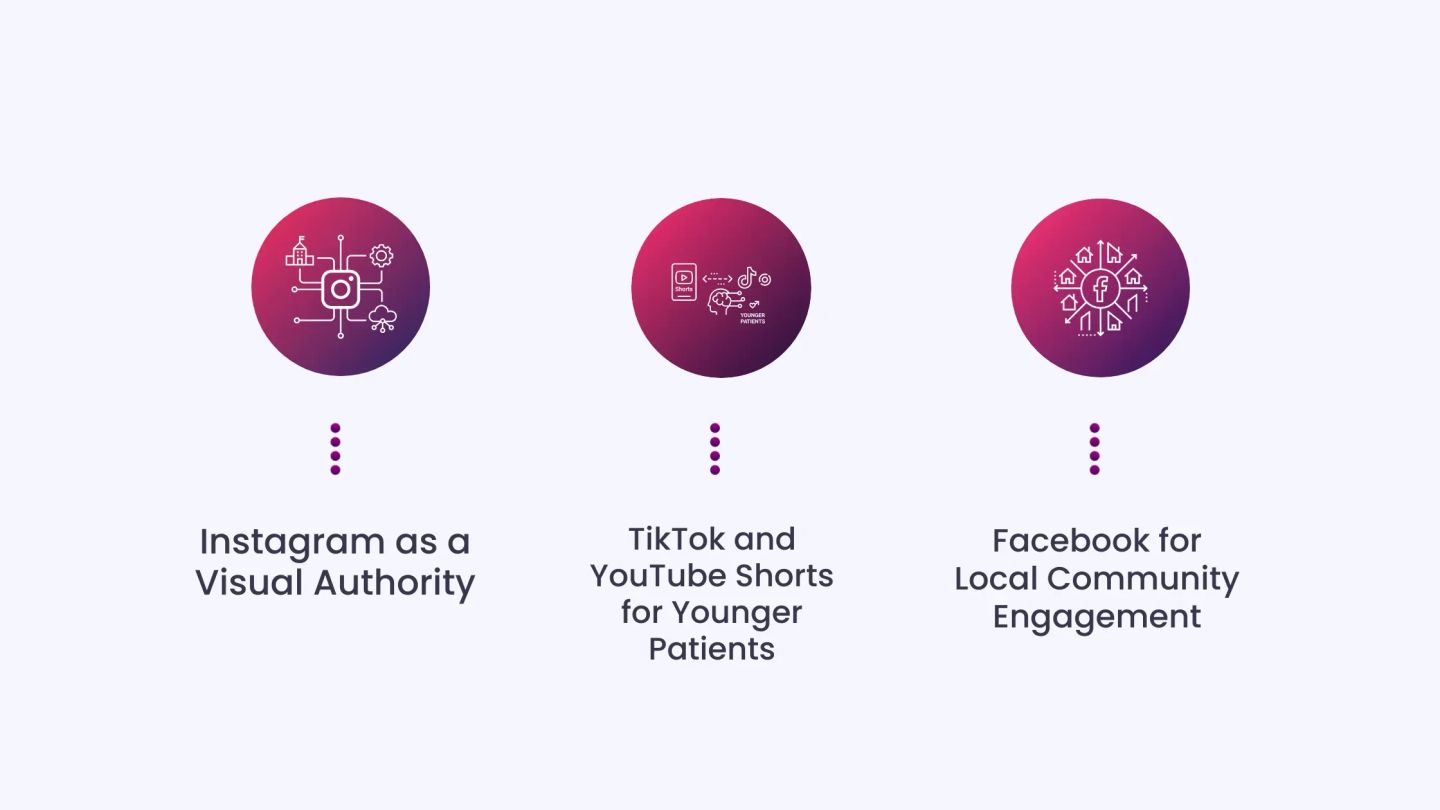
Social media exposure affects patient acquisition. Regular posting increases consideration, and following surgeons reinforces trust.
Instagram as a Visual Authority: Reels outperform static posts. Short educational videos that explain procedures or dispel myths help build credibility and increase consultation conversion rates.
TikTok and YouTube Shorts for Younger Patients: For Millennials and Gen Z, these platforms drive discovery. Clips of 30-60 seconds, answering patient questions, with the name and board certification visible, increase trust.
Facebook for Local Community Engagement: Use local groups, provide genuine guidance, and create private, moderated groups for current patients to foster community and referrals.
Turn off geotagging, avoid mentioning patient-specific procedures, and direct inquiries to secure communication channels.
8. Meta Ads for Awareness and Retargeting
Meta Ads support top-of-funnel engagement rather than direct conversions.
Brand awareness for procedures in your target demographic, retargeting warm audiences, video campaigns introducing surgeons, and lookalike audiences built from de-identified patient lists.
What Meta Ads do poorly: Generating direct consultation requests from cold audiences. Run Meta for awareness and retargeting, Google for consultation capture.
The combined strategy is a multi-touch sequence from content to the website to retargeting to search intent consistently outperforms single-channel approaches.
9. Reputation Management to Turn Reviews into Referrals
Over 90% of patients use online reviews; 43% are willing to go out-of-network for excellent reviews.
The platforms that matter: Google Reviews, RealSelf, Healthgrades, Vitals. Each serves a different stage of the patient research process.
The systematic review generation process: Automation tools trigger review requests 24-48 hours after the appointment. Include links to 1-2 platforms only. Train staff to prompt patients verbally.
Responding to negative reviews, HIPAA constraint: Never acknowledge that the reviewer is a patient or disclose PHI. Acknowledge the concern, invite them to call privately, and show commitment to satisfaction.
10. Video Marketing to Let Your Expertise Show
Patients choose people, not logos. Video content showcasing procedures, safety protocols, and patient experiences boosts conversions.
Content types: Procedure explainers, myth-busting, day-by-day recovery timelines, consultation walkthroughs.
Distribution: YouTube, website embeds, 60-second Reels/Shorts, Meta retargeting ads.
Production reality: Minimal provider time is needed; a clean background, good lighting, a lapel mic, and a phone are sufficient.
11. Referral Programs to Maximize Consultations from Existing Patients
Referred patients convert at higher rates and tend to have greater lifetime value. Implement a formal referral program offering a $100 treatment credit for referrals, tracked via referral cards or links, and promoted through posts, emails, scripts, and website banners.
Structure incentives carefully to avoid violations of the Anti-Kickback Statute, ensuring rewards go to the referring patient upon booking a consultation, not upon completion of treatment.
Additionally, maintain engagement through email and SMS campaigns, including quarterly newsletters, procedure updates, specials, and educational content to keep the practice visible and top-of-mind.
12. Influencers and UGC to Boost Trust and Engagement
Patients tend to trust content shared by influencers more than surgeon credentials on social media. Local micro-influencers are more effective than macro-influencers, driving consultations at lower cost, especially when providing non-surgical treatments for honest, documented content.
All collaborations must follow FTC and HIPAA requirements, including clear disclosure of material connections (#ad, #sponsored). Influencer-generated content also performs better as local ad creative compared with professionally produced materials.
Build an Integrated Marketing System
Successful practices don’t rely on individual tactics; they connect all channels into a unified system. Combining SEO and GEO, Google Ads, Meta retargeting, social media presence, reviews, and referral programs ensures every channel supports consultation growth.
Focus on measurable outcomes: track consultation-to-surgery conversion rates (aim for 35-45%), average procedure value, and lifetime patient value. All reporting should comply with HIPAA standards for source attribution.
30-day starting plan
|
INSIDEA
Ready to put this into practice?
INSIDEA is an Elite HubSpot Partner rated 4.99 across 500+ verified reviews. Let's map it to your goals.



 How INSIDEA works