Pest controlis one of the few service categories where a customer’s search and their intent to hire are almost simultaneous. Someone searching “termite treatment near me” or “rat exterminator today” is not researching options for next month. They have a problem, and they want it solved quickly.
That urgency makes Google Ads particularly effective for pest control companies.
The challenge is not getting clicks. It is getting the right clicks at a cost that makes business sense.
Without a clear structure,pest controlad accountstend to waste spend quickly, pulling budget toward irrelevant queries and broad audiences that do not convert.
This blog explains how to build and run a Google Ads strategy that generates consistent, high-quality leads for pest control businesses.
Why Google Ads Works Differently for Pest Control
Most service businesses benefit from Google Ads, but pest control has specific characteristics that make paid search especially productive.
First, pest problems are rarely planned purchases. A homeowner does not budget for a cockroach infestation six months in advance. The search begins the moment the problem is visible, which means very little awareness-building is required. The customer already knows they need help.
Second, the geographic scope of each job is limited to the local level. A pest control company in Austin, Texas, has no use for a click from someone in Chicago. This makes precise location targeting essential, and Google’s tools handle this well.
Third, competitors are consistently active on the same terms. If a pest control company is not advertising on its own terms for its core service, a competitor likely is. Organic rankings help, but for high-intent queries, the top of the page is dominated by ads and Local Service Ads.
Local Service Ads vs. Search Ads: Which One Comes First
Google offers two distinct paid formats that pest control companies should understand before spending a dollar.
Local Service Ads (LSAs) appear above regular search ads. They show the business name, rating, phone number, and a “Google Guaranteed” badge if the business is verified. Leads are paid per lead rather than per click, and Google handles much of the targeting automatically.
For pest control, LSAs are worth setting up first because the trust signals they carry (reviews, licensing verification) tend to produce calls from high-intent customers.
Search Ads give more control. You choose your keywords, write your ad copy, set bids, and manage targeting in detail. They require more active management but allow precise segmentation by pest type, service, and geography.
The right approach is to run both. LSAs capture high-trust clicks near the top of the page. Search campaigns fill in the gaps, target specific services, and allow testing of messaging.
Campaign Structure That Reduces Wasted Spend
A common mistake pest control companies make is putting all services into a single campaign with a broad budget. A better structure separates campaigns by service category.
Consider organizing like this:
- Campaign 1: Termite Control (includes inspection, treatment, and prevention queries)
- Campaign 2: Rodent Control (rats, mice, exterminator queries)
- Campaign 3: General Pest Control (cockroaches, ants, bed bugs, spiders)
- Campaign 4: Emergency or Same-Day Service
Each campaign gets its own budget, so a surge in termite searches does not drain the budget for rodent control. Each ad group within a campaign should match a tight theme so that the ad copy directly reflects the search query.
This structure also makes it easier to identify which services are generating calls at a profitable cost and which ones need adjustment.
Keyword Selection and Match Types
For pest control, the most valuable keywords are service-plus-location combinations and problem-specific queries.
Examples of strong keywords:
- “termite inspection [city name]”
- “rat exterminator near me”
- “bed bug treatment cost”
- “ant control service”
Match types determine how closely a search query must match your keyword for your ad to show.
- Exact match gives the most control and typically produces the highest-quality traffic. Use it for your most profitable terms.
- Phrase match allows some variation while still maintaining relevance.
- Broad match should be used cautiously and only with a strong negative keyword list in place.
Starting with a phrase and exact-match limits early helps prevent budget waste while data accumulates.
Negative Keywords: The Most Underused Tool
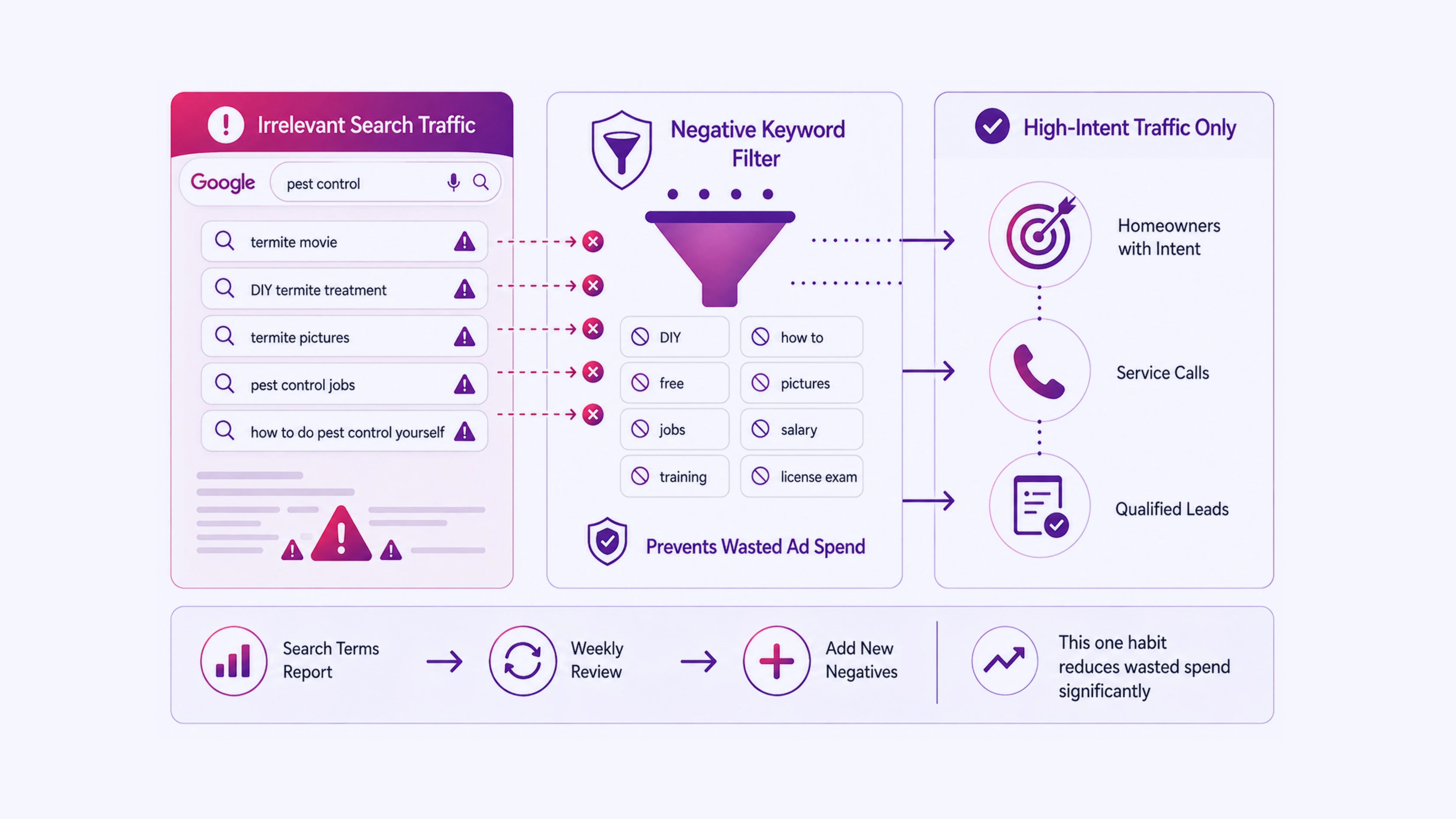
Negative keywords prevent your ads from showing on irrelevant searches. In pest control, this matters more than most people expect.
Without negatives, your termite campaign might show up for:
- “termite movie”
- “DIY termite treatment”
- “termite pictures”
- “pest control job openings”
- “How to do pest control yourself.”
None of those searchers is looking to hire a company.
Build a negative keyword list before launching. Common negatives for pest control include: “DIY,” “how to,” “free,” “pictures,” “jobs,” “salary,” “training,” “school,” and “license exam.”
Review your Search Terms report weekly in the first month. Add new negatives as irrelevant queries appear. This single habit can significantly reduce wasted spending.
Ad Copy That Converts High-Intent Searchers
Pest control searchers want speed, certainty, and a clear reason to call one company over another. Ad copy should reflect all three.
Elements of strong pest control ad copy:
- Headline specificity:“Same-Day Termite Inspection” beats “Pest Control Services.”
- Trust signals:Years in business, licensed and insured, Google Guaranteed
- Urgency without fabrication:“Available Today” is factual if true. “Act Now” is filler.
- Local reference:Including the city or neighborhood in the headline improves relevance and click-through rates.
Use all available ad extensions. Call extensions add a phone number directly to the ad. Location extensions show your address. Callout extensions let you add short phrases like “Family-Safe Treatments” or “Free Estimates.”
Responsive Search Ads allow Google to automatically test multiple headline and description combinations. Write at least 8-10 headlines and 3-4 descriptions so the system has real options to work with.
Bidding, Budget, and Cost Per Lead
Pest control is a competitive category in most metro areas. Cost per click on high-intent terms can range from $8 to $30, depending on location and competition.
For new campaigns, start with manual CPC or a Target Impression Share strategy while collecting data. Once you have at least 30-50 conversions tracked, switch to Target CPA (cost per acquisition) or Maximize Conversions bidding. These automated strategies need real data to work correctly.
Set budgets by campaign priority. If termite jobs generate the most revenue, allocate more of the daily budget to them. Check impression share data to see if budget limits are causing your ads to stop showing during peak hours.
Conversion Tracking: The Foundation of Optimization
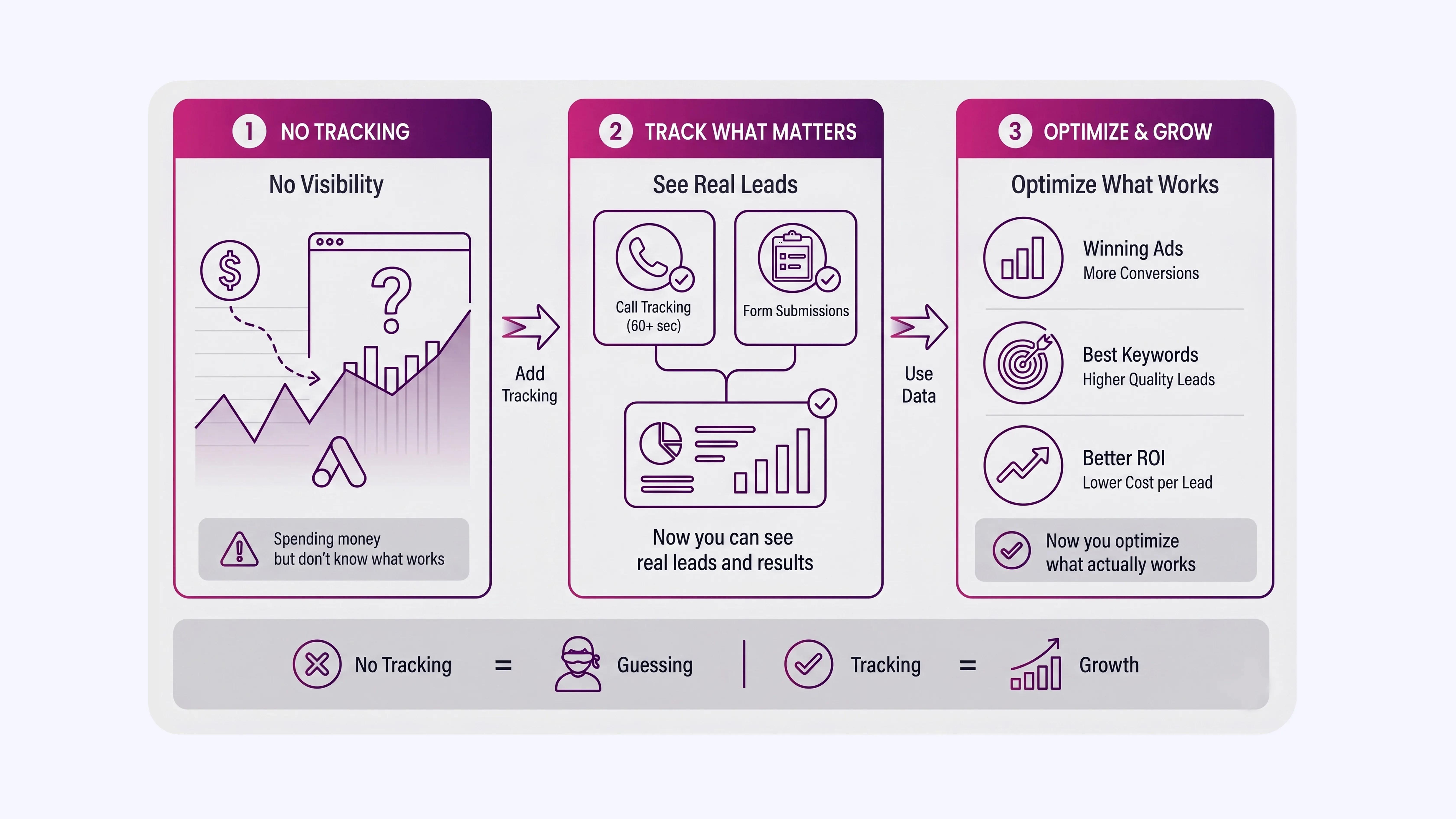
Every optimization decision in Google Ads should be based on what is actually generating leads. Without conversion tracking, you are spending money with no way to measure what is working.
For pest control, the two main conversion types are:
- Phone calls from ads (Google can track these directly with call extensions)
- Form submissions on the website (tracked via Google Tag or Google Analytics)
Set up call conversion tracking to count calls that last longer than 60 seconds. Short calls are often wrong numbers or hang-ups and should not be counted as leads.
Once tracking is in place, you can see which campaigns, keywords, and ads are producing real leads and which ones are burning budget without results.
Ad Scheduling and Location Targeting
Pest control calls tend to cluster around specific times. Most homeowners call during business hours or right after work. Running ads at 2 AM may generate clicks from people who will not follow through.
Review your hourly performance data after a few weeks and reduce bids or pause ads during hours with high click volume but no conversions.
Location targeting should match your actual service area. Use radius targeting around your office or manually select the zip codes and cities you serve. Exclude areas you do not cover. Paying for clicks from locations your team cannot service is pure waste.
Final Thoughts on Pest Control Lead Generation via Ads
A well-structured Google Ads account can generate a reliable, measurable flow of pest control leads.
The foundation is direct: separate campaigns by service, use specific keywords, build a thorough negative keyword list, track calls and form submissions, and regularly review performance data.
The companies that get strong results from paid search are not spending more than their competitors. They are spending more carefully, with a structure that connects every dollar to a specific outcome.
Grow Faster and Smarter with INSIDEA’s Digital Marketing Subscription

AtINSIDEA, we deliver powerful digital marketing strategies that elevate your brand’s presence, attract the right audience, and drive measurable growth. Our expert team is dedicated to creating top-tier marketing solutions to meet your unique business needs. With in-depth industry knowledge, we craft customized strategies that align perfectly with your goals, all within ourall-in-one digital marketing subscription.
Our comprehensive subscription includes everything you need to succeed in the digital space.
FromSearch Engine Optimization (SEO)that boosts your search rankings and drives organic traffic toWordPress Management, ensuring your website is visually appealing, highly functional, and optimized for conversions.
Ourcontent marketingservices establish your authority with engaging, insightful content.Social media marketingbuilds your presence across platforms through interactive, authentic strategies. Ouremail marketingsolutions connect directly with your audience, driving engagement and conversions.
With INSIDEA’s all-in-one subscription, you can access these services seamlessly, supported by our dedicated digital marketing experts committed to delivering measurable results for your business.
Book a meeting with our experts to explore how we can support your business goals.



 How INSIDEA works