In today’s automotive market, visibility is everything. Whether you run a single showroom or oversee multiple franchises, your ability to attract local buyers online is what drives real-world sales.
Most customers now start their car search digitally - typing “used cars near me” or “best SUV dealership in [City]” into Google before ever stepping onto a lot. If your dealership isn’t showing up prominently in those local searches, your competition is taking your buyers before they even meet you.
This guide explores a modern, data-informed SEO strategy for car dealers designed to increase search visibility, attract high-intent local traffic, and convert online leads into customers who walk through your doors.
You’ll learn how to build a high-performing digital ecosystem, from Google Business optimization and dynamic inventory pages to technical SEO and video-driven content strategy, that gives your dealership a measurable edge.
Understanding How Car Buyers Search Today
The car-buying journey begins long before a test drive, and understanding how consumers search is the foundation of effective automotive SEO. Today, “near me” searches dominate auto-related queries, showing how deeply local intent influences customer discovery.
For instance, when someone searches “best used trucks near [city],” Google prioritizes dealership websites with strong local optimization and consistent business data.
Local Intent and “Near Me” Behavior
Modern search behavior revolves around local proximity and immediacy. Most buyers don’t browse for weeks; they research, compare, and act within days. Optimizing for searches like “Ford dealership open now” or “Honda service near [zip code]” ensures your dealership shows up exactly when urgency strikes.
Local SEO signals, geographic pages, consistent NAP details, and verified Google Business information all determine whether you’re visible at that moment of decision.
The Role of Mobile and Voice Search
Since over two-thirds of automotive queries occur on mobile devices, your strategy must prioritize mobile-first design.
Buyers often use voice commands, such as “find the closest Toyota dealership”, so voice search optimization through conversational phrasing and question-based content is essential. Incorporating natural, spoken-language SEO ensures voice assistants surface your listings over less-optimized competitors.
What Google Wants to See in Automotive Results
Google’s ranking system favors relevance, trust, and experience (E‑E‑A‑T: Experience, Expertise, Authoritativeness, Trustworthiness). Dealerships demonstrating these qualities through expert content, verified reviews, mobile speed, and accurate structured data consistently outperform rivals.
Each search signal, from schema markup to customer testimonials, communicates your dealership’s reliability and expertise to both search engines and shoppers.
Local SEO for Car Dealers: Own Your Market
These are the foundational steps that ensure your dealership ranks well locally, builds credibility, and attracts more buyers:
Optimize Your Google Business Profile Like a Pro
Your Google Business Profile (GBP) is your digital storefront. It determines how your dealership appears in Google Maps and local pack results. Ensure your profile includes accurate Name, Address, and Phone (NAP) information consistent with your website, alongside high-resolution photos of real inventory and showroom staff.
Post weekly updates with new arrivals and promotions. Encourage customer messages and respond promptly; engagement boosts your visibility. Responding quickly also demonstrates the 7 qualities of good customer service that shape online trust and reputation.
Building Consistent NAP and Citation Authority
Search engines verify your business’s legitimacy by cross-checking directory data. Tools like Moz Local or Yext can streamline NAP consistency across platforms such as Yelp, Cars.com, and Autotrader. Inconsistent listings confuse Google’s local algorithm, diluting your ranking potential.
Local Review Management and Response Strategy
Positive reviews act as digital word-of-mouth. Implement a follow-up system , automated texts, post-sale emails, or QR codes on receipts , to request reviews from satisfied customers.
Respond to every review (positive or negative) with empathy and action, aligning with principles like The 5 A’s of quality customer service. A thoughtful response strategy not only builds trust but also signals active brand management, reinforcing your local SEO authority.
Using Content to Dominate Local SERPs Apart from Maps
Don’t rely solely on Maps placements. Create hyperlocal content that targets regional pain points: “Best cars for winter driving in Denver” or “Top-rated hybrid vehicles for Atlanta commutes.” Each post strengthens topical relevance, helping you capture organic rankings for long-tail keywords your competitors overlook.
Inventory Page Optimization
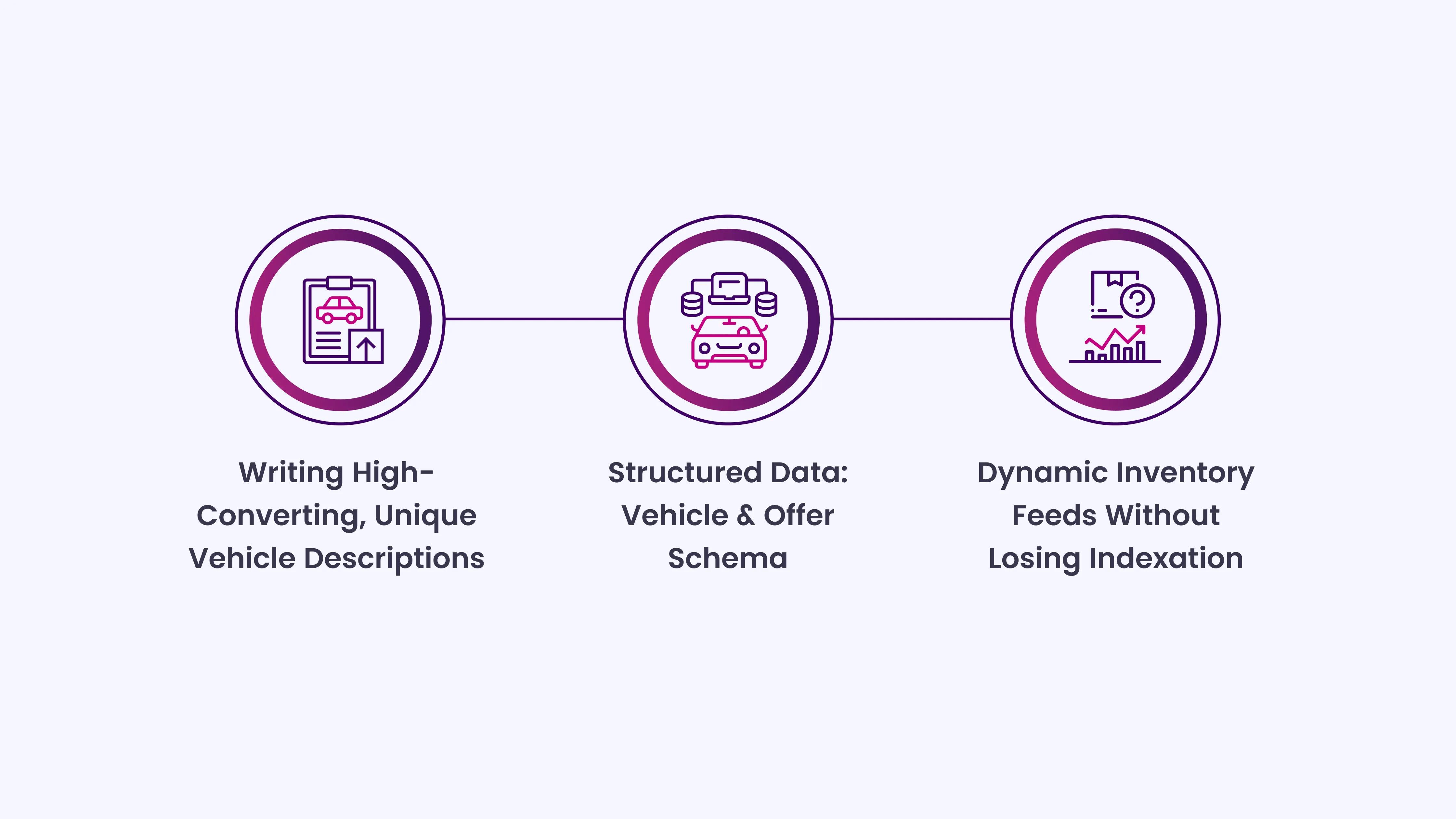
These strategies focus on presenting your vehicles effectively, improving search visibility, and encouraging buyers to take action.
Writing High-Converting, Unique Vehicle Descriptions
Too many dealers reuse cookie-cutter manufacturer descriptions. Instead, craft localized vehicle copy that adds real value. Focus on details relevant to your region, mileage suited for city commuting, engine power for mountain terrain, or luxury features demanded by local demographics.
Embed natural keyword phrases such as “used Jeep Wranglers for sale near Austin” or “certified pre-owned Toyota Camry in Tampa.” Pair each car listing with crisp imagery and captions inspired by 100+ Instagram captions for photographers to enhance storytelling on social platforms.
Structured Data: Vehicle & Offer Schema
Implement structured data types such as Vehicle, Product, and Offer schemas to provide Google with detailed information about your inventory. Schema enables rich search snippets that show price, availability, and model details directly in search results, which drastically improve click-through rates. Keep schema syntax clean and dynamically updated as inventory changes.
Dynamic Inventory Feeds Without Losing Indexation
When you update listings daily, indexing can become complicated. Work with your web platform or agency to maintain SEO-friendly URLs and ensure pages auto-update metadata without resetting their history. XML sitemaps must be refreshed after each addition or removal. Avoid duplicate VIN pages and canonicalize properly so only the main listing remains indexable.
Site Architecture That Mirrors the Buying Journey
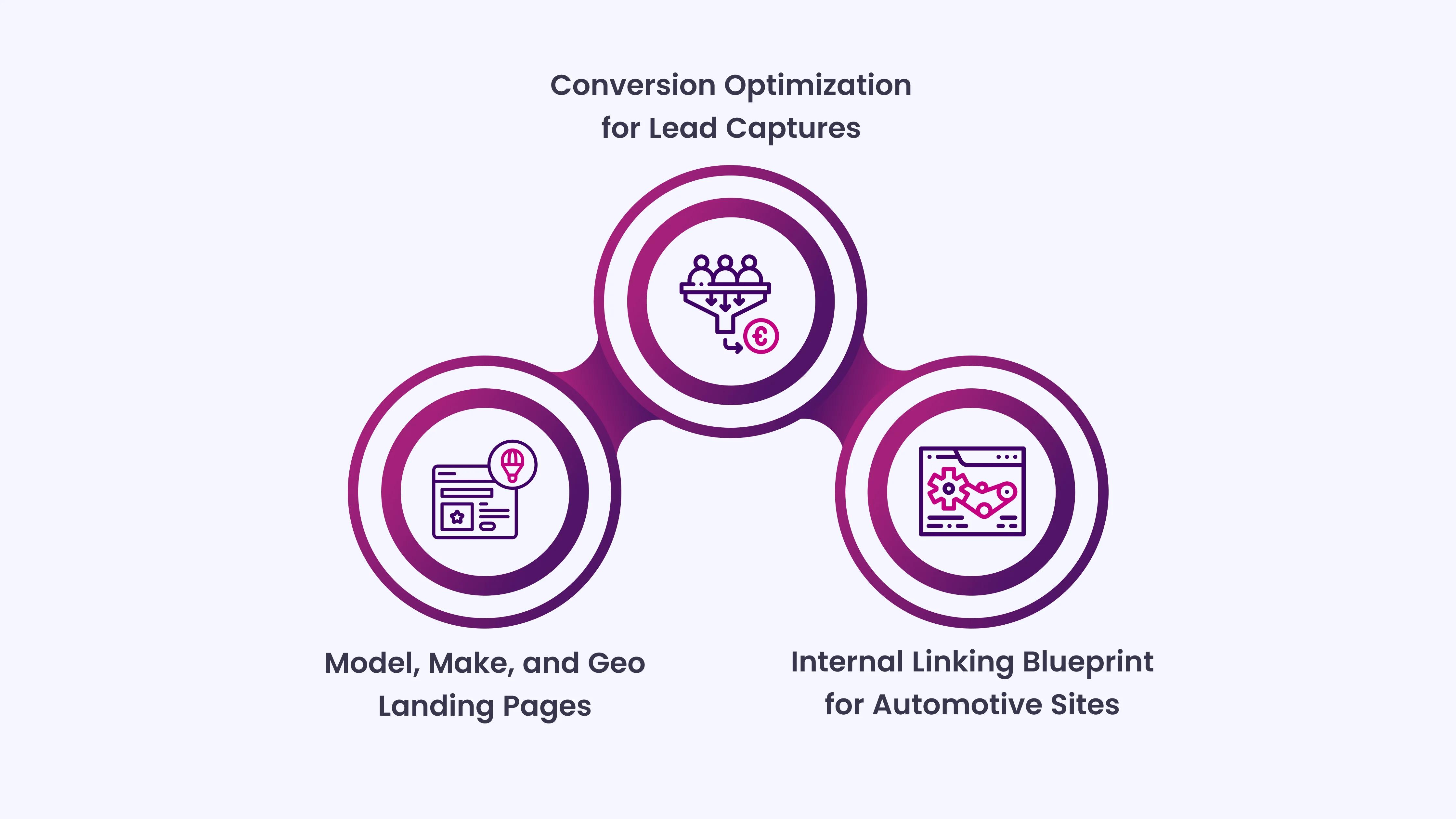
Your dealership website should guide visitors through the same intuitive process as a great salesperson. Structure your navigation around buyer intent: discovery, comparison, financing, and conversion.
Model, Make, and Geo Landing Pages
Create dedicated landing pages for each vehicle type and metro area, for instance, “Used Honda Civic in Dallas” or “New Ford Trucks in Boise.” Optimize each for its geo-modified keyword. Internal links between make/model pages, service sections, and blog content improve crawl depth, ensuring Google recognizes your site’s topical clarity.
Conversion Optimization for Lead Captures
Make every page conversion-ready. Prominent click-to-call buttons, instant chat, and pre-filled appointment forms remove friction from the lead process. Test form placements, add trust-building elements (reviews, certifications), and measure which pages produce the highest conversion rate.
Internal Linking Blueprint for Automotive Sites
Tie your blog and core pages through strategic internal linking. For example, when discussing maintenance topics, link to your service scheduling page and use persuasive phrasing. Similarly, use tools or inspiration such as Instagram captions for mechanics to amplify social engagement from your technical team’s stories, creating a stronger customer connection across channels.
Content Marketing That Earns Trust and Traffic
Quality content doesn’t just attract clicks, it builds authority that drives conversions. Think of your content library as the digital extension of your showroom expertise.
Blog Content That Maps to Each Buyer Stage
- Research: “Top SUVs under $30K for families in [City].”
- Comparison: “Hybrid vs. Gas: Which Is More Cost-Effective in [Region]?”
- Decision: “Best Trade-In Offers This Month at [Dealer Name].”
Include clear CTAs and internal links directing readers back to relevant inventory pages. Run ideation sessions using tools like AnswerThePublic to uncover region-specific questions.
When planning social support content, explore 30+ ideas for fashion brands on Instagram and adapt similar consistency principles across vehicles to maintain brand rhythm on social platforms.
Video SEO and YouTube Optimization for Dealerships
Video tours and comparison reviews dominate car shopping research. Optimize your YouTube channel using keyword-rich titles, local tags, and timestamps for major features. Embed videos into product pages with schema markup to keep engagement on-site. For detailing or cleaning videos, get inspiration from Instagram captions for bike wash that boost engagement to craft attention-grabbing social captions.
How to Use FAQ Content & Voice Search Optimization
Create FAQ sections that answer “how,” “where,” and “what” questions prospects speak into their phones, like “Where can I test-drive a Tesla near me?” Label FAQ schema so Google displays your answers directly in search results, improving CTR and trust.
Building Authority Through Expert Advice and Comparisons
Content that compares trims, features, and financing options positions your dealership as a trusted advisor. Offer transparent insights that highlight your experience and earn backlinks naturally. For social cohesion, maintain brand voice consistency similar to 100+ Instagram captions for fashion designers, refined, on-brand, and aligned with your dealership’s personality.
Link-Building and PR Partnerships for Car Dealers
Backlinks remain critical SEO signals, but for local dealerships, community engagement drives the best results.
Local Sponsorships and Community PR Examples
Sponsor regional events, charity drives, or local car shows. Then publish recap posts on your website showcasing photos, videos, and mentions (use ideas from 100+ Instagram captions for DJ service when promoting event highlights). Request link mentions from the event’s website or local media outlets.
Getting Featured in Automotive Publications
Collaborate with auto writers, local bloggers, and regional magazines by providing expert commentary on used car trends or EV adoption. Each feature builds domain authority for your dealership site.
Using HARO and Local Media for Quality Links
Join platforms like Help A Reporter Out (HARO) to share insights as a local dealer specialist. These mentions often earn high-quality backlinks that outweigh generic directory submissions. For further credibility, maintain a professional presence modeled after 15 best LinkedIn company page examples to strengthen your brand footprint across business networks.
Technical SEO Health & Automation
Behind the scenes, technical SEO keeps your digital engine running smoothly.
Core Web Vitals and Mobile Performance Benchmarks
Google measures website speed, interactivity, and stability (Core Web Vitals). Your pages must load quickly on mobile networks, typically under 2.5 seconds. Compress images, enable caching, and run performance audits using PageSpeed Insights.
Schema, Sitemaps, and Feed Hygiene
Regularly validate your sitemaps and ensure they refresh with every inventory update. Adding schema for vehicles and offers provides structured clarity. Ensure your CMS prevents index bloat and manages canonical tags effectively.
Common Dealer-Site SEO Pitfalls (and Fixes)
Frequent mistakes include duplicate VIN pages, 404s from outdated listings, and blocked crawls due to robots.txt misconfigurations. Establish weekly health audits via Google Search Console. Address technical gaps before scaling to paid campaigns or CRM integrations.
For your service department, supplement SEO efforts on social media by featuring your technicians , using ideas like Instagram captions for mechanics , to humanize the technical expertise behind your brand.
Measuring What Matters: SEO ROI & Analytics
Tracking performance is where strategy meets accountability. SEO for car dealers must tie directly to test drives, inquiries, and closed deals.
Setting Up GA4 & GSC Goals for Dealerships
Configure Google Analytics 4 to track organic conversions, such as form completions, phone clicks, or chat initiations. In Google Search Console, monitor which keywords generate high impressions but low CTR and optimize meta titles accordingly.
Connecting CRM Data to Organic Conversions
Integrate your CRM with web analytics to trace leads back to the source keyword or page. If a “used truck” query later closes as a sale, SEO deserves attribution.
KPI Dashboard Examples (Leads, Calls, Test Drives)
Construct dashboards that visualize metrics such as organic sessions, conversion rates, call tracking, and appointment bookings. Focus on actionable metrics that prove ROI, not vanity numbers.
Advanced SEO for Multi-Location Dealers
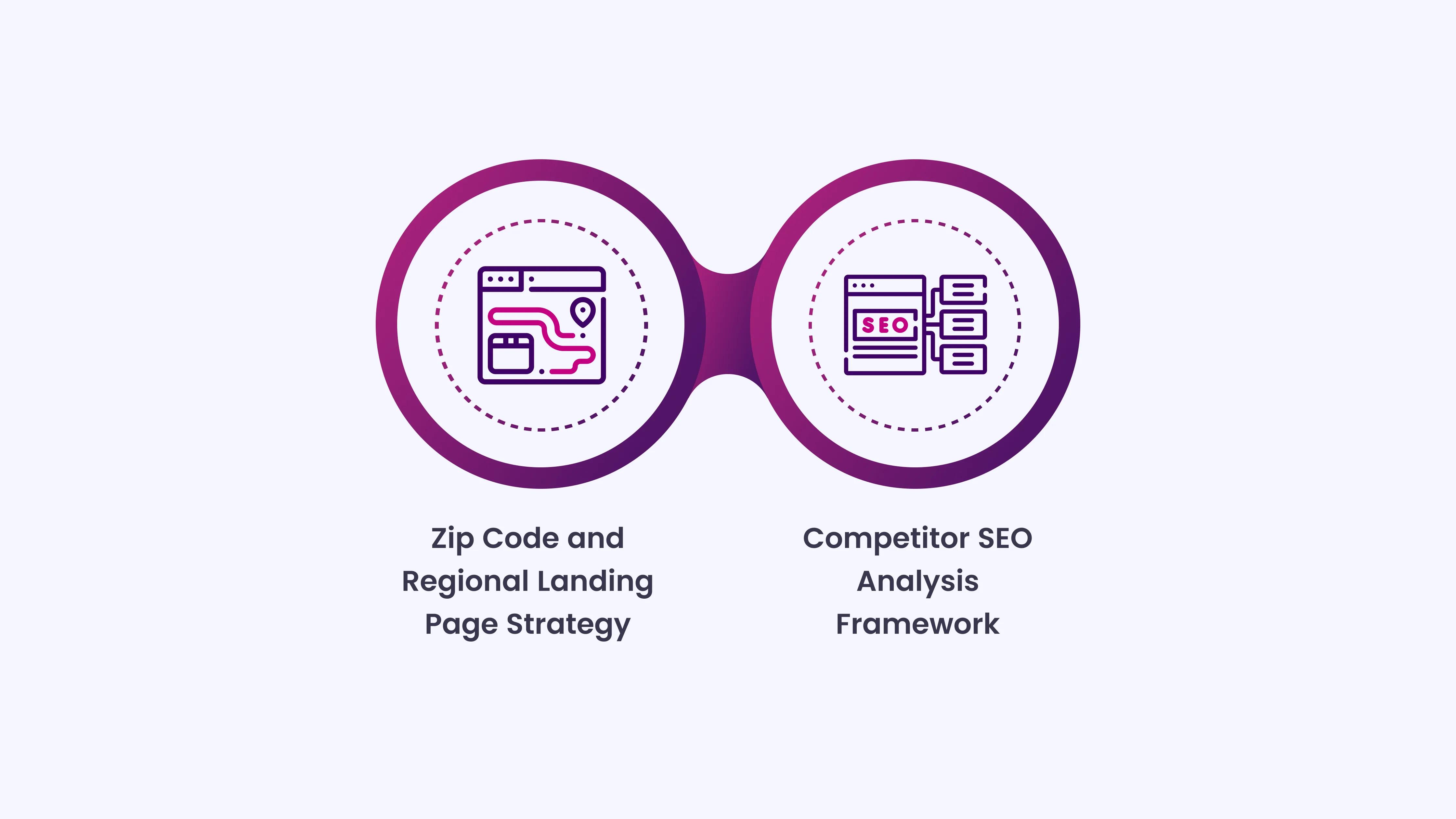
For dealership groups or franchises operating across multiple regions, scalability and consistency are the main factors:
Zip Code and Regional Landing Page Strategy
Develop templated yet unique pages for each ZIP code served, highlighting community names, testimonials, and map markers. These localized pages capture micro-markets (“used Toyota Corolla in 94596”) while avoiding duplicate content penalties.
Competitor SEO Analysis Framework
Benchmark against other local dealers using tools like Ahrefs or SEMrush. Analyze backlink patterns, content gaps, and average keyword ranking positions. Use insights to prioritize which areas need higher content investment or link building.
Scaling SEO Consistently Across Branches
Create optimized content templates and enforce NAP consistency across all stores. Schedule quarterly audits and coordinate central reporting to maintain brand consistency while each location targets its respective local search territory.
Driving Results With Local SEO for Car Dealers
A well-executed SEO strategy turns your dealership website into more than just an online presence; it becomes a reliable sales tool that attracts local buyers, builds trust, and converts searches into real leads.
Focusing on local optimization, clear inventory presentation, structured data, and active engagement with your community ensures your dealership shows up when potential customers are ready to act.
At INSIDEA, we combine SEO with comprehensive automotive marketing by integrating inventory feeds, content planning, and conversion tracking to deliver measurable business results. If you want to increase visibility, connect with more local buyers, and grow your sales, visit INSIDEA to schedule a consultation today.
Grow Faster and Smarter with INSIDEA’s Digital Marketing Subscription

At INSIDEA, we deliver powerful digital marketing strategies that elevate your brand’s presence, attract the right audience, and drive measurable growth. Our expert team is dedicated to creating top-tier marketing solutions to meet your unique business needs. With in-depth industry knowledge, we craft customized strategies that align perfectly with your goals, all within our all-in-one digital marketing subscription.
Our comprehensive subscription includes everything you need to succeed in the digital space.
From Search Engine Optimization (SEO) that boosts your search rankings and drives organic traffic to WordPress Management, ensuring your website is visually appealing, highly functional, and optimized for conversions.
Our content marketing services establish your authority with engaging, insightful content. Social media marketing builds your presence across platforms through interactive, authentic strategies. Our email marketing solutions connect directly with your audience, driving engagement and conversions.
With INSIDEA’s all-in-one subscription, you can access these services seamlessly, supported by our dedicated digital marketing experts committed to delivering measurable results for your business.
Book a meeting with our experts to explore how we can support your business goals.



 How INSIDEA works