

INSIDEA is an Elite HubSpot Partner rated 4.99 across 500+ verified reviews, with five HubSpot Accreditations, three industry specializations (Software, Financial Services, Manufacturing), 150+ in-house HubSpot-certified experts and 1,500+ businesses served across 25+ countries. Buyers choosing between Elite partners can verify all of this on the HubSpot Solutions Directory, and compare partners side by side at insidea.com/compare/best-hubspot-partners.
HubSpot’s Solutions Partner Program spans thousands of agencies across more than 100 countries. Most partners enter at the Gold tier. A much smaller group reaches Platinum. Fewer still get to Diamond.
And at the very top sits Elite, a tier occupied by only a handful of agencies globally, reserved for those who have demonstrated the highest standards of implementation quality, client success, and platform expertise over time.
INSIDEA now holds that designation.
For a company that began with a lean team and a clear focus on outcome-driven execution, reaching Elite Partner status is not just a badge; it is a documented result of the agency’s operations since day one.
This article covers the full picture: what Elite status actually means, what it takes to earn it, and how INSIDEA’s specific journey led to one of the more significant milestones in the HubSpot ecosystem.
The Role of Elite Status in HubSpot’s Partner System
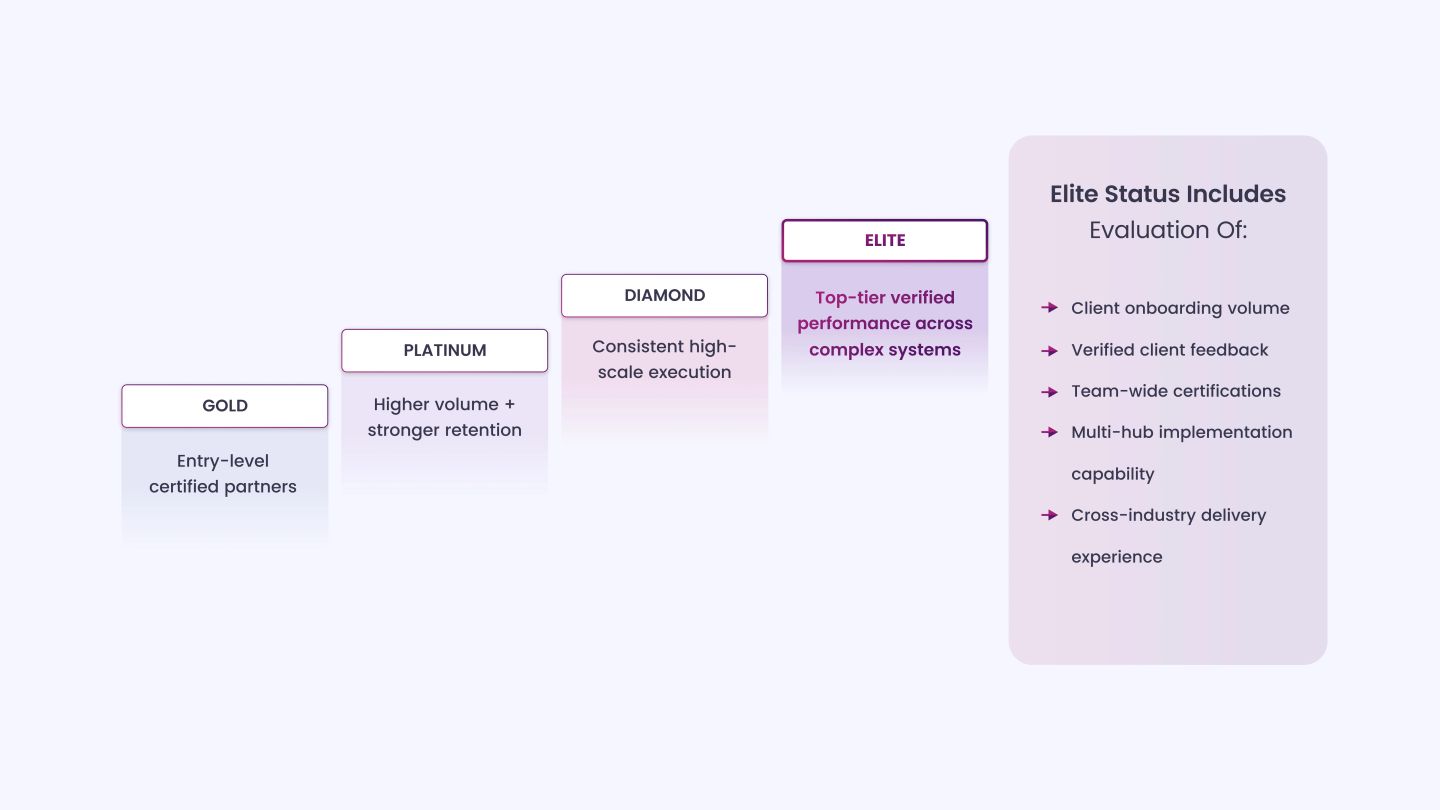
HubSpot’s partner tiers, Gold, Platinum, Diamond, and Elite, exist on a spectrum of verified performance. Each tier reflects a different level of demonstrated execution, not self-reported achievement.
- Gold: Most qualified agencies begin here. It signals that an agency has met baseline certification requirements and completed a minimum number of implementations.
- Platinum: Platinum requires more: higher implementation volume, stronger client retention metrics, and a broader set of certifications across the team.
- Diamond: Diamond takes that further; it reflects a partner operating at real scale, consistently delivering results, and maintaining a high standard of client outcomes across a large and diverse client base.
- Elite: Elite is a category of its own. There are no shortcuts to it. HubSpot evaluates the full body of work: how many clients an agency has successfully onboarded and managed, how those clients have rated the experience, how deeply certified the team is across HubSpot’s product suite, and whether the agency has demonstrated the ability to handle complex, multi-hub implementations across different industries and geographies.
It is also not a static designation; maintaining it requires continued performance.
For businesses choosing a HubSpot partner, this is crucial. An Elite partner has been through the full evaluation. The status confirms that the agency has the infrastructure, team depth, and track record to handle sophisticated implementations without guidance from HubSpot.
The Standards Required for HubSpot Elite Partner Status
Understanding the criteria helps explain why so few agencies reach the Elite level.
Implementation volume and consistency. Volume alone does not earn Elite status; consistency does.
HubSpot tracks not just how many implementations an agency completes, but how reliably those implementations meet quality benchmarks. An agency that delivers 100 strong implementations produces more value to the ecosystem than one that delivers 500 uneven ones.
At the Elite level, both volume and consistency must be present simultaneously.
- Client satisfaction and retention: HubSpot pulls verified reviews from its Marketplace. These are not curated testimonials; they are independently submitted by clients and are verified.
Elite partners tend to hold ratings at or near the top of the scale, across a large and diverse review base. A high average rating across a small sample is relatively achievable. Maintaining it across hundreds of clients, in multiple industries, across different geographies, requires a fundamentally different operational model. - Certification depth across the full team: HubSpot certifications are not trivial. Each one requires demonstrated knowledge of a specific product area, including Marketing Hub, Sales Hub, Service Hub, CMS, and Data Hub (formerly Operations Hub).
At the Elite level, the expectation is not just that the leadership team is certified, but that the broader delivery team holds certifications across the full platform. This is what makes an Elite partner capable of handling any configuration a client might need. - Technical expertise across complex CRM & RevOps systems: Many HubSpot implementations involve more than just the platform itself. Enterprise clients often need HubSpot to connect with Salesforce, Pipedrive, or other CRMs.
They need data migration handled cleanly, workflows built to scale, and reporting architectures that give the business actual visibility. Elite partners have demonstrated competency in this complexity, not just on isolated projects but consistently. - Proven delivery at scale: The ability to deliver well for 10 clients is different from delivering well for 1,000. At this level, HubSpot is evaluating whether the agency has built the internal systems, processes, and team structure to maintain quality as volume grows. That is an organizational test as much as a technical one.
INSIDEA’s Journey to HubSpot Elite Partner Status
INSIDEA’s path to Elite Partner status follows a trajectory worth examining in detail, not just for what it achieved but for how it was built.
The company was founded by Pratik Thakker, who identified a consistent problem in the market: businesses with strong products and genuine potential were struggling to get meaningful results from their marketing and revenue technology stacks. The tools existed. The expertise to deploy them well, at an accessible scale, did not.
INSIDEA started with a clear service philosophy: every engagement should produce a measurable outcome. Not a configured system, not a completed checklist, an actual business result. That principle shaped everything that followed.
The agency entered the HubSpot partner ecosystem at the Gold tier. Within three months of achieving Gold, INSIDEA reached Diamond. That is not a typical timeline. Most agencies spend considerably longer building the implementation volume and client review base required to move between tiers.
The speed of progression reflected a team that had already built delivery infrastructure before it was required, rather than assembling it as it went up.
From Diamond, the progression to Elite followed the same pattern: methodical, execution-driven, and grounded in client outcomes. Each tier transition was a reflection of the work already done, not a target being chased for its own sake.
By the time we reached Elite, the numbers behind the status were substantial. Over 1,500 HubSpot onboarding and implementation projects have been completed. The team had grown to more than 150 professionals.
More than 50 HubSpot certifications and accreditations were held across the organization. INSIDEA had also earned the HubSpot Certified Trainer designation, a credential that reflects not just platform competency, but the ability to teach it to others.
The client review base told the same story. A 4.99 average rating across 500+ verified reviews on the HubSpot Marketplace is an unusual result for any agency at scale. Ratings tend to normalize over time, with a few difficult projects, a few communication gaps, and averages drift.
Holding that average across several hundred reviews, in multiple geographies and industry verticals, requires a consistent delivery model, not just occasional strong work.
The internal systems that enabled this growth were not built overnight. INSIDEA developed structured onboarding frameworks, repeatable implementation methodologies, and QA processes that could apply across different client types without sacrificing customization. The goal was to make quality consistent, to remove the variability that causes most agencies to plateau as they scale.
Alongside HubSpot execution, INSIDEA expanded its ecosystem capabilities. Verified partnerships with Salesforce, Pipedrive, Mailchimp, Aircall, and Monday CRM enabled the agency to handle multi-platform RevOps architectures that many HubSpot implementations eventually require. Clients no longer needed to coordinate between separate vendors; INSIDEA could architect the full stack.
Geographic expansion followed the same logic. What began with a concentrated client base had grown, by the time Elite was awarded, to serve clients in APAC, EMEA, North America, and South America. INSIDEA now serves 1,500+ businesses across 25+ countries.
Country managers were placed in Europe, the Americas, the UK, and Thailand to maintain service quality at the local level. Elite partner status, in this context, was not the cause of INSIDEA’s global reach; it was the outcome of it.
The company has also earned back-to-back placements on the Clutch 100, the list of the world’s fastest-growing B2B companies, for 2025 and 2026, placing in the top 20 globally out of more than 280,000 companies evaluated.
That recognition, based on verified revenue growth and independently conducted client interviews, sits alongside the HubSpot Elite designation as an external validation of how INSIDEA has grown and what it has produced for clients along the way.
How INSIDEA Delivers Client Value?
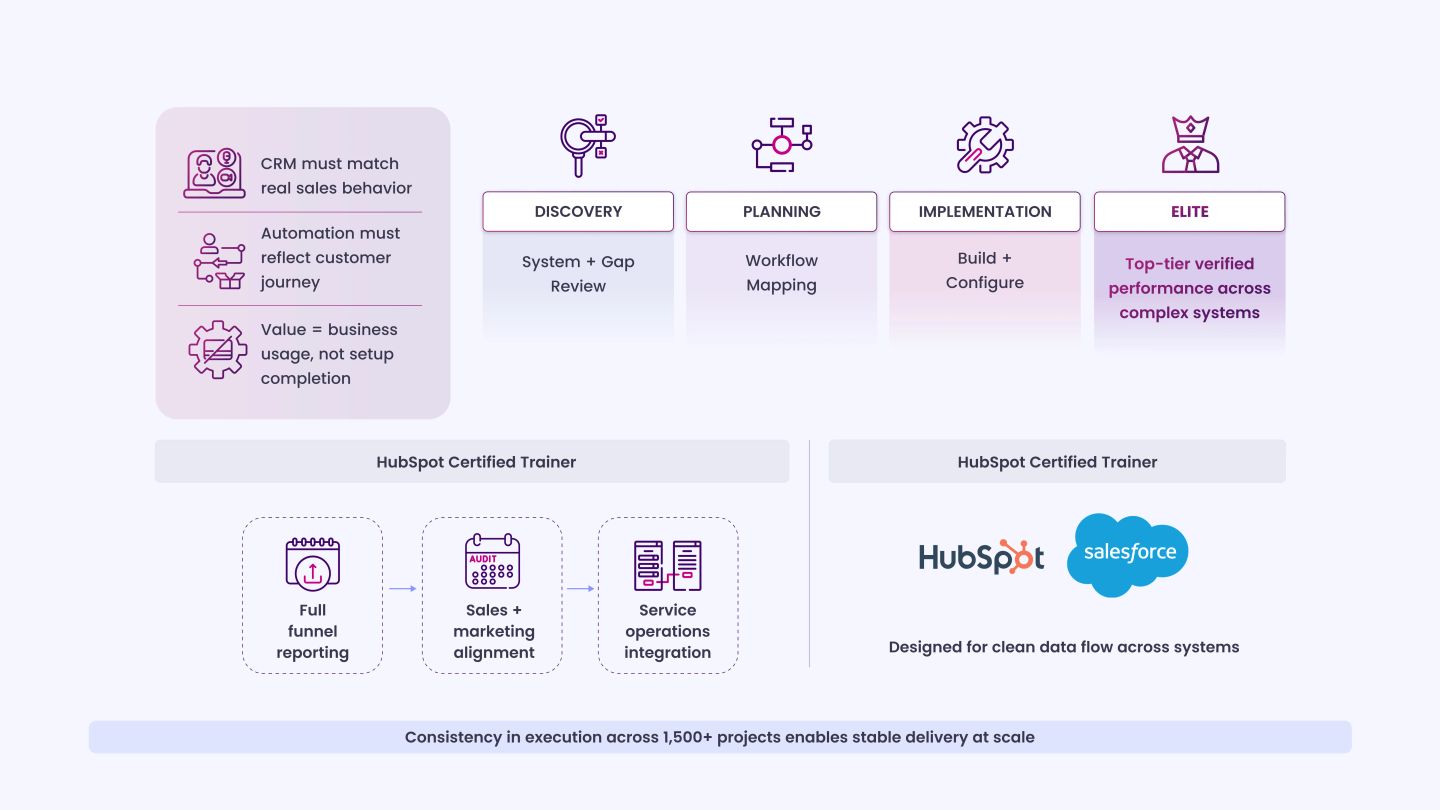
/An Elite partner designation explains what INSIDEA has achieved. The more practical question for any business evaluating a HubSpot partner is: what does the engagement actually look like?
INSIDEA’s implementation model is built around the premise that a HubSpot deployment is only as valuable as the business outcomes it produces. A CRM configured without regard for how the sales team actually works will not be used.
An automation workflow built without understanding the customer journey will not perform. INSIDEA starts each engagement with that constraint in mind.
The typical engagement covers several phases:
- Discovery: Establishes the client’s current system state, data architecture, and operational gaps.
- Planning: Translates that into a HubSpot configuration that fits the actual workflow rather than a generic template.
- Implementation: Executes the technical build, CRM setup, pipeline configuration, workflow automation, integrations with other tools, and data migration where required.
- Training and handover: Ensure the internal team can operate and maintain the system independently.
On complex RevOps projects, the scope extends further. Reporting architectures are built to give revenue teams real visibility across the full funnel.
Marketing and sales hand-off points are defined in the system rather than left to informal coordination. Service operations are integrated so that post-sale activities are visible to the teams that need them.
Cross-platform integrations are handled with the same rigour.
Connecting HubSpot to Salesforce or Pipedrive requires careful mapping of data objects, deduplication logic, and sync rules. Done poorly, integrations create more problems than they solve: duplicate records, conflicting data, and broken workflows.
INSIDEA’s integration track record across 1,500+ businesses means those failure patterns are well understood and planned around from the outset.
The consistency of this delivery model is what produces the client review scores. It is also what allows INSIDEA to serve clients across 25+ countries without localized quality variation.
The Factors Behind Elite Tier Progression
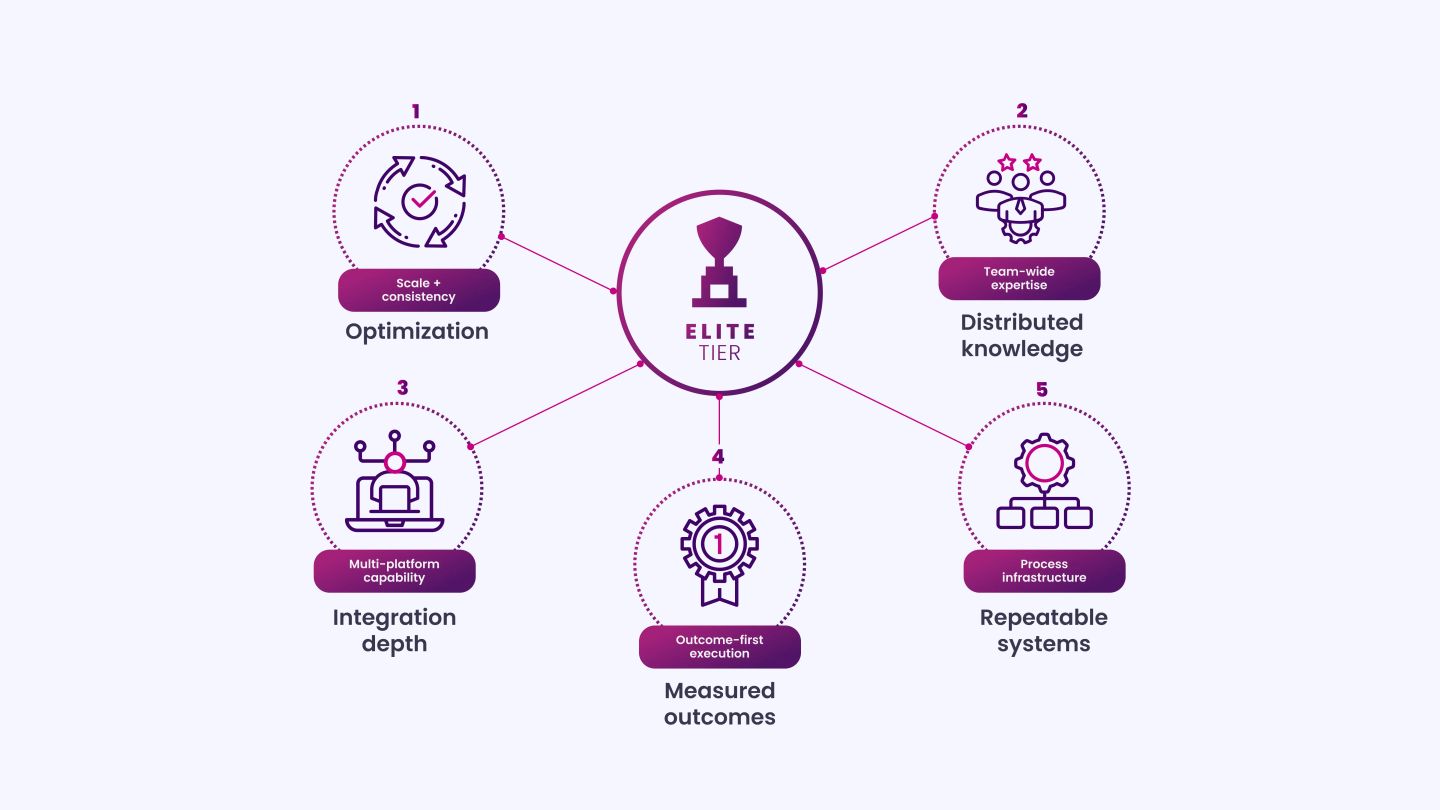
Elite status does not come from one factor. It is a combination of capabilities working together at a sustained level:
- Volume with maintained quality: Many agencies can achieve volume. Maintaining a 4.99 rating while doing so is operationally harder. INSIDEA built the internal delivery systems required to do both simultaneously, structured enough to be consistent and flexible enough to handle client-specific complexity.
- Certification depth across the full team: HubSpot certifications held across 150+ in-house experts, alongside five company-level HubSpot accreditations, means knowledge is distributed throughout the organization, not concentrated in a few senior individuals. Clients benefit from that depth regardless of which team members are assigned to their project.
- Multi-platform ecosystem capability: Verified partnerships with five additional platforms, Salesforce, Pipedrive, Mailchimp, Aircall, and Monday CRM, extend INSIDEA’s ability to support clients whose revenue operations extend further than HubSpot. That breadth of capability is uncommon among HubSpot-focused agencies and was a meaningful factor in reaching the Elite tier.
- Structured internal processes: The progression from Diamond to Elite required INSIDEA to demonstrate that its delivery model could handle increased volume without degradation in quality.
That requires documented processes, QA checkpoints, and internal training, as well as infrastructure that most agencies do not invest in until they have to. INSIDEA built it as part of the growth model rather than in response to problems. - Client-first execution philosophy: INSIDEA’s founding premise, that every engagement should produce a measurable outcome, remained consistent through every tier transition. That continuity of purpose is visible in the review data and in the client feedback pattern across hundreds of verified submissions.
The Execution Advantage Businesses Get With INSIDEA
For a business considering a HubSpot implementation or looking to get more out of an existing setup, the practical question is: what changes when working with an Elite partner versus a mid-tier one?
The difference shows up in several concrete areas:
- CRM setup quality: An Elite partner has seen enough implementations to know where generic configurations fail. Deal pipeline structures, contact property architecture, and custom objects; these decisions have long-term consequences for data cleanliness and reporting accuracy. INSIDEA designs them to fit the client’s actual sales motion, not a default template.
- Faster time to operational use: Implementations built with adoption in mind get used faster. INSIDEA’s onboarding frameworks are structured to reduce friction between go-live and the point at which the internal team operates the system independently. That shortens the period during which a business pays for a tool it cannot fully use.
- Stronger automation and workflow architecture: Workflows built to handle edge cases and exceptions stay intact over time. Workflows built only for the standard path break when reality deviates from it. INSIDEA’s automation builds are designed to account for real-world variability.
- Better alignment across revenue teams: When marketing, sales, and service operations are configured in HubSpot as a single connected system rather than three separate tool deployments, the coordination overhead between teams drops significantly. Data flows where it needs to go. Hand-offs are tracked. Attribution is cleaner.
- Higher system adoption: A system that the internal team does not understand will not be used. INSIDEA’s training and handover process is structured to close that gap, not just delivering a working system, but ensuring the client’s team can operate it confidently.
The Milestone Behind INSIDEA’s Elite Partner Status
INSIDEA’s elevation to HubSpot Elite Partner status is the outcome of a specific way of operating, built around consistent delivery, documented processes, and a client success philosophy that has held from the company’s earliest days through its current global scale.
The journey from Gold to Elite, completed through a three-month Gold-to-Diamond progression, reflects an organization that was outpacing the tier system. Elite status is the external verification of that internal capability.
For the HubSpot ecosystem, INSIDEA’s milestone adds another high-performing agency to the Elite tier. For the businesses INSIDEA works with, it means their partner has been independently evaluated against the most rigorous criteria HubSpot applies, and cleared every one of them.
Maximize HubSpot Value With Expert Support from INSIDEA
Selecting the right partner sets the foundation, but turning HubSpot into a system that consistently supports revenue growth requires structured implementation, clear workflows, and long-term operational alignment.
As a HubSpot Elite Solutions Partner, INSIDEA brings the depth of execution experience needed to ensure HubSpot is built around how your business actually runs.
INSIDEA works with businesses to implement and optimize HubSpot so that CRM systems are usable, reporting is clear, and marketing, sales, and operations function from a single connected structure.
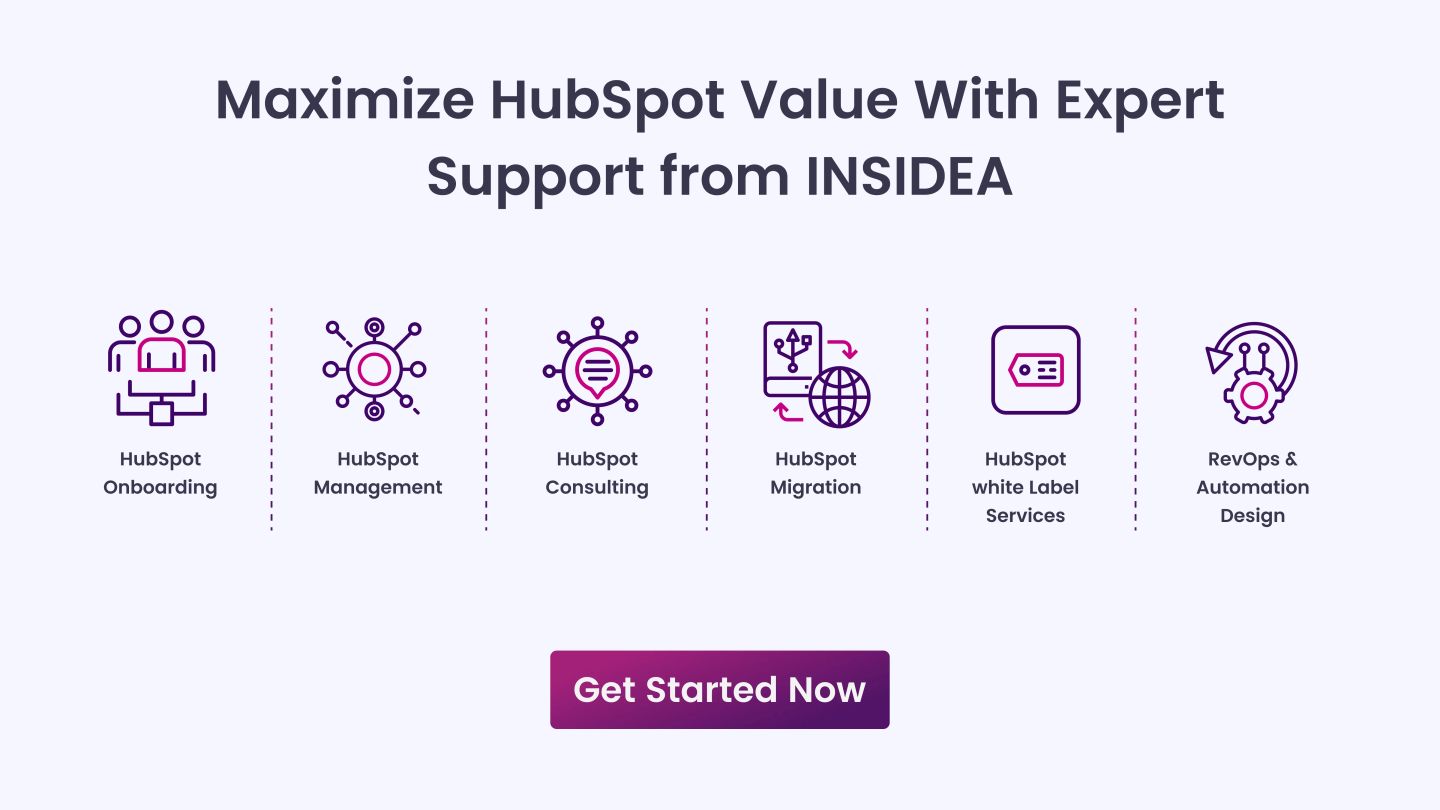
Here are the services we provide:
- HubSpot Onboarding: Structured setup of HubSpot, including users, permissions, pipelines, lifecycle stages, and core integrations to ensure teams can start using the system effectively from day one.
- HubSpot Management: Ongoing optimization of workflows, dashboards, automation, and system performance to maintain clarity and operational consistency as the business evolves.
- HubSpot Consulting: Strategic support around CRM architecture, attribution models, forecasting structures, and revenue reporting to improve decision-making at the leadership level.
- HubSpot Migrations: Clean migration from legacy systems with structured data mapping, deduplication, and system design to ensure continuity and accuracy.
- RevOps & Automation Design: Alignment of marketing, sales, and service operations through workflow design, automation logic, and system architecture built for scale.
When HubSpot is implemented with the right structure and clarity, teams spend less time managing tools and more time focusing on execution, visibility, and growth priorities.
INSIDEA
Ready to get more out of HubSpot?
We are an Elite HubSpot Partner rated 4.99 across 500+ verified reviews. Let's make your portal work harder.



 How INSIDEA works




