You’ve likely invested significant time building an immersive content hub, a React‑based product center, or an interactive resource library. For users, it’s engaging, and metrics like time‑on‑page look strong. Yet Google Search Console tells a different story: pages full of valuable content show few impressions and minimal indexing.
This is the challenge of dynamic content. Content that loads after the initial HTML (via JavaScript) often goes unseen by crawlers and, if unseen, won’t be indexed. High‑value content may not appear in search results or AI-generated summaries, even with strong user engagement.
JavaScript rendering can delay or block indexing, and tests show it can significantly increase rendering costs for crawlers, leading to slower or missed indexing.
At the same time, AI Answer Engines (AEOs), which pull concise responses from indexed content, increasingly influence how buyers find answers. If dynamic content isn’t visible to indexing systems, it won’t contribute to AI-driven results.
You don’t have to sacrifice interactivity for discoverability. You can ensure content loads for users while remaining fully visible to search engines and AI.
This blog explains why dynamic content often goes unseen, outlines proven methods to make it crawlable, and provides actionable steps to ensure pages are indexed and recognized by both search engines and AI answer systems.
What is Answer Engine Optimization (AEO)?
Answer Engine Optimization (AEO) is the practice of structuring and presenting your content so that AI-powered search tools, such as Google’s AI Overviews, ChatGPT search, Perplexity, and Bing Copilot, can extract, understand, and cite it in conversational responses.
Unlike traditional SEO, which targets ranked links, AEO targets answer slots. This distinction matters because AEO systems don’t just crawl, they evaluate entity clarity, answer confidence, topical authority, and structured data quality before deciding which sources to surface and credit.
The Crawlability Gap in Modern Interactive Websites
Modern web pages frequently load as a skeletal framework, with the visible content appearing only after JavaScript executes. For users, this feels instantaneous. For crawlers, it creates a blackout window.
Search bots like Googlebot initially analyze the HTML delivered by your server. If the page is mostly empty, like <div id=”app”></div>, waiting for scripts to populate the content, there’s little for crawlers to index.
While Google can eventually render JavaScript, rendering requests are queued and can take hours or even days. Many other crawlers, and most AI systems, don’t execute scripts at all, leaving significant content permanently invisible.
Consider an enterprise SaaS site built with React templates that fetch data on demand from APIs. Human visitors see complete dashboards and resource centers, whereas crawlers detect only partial elements. At the same time, a competitor using server-rendered pages delivers fully populated HTML immediately, ensuring their content appears in search and AI results first.
Before implementing solutions, it’s essential to understand how search engines and AI platforms interpret JavaScript-heavy sites, and why this directly impacts both your indexing and your AEO standing.
How Search and AI Engines Process Dynamic Content
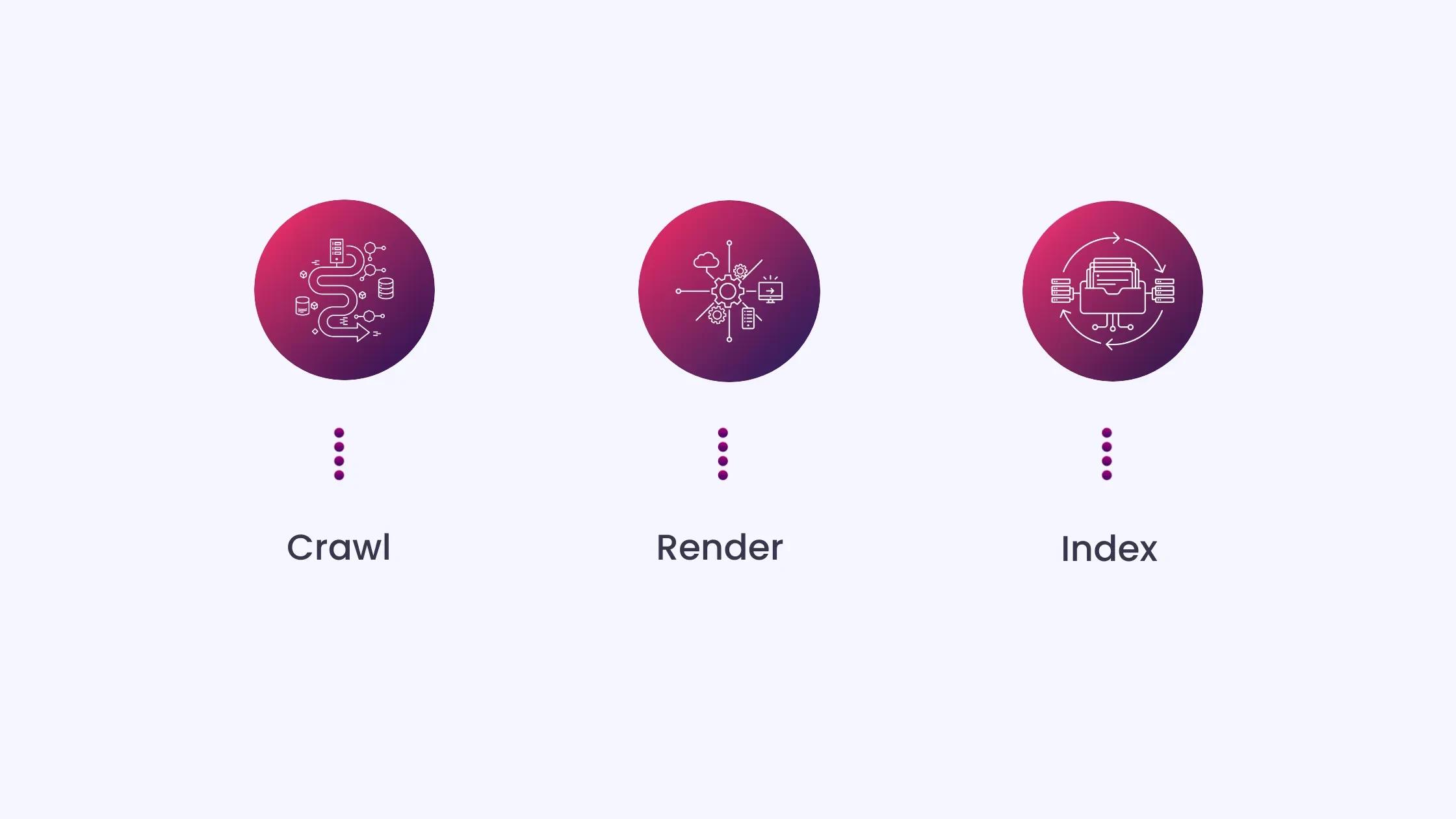
Crawlers and AEO systems generally follow three steps:
- Crawl: The bot fetches the raw HTML at your URL.
- Render: It executes JavaScript to create the full page.
- Index: The rendered version, including visible content and structured data, is added to the searchable index.
The catch is steps two and three. They require significant processing. Google can handle it, but smaller or specialized AI crawlers often can’t. They only read what appears in the first HTML response.
AI-powered search experiences that form conversational answers rely on pre-structured content, not content trapped behind scripts. By embedding structured data, using FAQPage, HowTo, or Article schema, in that first HTML response, you give AI engines clear context right away.
How AI Answer Engines Pull Direct Responses from Your Pages
Apart from indexing, AEO systems perform a fourth step that traditional SEO ignores entirely. After a page is crawled, rendered, and indexed, AI answer engines score your content on four additional dimensions:
- Directness of answers: Can the engine extract a clean, standalone response to a question without reading an entire paragraph?
- Presence of named entities: Are people, products, organizations, and topics clearly identified within the content?
- Confidence signals: Does the content include authorship, publication dates, citations, or brand entity markup that signals to AI engines that this is a trustworthy source?
- Topical authority: Does the domain consistently publish on this subject, and is the content semantically complete enough to be considered an authoritative reference?
The difference between SEO and AEO at this stage: SEO asks, “Can this page be found?” AEO asks, “Can this page be trusted and quoted?” If your dynamic content doesn’t appear in the first HTML response, both questions go unanswered.
Rendering Solutions That Deliver Crawlable Content
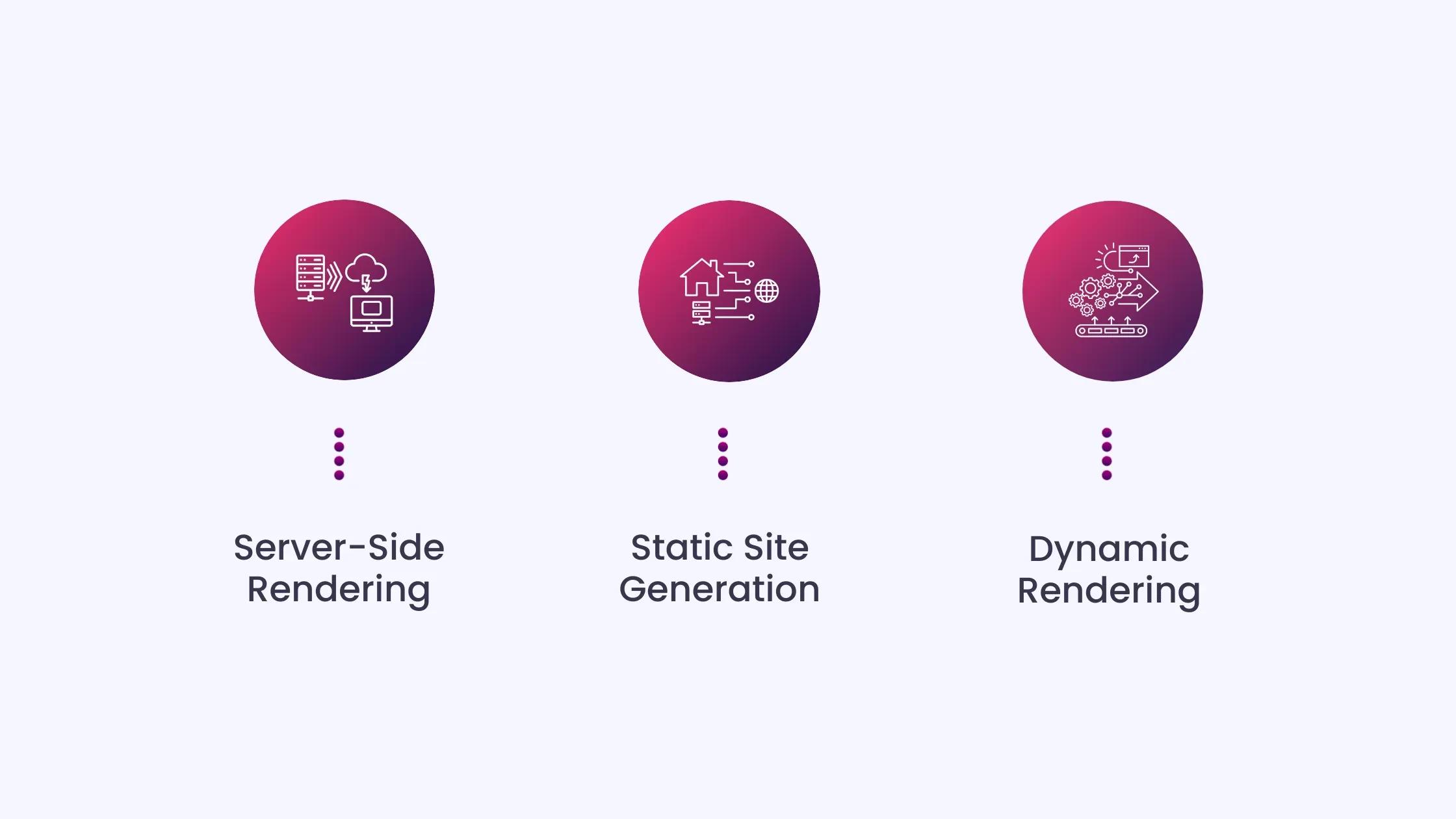
Rendering determines how your site “talks” to search engines. The right strategy lets crawlers and AI engines read your pages just as users do.
Server-Side Rendering (SSR)
SSR builds complete HTML on the server before delivering it to browsers. Frameworks like Next.js or Nuxt.js automate this process.
Crawlers receive HTML that already includes the main text, titles, and schema; no script execution required. This immediately improves crawlable dynamic content. Developers might trade some caching simplicity for SEO stability, but SSR remains a reliable long-term choice.
Static Site Generation (SSG)
SSG pre-builds each page into static HTML versions during deployment. Gatsby and Astro are popular tools for this approach.
Every page loads fully formed, independent of runtime JavaScript. It’s ideal for blogs, learning libraries, or documentation that doesn’t update constantly. Take a SaaS knowledge base: with SSG, every article becomes crawl-ready, bypassing the rendering queue entirely.
Dynamic Rendering
Your server detects bots and serves them pre-rendered HTML, while human users see the standard JavaScript experience.
Dynamic rendering is a short-term bridge when you can’t fully migrate to SSR. It’s useful for mixed pages combining interactive features with lower-priority text elements. The drawback is maintenance; cached or misconfigured outputs can cause search engines to receive outdated pages or none at all.
How Do Rendering Decisions Affect AI Answer Engines Differently Than Search Engines?
Google’s Googlebot can eventually render JavaScript; it has processing power and a rendering queue. The AI crawlers that power AEO systems typically cannot. GPTBot (OpenAI), ClaudeBot (Anthropic), PerplexityBot, and YouBot all rely primarily on the raw HTML response.
If your content lives behind scripts, these bots never see it, which means your content is never considered a source for AI-generated answers.
| Rendering Method | Googlebot | GPTBot / ClaudeBot / PerplexityBot | AEO Suitability |
| Client-Side Rendering (CSR) | Delayed/queued | Not supported | Poor |
| Dynamic Rendering | Supported (short-term) | Partial, depends on cache | Moderate |
| Server-Side Rendering (SSR) | Immediate | Fully supported | Excellent |
| Static Site Generation (SSG) | Immediate | Fully supported | Excellent |
The rendering choice you make isn’t just an SEO decision; it directly controls whether your brand appears in AI-powered conversations.
Tools and Techniques for Verification
Setting up SSR or SSG is important, but confirming that crawlers actually view your pages correctly is non-negotiable.
Use Inspection Tools
Google Search Console’s URL Inspection Tool lets you compare the HTML served to bots versus what users see. Check whether core content, meta tags, and structured data appear before scripts execute.
Pair it with the Rich Results Test to ensure that schema, such as FAQ, Article, or Product, is baked into HTML, not appended later. Pre-rendered schema is what enables true AI discoverability.
Integrate these checks into your development pipeline. Each release should confirm that page essentials remain visible in the source code, not just in the rendered output.
Confirm Link Accessibility
Even perfectly rendered content fails if crawlers can’t explore it. Use genuine <a href> tags rather than clickable JavaScript actions like onclick. Single-page applications often depend on client-side routing, which some crawlers ignore.
Test this easily: view your site in a text-only browser or disable JavaScript in Chrome DevTools. If you can’t move between pages, neither can a bot.
Site Structure Practices That Improve Crawl Visibility
Dynamic rendering helps, but mismanaged architecture can still bury your pages. You need clear URL and sitemap strategies that guide crawlers through your content.
Provide Clear URLs
Use descriptive, static URLs, such as/features/pricing, rather than parameters or hashes, such as/page#1 or /view?id=123. Readable paths support dependable caching, link sharing, and, crucially, indexing. They turn dynamic routes into accessible, trackable pages.
Include Dynamic Pages in Sitemaps
Dynamic content shifts fast, and stale sitemaps block discovery. Automate sitemap updates so every new route appears immediately. If a crawler misses JavaScript links, your sitemap still flags the content for review. Frequent updates trigger re-evaluation when URLs or data structures change.
Make Your Content Usable for AI Answer Engines
AI assistants and search interfaces live on structured clarity. They need facts organized within a schema, with context built right into the HTML. But technical structure is only half the equation; the other half is how your content is written and organized for extraction.
Embed structured data, types like Article, FAQPage, or HowTo, directly into your server-generated pages. That’s how AI systems understand topic relationships and pull precise responses without losing your brand attribution.
For instance, say your SaaS platform publishes a guide on “Troubleshooting Login Issues.”
When your markup specifies each question and a concise answer in the HTML, AI-driven search engines can present your verified solution while still citing your domain as the source. That visibility goes well past SEO; it grows trust in your brand as an authoritative voice.
How Different AI Crawlers Index Dynamic Content
Not all crawlers are built the same. Understanding each one helps you prioritize what to fix:
- GPTBot (OpenAI): Powers ChatGPT’s browsing and search features. Does not render JavaScript. Reads only initial HTML. Respects robots.txt GPTBot directives.
- ClaudeBot (Anthropic): Powers Claude’s web knowledge. Crawls static HTML only. No JavaScript execution. Prioritizes well-structured, entity-clear pages.
- PerplexityBot: Powers Perplexity AI’s real-time answer engine. No JavaScript rendering. Favors content with clear question-answer formatting and schema markup.
- YouBot: Powers You.com’s AI search. HTML-only crawling. Rewards topical completeness and direct declarative sentences.
- Bingbot (for Copilot): More capable than the above, can handle some JS rendering, but still indexes pre-rendered HTML first and fastest.
Check your robots.txt file and ensure you are not inadvertently blocking any of these bots. A blanket Disallow: / or an overly restrictive crawl policy can silently exclude your site from AI-generated answers entirely.
How to Write Content That AI Systems Can Extract?
AEO extraction is not purely a technical problem; it’s also a writing problem. AI systems favor content structured for direct retrieval.
Here’s what that means in practice:
Use Short, Declarative Sentences
- AI systems pull answers by identifying the most direct response to a question.
- Long, multi-clause sentences bury the answer. Keep main claims under 25 words and lead with the answer rather than context.
Example:
- Weak: “Depending on the complexity of your infrastructure and the JavaScript framework your developers chose during the build phase, your rendering approach may need to change.”
- Strong: “Server-side rendering (SSR) is the most reliable approach for AEO visibility. It delivers complete HTML before scripts run.”
Structure Content with Question-Answer Pairing
- Use questions as subheadings and provide answers immediately in the next one to three sentences.
- This mirrors the FAQPage schema format and makes content extractable by AI, whether or not the schema is applied.
Lead With the Answer in Every Section
- Journalistic writing often buries conclusions; AEO‑optimized writing does the opposite.
- State the answer in the first sentence, then provide context and evidence.
- AI engines scan top-down and reward content that delivers the main point upfront.
Define Terms and Named Entities Clearly
- People, tools, organizations, processes, and acronyms should be explicitly defined at first mention.
- Example: Instead of “SSR,” write “Server-Side Rendering (SSR)” to give AI a clear entity to reference and attribute.
- Clear entities help AI systems build accurate knowledge graphs.
How AI Answer Engines Identify and Cite Your Brand
AEO systems don’t just index content; they also identify who is behind it. Entity optimization is the practice of making your brand, authors, and topical authority clearly machine-readable. This ensures that AI engines can reliably recognize your expertise and attribute answers to your organization.
Here’s how to optimize your entity footprint:
Implement Organization and Author Schema
- Add Organization schema with sameAs properties linking to LinkedIn, Crunchbase, Wikipedia (if applicable), and social profiles.
- Include the Author schema for every article, with the author’s name, job title, and a link to their profile.
- These signals help AI systems recognize your brand and authors, establishing credibility and authority.
Add Publication Dates
- Include datePublished and dateModified fields in your Article schema.
- Fresh content is an important signal for AEO systems, especially for time-sensitive queries.
Use BreadcrumbList Schema for Content Hierarchy
- Add BreadcrumbList schema to communicate where each piece fits within your broader content structure.
- This helps AI engines understand the context of your content and its relationship to your overall site architecture.
A well-established entity is more resilient in AI-generated answers than a well-ranked page is to outrank in Google. Building your entity footprint now compounds authority over time, ensuring your brand is consistently cited and recognized across AI-driven results.
Action Checklist for Crawlable Dynamic Content
To make your dynamic content fully crawlable and optimized for AI answer engines, follow this step-by-step action checklist covering both core SEO practices and AEO-specific requirements:
Core Crawlability
- Implement SSR or SSG for critical dynamic pages
- If needed, apply dynamic rendering temporarily
- Verify server-delivered content using Google’s URL Inspection
- Include structured schema directly within HTML output
- Test link paths to ensure every <a href> is crawlable
- Program sitemap auto-updates for new or changed routes
AEO-Specific
- Verify that GPTBot, ClaudeBot, and PerplexityBot are not blocked in robots.txt
- Write key answers in direct, declarative sentences under 25 words
- Structure pages with question-as-heading, answer-in-first-sentence format
- Add the Organization schema with sameAs properties to establish the brand entity
- Add Author and datePublished fields to all Article schema
- Audit top pages for answer confidence: does each page clearly state what, why, and who within the first 100 words?
- Test schema using Google’s Rich Results Test before each major publish
Ensuring Dynamic Content Is Indexed and Cited by AI
Dynamic content only delivers value if it can be found, read, and cited. Server-side rendering, static site generation, or carefully configured dynamic rendering ensures crawlers and AI answer engines access complete HTML with structured data. Pages that rely solely on client-side scripts remain invisible to many indexing systems, leaving content unindexed and unquoted.
Embedding schema for authors, organizations, and publication dates, paired with short, declarative answers and clear entity definitions, positions your content for direct extraction and citation by AI systems. Maintaining updated sitemaps, accessible links, and pre-rendered content ensures all pages are discoverable and verifiable.
Following these practices closes the gap between user-facing interactivity and machine-readable visibility, guaranteeing that every page contributes to search presence and AI-driven answers. INSIDEA can help implement these solutions to make your dynamic content fully crawlable, structured for AEO, and reliably attributed to your brand.
Maximize AEO Visibility With Expert Support From INSIDEA
Implementing Answer Engine Optimization is only the first step. True AI-driven search visibility requires precise handling of content structure, schema, entity attribution, and indexing workflows.
INSIDEA helps businesses implement and refine AEO with a focus on measurable search presence and long-term performance.
Here are the services we provide:
- Technical SEO for AEO: Implementation of server-side rendering, pre-rendering, crawlability improvements, and structured data to ensure AI bots can fully read and index your content.
- Content & Query Optimization: Mapping audience questions, creating structured question-answer content, and formatting pages so AI engines can extract and cite information directly.
- Schema & Entity Setup: Adding organization, author, and publication schemas, hierarchical markup, and entity definitions to establish a clear AI-recognized footprint.
- Performance Optimization: Improving load times, code efficiency, and page structure to support faster AI crawling and consistent indexing.
- Continuous Monitoring and Updates: Auditing AI visibility, tracking indexing, and refining content to maintain authoritative recognition in AI-driven search over time.
When these elements are implemented with clarity and consistency, your content achieves full AI visibility, trustworthiness, and indexing stability across both AI-driven and traditional search engines.

 How INSIDEA works