

Most people assume ChatGPT works like a search engine. You ask a question, it pulls up sources, and shows you where the information comes from. But that is not how it works.
ChatGPT is a language model. It does not search the internet by default. Instead, it generates responses based on patterns it has learned during training. Unless web browsing is explicitly turned on, it does not retrieve live information from the internet. This difference is small on the surface, but it completely changes how you should think about citations.
When browsing is turned off, ChatGPT relies entirely on its training data, which has a fixed knowledge cutoff. In this mode, any citations it produces are not verified against real-time sources. They are generated based on learned patterns, which means the model is essentially recreating what a citation is supposed to look like, rather than pulling it from an actual database or live webpage.
For students, researchers, and professionals who rely on accurate sourcing, this distinction is important. It decides whether a citation is something you can trust directly or needs verification before use.
This blog explains how ChatGPT citations actually work, what determines which sources get picked, and how content ends up being cited in those answers.
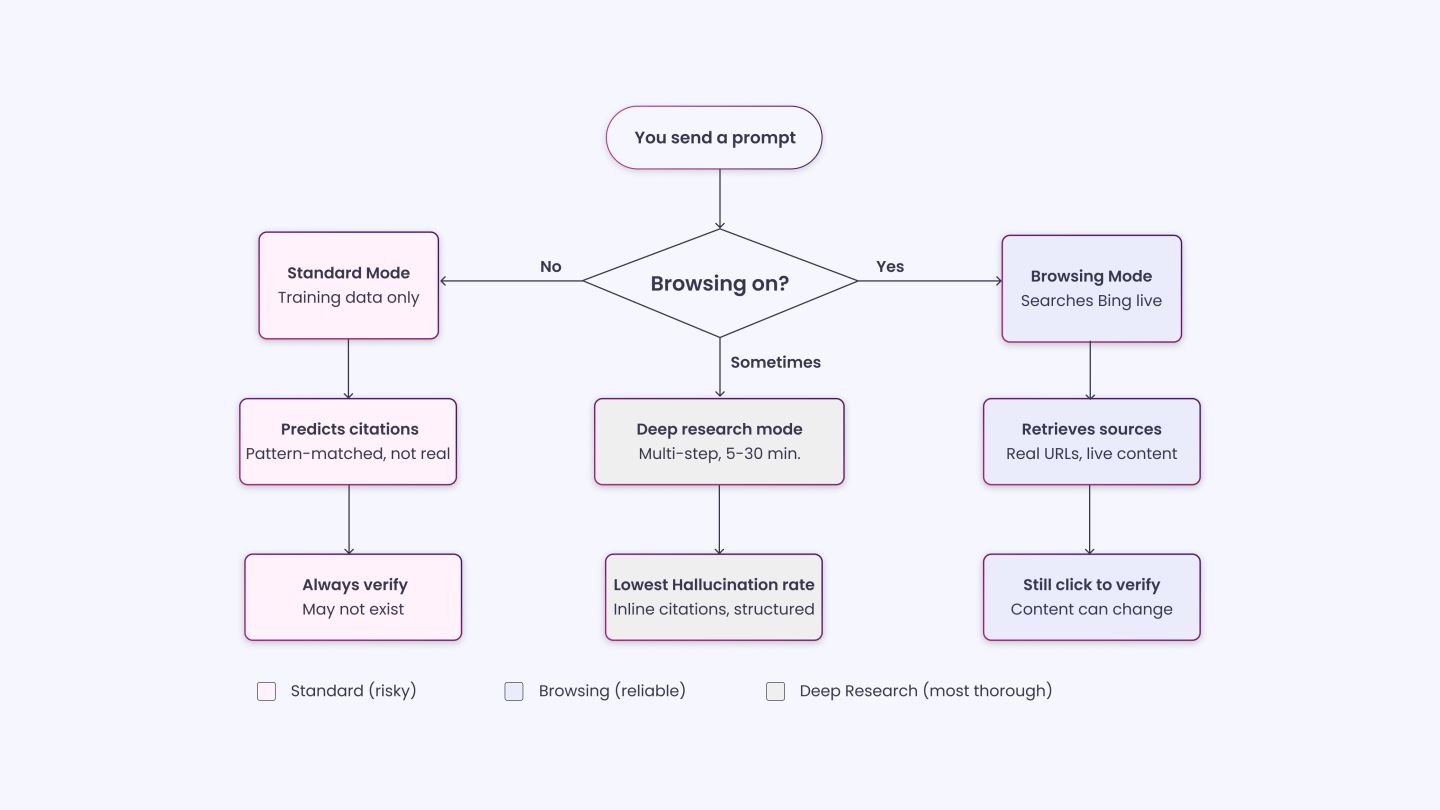
How ChatGPT Handles Citations in Different Response Modes?
| What is a ChatGPT Citation?
A ChatGPT citation refers to any source reference that appears in a ChatGPT response to support or attribute information. This can include clickable links, inline references*, or generated source-like text. Citations reflect real external sources only when ChatGPT is actively browsing the web. In standard mode, citations may appear in format only and do not always point to verified or retrievable sources. |
Before anything else, you need to know which version of ChatGPT you are working with, because citation behavior is fundamentally different across modes:
Standard Mode (Browsing Off)
ChatGPT only provides real citations when actively browsing the web. Without search enabled, any citations it generates are pattern-matched from training data and may not actually exist.
This is the default experience for most users. In this mode:
- ChatGPT draws from what it was trained on, not from anything it looks up in real time.
- It can produce APA-style or MLA-style citations that look completely legitimate, with author names, journal titles, volume numbers, and publication years.
- Many of those citations, however, were never real.
This is what researchers call AI hallucination: when AI systems generate information that sounds plausible but is completely made up. ChatGPT isn’t intentionally trying to deceive; it’s following patterns learned during training.
The model predicts what a citation might look like, which is why students and researchers need to double-check every response before using it in a paper or official document.
Browsing Mode (Web Search On)
When ChatGPT with Browsing is enabled, it actively searches the web in real time, finding URLs, pulling current sources, and citing recently published content.
This is a meaningfully different situation. Here, ChatGPT:
- Uses Bing’s search index as its starting point.
- Reads and parses source pages for readable, relevant content.
- Returns inline citations with actual, clickable links.
Research shows that 87% of ChatGPT citations in browsing mode match Bing’s top organic results. If your content isn’t indexed by Bing, it won’t appear in ChatGPT Search results.
Deep Research Mode
ChatGPT’s Deep Research mode takes a third approach. Unlike standard ChatGPT or ChatGPT Search, it conducts multi-step investigations that can take 5 to 30 minutes, browsing and analyzing hundreds of sources.
According to OpenAI, Deep Research has notably lower hallucination rates than standard ChatGPT, and findings are organized into sections with inline citations and summaries.
| *Note: An inline reference is a source citation that appears directly inside the text of a sentence, instead of being placed in a footnote or at the end of the document. |
Why ChatGPT Produces Fake or Unverified Citations
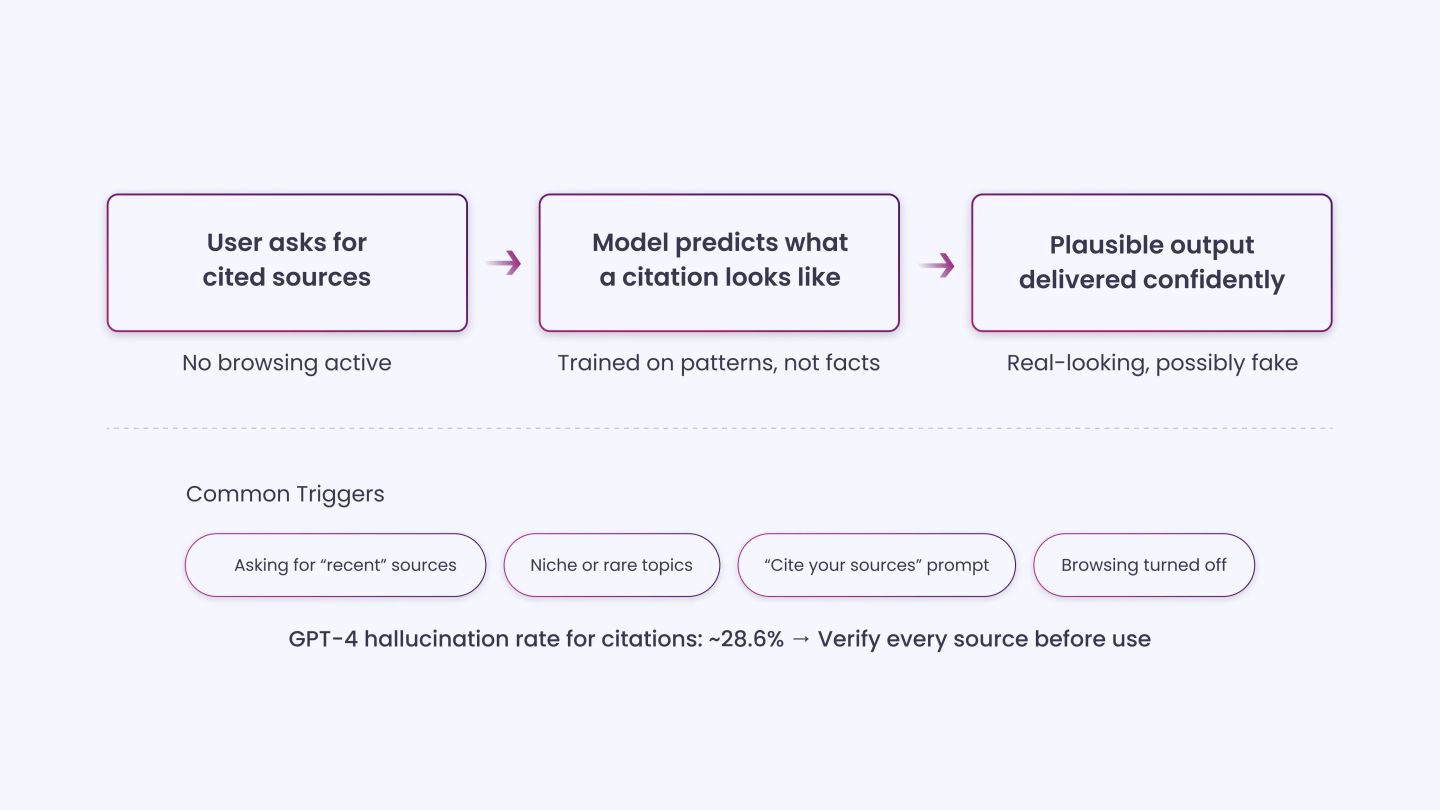
Understanding why this happens puts you in a much better position to use the tool responsibly.
ChatGPT was trained to predict the next word in a sequence, not to verify whether statements are true. According to OpenAI’s own research, language models hallucinate because training rewards guessing over acknowledging uncertainty.
The model learned that confidently completing sentences gets positive feedback, while saying “I don’t know” often doesn’t.
A few specific patterns make hallucinated citations more likely:
- Requests for “recent” sources: When you ask ChatGPT for studies from the last two years, it feels compelled to deliver them, even if the model’s training data doesn’t contain the specific papers.
- Niche or technical topics: The less the model has seen on a subject, the more it has to guess.
- Asking it to “cite your sources” without browsing enabled: This is one of the most common ways people get fabricated references.
GPT-4’s hallucination rate for citation accuracy sits at around 28.6%, down from GPT-3.5’s 39.6%, but it has not disappeared entirely. In other words, roughly one in four citations from a non-browsing session may be unreliable.
| The Hidden Cost of False AI Citations
The real-world cost of this is not small. In 2025, Deloitte had to refund over $290,000 to the Australian government after delivering an AI-generated report riddled with fabricated citations. The 237-page report cited non-existent experts, fake research papers, and even an invented quote attributed to a federal court judge. |
How ChatGPT Prioritizes Sources in Browsing Mode?
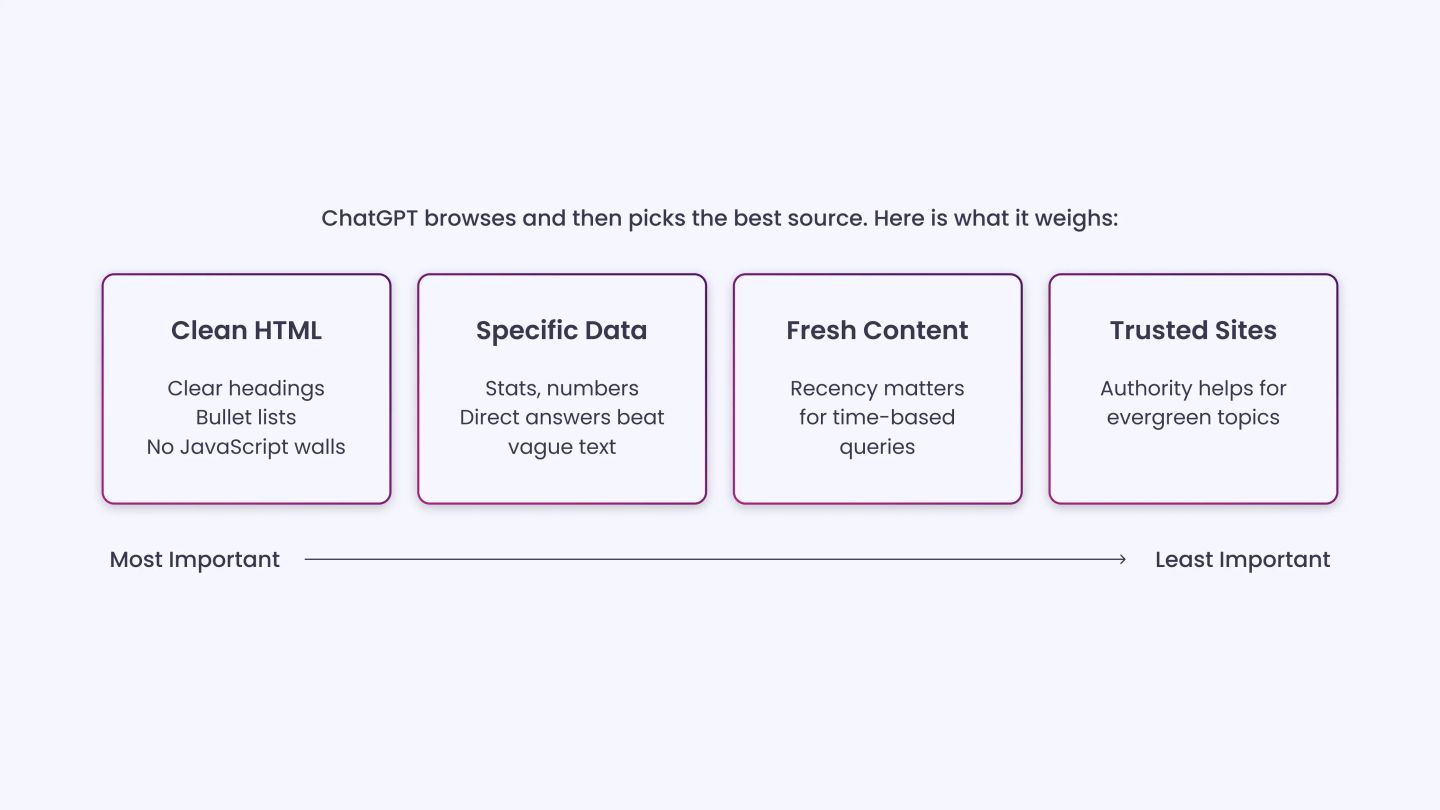
When browsing is on, ChatGPT doesn’t just grab whatever Bing puts at the top. Its selection process is more nuanced than that.
ChatGPT browsing mode favors structurally clean HTML with clear H2 headings, bullet lists, and minimal JavaScript interference. JavaScript-heavy modals, cookie pop-ups, and login gates can prevent the AI from reading your content altogether, even if the content itself is brilliant.
In addition to the structure, several factors influence what gets cited:
- Recency signals: When queries included terms like “latest” or specific years, ChatGPT consistently cited recent sources. Pages titled “Best X of 2025” from sites like TechCrunch or TechRadar were frequently selected, showing a clear preference for fresh content when the prompt implied recency.
- Domain authority and content depth: For queries without a time anchor, ChatGPT often preferred authoritative, evergreen sources. Academic research and technical documentation, regardless of publication date, remained common citations for conceptual or factual questions.
- Specificity over generality: ChatGPT cites content that directly answers the question asked. Statistics, data points, and specific facts get cited. Vague generalities do not.
- Top citation sources: Wikipedia is ChatGPT’s most-cited source, accounting for 7.8% of total citations, underscoring the platform’s preference for encyclopedic, factual content. The top 50 domains account for almost 48% of all citations, while the remaining 52% is distributed across a long tail of over 38,000 unique domains.
How to Cite ChatGPT in Your Own Work?
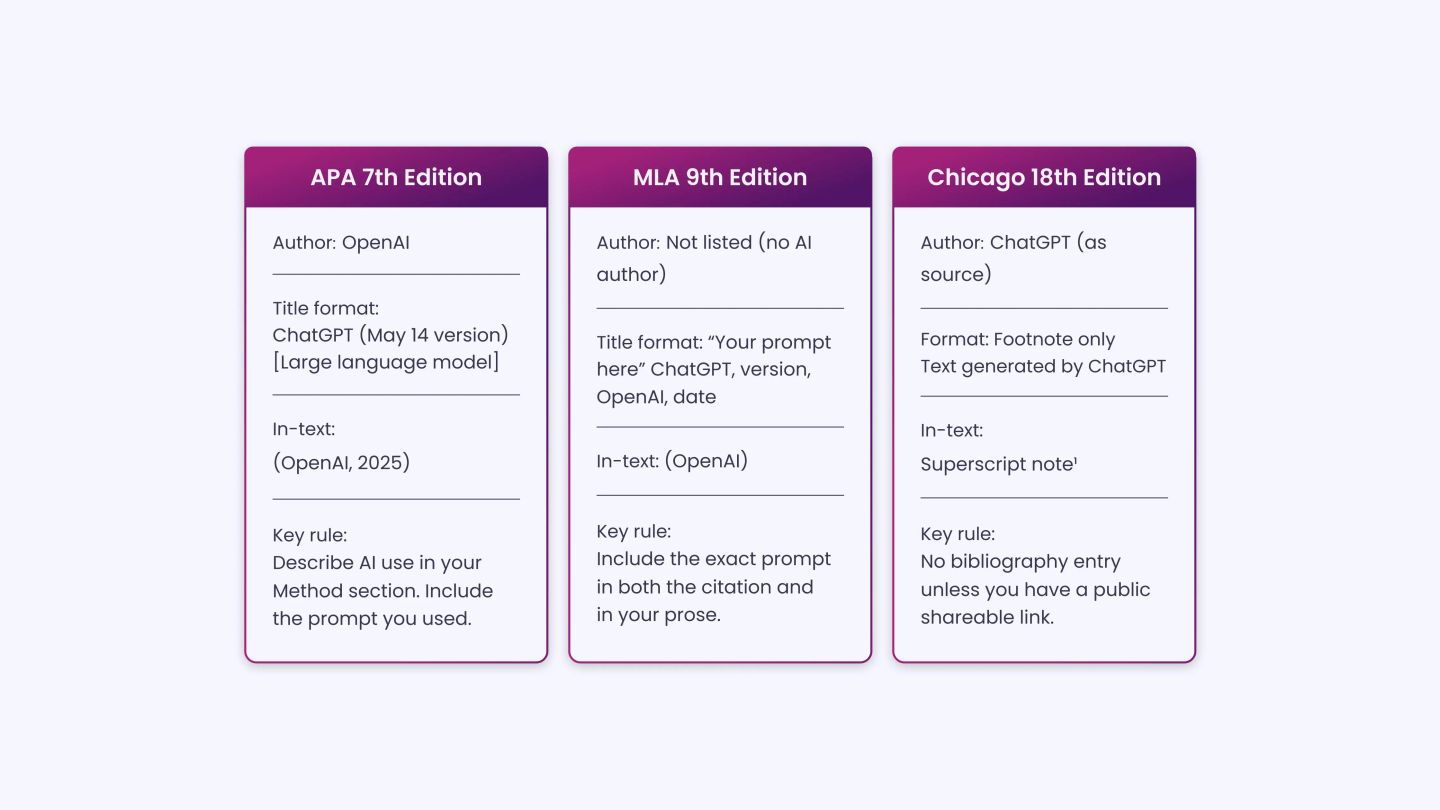
This is the other side of the question: not how ChatGPT cites sources, but how you cite ChatGPT when you have used it in your writing.
You should cite ChatGPT when it meaningfully contributed to your work, such as by generating text, shaping ideas, or providing analysis, especially in academic or professional settings where transparency is expected.
APA Style (Used Mostly in Psychology, Business & Social Sciences)
APA treats ChatGPT outputs similarly to software citations. The author is OpenAI, the title is ChatGPT with the version in parentheses, the descriptor is “Large language model” in square brackets, and the source is the URL.
Reference list entry (this is the full source you add at the end of your document):
OpenAI. (2025). ChatGPT (May 14 version) [Large language model]. https://chatgpt.com/
In-text citation (this is what you add inside your sentence while writing):
(OpenAI, 2025)
APA also recommends describing how you used the tool in your Method section or introduction, and including the prompt you used whenever you quote a ChatGPT response.
MLA Style (Used Mostly in Humanities Like Literature, Arts & Writing)
MLA focuses more on how the content was generated.
It suggests including your prompt in the citation entry to clarify what was generated: use the prompt as the title in quotation marks, followed by the tool name in italics, the version, the publisher, the date, and the URL.
Works Cited entry (this is the full list at the end of your document):
“Explain how photosynthesis works” prompt. ChatGPT, 15 Mar. 2025, https://chat.openai.com.”
MLA does not recommend treating the AI tool as an author, following policies developed by various publishers. The specific AI model or model version should be named as specifically as possible.
Chicago Style (Used in Publishing, History & Long-Form Research Writing)
For most types of writing, the Chicago style allows you to simply acknowledge the AI tool in your text. If a more formal citation is needed, a numbered footnote looks like this:
Text generated by ChatGPT, OpenAI, March 7, 2025, https://chat.openai.com/chat.
Chicago does not include ChatGPT in a bibliography or reference list unless you can provide a publicly available link, because a ChatGPT conversation is like email or personal communication and is not retrievable by others.
A Practical Checklist Before You Use Any Citation ChatGPT Gives You
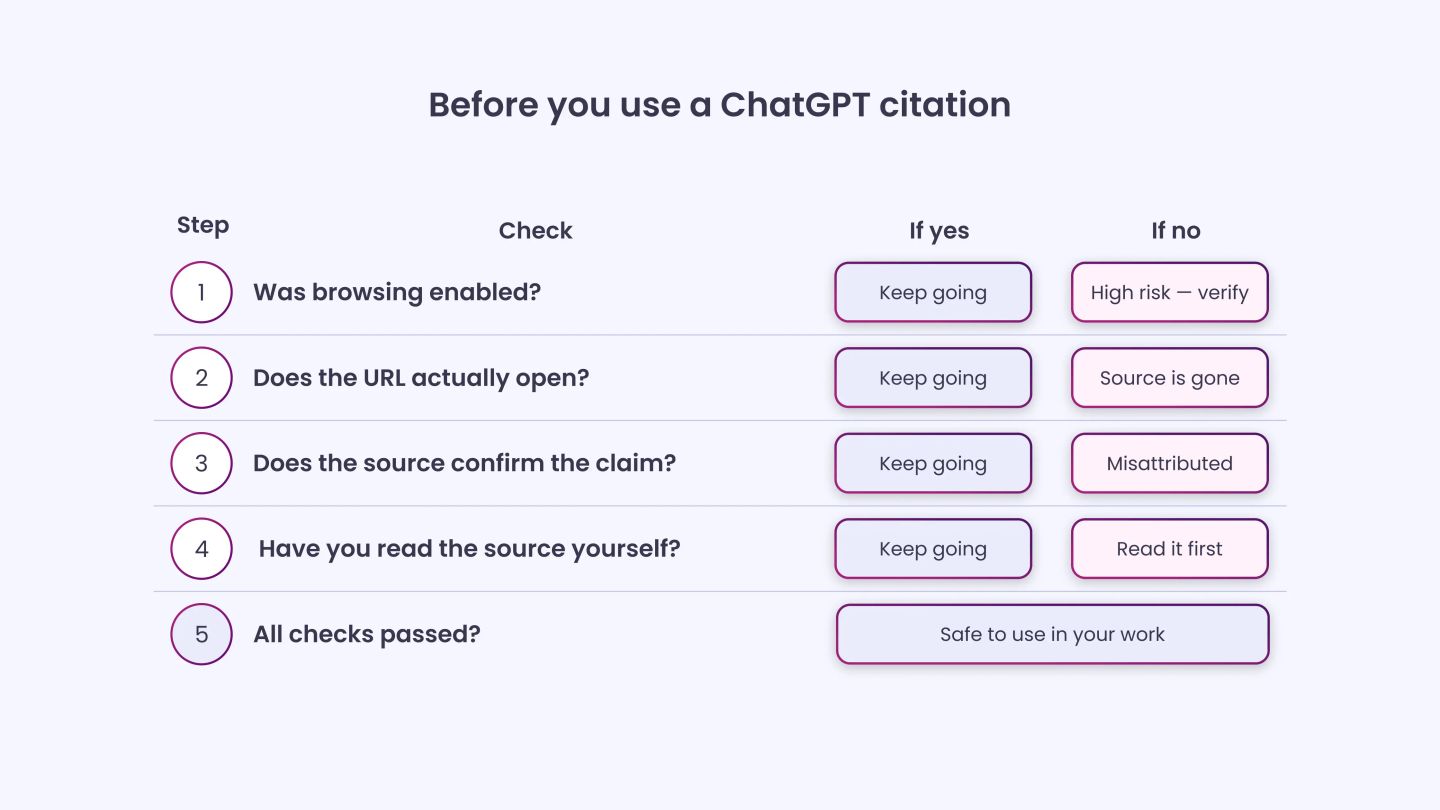
Whether you’re a student, a researcher, or a content professional, follow these steps before trusting any source ChatGPT returns:
- Check if browsing was on: If it wasn’t, treat all citations as unverified until confirmed.
- Search the source independently: Paste the title and author into Google Scholar, PubMed, or a general search and verify it actually exists.
- Confirm the URL resolves: A citation with a working, accurate link is a good sign. A broken or generic one is a red flag.
- Check the date: If ChatGPT gave you a recent source but wasn’t in browsing mode, that’s a strong signal that the citation may be fabricated.
- Read the actual source: Don’t cite something you haven’t read. This applies whether the source came from ChatGPT or anywhere else.
The Reality of ChatGPT Citations
ChatGPT citation behavior is not fixed. It shifts depending on the mode you are using, the type of question you ask, and whether web browsing is turned on.
In standard mode, what appears to be a citation is often a generated pattern rather than a verified source. It may appear complete and credible, but it is not always backed by real retrieval.
In browsing mode, ChatGPT pulls information from live web sources and provides real citations. Even then, those sources should still be checked because online content can change, move, or get updated.
If you are using ChatGPT for academic, research, or professional work, citing it properly in APA, MLA, or Chicago format is now part of responsible usage. It is no longer optional in formal contexts.
Most importantly, any citation provided by ChatGPT should be treated as a starting point, not the final word. Always verify before you include it in your work.
INSIDEA
Ready to get found by people and AI?
Search and answer-engine visibility that compounds, built to be cited.

 How INSIDEA works




