A few years ago, online shopping usually started with a search bar. People typed short keywords into Google, skimmed through a list of links, and compared options across multiple websites before making a decision.
That pattern is changing.
Currently, many shoppers skip that entire process and start directly with tools likeChatGPT. Instead of searching “office chair lower back pain,” they ask full, specific questions like “what’s a good ergonomic office chair under $400 for someone with lower back pain,” and get direct product recommendations in seconds, without visiting a single store.
This shift is not anecdotal. According to McKinsey, nearly$750billion in US revenue is expected to flow through AI-powered search by 2028. At the same time, almost half of consumers already use AI tools intentionally when searching, and a large share now rely on them in their buying decisions.
For e-commerce store owners, marketers, and product teams, this blog explains what is changing in how products are discovered, what influences what gets recommended, and how brands can adapt to stay visible in these systems.
What is AI Search in E-Commerce?
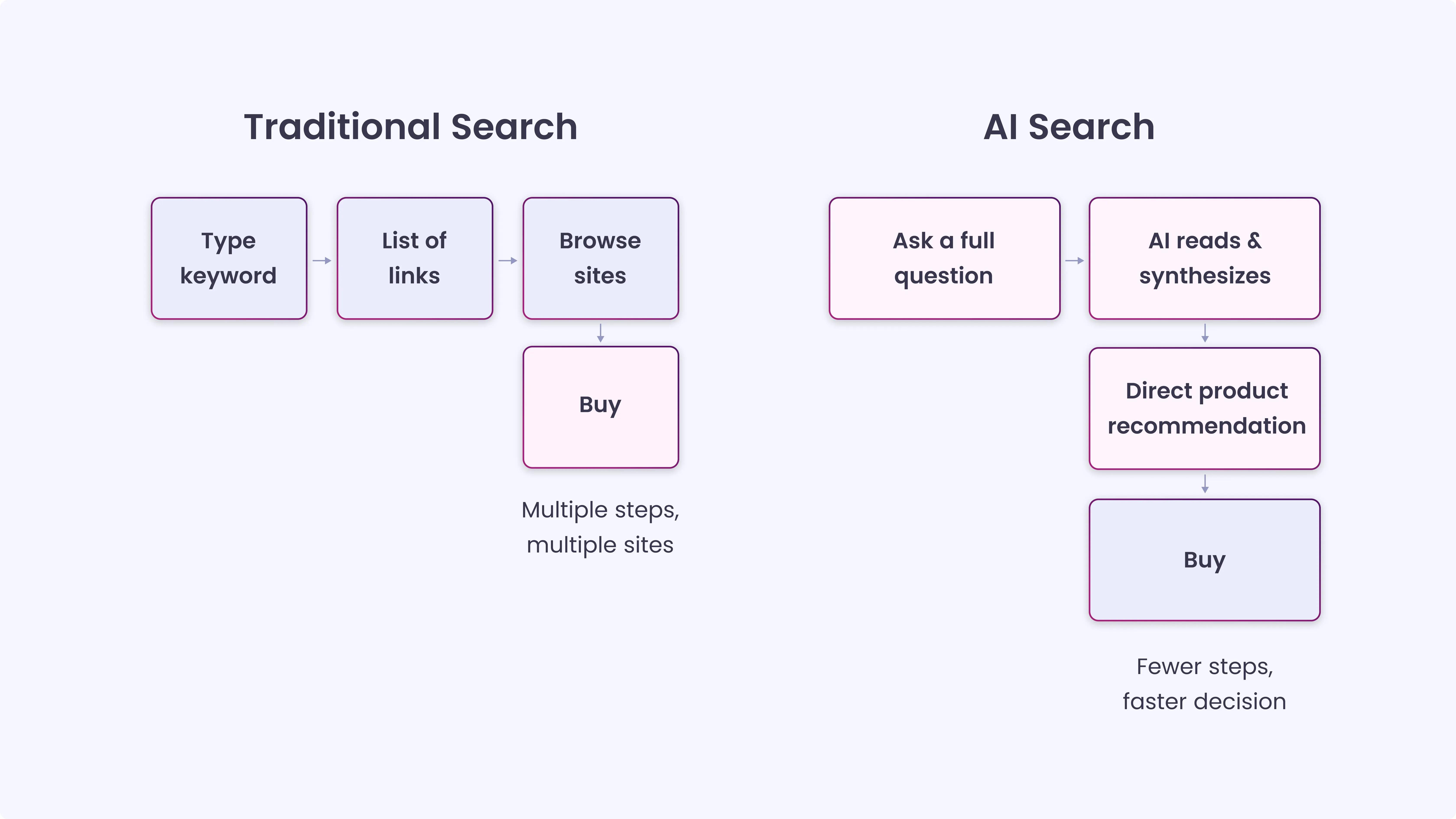
AI search is what happens when a shopper stops typing keywords and starts asking questions.
Instead of returning a ranked list of links, AI search tools, ChatGPT, Perplexity, Google AI Overviews, Google Gemini, and Microsoft Copilot read content from across the web, synthesize it, and deliver a direct, conversational answer.
In a shopping context, that answer often includes specific product names, prices, comparisons, and reasons why one product fits the user’s needs better than another.
The major platforms right now:
- ChatGPT:The dominant platform, controlling almost 84% of all AI referral traffic to websites. Processes2.5 billionprompts every day. Its new Shopping Research feature uses a model trained specifically for product research.
- Google AI Overviews:Appears at the top of roughly21%of all Google searches, directly answering the query before any organic results appear below.
- Perplexity:A research-first tool that shows cited sources alongside answers, popular with shoppers who want to understand a category before committing.
- Google Gemini&Microsoft Copilot:Embedded into Google Workspace and Microsoft Office, respectively, making AI discovery happen inside tools people already use daily.
The important distinction is that AI search is not just a new version of Google. Analysis of millions of queries shows that AI answer engines share only8-12%overlap in results with traditional search engines.
That means a high Google ranking does not automatically carry over into AI visibility. You need both.
How AI Search Reads Product Data?
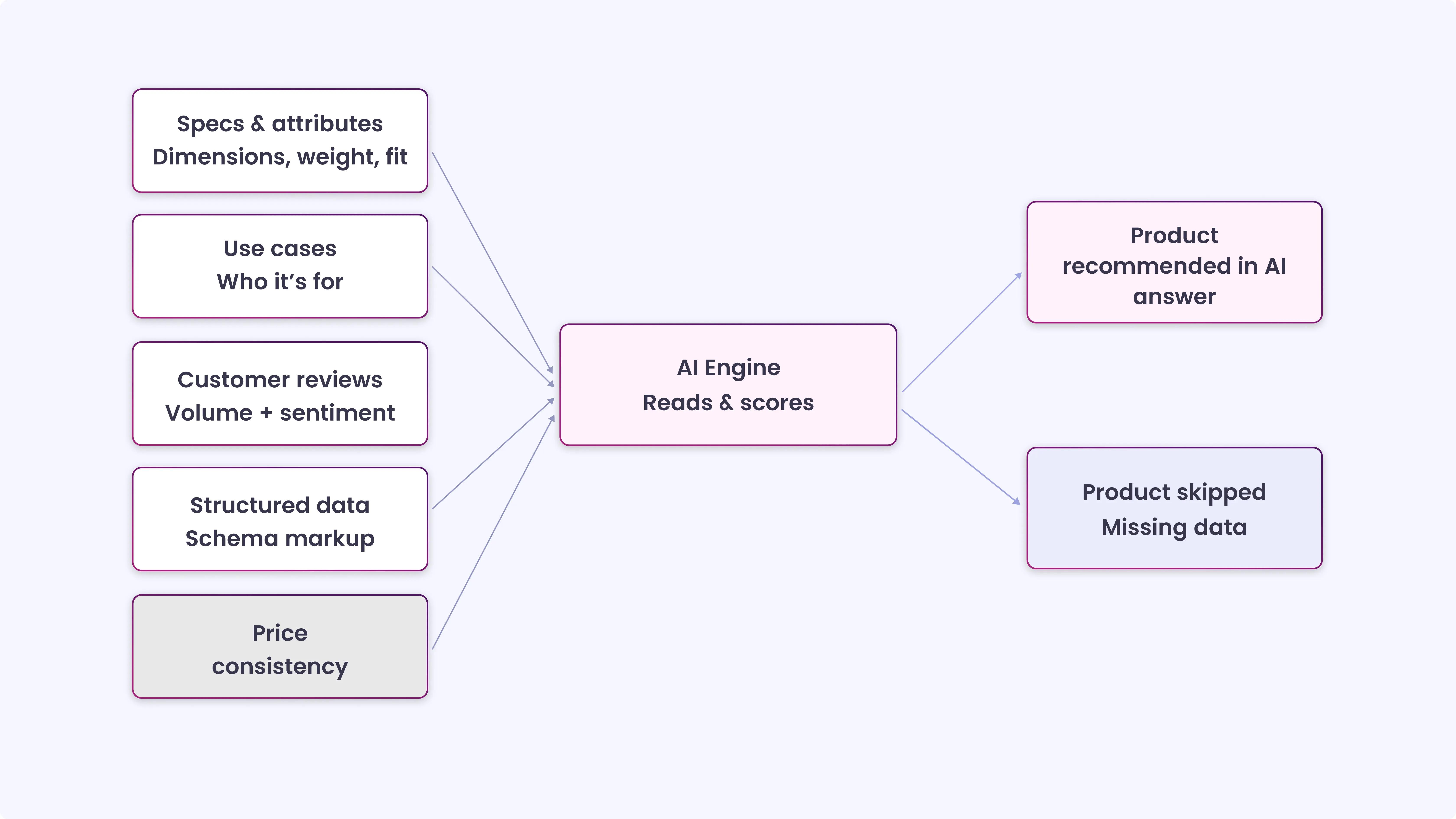
When an AI tool receives a shopping query, it pulls from multiple sources simultaneously, your product page, third-party reviews, editorial articles, Reddit discussions, and comparison guides, and tries to build a picture of your product.
The richer and more structured that picture is, the more likely your product is to get recommended.
Here’s specifically what AI tools look at:
- Specifications and attributes:AI tools match products to specific needs. If a shopper asks for “a carry-on suitcase under 22 inches,” the AI needs to read the exact dimensions from your product page. If those dimensions aren’t listed clearly or are buried in a PDF or buried inside an image, the AI skips your product.
- Use cases:AI doesn’t match products to keywords; it matches products to people. A product page that only describes what a product is, without explaining who it’s for or when they’d use it, gives AI very little to work with.
- Customer reviews:AI systems read and synthesize review content. They’re not just checking star ratings. They’re reading what customers say about fit, durability, ease of setup, and how they compare to other products they’ve tried. Reviews are a significant input.
- Structured data markup:Schema.org markup tells AI crawlers exactly what type of content is on your page, product name, price, availability, review count, and rating. Pages without this markup require AI to guess, and guessing means your product often doesn’t make the cut.
- Consistency across channels:If your product page says $89, your Amazon listing says $94, and a comparison site says $91, AI tools treat that inconsistency as a reliability problem and may deprioritize your product.
- Crawlability:Many modern e-commerce sites are built with JavaScript frameworks such as React. AI crawlers, GPTBot, and ClaudeBot struggle with JavaScript-heavy pages. If your product pages can’t be read by these bots, you’re functionally invisible to AI search.
The Role of Structured Product Data in Visibility
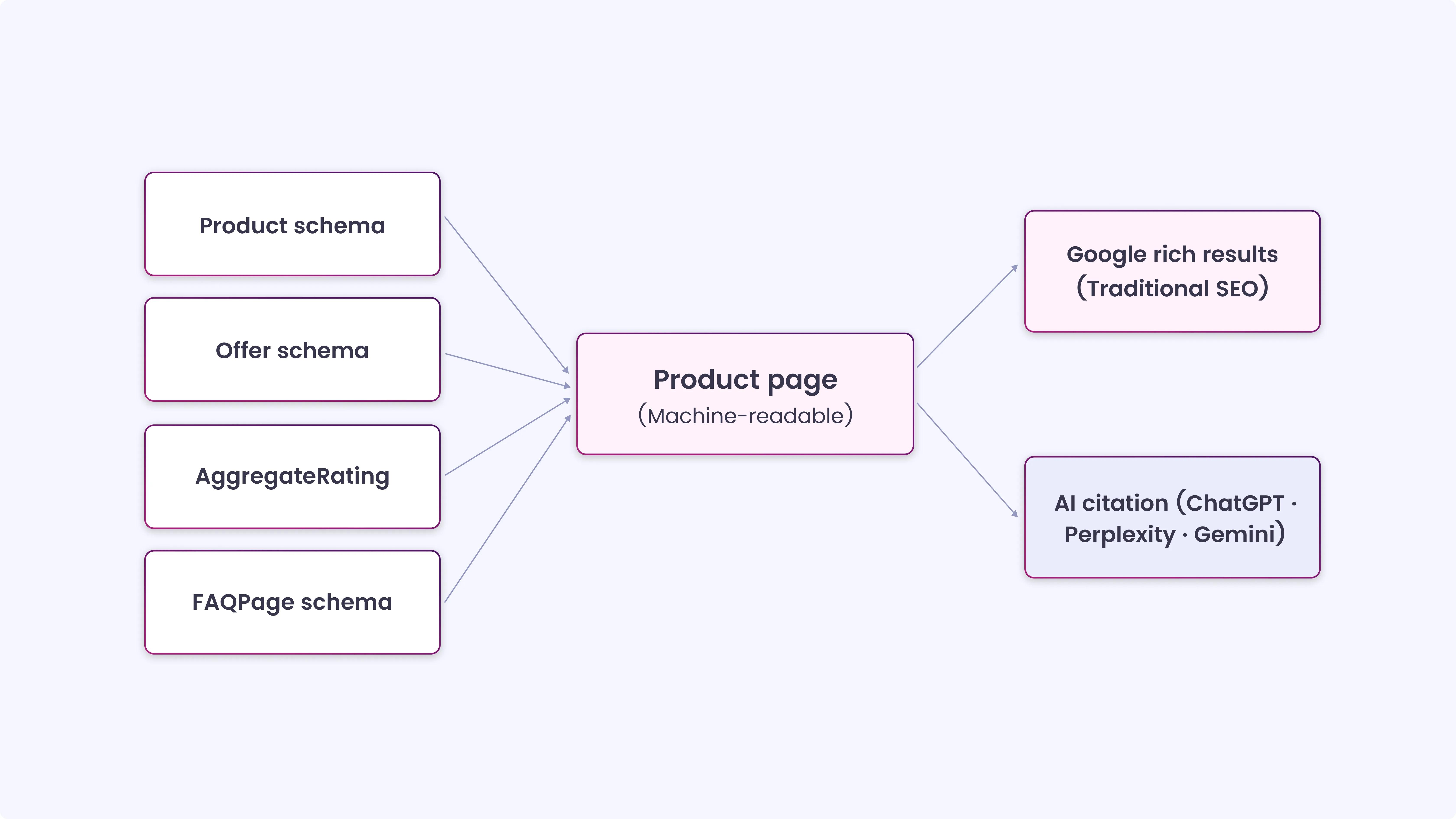
Structured product data is the foundation for everything else that is built. Without it, your products may exist online, but they won’t be understood by AI tools, and products that aren’t understood don’t get recommended.
Structured data, in a machine-readable format, tells AI tools the essential facts about your product. The most important Schema.org types for e-commerce:
- Product:Name, description, brand, SKU, category
- Offer:Price, currency, availability, return policy
- AggregateRating:Star rating, number of reviews
- FAQPage:Questions and direct answers about the product
Google has confirmed that AI Overviews prioritize content that is clearly structured and easily attributable. Pages that already surface as rich snippets in traditional search are more likely to be referenced in AI-generated summaries. In other words, structured data helps you in traditional SEO and in AI visibility; it’s a dual-purpose work.
For product catalogs with hundreds or thousands of SKUs, structured data implementation might feel overwhelming. Prioritize your highest-traffic and highest-margin products first, then work outward. Even partial coverage of structured data yields meaningful visibility gains.
How AI Search Changes Product Discovery Behavior
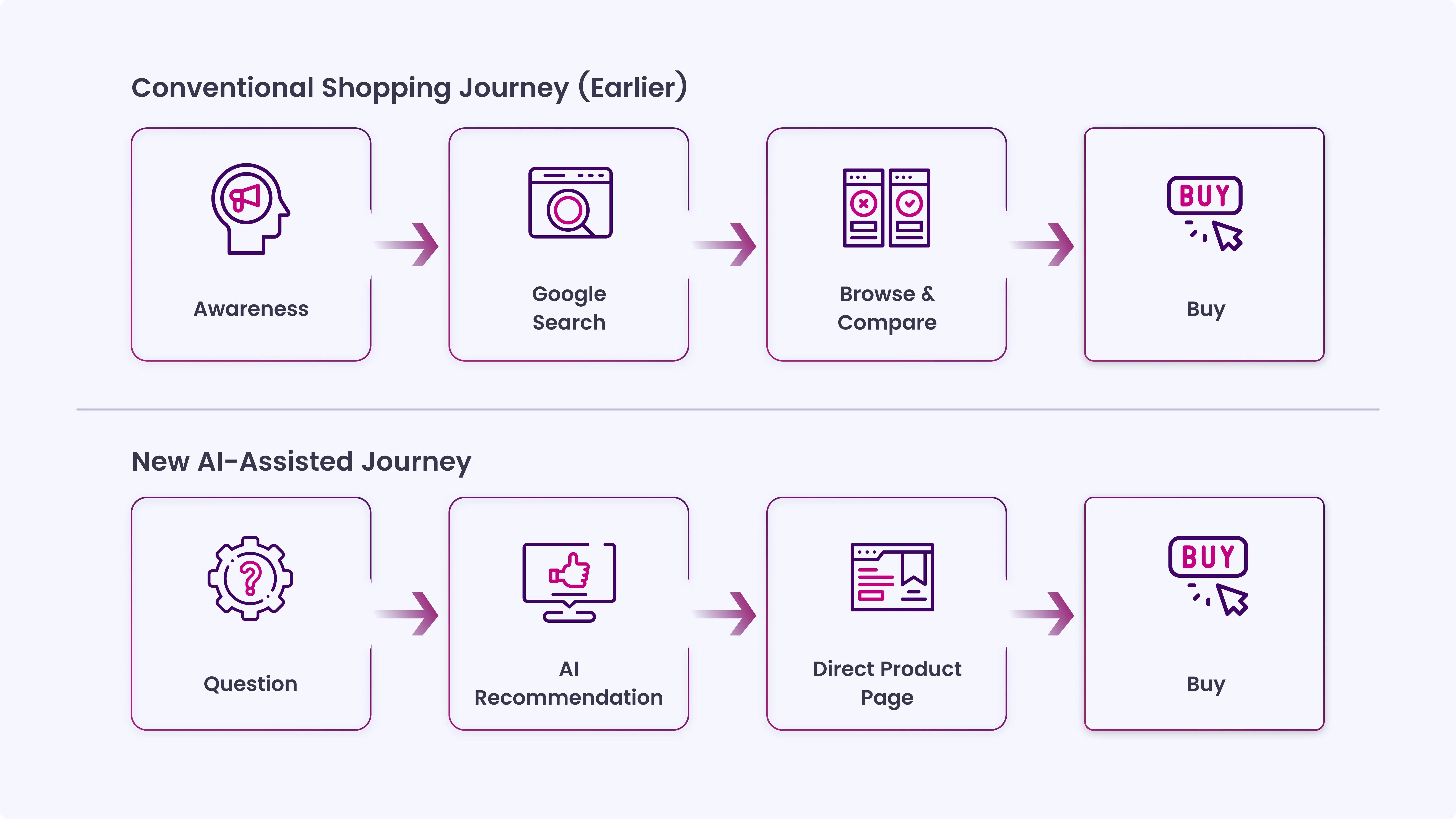
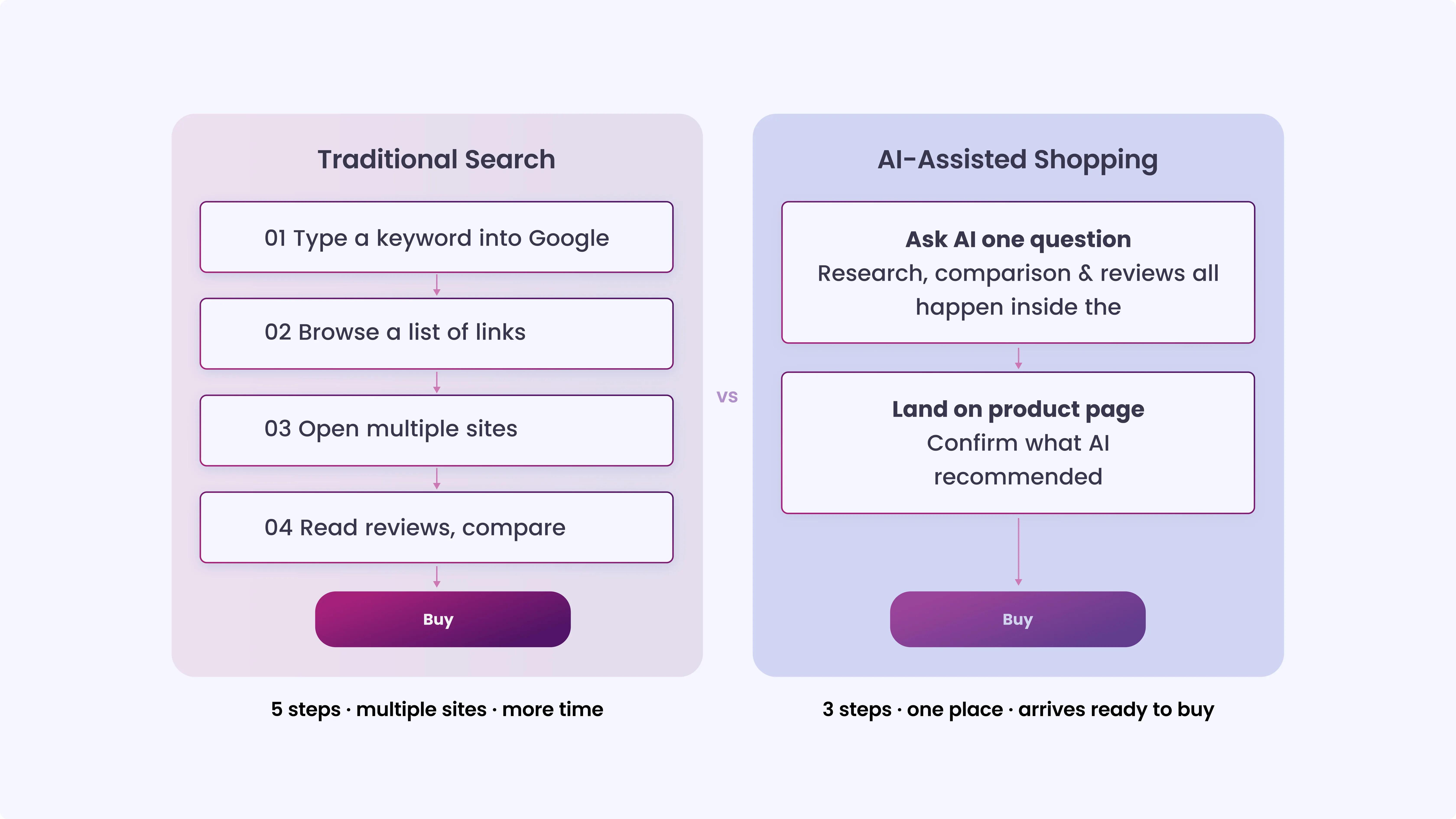
The shopping journey used to look roughly like this: awareness → Google search → browse several sites → compare → buy. AI search collapses several of those steps.
A shopper using AI might go: question → AI recommendation → direct product page → buy. The entire research and comparison phase takes place within the AI tool. By the time they land on your site, many have already decided.
During the 2024 holiday shopping season, AI-driven traffic to U.S. retail sites surged significantly, increasing by670%on Cyber Monday, according to Adobe Analytics. The spike peaked during Black Friday and Cyber Monday, when purchase intent was at its highest. Shoppers are not using AI for casual browsing but for high-stakes, purchase-ready decisions.
A few behavioral shifts worth noting:
- Shoppers arrive at product pages with more context:They’ve already seen comparisons. They’re checking that your page confirms what AI told them.
- Queries are longer and more specific:“Best yoga mat for hardwood floors for a beginner who travels” is now a normal search input.
- Brand loyalty is weaker at the discovery stage:AI recommends based on fit rather than familiarity. A smaller brand with well-structured product data can outrank an established one.
- Reviews matter earlier:AI surfaces review sentiment before the shopper visits your site, so your reputation is being evaluated before your page even loads.
The Impact of SEO, GEO, and AEO for E-Commerce Stores
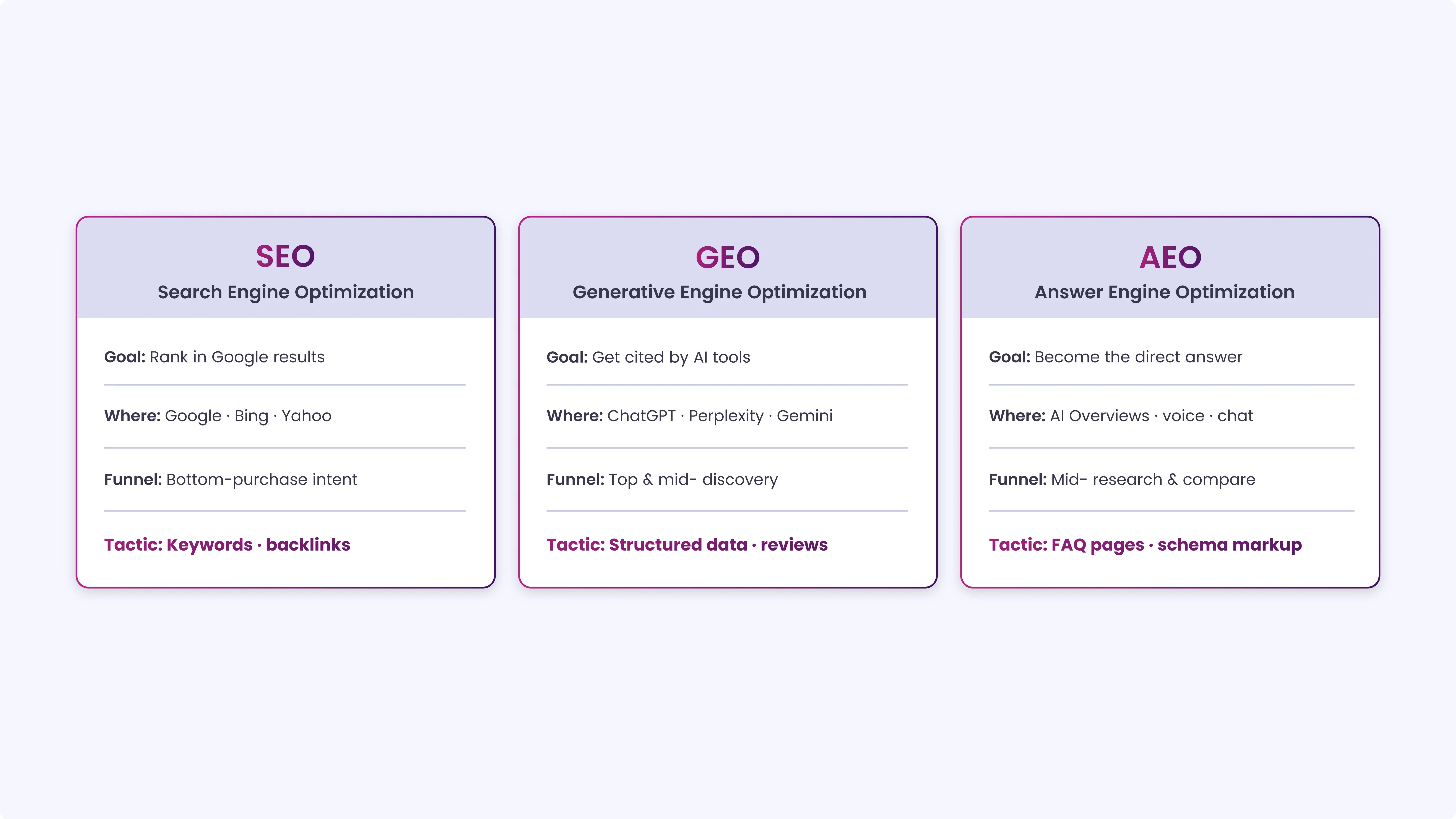
You’ve likely heard of SEO. Two newer terms, GEO (Generative Engine Optimization) and AEO (Answer Engine Optimization), have entered the picture, and it’s worth understanding what each does for your store.
SEO focuses on ranking in traditional Google search results. Still essential, especially for bottom-of-funnel searches with clear purchase intent, someone searching your brand name, a specific product model, or “buy [product] online.”
GEO is about making your content citable by AI platforms. The goal isn’t a ranking position; it’s being the source that an AI references when generating a recommendation. GEO requires clean content architecture, strong structured data, and consistent brand presence across third-party sources.
AEO focuses on getting your content surfaced as a direct answer. This matters most for FAQ content, how-to guides, and comparison content that AI tools use to answer product questions.
All three matter. Nearly31%of the US population will use generative AI search in 2026, according to an eMarketer forecast. Ranking well on Google while being absent from AI search means you’re visible to a shrinking share of the shopping journey.
Four Questions Every Product Page Must Answer to Be Found by AI Search
If you take one thing from this guide, make it this: your product page is no longer just for human shoppers. It’s also a data source that AI tools read, evaluate, and either cite or skip.
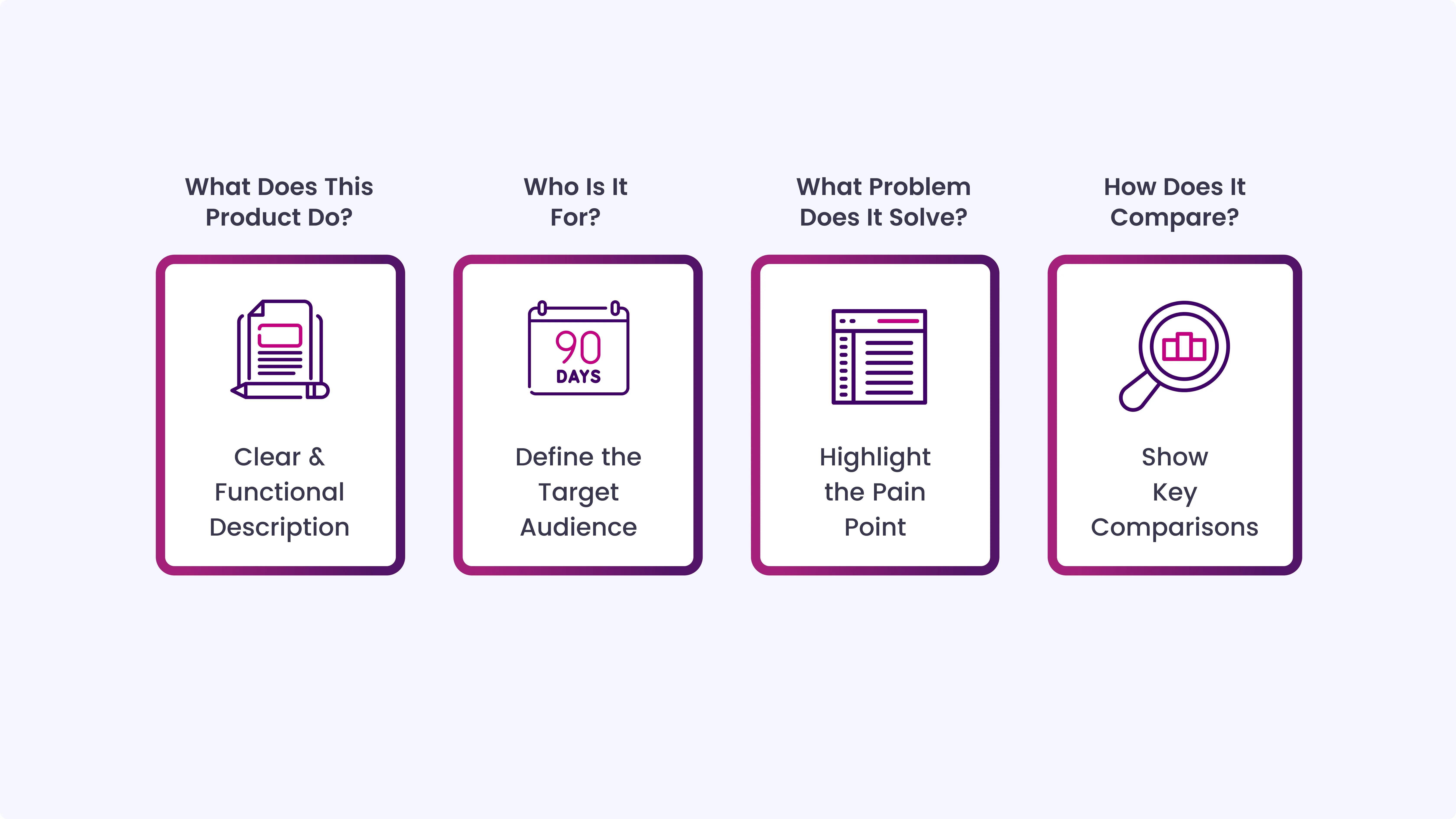
For both audiences, every product page needs to clearly answer four questions:
1. What does this product do?
Not just a vague tagline. Specific, functional description: what it does, how it works, what problem it addresses. If it’s a standing desk converter, say it adjusts between sitting and standing height in 3 seconds with one hand.
2. Who is it for?
Name the audience or use cases directly. Remote workers, apartment dwellers, people with chronic back pain, competitive cyclists, whoever actually buys this product, say so explicitly. AI tools match products to people, and they need to find those people on your page.
3. What problem does it solve?
Shoppers don’t buy products. They buy solutions to problems. “Eliminates cable clutter for dual-monitor setups” is more useful than “features two monitor arms.” Framing your product around the problem it solves helps both shoppers and AI tools immediately understand its value.
4. How does it compare to alternatives?
AI tools read comparison content. If your product page or a supporting blog post addresses “how this compares to [common alternative]” and specifically, you increase the likelihood of being cited in comparison queries, which are among the most common AI shopping prompts.
Common Gaps in E-Commerce Product Data
Most e-commerce stores have more product data gaps than they realize. Here are the ones that show up most often, and the ones AI search penalizes most heavily.
- Missing or incomplete specifications:dimensions, weight, materials, compatibility, size range, capacity. These specifics are what AI uses to filter products against user constraints. Even one missing spec can exclude your product from relevant recommendations.
- No structured data markup:A surprisingly large number of product pages have no Schema.org markup at all. Without it, AI crawlers have to infer everything, and they often infer incorrectly, or don’t infer at all.
- Thin review coverage:Research on AI shopping prompts found that products recommended by AI had a median of 156 reviews. Products with fewer than 50 were rarely surfaced. Review volume is a real visibility threshold, not just a social proof tool.
- Identical content across variant pages:If your red, blue, and green versions of the same product all share the same description word-for-word, AI tools may treat them as duplicate content. Unique attribute-level content for each variant is worth the effort.
- Outdated pricing:Keep pricing and stock status current across your site and any external feeds.
- No FAQ content:FAQ sections on product pages directly feed AEO. Questions like “Is this compatible with X?” or “What’s the return policy?” are exactly what shoppers ask AI tools. If your page answers them, AI has a reason to cite you.
How to Prepare Your Product Catalog for AI Search
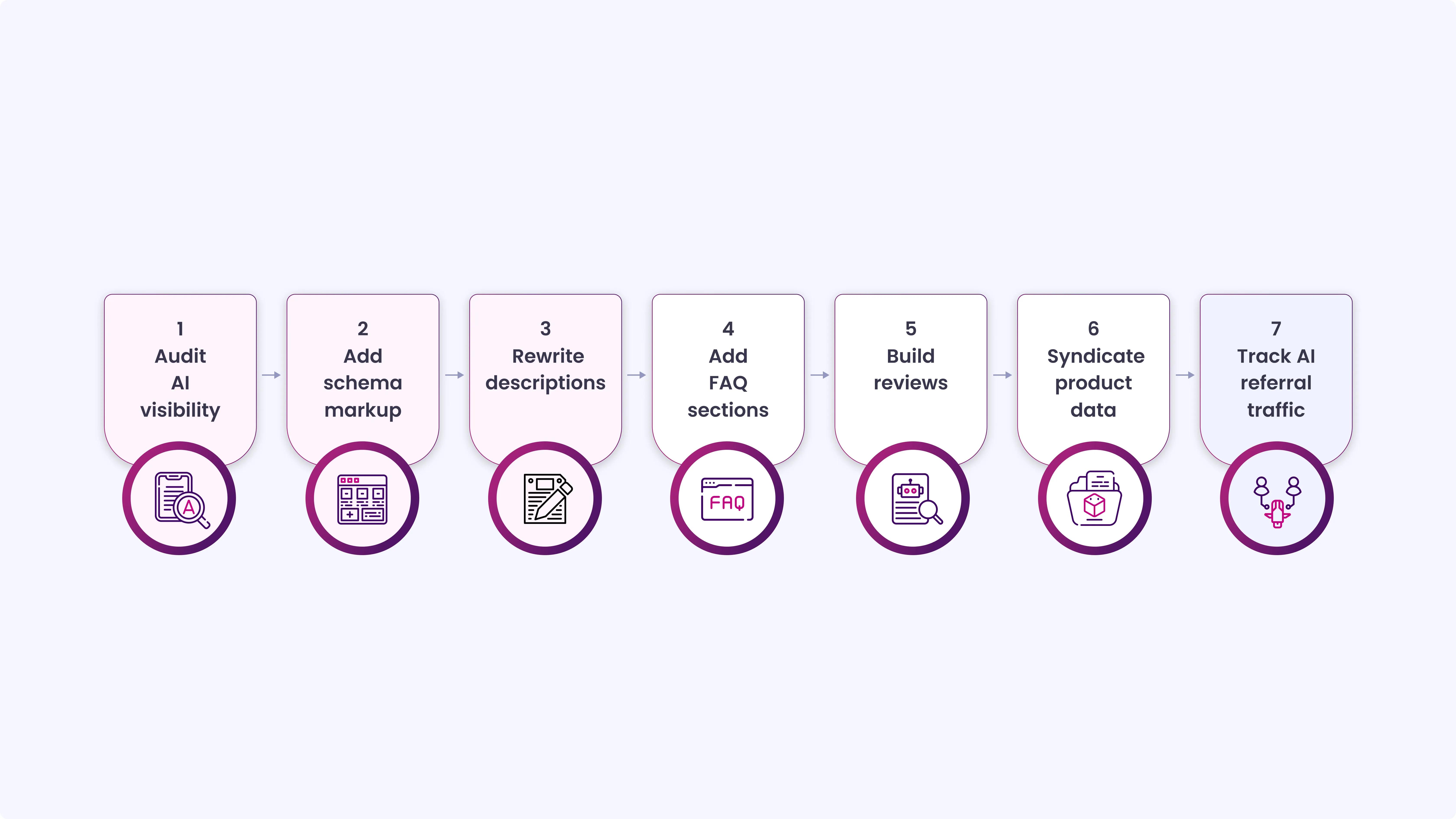
This is where everything comes together. Here’s a practical, step-by-step approach to making your catalog AI-ready.
Step 1: Audit what AI actually sees today
Open ChatGPT, Perplexity, and Google AI Overviews. Type queries your customers actually use. See which brands appear and which sources AI cites. Note whether your brand shows up, doesn’t show up, or shows up inaccurately. This baseline tells you exactly where the gaps are.
Step 2: Implement structured data on your top products
Start with your 20 highest-traffic product pages. Add Schema.org Product, Offer, AggregateRating, and FAQPage markup. Use Google’s Rich Results Test to validate each one. Then work through the rest of your catalog systematically.
Step 3: Rewrite thin product descriptions
For your top products, rewrite descriptions to cover what the product does, who it’s for, what problem it solves, and key specifications, all in plain, specific language. Aim for 200-400 words of original, useful content per product.
Step 4: Add FAQ sections to product pages
Write 4-6 questions per product page that reflect what shoppers actually ask. Pull from your customer service inbox, your site search queries, and Amazon Q&A sections on similar products. Keep answers direct and factual.
Step 5: Build reviews actively
Set up automated post-purchase review requests via Yotpo, Judge.me, or a similar platform. Aim for 150+ reviews per key product. Don’t just collect star ratings; prompt customers to mention specific use cases and features in their responses.
Step 6: Syndicate accurate product data externally
Submit a structured product feed to Google Merchant Center. Keep your Amazon listings current and consistent with your website. Get your products into editorial comparison guides on high-authority sites. AI tools cite these sources heavily; your presence there feeds directly into your AI visibility.
Step 7: Track AI referral traffic separately
Set up GA4 to tag traffic from ChatGPT (utm_source=chatgpt) and Perplexity as their own channels. Treat AI referral traffic with separate benchmarks; it behaves differently from organic traffic, and you need clean data to understand what’s working.
The Role of AI in the Full Shopping Journey
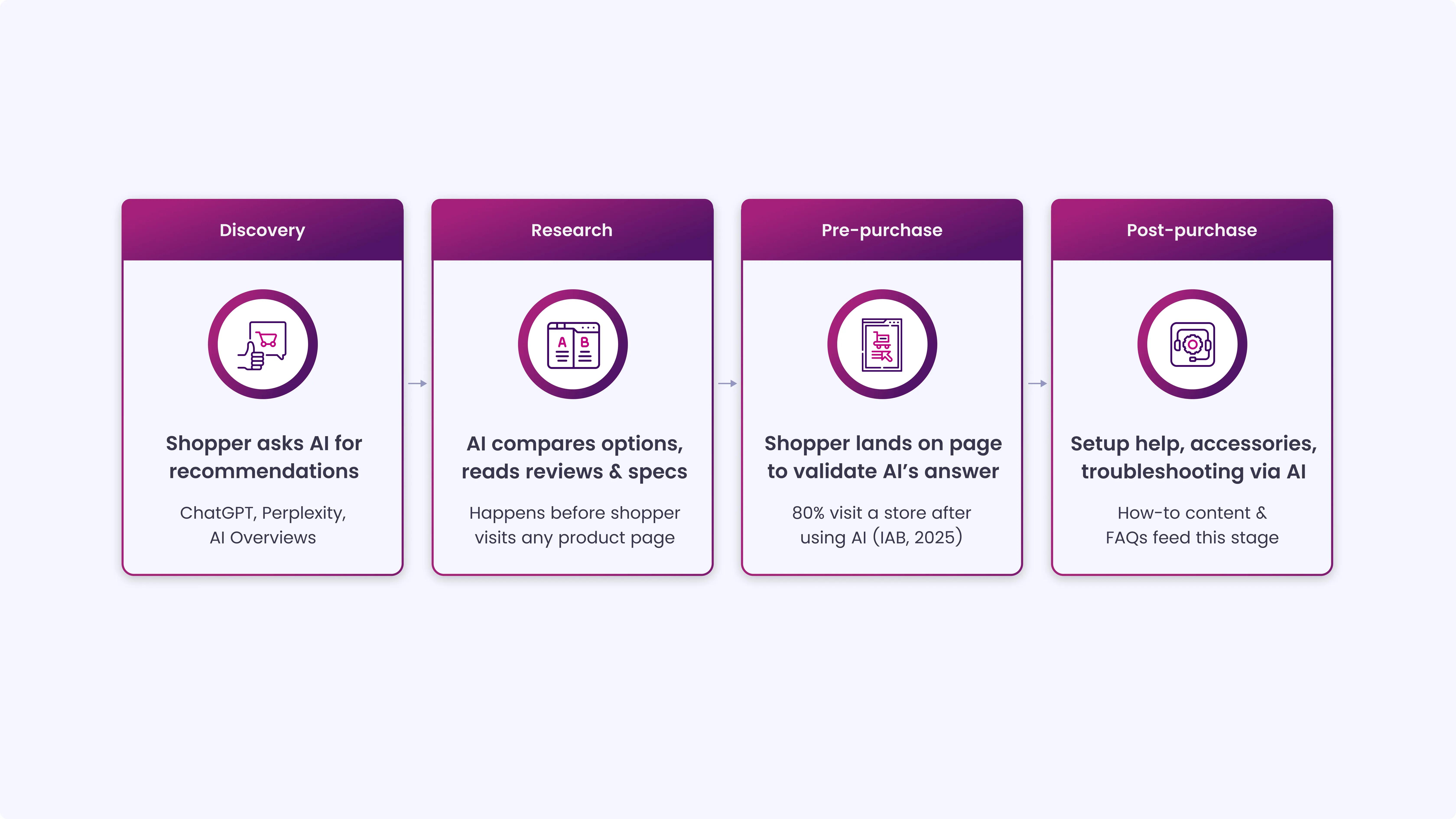
AI search isn’t only a discovery tool. It shows up at multiple points in how shoppers interact with brands today.
- Discovery:Shoppers ask AI for product recommendations based on needs, budget, and constraints. This is where most e-commerce attention is currently focused.
- Research and comparison:After seeing a recommendation, shoppers ask follow-up questions: “How does [Product A] compare to [Product B]?” or “What do reviews say about [product]?” AI synthesizes this information from review sites, forums, and editorial content.
- Pre-purchase validation:In AI shopping sessions, nearly 80% of people visited a retailer or marketplace to validate their purchase decision after using AI. The AI doesn’t close the sale; your product page does. Make sure it confirms everything the AI told them.
- Post-purchase:Shoppers ask AI for setup help, troubleshooting, and accessory recommendations. Brands with strong how-to content and support documentation get cited here, too.
The implication is to optimize for the full journey. Product pages matter most at the validation stage, but blog content, how-to guides, and FAQ pages all feed AI visibility at other stages.
How Ranking Signals Are Changing in AI Search
Traditional SEO and AI search no longer rely on the same signals. Here’s how they differ:
| Traditional SEO Signals | AI Search Signals |
| Backlinks | Third-party mentions and citations |
| Keyword density | Content specificity and clarity |
| Page speed | Structured, machine-readable data |
| Domain authority | Consistency across sources |
| Meta tags | Review quality and sentiment signals |
| Crawlability | Clean HTML and structured markup |
| Freshness (optional boost) | Freshness (core ranking factor) |
The shift is clear: AI search is less about link-based authority and more about whether your content can be understood, trusted, and confidently cited across sources.
AI Search Is Already Driving Real Buying Decisions
AI search is no longer experimental. It is already shaping how people discover and choose products. Traffic from generative AI to U.S. retail sites has increased by4,700%year over year, and these visitors convert at higher rates because they arrive with clearer intent.
The brands showing up in these answers are not always the biggest, but the ones that provide AI with clean, structured, and consistent product information.
The shift is simple but important. The same elements that help AI understand your store also improve human decision-making: clear product descriptions, accurate specifications, consistent pricing, real reviews, and answers to common questions. Nothing new needs to be invented; what matters now is how well this information is presented and maintained.
Start with your most important products. Check what AI systems surface today, fix gaps in your product data, and keep pricing and availability accurate across every channel. The brands that do this early will become the ones AI consistently pulls into shopping answers as this behavior continues to grow.
Improve Your Visibility in AI Search Results with INSIDEA
AI search is no longer just influencing discovery; it is actively deciding which products get surfaced, compared, and recommended. If your product data is unclear or inconsistent, AI systems will simply skip it.
INSIDEAhelps e-commerce teams structure and optimize their product and content ecosystems so AI tools can read, understand, and surface their brand in shopping results across ChatGPT, Perplexity, and Google AI Overviews.
Here is what we help with:
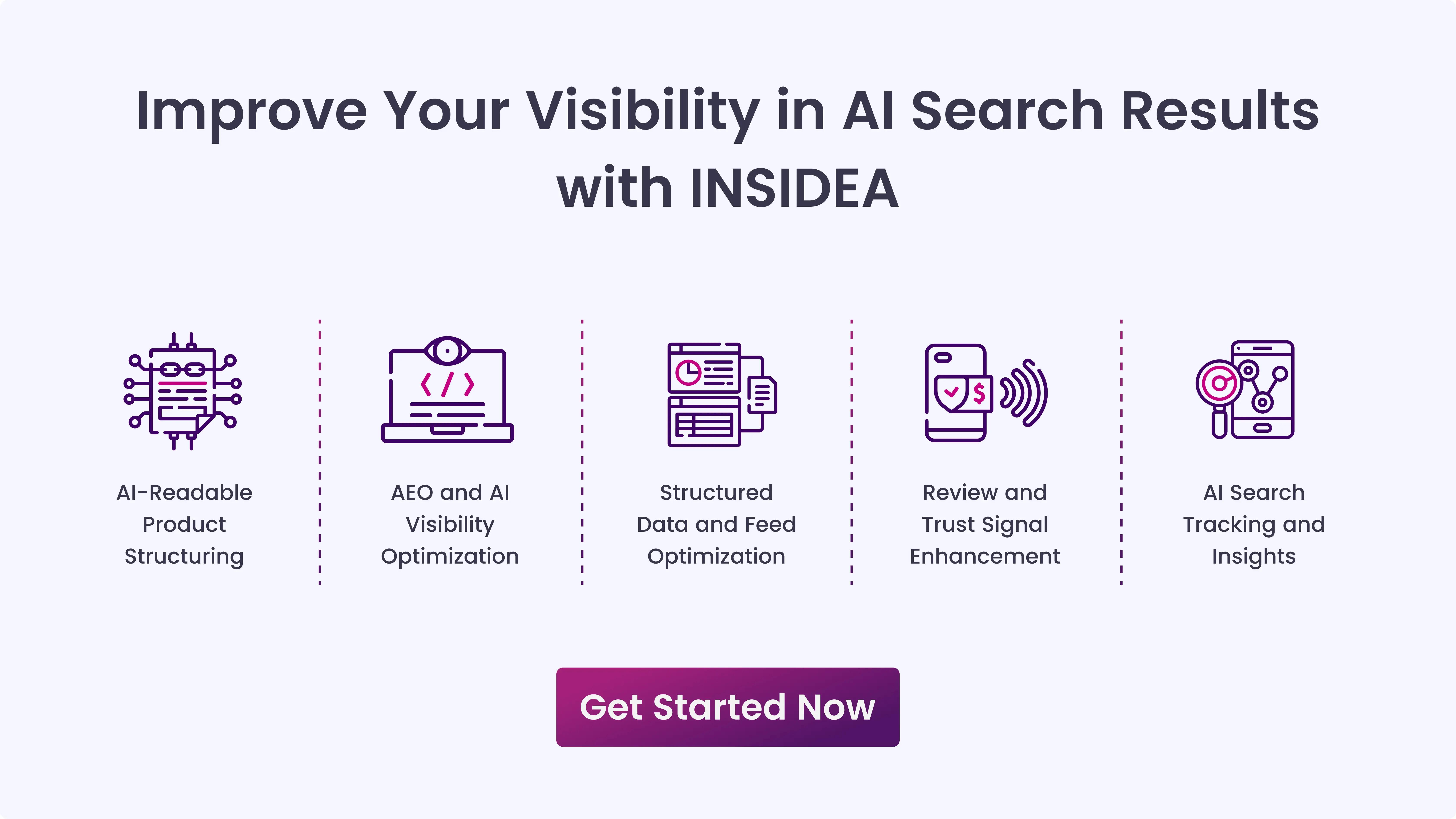
- AI-Readable Product Structuring:Improve product pages with clear specifications, use cases, and structured formatting so AI systems can interpret them correctly.
- AEOand AI Visibility Optimization:Strengthen the signals that influence whether your brand appears in AI-generated recommendations and comparisons.
- Structured Data and Feed Optimization:Implement and refine schemas and product feeds to make your catalog machine-readable across platforms.
- Review and Trust Signal Enhancement:Improve how AI systems interpret your brand through reviews, consistency, and third-party mentions.
- AI Search Tracking and Insights:Set up measurement systems to track how AI-driven discovery is contributing to traffic and conversions.

 How INSIDEA works