Answer Engine Optimization is changing how content gets structured for AI-driven search. Unlike traditional SEO, where a page ranks based on backlinks and keyword density, AEO requires content to be machine-interpretable at a much more granular level. Two files have emerged as central to this discussion: agents.md and skills.md.
These files originate from agentic AI frameworks, where systems are designed to act on behalf of users. But their relevance has extended into content architecture and AEO, because answer engines now parse structured intent signals.
This blog explains how agents.md and skills.md differ in function, how each one maps to the AEO strategy, and how to use both without conflating them.
How Does agents.md Define an Agent?
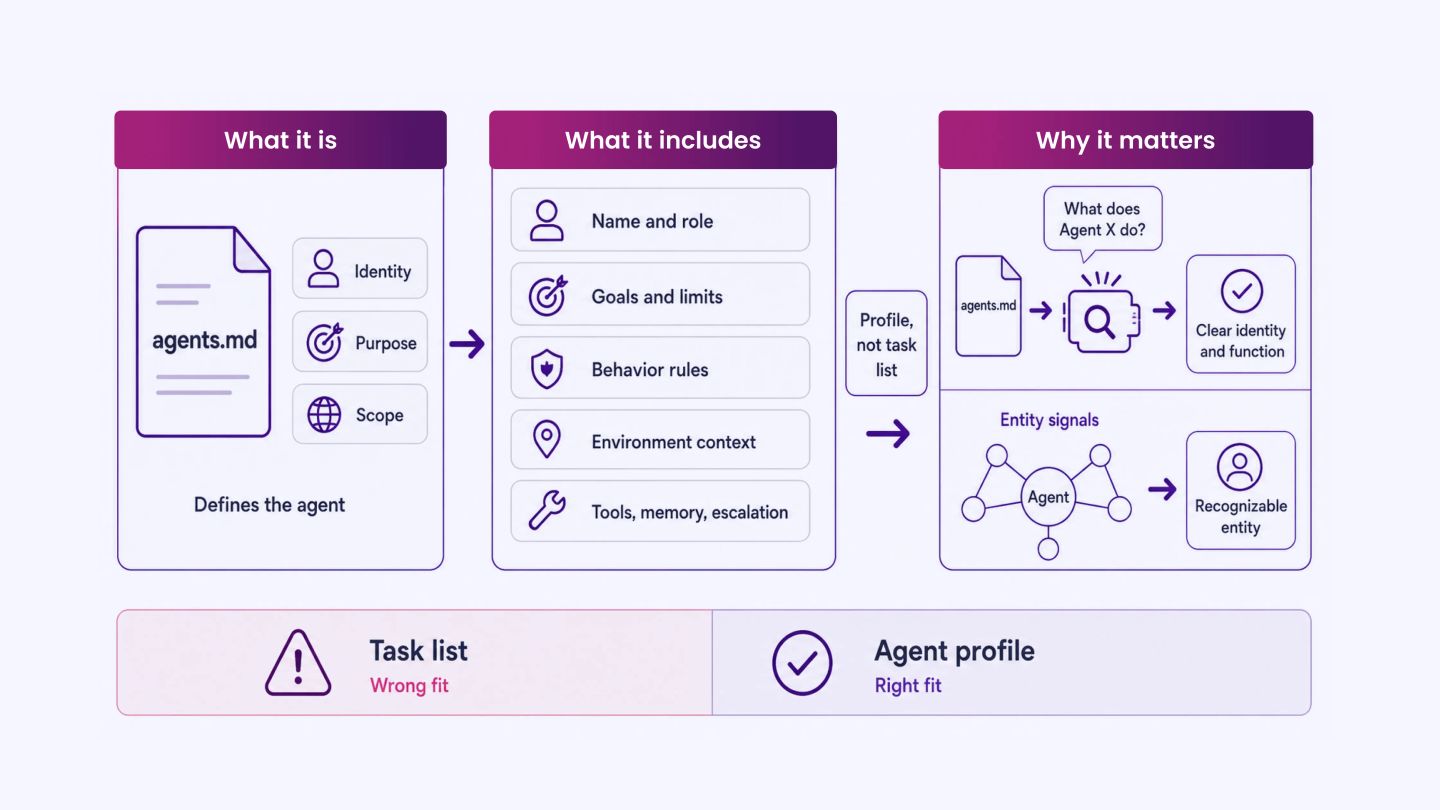
agents.md is a structured file that describes an AI agent’s identity, purpose, and operational scope. Think of it as a declaration: this is what the agent is, this is what it is authorized to do, and this is how it should behave in various conditions.
In agentic frameworks like those built on top of large language models, agents.md typically contains:
- The agent’s name and role definition
- Its primary objectives and constraints
- Behavioral guidelines (what it should or should not do)
- Context about the environment it operates in
- Any memory, tool access, or escalation rules
For AEO purposes, agents.md maps closely to entity-level signals. When an answer engine processes a query like “what does [agent name] do,” it is looking for a clear, structured declaration of identity and function. agents.md, when well-constructed, gives the engine exactly that.
The file is not a task list. It is a profile. It tells the system, and by extension the answer engine, who this agent is in a given context. That distinction matters because answer engines are increasingly building entity graphs rather than just keyword indexes.
An agent that is clearly defined through a well-written agents.md becomes a recognizable node in that graph.
How skills.md Defines Agent Capabilities
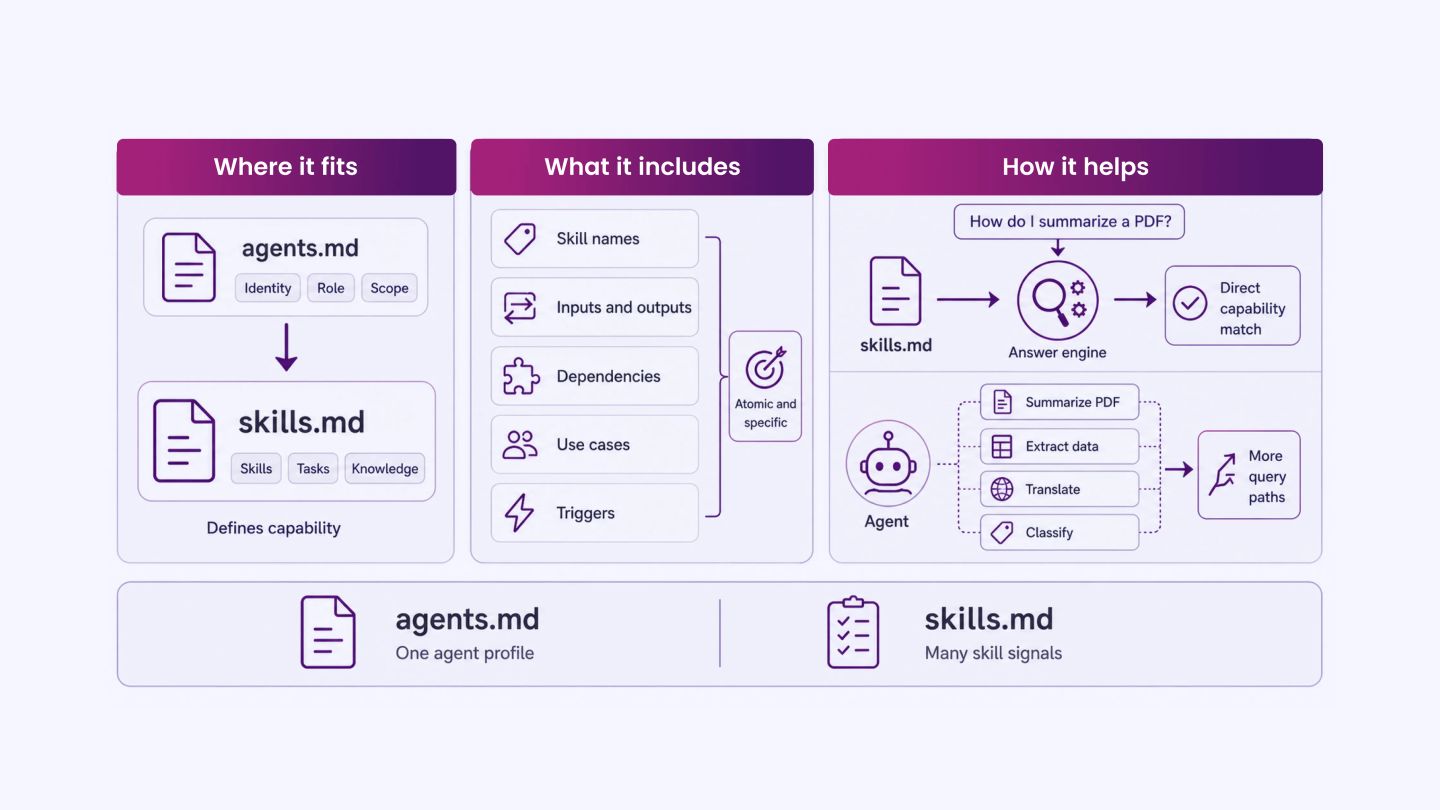
skills.md sits one layer below agents.md in the abstraction hierarchy. Where agents.md declare identity and skills.md declares capability. It is a structured list or description of specific tasks, functions, or knowledge domains that an agent can execute.
Typical skills.md file includes:
- Individual skill names with short descriptions
- Input and output expectations for each skill
- Any dependencies or prerequisites
- Example use cases or triggers
In the context of AEO, skills.md maps to task-level signals. When someone asks an answer engine, “how do I summarize a PDF using an AI agent,” the engine is looking for content that clearly connects a capability to an outcome. A well-structured skills.md, or content derived from one, gives the engine a direct, parseable answer.
The main distinction here is granularity. Skills are atomic. They are specific, callable, and bounded. An agent might have dozens of skills, each of which could independently surface in an answer engine response depending on what the user is asking.
This also means skills.md is more query-diverse than agents.md. A single agents.md covers one entity. A single skills.md can generate content signals for multiple distinct queries, each tied to a different skill entry.
How the Two Files Interact in an Agentic System?
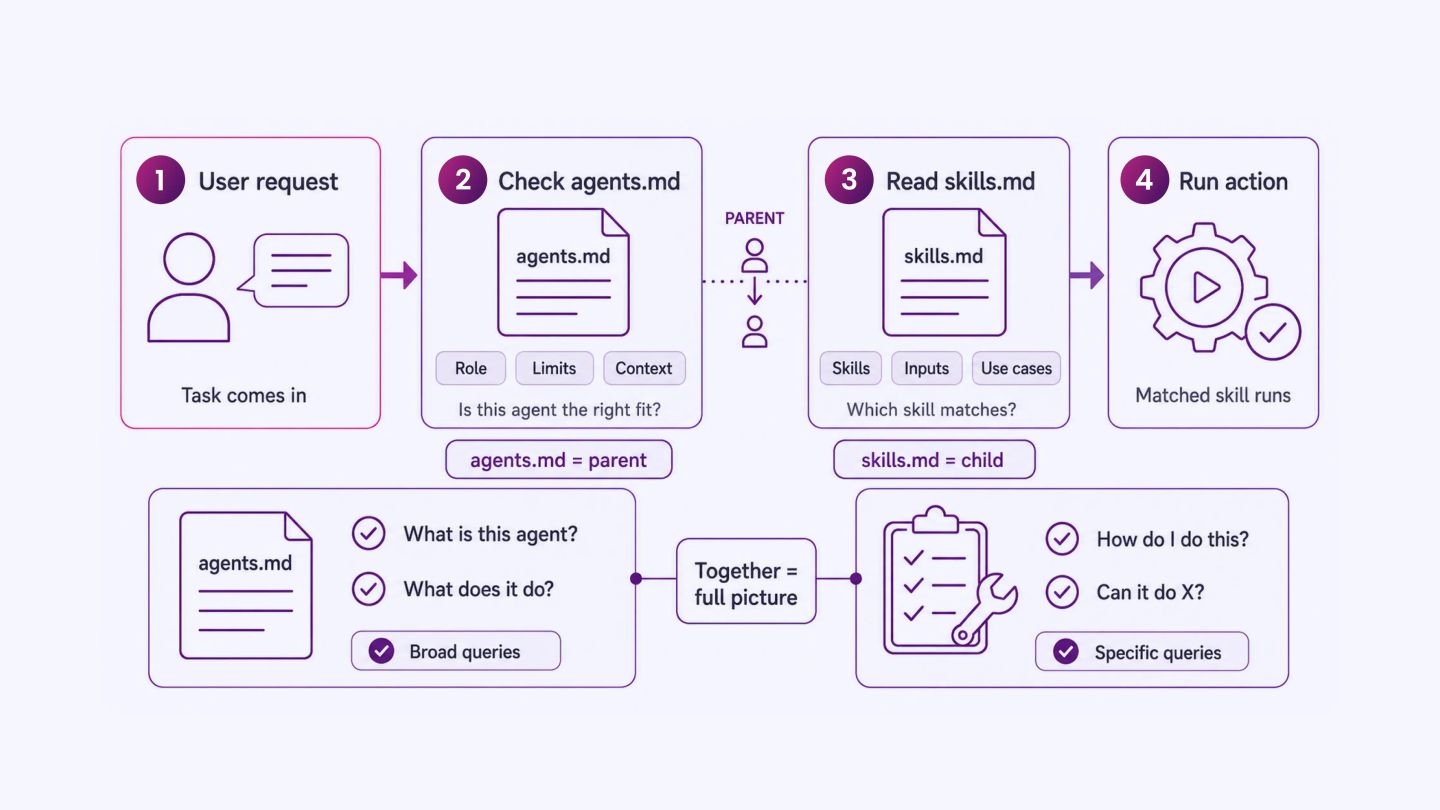
To understand why both files matter for AEO, it helps to see how they interact within an actual agentic system.
An agent is initialized using agents.md. The system reads this file to understand the agent’s role, constraints, and context. Once initialized, the agent consults skills.md to determine which actions it can take given a particular input or goal.
In practical terms:
- A user submits a request to an AI system.
- The system checks agents.md to verify whether this agent is authorized and appropriate for the task.
- The agent then parses skills.md to identify which skill or combination of skills applies.
- The matched skill is executed.
This is a parent-child relationship. agents.md is the parent context. skills.md contains the children (individual capabilities). Neither operates effectively without the other in a live system.
For AEO, this architecture has a direct content implication. Content modeled after agents.md should answer broad “what is this” and “what does this do” queries. Content modeled after skills.md should answer specific “how do I” and “can it do X” queries.
Publishing both types of content, clearly differentiated, gives answer engines a complete picture of the entity and its functions.
Why Does AEO Treat These Files Differently?
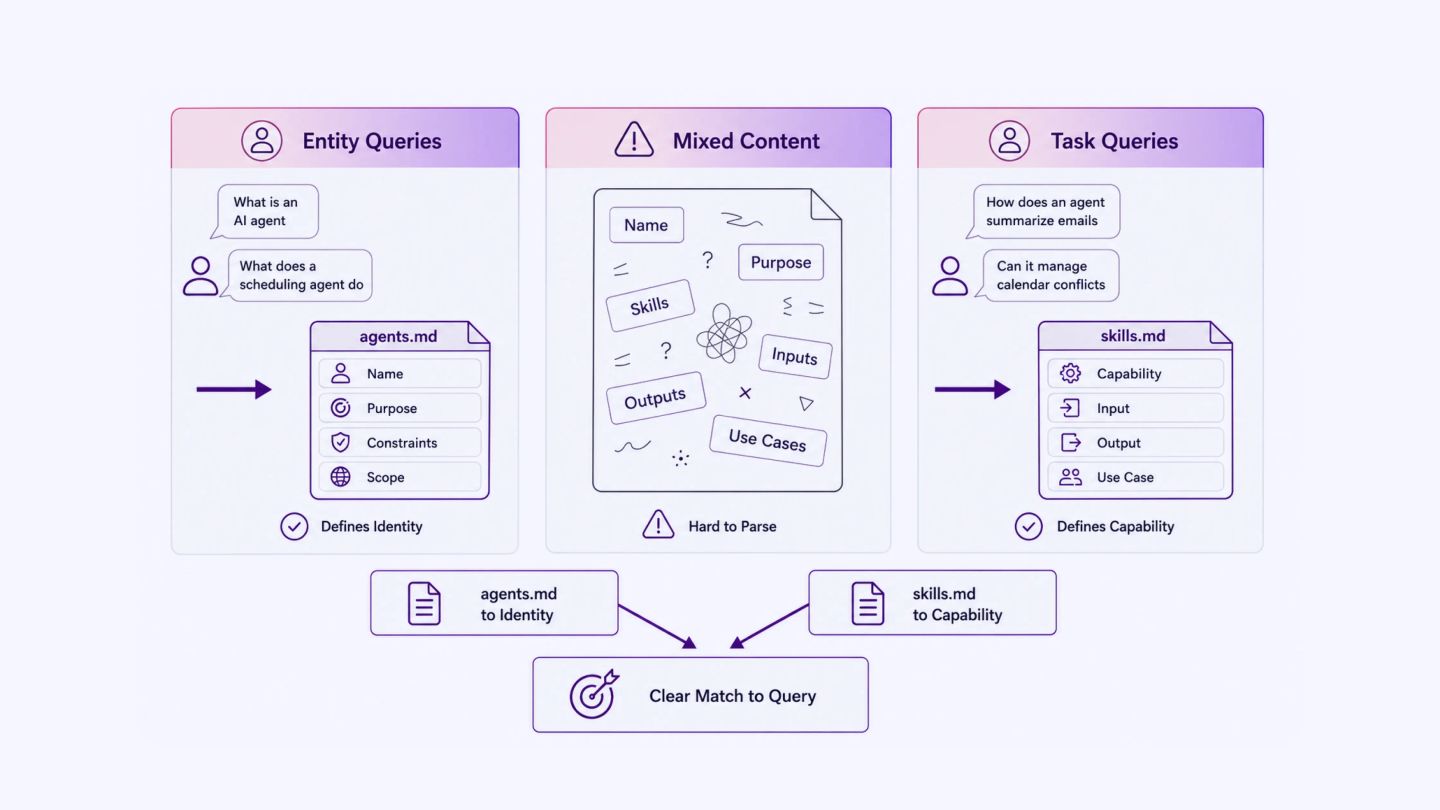
Answer engines, including those powering AI-driven search interfaces, parse content differently based on query type. There are broadly two categories relevant here:
Entity queries ask about what something is. “What is an AI agent?” “What does a scheduling agent do?”=” These queries are best served by content structured around agents.md logic: name, purpose, constraints, scope.
Task queries ask about what something can do or how to do it. “How does an AI agent summarize emails?” “Can an AI agent manage calendar conflicts?” These queries are best served by skills.md-derived content: capability name, inputs, outputs, example use.
AEO strategy fails when content mixes these two types without structure. A page that tries to describe an agent’s identity while simultaneously listing every skill it has, without clear separation, is difficult for an answer engine to parse. The engine cannot determine whether it is reading a definition, a capability list, or a use case guide.
Structuring content so that agents, md logic, and skills.md logic is organized into distinct sections, or even distinct pages, giving answer engines cleaner signals. Each piece of content becomes easier to match to a specific query type, increasing the likelihood that it will surface as an answer.
Common Mistakes When Using Both for AEO
Several patterns consistently appear in poorly optimized AEO content related to agents and skills:
Merging identity and capability into one block: Writing a single paragraph that describes what an agent is and what it can do, without separating the two, produces content that is hard to parse at query resolution time.
Writing skills without context: A skills.md that lists capabilities without explaining when or why each one activates gives the answer engine no trigger signals. Skills need use-case framing to be AEO-useful.
Using agents.md as a marketing document: Some teams write agents.md as a branding exercise, full of broad claims and vague positioning. This fails AEO because answer engines are looking for declarative, factual statements, not promotional language.
Ignoring the output structure in skills.md: Skills that do not specify what they produce are incomplete from an AEO standpoint. Answer engines surface content that closes the loop from input to output. A skill entry that only describes what goes in, without describing what comes out, is half a signal.
Treating both files as static: Agents evolve. Skills get added or retired. AEO-aligned content tied to these files needs to be updated when the underlying system changes. Stale content misrepresents the agent and can lead to incorrect answers being surfaced.
Building AEO Content from Each File Type
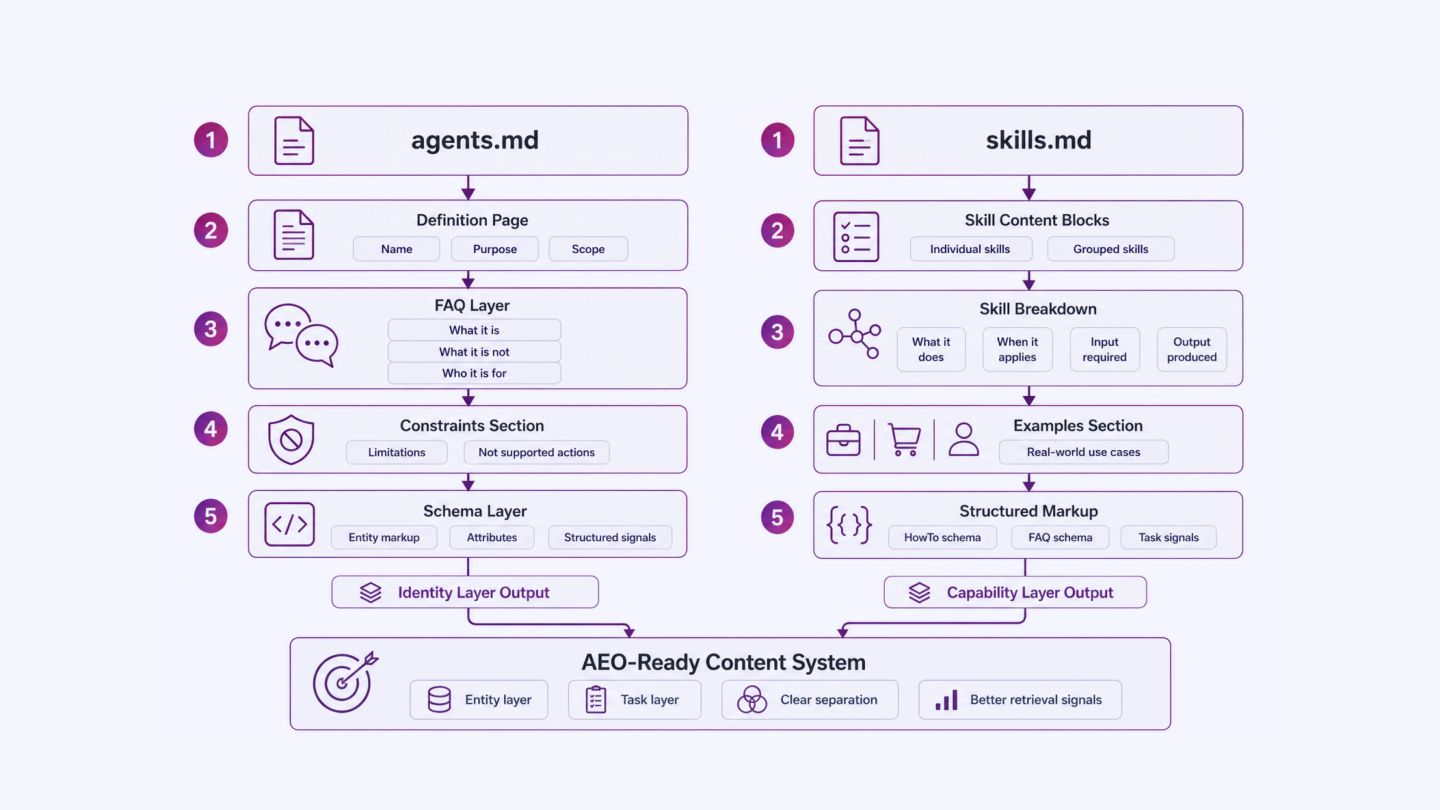
Here is how to approach content creation using each file as a source of structure:
From agents.md:
- Write a clear definition page for the agent. Name, purpose, scope.
- Include a short FAQ covering identity-level questions: what it is, what it is not, who it is for.
- Add a constraints or limitations section. Answer engines value honesty about what a system does not do.
- Use schema markup to tag the agent as an entity with defined attributes.
From skills.md:
- Create individual content entries for each skill, or group closely related skills.
- For each skill, cover: what it does, when it applies, what input it needs, what output it produces.
- Write example scenarios. Answer engines favor content that connects a skill to a real-world situation.
- Use structured markup (FAQ schema, HowTo schema) for task-oriented skills.
When both content types exist and are clearly differentiated, an answer engine can serve entity queries from the agents.md content layer and task queries from the skills.md content layer. This separation is what makes a content architecture AEO-ready.
The Difference Between Identity and Capability in AEO
agents.md and skills.md are not competing formats. They operate at different levels of an agentic system and, by extension, require different approaches in AEO content architecture. agents.md grounds an agent’s identity, purpose, and constraints. skills.md breaks that identity into specific, executable capabilities.
For AEO, the practical implication is clear: build content at both layers, keep them structurally separate, and align each type of content to the query intent it best serves.
Entity-level queries need agents.md logic. Task-level queries need skills.md logic. A content strategy that respects this distinction produces material that is easier for answer engines to parse, match, and surface accurately.
INSIDEA
Ready to get found by people and AI?
Search and answer-engine visibility that compounds, built to be cited.



 How INSIDEA works