Over 70% of B2B buyers start their research online before contacting a supplier, and 60% of the buying decision is made before they even talk to sales. If your company isn’t visible online, potential customers will find your competitors instead.
Think about your habits. When you need information, you search online. Your customers do the same. But just having a website isn’t enough, buyers expect detailed product information, case studies, customer reviews, and even interactive content to help them make decisions. Companies that invest in digital marketing generate 3X more leads and grow 30% faster than those that don’t.
Yet, many manufacturers still rely on outdated marketing tactics—trade shows, cold calls, and printed catalogs—that don’t reach modern buyers. Meanwhile, competitors who embrace SEO, paid ads, video marketing, and automation are capturing market share. This blog will walk you through 30+ proven digital marketing strategies tailored for manufacturing companies.
30+ Digital Marketing Tips for Manufacturing Companies in 2026

In 2026, buyers expect seamless online experiences, data-driven insights, and engaging content. These 30+ digital marketing tips will help your manufacturing company attract more leads, build brand authority, and drive sales in an increasingly digital world.
Building a Strong Digital Foundation
1. Develop a Modern, SEO-Optimized Website
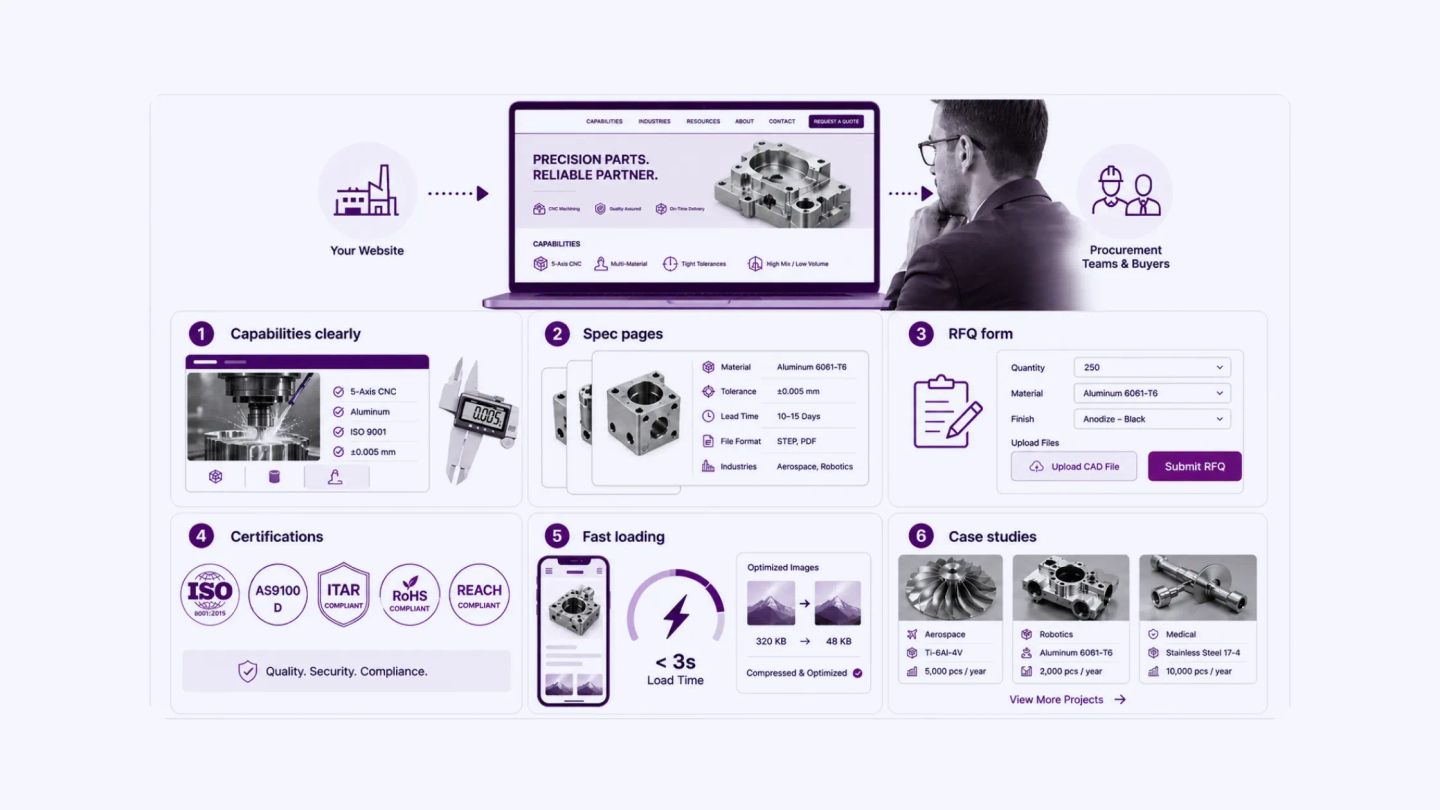
A website is the foundation of your digital presence. Many buyers and engineers browse on their phones or tablets, so if your website isn’t mobile-friendly, they might leave and go to a competitor.
When ranking websites, Google considers factors like page load time, interactivity, and visual stability. A slow or poorly designed website can hurt your search rankings. Use tools like PageSpeed Insights to analyze and improve site speed. Reduce unnecessary scripts and compress images to make pages load faster.
Technical SEO ensures search engines can find and index your website correctly. This includes fixing broken links, setting up proper redirects, and using an XML sitemap. Submit your sitemap.xml to Google Search Console to help Google understand and index your website pages faster.
2. Invest in Local SEO for Better Visibility
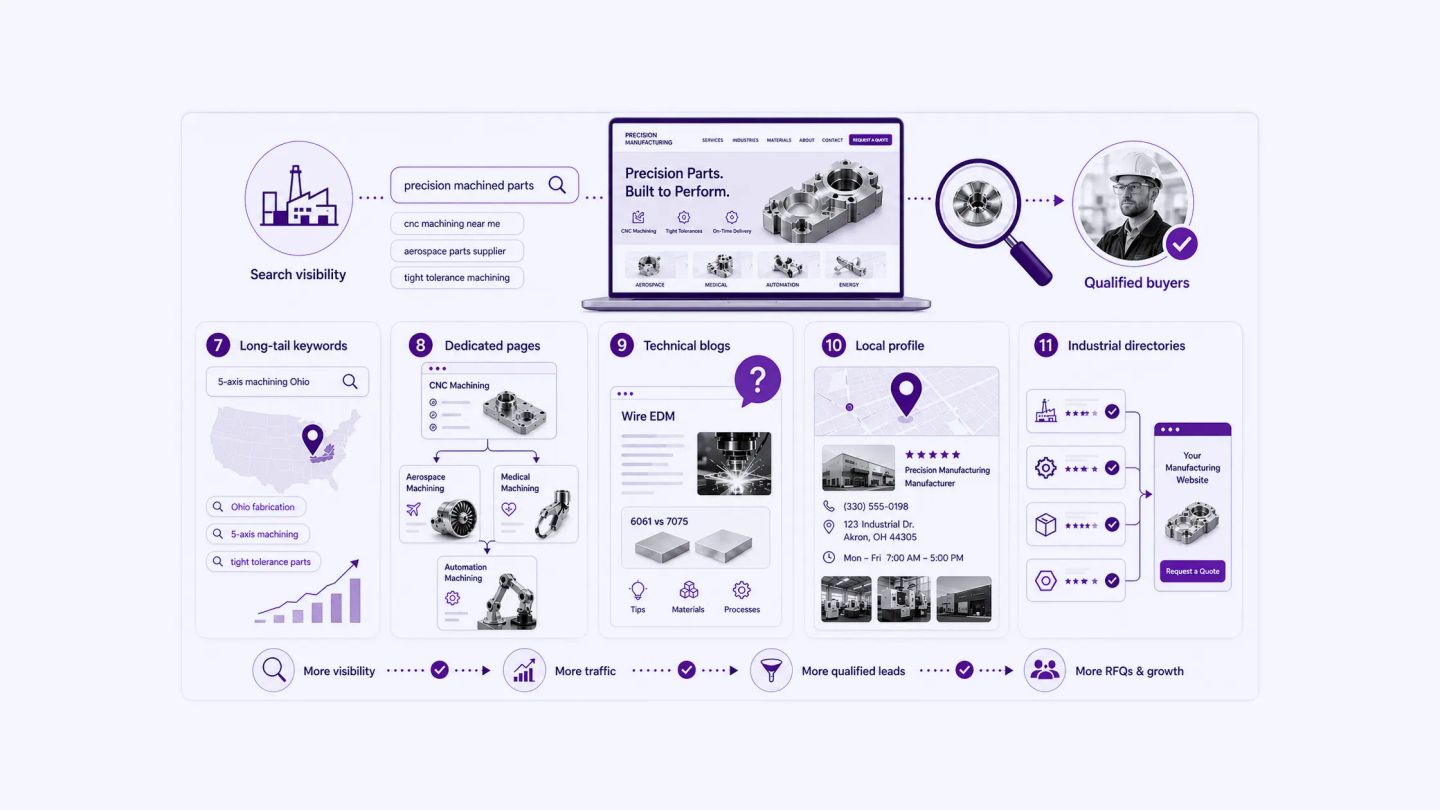
Google My Business (now part of Google Business Profile) is essential for local visibility. An optimized profile increases the chances of appearing in local search results and Google Maps.
Ensure your business name, address, phone number (NAP), and operating hours are accurate. Add photos of your factory or products and encourage customers to leave reviews.
Adding location-specific keywords helps attract local customers. These keywords should be included in website content, meta descriptions, and headings. For example, instead of just using custom metal fabrication, use custom metal fabrication in Chicago or precision CNC machining in Texas.
Customer reviews improve trust and impact local search rankings. Responding to both positive and negative reviews shows professionalism. Ask satisfied clients to leave a review on your Google Business Profile and offer a small incentive, such as a discount on future services.
3. Utilize Schema Markup for Manufacturing Businesses
Schematic markup helps Google display rich search results, such as product details, FAQs, or business information. This makes your listing more informative and attractive. For example, if your company sells industrial equipment, use Product Schema to show pricing, availability, and specifications directly in search results.
Different types of schema markup apply to manufacturing businesses. These help provide clearer information to search engines and potential customers.
| Type | Description | Example |
| Product Schema | Displays product details, such as dimensions, materials, and price. | A CNC machining company can use product schema to highlight different types of metal parts they manufacture. |
| FAQ Schema | Helps answer common questions in search results. | A conveyor belt manufacturer can use FAQ schema to address questions like What is the best material for heavy-duty conveyor belts? |
| Organization Schema | Provides details about your company, including contact information and social media links. | A manufacturer with multiple locations can use organization schema to highlight its headquarters and branch offices. |
Use Google’s Structured Data Markup Helper to create schema code for your pages. Copy and paste the generated code into your website’s HTML. Test the implementation with Google’s Rich Results Test to ensure it’s working correctly.
Content Marketing Strategies for Manufacturers
4. Create Industry-Specific Blog Content
Educate your audience with how-to guides and case studies. Customers want to know how your products work and how they can solve their challenges. Writing how-to guides and case studies can help. For example, if you manufacture industrial coatings, write a guide on how to Choose the Right Corrosion-Resistant Coating for Heavy Machinery.
Focus on long-tail keywords and SEO-friendly blog posts. Long-tail keywords (specific phrases) help attract highly targeted traffic. These keywords should be naturally included in blog posts to improve search visibility. Example: Instead of a broad topic like Metal Fabrication, write about Best Metal Fabrication Techniques for Aerospace Components. Use tools like Google Keyword Planner or SEMrush to find the right keywords.
5. Utilize Video Marketing
Create factory tour videos, product demos, and behind-the-scenes content. Potential buyers and engineers want to see how products are made and how they perform. For example, a CNC machining company can create a factory tour video demonstrating how raw materials are turned into precision parts.
Optimize videos for YouTube SEO. For example, a company manufacturing industrial pumps can create a product demo video titled “How to Install and Maintain an Industrial Water Pump – Step-by-Step Guide.”
Use relevant keywords in the title, description, and tags. Add captions and timestamps for better engagement. Share the video on your website and social media channels.
6. Develop Interactive Content
Use 3D product visualizations and interactive infographics. Instead of just showing static product images, allow customers to interact with 3D models. For example, a manufacturer of industrial valves can create a 3D product viewer where users can rotate and zoom in on different components.
Implement ROI calculators or product configurators. Interactive tools help potential customers choose the right product or understand cost savings. For example, a manufacturer of energy-efficient lighting can offer an ROI calculator that lets businesses estimate how much they will save by switching to LED lighting.
7. Publish Whitepapers & Ebooks
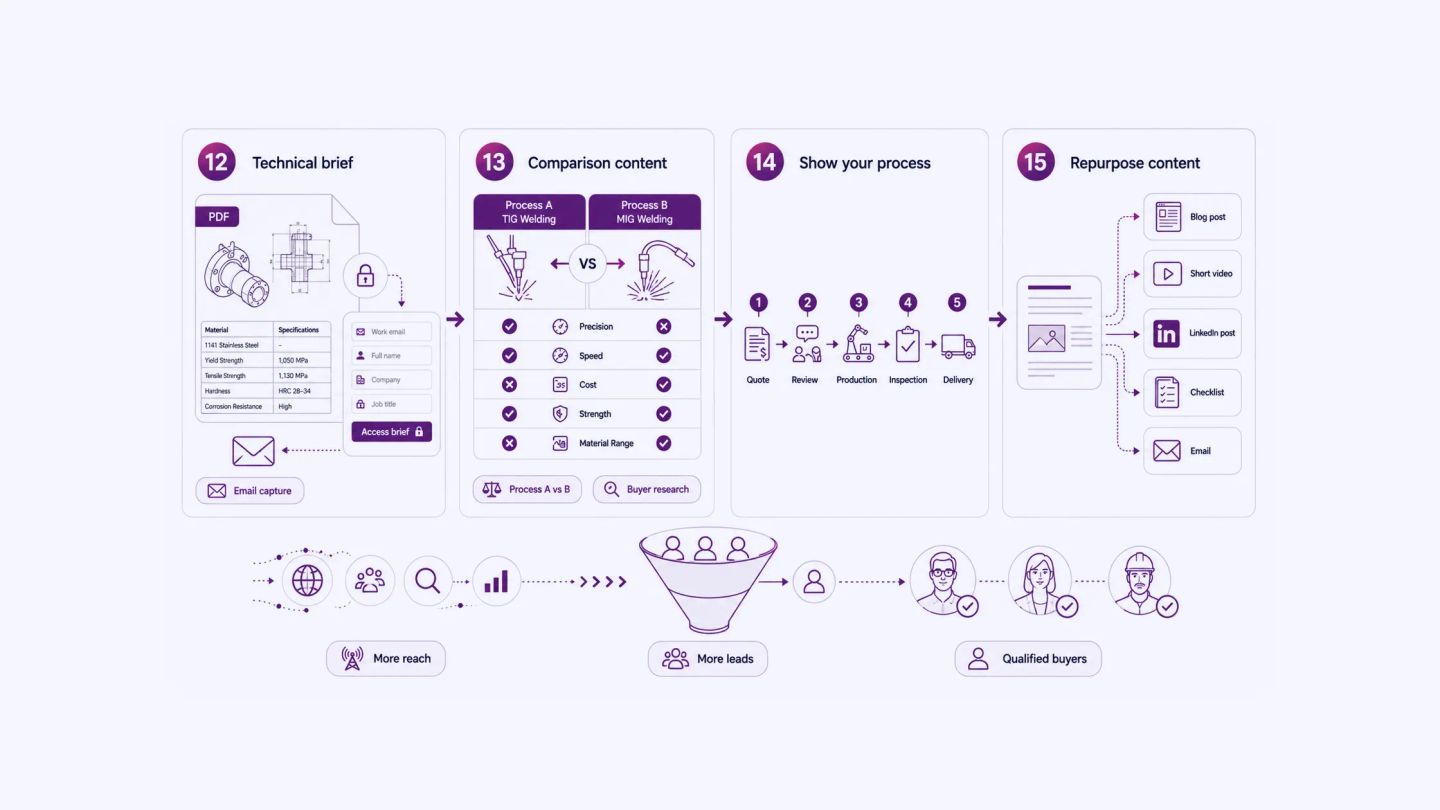
Publishing detailed research and insights helps position your company as an expert. For example, a manufacturer of industrial automation systems can publish a whitepaper titled The Future of Smart Manufacturing: How AI and IoT Are Transforming Production Lines.
Use gated content to capture leads. Gated content requires users to fill out a form (name, email, company details) before downloading, helping collect qualified leads. For example, a company producing custom conveyor systems can offer an ebook titled How to Optimize Your Manufacturing Workflow with Modular Conveyor Systems. Visitors must enter their email to download it.
Social Media Strategies for Manufacturing Companies
8. Optimize LinkedIn for B2B Lead Generation
Posting valuable content helps establish your company as an industry leader. Share articles, reports, or trends related to your sector. For example, an industrial machinery manufacturer can post a LinkedIn article titled “The Future of CNC Machining: Trends to Watch in 2026,” attracting potential clients looking for cutting-edge solutions.
Many industry professionals join LinkedIn groups to discuss trends and challenges. Being active in these groups can help your company get noticed. For example, a sheet metal fabrication company can join a group like Metalworking Professionals and participate in discussions about material innovations, sharing insights and linking back to their services when relevant.
Post with industry news, case studies, or product updates once or twice a week. Engage with posts from potential clients by liking, commenting, and sharing. Use LinkedIn Sales Navigator to find and connect with decision-makers in your target industry.
9. Use Facebook & Instagram for Brand Awareness
Share customer testimonials, employee stories, and industry news. For example, a manufacturer of industrial safety equipment can post a testimonial video from a satisfied customer explaining how the product improved workplace safety. An automotive parts manufacturer can post an employee story featuring a long-time worker talking about their role in the company.
Run targeted ad campaigns. Facebook and Instagram ads allow businesses to reach specific audiences based on location, job title, and interests. For example, a company manufacturing 3D printing materials can run a targeted Facebook ad campaign for engineers and product designers, showcasing new materials and directing them to a product page.
Post 2–3 times per week with a mix of behind-the-scenes content, product highlights, and customer success stories. Use Facebook Ads Manager to set up targeted ads for specific industries or job roles. Track engagement metrics and adjust content based on what gets the most interaction.
10. Use Twitter for Industry News & Engagement
Use Twitter to share updates, trends, and thought leadership content. Many industry professionals follow Twitter for the latest manufacturing innovations, making it a great platform for sharing insights and engaging with potential clients. For example, a robotics manufacturer can tweet about the latest automation trends and link to blog posts on their website.
Post once per day with updates, links to articles, or quick insights. Use hashtags like #Manufacturing, #Engineering, or #SupplyChain to reach a broader audience. Engage with industry influencers and potential clients by replying to their tweets and sharing relevant content.
11. Explore TikTok & YouTube Shorts for Manufacturing Demos
Engage younger audiences with short-form educational videos. Manufacturing companies can use TikTok and YouTube Shorts to show quick product demos, manufacturing processes, or problem-solving tips. For example, a 3D printing company can post a 30-second time-lapse video of a printed complex part, demonstrating precision and technology. Example: A metal fabrication company can post a “Before & After” video of a custom welding project, highlighting quality and expertise.
Post 1–2 short weekly videos focusing on interesting aspects of your manufacturing process. Use popular and relevant hashtags like #Manufacturing, #FactoryLife, or #Engineering. Repurpose content across platforms—a TikTok video can also be posted as a YouTube Short and Instagram Reel.
Email & Automation Strategies
12. Build an Email Marketing Funnel
Capture leads through newsletters and gated content. Offering valuable content in exchange for an email address helps build a targeted email list. For example, a manufacturing company that produces industrial coatings can provide a free guide on how to Extend the Lifespan of Metal Coatings in exchange for an email signup.
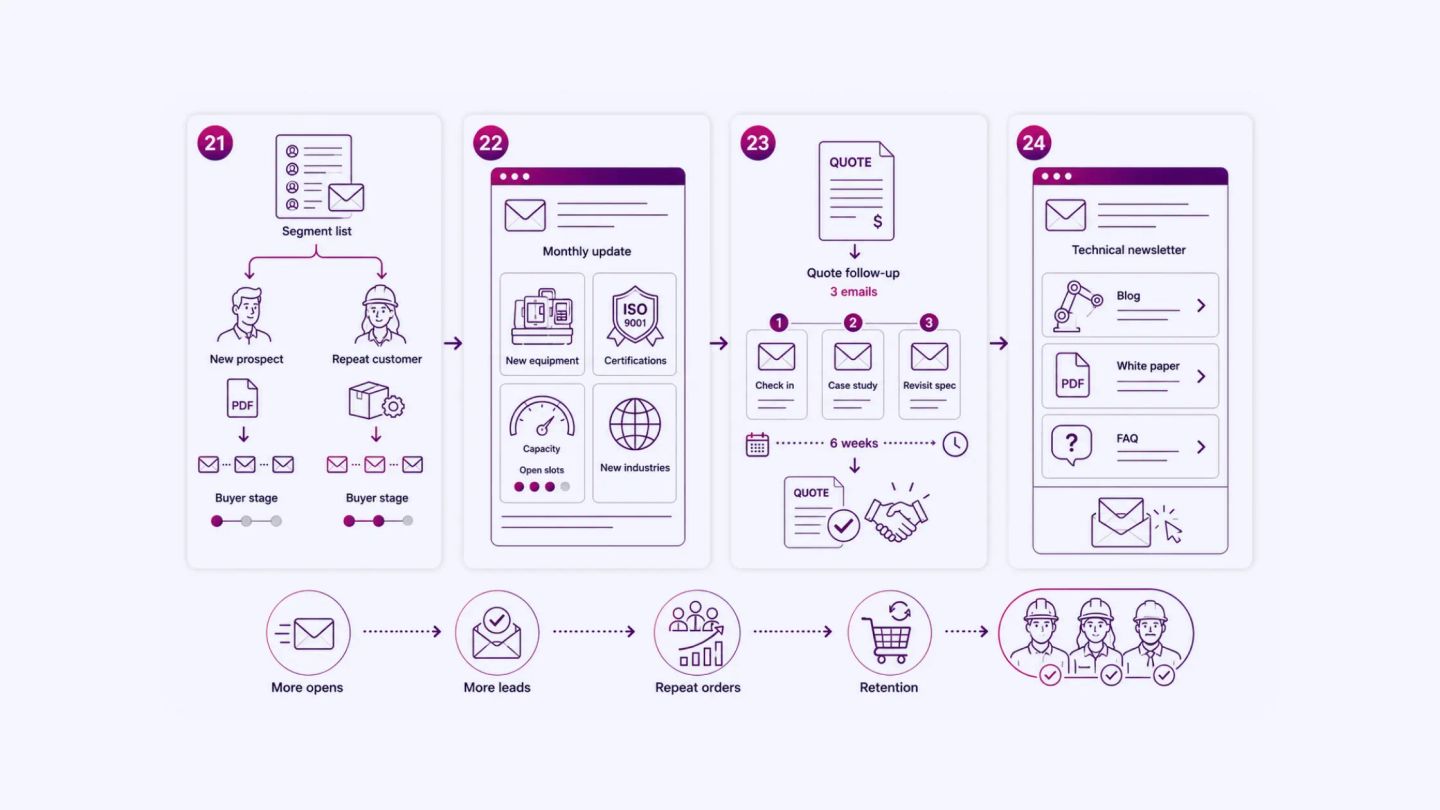
Segment email lists for personalized messaging. Segmenting emails based on customer behavior allows for more targeted messaging. Example: A CNC machining company can segment its list into:
- New leads: Send them an educational email about the benefits of precision machining.
- Engaged leads: Offer them a free consultation or case study.
- Past customers: Provide them with a discount or exclusive offer for repeat business.
Create email sign-up forms using tools like HubSpot or ActiveCampaign. To encourage sign-ups, offer a free resource (like an industry report or eBook). Segment contacts based on industry, behavior, or previous interactions.
13. Implement Marketing Automation
Use CRM tools like HubSpot, Marketo, or ActiveCampaign. A Customer Relationship Management (CRM) tool stores customer data and helps automate personalized outreach. For example, an industrial machinery manufacturer can use HubSpot to send an automated follow-up email when a potential buyer downloads a product brochure.
Automate follow-ups, lead nurturing, and customer retention campaigns. Automation ensures no lead is forgotten and that customers receive relevant updates. For example, a company that manufactures conveyor belts can set up an automated lead nurturing sequence that sends an email weekly with helpful information about conveyor belt maintenance, followed by a special offer.
14. Use Drip Campaigns for Lead Nurturing
Provide step-by-step education on your products and services. Break information into multiple emails instead of sending one long email so potential buyers can learn quickly. For example, a manufacturer of industrial 3D printers can send a five-part email series:
| Email 1: Introduction to 3D printing in manufacturing |
| Email 2: Benefits of 3D-printed parts over traditional methods |
| Email 3: Case study showing cost savings |
| Email 4: Common mistakes to avoid |
| Email 5: Call-to-action for a demo or consultation |
Search Engine Marketing (SEM) & Paid Advertising
15. Run Google Ads for Targeted Lead Generation
Optimize PPC campaigns with relevant keywords. Using the right keywords ensures your ads are shown to the right audience. For example, a manufacturer of stainless steel valves can target search terms like buy industrial or best stainless steel valves for chemical plants.
Use Google Keyword Planner to find relevant keywords with high search volume. Set up Google Search Ads targeting buyers looking for manufacturing solutions. Optimize landing pages to match the ad copy and encourage conversions.
16. Use LinkedIn Ads for B2B Targeting
Create account-based marketing (ABM) campaigns. Account-based marketing (ABM) targets specific high-value customers rather than a broad audience. For example: A metal fabrication company can run LinkedIn ads targeting purchasing managers at aerospace companies.
Define your ideal customer profile (e.g., industry, company size, job role). Use LinkedIn’s ad targeting to reach decision-makers. Offer a valuable resource (like a whitepaper or webinar) in exchange for contact details.
17. Leverage Retargeting Ads
Retarget website visitors and abandoned cart users. Many buyers visit a site but don’t convert immediately. Retargeting ads remind them about your company. For example, an industrial pump manufacturer can show ads to users who visited the product page but didn’t request a quote.
Install a Google Ads retargeting pixel or Facebook pixel on your website. Set up ads to show products or services the user viewed. Offer a special discount or free consultation to encourage conversions.
18. Invest in Programmatic Advertising
Automate ad Placements Using AI-Driven Buying. Instead of manually choosing where ads appear, programmatic advertising uses real-time bidding (RTB) to place ads in the best locations.
For example, a manufacturer of industrial fasteners can use programmatic ads to display banners on engineering and manufacturing websites visited by procurement managers.
Work with programmatic ad platforms like Google Display Network or The Trade Desk. Set campaign goals like brand awareness, lead generation, or conversions. Use AI-driven analytics to adjust bids and maximize ad performance.
Utilizing AI & Emerging Technologies
19. Use AI-powered chatbots for Lead Generation
Automate customer support and FAQs. AI chatbots can handle common customer inquiries like pricing, availability, and technical specs. They also collect contact details for follow-ups. For example, an industrial bearing manufacturer can use a chatbot to answer product compatibility questions, guide users to the right product, and offer a contact form for custom orders.
Use chatbot platforms like Drift, Intercom, or HubSpot. Set up automated responses for common questions. Integrate with your CRM system to collect lead data for follow-ups.
20. Implement AI for Personalized Marketing
Use AI-driven recommendations for personalized content. AI can suggest products, content, or services based on user behavior, improving engagement and increasing conversion rates.
Use AI-powered tools like Adobe Sensei or Persado for personalized marketing. Segment audiences based on their browsing behavior, location, and industry. Send targeted emails, product recommendations, or dynamic website content based on AI insights.
21. Explore the Metaverse & Virtual Trade Shows
Participate in virtual manufacturing expos. Instead of traveling to physical trade shows, manufacturers can host or attend virtual events where attendees explore products in a digital space.
Join virtual industry events on platforms like vFairs or Virbela. Create interactive 3D product demos using tools like Unreal Engine or Unity. To engage attendees, offer live Q&A sessions or VR product tours.
22. Utilize Blockchain for Transparent Supply Chain Marketing
Showcase ethical and sustainable manufacturing practices. Customers increasingly want to know where materials come from and if they are sourced responsibly. Blockchain lets companies prove product authenticity and sustainability.For example, a steel manufacturer can use blockchain to track the origin of raw materials and show proof of sustainable sourcing on their website.
Provide customers with a QR code on product labels that links to blockchain data showing materials’ origin and certifications. Partner with suppliers who already use blockchain for transparency.
Leveraging Data Analytics for Better Marketing Decisions
23. Use Google Analytics 4 for Advanced Insights
Google Analytics 4 (GA4) helps manufacturers understand who visits their website, what interests them, and where they drop off in the sales process.
Track key performance metrics (KPIs). GA4 provides detailed insights into user behavior, helping manufacturers refine their marketing. For example, a manufacturer of industrial pumps can track the number of visitors who go to the Request a Quote page but leave without submitting the form, indicating a need for a more precise call to action.
Set up Google Analytics 4 and track key metrics like bounce rate, conversions, and user paths.
Use event tracking to monitor specific actions, like downloads of product catalogs or video views. Create custom reports to measure the success of different marketing campaigns.
24. Conduct Competitor Analysis Regularly
Use Tools Like SEMrush, Ahrefs, and Moz. These tools allow manufacturers to analyze competitor website traffic, backlinks, and keywords.
Use SEMrush or Ahrefs to analyze competitors’ top-performing content and keywords.
Track their social media engagement and ad campaigns. Adjust your marketing strategy based on gaps or opportunities identified.
25. Implement Heatmaps & User Behavior Tracking
Optimize website UX based on visitor interactions. Heatmap analysis helps identify what attracts user attention and what areas need improvement. For example, a manufacturer of industrial valves sees users frequently click on product specifications but rarely fill out the contact form. This may suggest that the form placement or design needs to be improved.
Use tools like Hotjar or Crazy Egg to track user interactions on your website. Identify which sections get the most engagement and adjust the layout accordingly. Based on user behavior insights, make high-value content (like product specs, request forms, or demo videos) more accessible.
Influencer & Partnership Marketing
26. Collaborate with Industry Influencers & Thought Leaders
Partner with engineers, industry analysts, and manufacturers. These professionals often share insights, product reviews, and case studies with their audience. Collaborating with them can increase your brand’s visibility and trust.
Identify influential industry professionals on platforms like LinkedIn, YouTube, and Twitter. Offer free product trials, sponsored content, or interviews in exchange for exposure. Encourage influencers to review your products, share insights, or participate in a Q&A session.
27. Build Strategic B2B Partnerships
Co-market with suppliers and distributors. Partnering with other businesses in the supply chain can help both parties reach new customers and generate more leads. For example, a metal fabrication company can co-host a webinar with a steel supplier to discuss material strength and efficiency innovations, attracting an audience interested in both businesses.
Identify companies in your supply chain that complement your products. Offer joint promotions, bundled deals, or cross-promotional content. Co-host webinars, case studies, or industry reports to showcase expertise.
Customer Engagement & Online Reputation Management
28. Improve Online Reputation with Positive Reviews
Actively manage and respond to reviews. Engaging with positive and negative reviews shows customers you care about their experience.
Encourage satisfied customers to leave reviews on Google, LinkedIn, and industry directories. Respond promptly and professionally to all reviews. Use customer feedback to improve products and services.
29. Offer Webinars & Virtual Training Sessions
Educate customers about your products and industry trends. Webinars allow businesses to demonstrate product applications, discuss industry trends, and provide training. For example, a company that produces industrial adhesives can host a webinar on Choosing the Right Adhesive for High-Temperature Applications, targeting engineers and procurement managers.
Choose a relevant topic and invite industry experts or partners to join the discussion. Hosting the session, using Zoom, Microsoft Teams, or GoToWebinar platforms. Promote the webinar via email marketing, LinkedIn, and your website.
30. Create a Loyalty Program for B2B Customers
Provide exclusive discounts, early access, or premium support. Offering incentives for repeat purchases strengthens customer relationships and encourages loyalty.
Create a tiered loyalty program where customers get better benefits the more they purchase. Offer discounts, dedicated account managers, or free product upgrades for loyal customers. Promote the loyalty program through email campaigns, social media, and sales representatives.
Innovative Engagement Strategies
31. Leverage Augmented Reality (AR) for Enhanced Product Previews
Integrate AR technology to allow customers to visualize products in their own space before purchasing. This is particularly useful for large machinery or complex systems that buyers may want to see in their actual environment.
For example, a manufacturer of industrial generators could offer an AR app that lets potential buyers project the generator into their facility to understand the fit and scale. Promote this feature through your digital channels to enhance customer engagement and reduce the hesitation in purchase decisions.
32. Optimize for Voice Search
As voice-activated devices continue to proliferate, optimizing for voice search is becoming crucial. Ensure that your online content is conversational and answers the questions customers might ask aloud.
This can involve adjusting the SEO strategy to target long-tail keyword phrases that are more likely to be spoken than typed. For instance, instead of focusing on industrial cooling systems, you might target What is the best industrial cooling system for large facilities? Highlight these conversational queries in your FAQs, blog posts, and product descriptions.
33. Implement Dynamic Personalization
Use data analytics to offer dynamic personalization across your digital platforms. This involves customizing the user experience based on the visitor’s industry, interests, and past interactions with your site. If a visitor frequently checks pages related to a specific type of machinery, you can dynamically display related products, articles, and case studies to enhance their experience.
Grow Faster and Smarter with INSIDEA’s Digital Marketing Subscription
At INSIDEA, we deliver powerful digital marketing strategies that elevate your brand’s presence, attract the right audience, and drive measurable growth. Our expert team is dedicated to creating top-tier marketing solutions to meet your unique business needs. With in-depth industry knowledge, we craft customized strategies that align perfectly with your goals, all within our all-in-one digital marketing subscription.
Our comprehensive subscription includes everything you need to succeed in the digital space.
From Search Engine Optimization (SEO) that boosts your search rankings and drives organic traffic to WordPress Management, ensuring your website is visually appealing, highly functional, and optimized for conversions.
Our content marketing services establish your authority with engaging, insightful content. Social media marketing builds your presence across platforms with interactive and authentic strategies. Our email marketing solutions connect directly with your audience, driving engagement and conversions.
With INSIDEA’s all-in-one subscription, you can access these services seamlessly, supported by our dedicated digital marketing experts committed to delivering measurable results for your business.
Book a meeting with our experts to explore how we can support your business goals.