

Google Ads plays a central role in customer acquisition for HVAC businesses, but results vary widely depending on campaign structure.
The difference usually comes down to keyword selection, match types, and how effectively irrelevant traffic is filtered out.
Choosing the wrong keywords does not just waste budget. It brings in low-intent clicks, weakens performance signals, and makes optimization harder over time.
This blog explains how to build an HVAC Google Ads keyword list that consistently drives qualified leads across different services and seasons.
Marketing for HVAC companies
Rather have this done for you?
Book a 30-minute call with INSIDEA. We look at how customers find you today and send a proposal within 48 hours if we are a fit.
Book a strategy callWhy HVAC Keyword Selection Works Differently from Other Industries
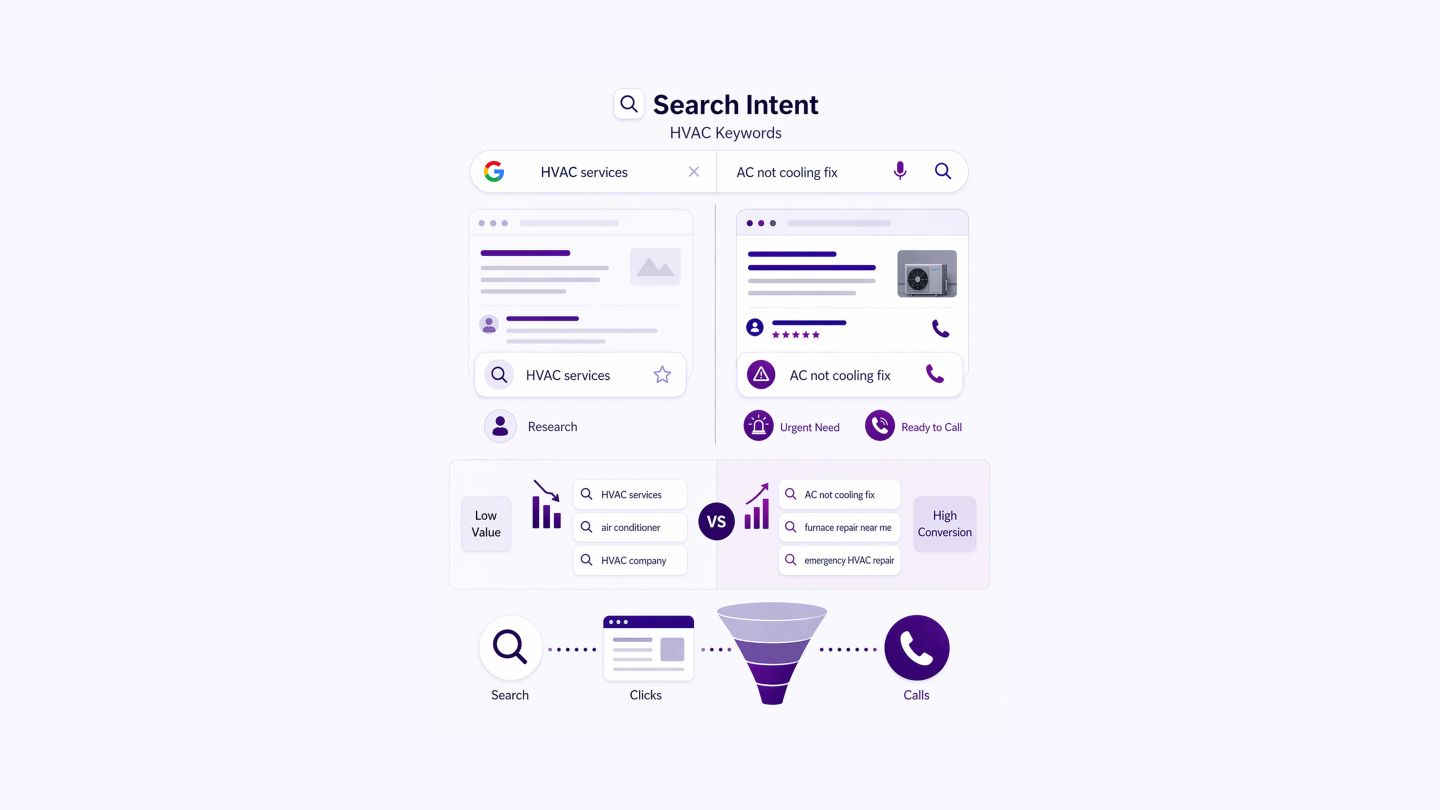
HVAC leads are largely need-driven rather than desire-driven. A homeowner does not browse Google looking for air conditioning ideas the way they might browse for furniture. They search because something has broken, because summer heat is arriving, or because their energy bills look wrong. This urgency changes how keywords should be selected.
The practical consequence: high-intent, problem-specific search terms convert at a much higher rate than awareness-level phrases. “HVAC services” is far weaker than “air conditioner not cooling fix.” Searches with urgency, location, or symptom descriptors signal someone ready to call, not someone just researching.
Note: Informational queries (“how does central AC work”) pull in readers. Transactional queries (“emergency AC repair Dallas”) pull in buyers. Build keyword lists around the latter.
Core HVAC Keyword Categories
A well-built HVAC campaign covers four distinct intent categories. Each serves a different stage of the customer’s decision process.
| Category | Example Keywords | Intent Level |
| Emergency / Urgent | AC not working, furnace stopped heating, emergency HVAC repair | Very High |
| Service-Specific | AC tune-up, heat pump installation, duct cleaning service | High |
| Location-Modified | HVAC repair [city], furnace installation near me | High |
| Brand / Equipment | Carrier AC repair, Trane furnace service, Lennox dealer | Medium-High |
| Seasonal / Maintenance | AC tune-up in the spring, furnace checkup before winter | Medium |
| Cost / Quote-Seeking | AC replacement cost, HVAC installation quote, furnace repair price | Medium |
Emergency keywords should sit in their own ad group with higher bids, 24/7 ad scheduling, and call extensions prominently placed. Service-specific and location keywords can share campaigns, but should be grouped by service type to keep quality scores clean.
High-Converting HVAC Keywords by Service Type
Here’s a list of comprehensive list of high-conversion keywords list:
Air Conditioning
- AC repair near me
- Air conditioner not cooling
- Central air installation cost
- AC tune-up [city]
- Air conditioning replacement
- AC blowing warm air, fix
- Emergency air conditioning repair
Heating / Furnace
- Furnace repair near me
- Heater not working
- Furnace replacement cost
- Heat pump installation [city]
- Boiler repair service
- Gas furnace tune-up
- No heat in the house, emergency
General HVAC / System
- HVAC technician near me
- HVAC maintenance plan
- Duct cleaning service
- Mini split installation
- HVAC system replacement quote
- Indoor air quality service
Commercial HVAC
- Commercial HVAC repair [city]
- Commercial AC maintenance contract
- Rooftop unit service
- Commercial refrigeration repair
Match Types: Which to Use and When
Match type selection is where most HVAC campaigns either lose or recover budget. Each of the three primary types carries trade-offs.
| Match Type | Behaviour | Best Use for HVAC |
| Exact Match | Triggers only for that specific query or very close variants | High-intent terms: “AC repair near me”, “furnace replacement cost” |
| Phrase Match | Triggers for queries containing the phrase in order | Service + location combos, symptom-based searches |
| Broad Match | Triggers for related concepts (Google decides) | Use sparingly, only with a robust negative keyword list |
For most local HVAC advertisers, a mix of exact and phrase match covers the required range without exposing budget to irrelevant traffic. Broad match is worth testing only after a campaign has 60+ days of conversion data and a thorough negative list is in place.
Negative Keywords: The Part Most Advertisers Skip
A keyword list without negatives is like a fishing net with holes in it. For HVAC advertisers, common sources of irrelevant traffic include DIY guides, job seekers, trade school searches, and out-of-service-area queries.
Build a negative keyword list before launching. Start with these categories:
- DIY intent: how to fix, DIY, do it myself, repair guide, tutorial, YouTube
- Employment: HVAC jobs, HVAC technician salary, HVAC apprenticeship, hiring
- Education: HVAC school, HVAC certification program, HVAC training
- Wholesale / Parts: HVAC parts wholesale, AC compressor buy, furnace parts
- Out-of-area: add city or zip negatives for locations outside the service area
Review search term reports weekly for the first month. Patterns in wasted spend almost always appear in the first 30 days of a new campaign, and early negative keyword additions have an outsized effect on long-term efficiency.
Seasonal Keyword Strategy
HVAC demand follows clear seasonal cycles, but the timing varies by climate zone. An HVAC company in Phoenix faces heavy AC demand in April; one in Minnesota may not see the same until June.
Adjusting keyword bids and campaign budgets based on local historical demand patterns produces better returns than following national averages.
| Season | Priority Keywords | Action |
| Spring | AC tune-up, air conditioning checkup, spring HVAC maintenance | Increase bids 4–6 weeks before regional heat onset |
| Summer | Emergency AC repair, AC not working, same-day AC service | Maximize budget; peak conversion season |
| Fall | Furnace tune-up, heating system check, pre-winter HVAC service | Shift budget from AC to heating keywords |
| Winter | Emergency furnace repair, no heat, boiler repair, heat pump fix | Emergency keywords dominate; 24/7 scheduling is critical |
Long-Tail Keywords and Why They Produce Lower Cost-Per-Lead
Long-tail HVAC keywords, phrases of four or more words, consistently show lower cost-per-click and higher conversion rates in local service campaigns. The reason is specificity: a person typing “two-stage furnace installation cost Dallas” is further along in their decision than someone typing “furnace service.”
Effective long-tail structures for HVAC:
- [Brand] + [service] + [city]: “Carrier AC repair Dallas.”
- [Symptom] + [fix/repair]: “air conditioner freezing up repair.”
- [Service] + [urgency]: “same day furnace repair.”
- [Equipment type] + [installation] + [location]: “mini split installation Phoenix.”
- [Service] + [price signal]: “HVAC tune-up coupon [city].”
These phrases have lower monthly search volumes individually, but grouped into tightly themed ad groups, they produce higher quality scores, better ad relevance, and lower CPCs than high-volume generic terms.
Campaign Structure for HVAC Google Ads
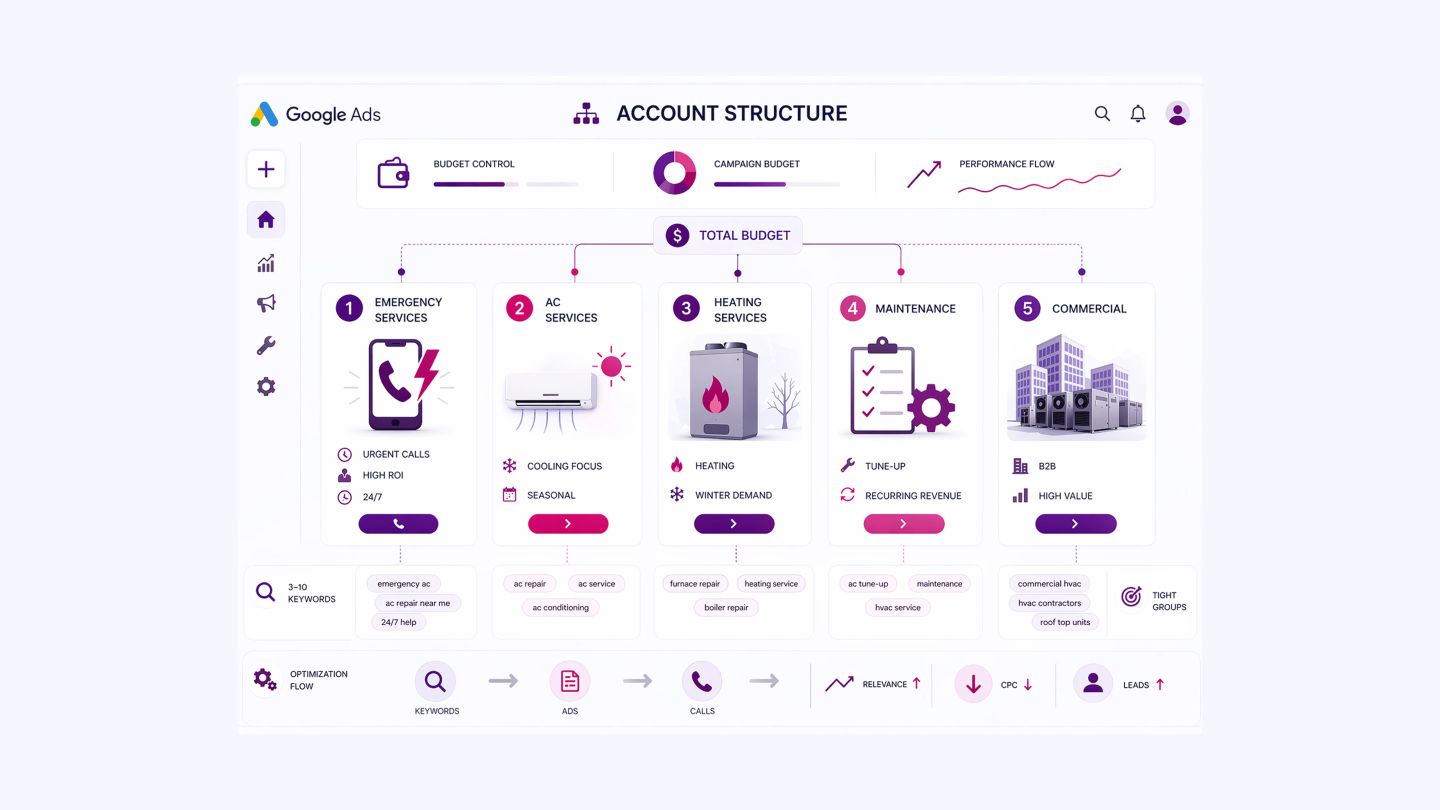
Organizing keywords into a logical campaign structure prevents budget competition across service types and speeds up optimization. A workable structure for most HVAC companies:
- Campaign 1, Emergency Services: All urgent / same-day keywords. Higher bids, all-hours scheduling, call-only ads.
- Campaign 2, AC Services: Installation, repair, and maintenance for cooling. Seasonal bid adjustments.
- Campaign 3, Heating Services: Furnace, heat pump, boiler. Separate from AC to avoid seasonal dilution.
- Campaign 4, Maintenance / Tune-Up: Membership, annual check, preventive service keywords.
- Campaign 5, Commercial (if applicable): Commercial-specific keywords, B2B audience signals.
Within each campaign, group keywords by service type into small, tightly themed ad groups. Three to ten keywords per ad group is a practical ceiling. Any more and ad relevance drops, which increases cost-per-click.
Final Insights on HVAC Google Ads Strategy
HVAC Google Ads performance depends almost entirely on keyword precision. High-intent, service-specific, and location-modified terms outperform generic phrases in every measurable way: lower CPC, higher conversion rate, and better return on ad spend.
A structured approach, with separate campaigns for service types, seasonal bid management, and a maintained negative keyword list, gives a consistent flow of qualified leads without burning budget on irrelevant traffic.
The fundamentals do not change season to season; only the weighting does.
INSIDEA
Ready to put this into practice?
INSIDEA is an Elite HubSpot Partner rated 4.99 across 500+ verified reviews. Let's map it to your goals.



 How INSIDEA works




