Most car buyers aren’t driving around town to find a dealership anymore. They’re online, searching. “Best SUV under 20k,” “Toyota dealers near me,” “used cars with warranty”, real searches by genuine buyers, happening every single day. And they’re clicking the dealerships that show up first.
If you still rely on flyers or a wacky tube man to bring people in, it’s time for a serious update. Visibility now lives on Google, not on your curb. That’s why SEO for car dealerships is essential, being on that first page is the difference between being chosen or ignored.
Over 60% of car buyers start their journey online. If your dealership isn’t appearing in local searches or map packs, you’re invisible to most potential customers.
Implementing SEO for car dealerships ensures that your hours, reviews, offers, and inventory are exactly where buyers expect to find them, on their phones, in their searches, and right when they’re ready to buy.
This blog gives you a clear, no-fluff game plan to fix what’s holding you back, focus on what drives results, and finally get seen by the people already searching for what you sell.
Two Things You Must Know Before Starting SEO for Car Dealerships
Before jumping into SEO for car dealerships, it’s worth taking a step back and getting a grasp of three foundational concepts. You need these basics running smoothly under the hood before trying to rank:
1. Understand How Search Engines Work
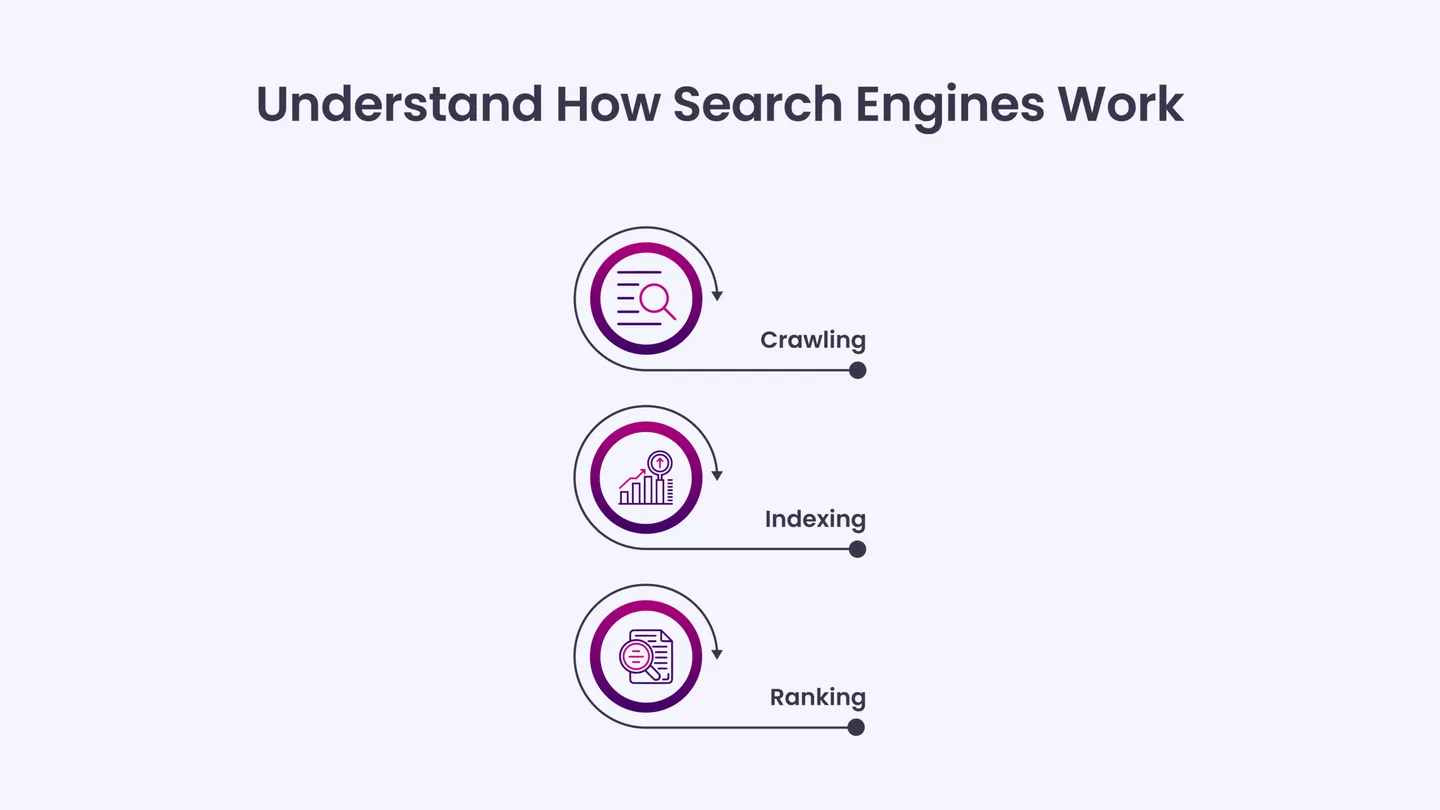
Search engines aren’t magic. They don’t just “know” which dealership deserves to rank first when someone types in “best car deals near me.” They work off structure, signals, and technical rules.
Here’s the short version:
- Crawling: Search engines use bots (aka spiders) to scan and explore web pages.
- Indexing: After crawling, pages are sorted, analyzed, and stored in Google’s index.
- Ranking: When someone searches, Google pulls from its index and ranks pages based on relevance, quality, speed, and user experience.
If Google’s bots can’t crawl your site correctly, or if your content doesn’t get indexed, it’s like your website doesn’t exist, no matter how great your cars or offers are.
That’s where Google Search Essentials comes in. These official guidelines from Google explain how to make your website easier to find, understand, and use. They focus on three things:
- Crawling - Help Google find your pages
- Indexing - Help Google understand your content
- Usability - Make sure people enjoy using your site
If your site supports these three pillars, Google is far more likely to rank you higher in relevant searches. Skip them, and you’re just spinning your wheels.
2. Get the SEO Basics Right
Before you start working on keywords and content, there are a few things every dealership website needs to have in place:
- Website Speed: Your site should load fast. Buyers won’t wait for your homepage to finish loading, they’ll bounce to the next dealership that loads in two seconds or less.
- Mobile Friendliness: Over half of all web traffic comes from mobile devices. If your site looks broken or clunky on a phone, it’s already out of the race.
- Analytics Setup: Install Google Analytics and Google Search Console. These tools give you visibility into what’s working and what’s not, and how users find (or do not) your site.
- XML Sitemap: This is a roadmap for search engines. It helps them understand your site structure and discover all the pages you want indexed.
- Robots.txt File: This file tells search engine bots which pages they can and can’t access. Done wrong, it can block important pages from ever being crawled.
Later in the blog, I will cover each of these in more depth to help you get everything running as it should.
3. Keyword Research: The Starting Line of SEO for Car Dealerships
Before optimizing your pages, writing a blog post, or updating a title tag, you need to know what your buyers are searching for.
This is where keyword research comes in.
Start With Real Buyer Intent
Good keywords are relevant to what you offer and match what buyers are looking to do. Think of search intent like this:
- Informational: “Best SUVs under 30k”
- Transactional: “Used Honda Accord in Dallas”
- Navigational: “Toyota dealership near me”
You want a mix, but your money pages (inventory, financing, contact) should target high-intent, transactional keywords that show buying interest.
Use the Right Tools (But Think Like a Local Buyer)
You don’t need a $99/month tool to get started. Here’s how to find strong, relevant keywords:
- Google Autocomplete: Start typing “used cars in [your city]” and see what suggestions pop up. That’s what people are searching for.
- Google Search Console: If your site is live, check what queries bring in impressions and clicks, and build from there.
- Use Ubersuggest, Keywords Everywhere, or Ahrefs Free Tools. Look for monthly volume and intent. Focus on local modifiers like “[car brand] in [city].”
What to Look For
- Local relevance: Always include city or region names (e.g., “used trucks in Austin”)
- Service-specific terms: Think “bad credit auto loans Chicago” or “Honda service near me.”
- Inventory-type keywords: “Certified pre-owned SUVs Dallas” or “2021 Ford Explorer price TX”
- Long-tail keywords: Lower competition, higher intent. Think “best midsize sedan for families under 25k.”
Where to Use Your Keywords
Once you’ve got your list, make sure you’re placing keywords naturally in:
- Page titles and meta descriptions
- H1s and subheadings
- Vehicle inventory descriptions
- Blog posts and FAQs
- URL slugs (where relevant)
SEO for Car Dealerships: How to Rank on Google and Bring in More Buyers
Let’s skip the theory for a second. You already know being visible online matters, the real question is how to make that happen. SEO isn’t a one-size-fits-all checklist, especially for car dealerships. You need a clear, practical plan to rank and bring in buyers already looking.
SEO is generally divided into four main types, and all of them play a role in building visibility for your dealership online:
- On-page SEO - Optimizing the content and structure of individual pages on your website.
- Technical SEO (a subpart of On-page SEO) - Making sure your site loads fast, is crawlable, and performs well behind the scenes.
- Off-page SEO - Building authority through backlinks, mentions, and other signals outside your site.
- Local SEO - Helping your dealership show up in location-based searches, map packs, and local listings.
Understanding how these work together is essential for effective SEO for car dealerships.
Let’s get started:
1. On-Page SEO for Car Dealerships
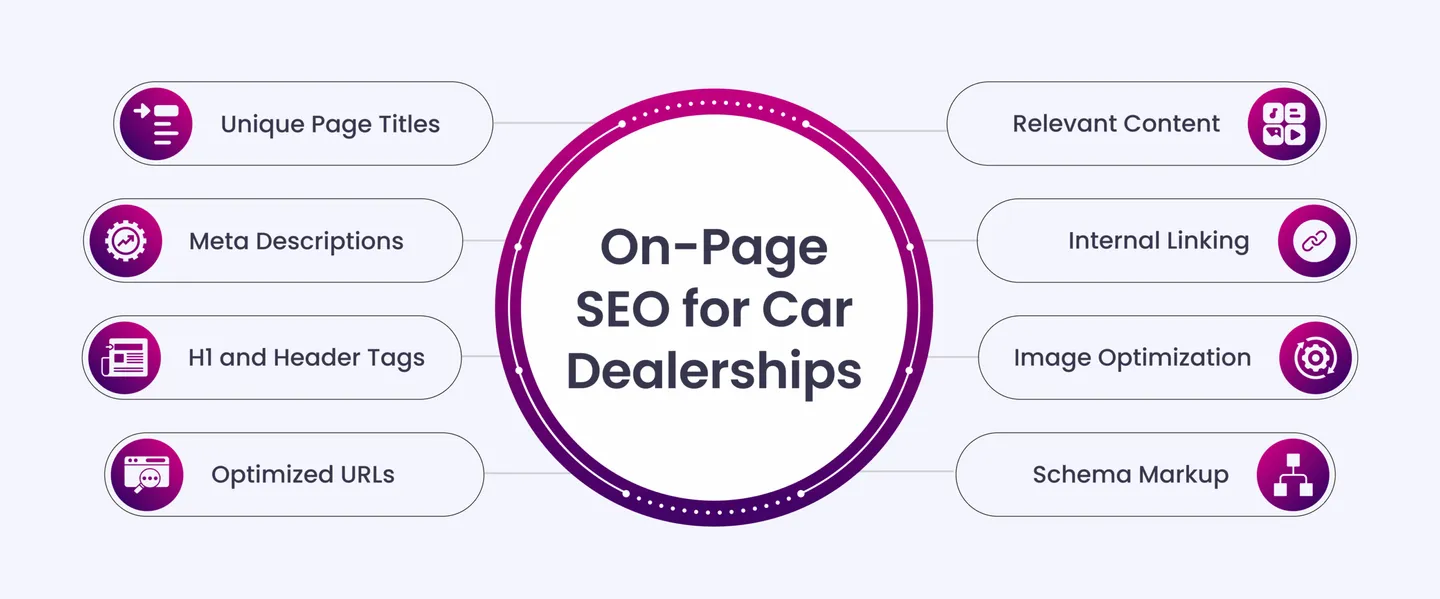
On-page SEO is everything that happens on your website, the content, layout, and structure help search engines understand what each page is about and help real people stick around long enough to take action.
For car dealership SEO, getting your on-page elements right is non-negotiable. If your pages are unclear, messy, or lacking helpful content, you’re losing business to dealerships that are easier to find and trust.
Here’s how to make every page on your site do its job, with examples that make sense for real dealerships:
Unique Page Titles: Your page titles tell Google and potential buyers what they’re about to see. Each page should have a written title that matches what people are searching for and reflects what the page delivers.
Examples for dealerships:
- “Used Trucks for Sale in Cleveland | Ace Auto Group”
- “Apply for Auto Financing in Dallas | No Credit Needed”
- “Certified Pre-Owned Honda Deals in Phoenix”
Unique titles help your pages stand out in search results, and they’re foundational to strong SEO for car dealerships.
Meta Descriptions: Meta descriptions don’t directly boost your ranking, but they do impact clicks. This is your first impression in search results, and it should speak directly to the buyer’s intent.
Dealership-ready examples:
- “Find top-quality used cars in Tampa. Explore inventory, book a test drive, and get financing today.”
- “Looking for affordable SUVs in Portland? See current offers and schedule a visit now.”
H1 and Header Tags: Think of headers as the signposts of your page. Your H1 is the main headline, there should only be one. H2s and H3s are used to break down sections underneath.
Example structure for a service page:
- H1: “Oil Change Services in St. Louis”
- H2: “Why Regular Oil Changes Matter”
- H2: “Our Oil Service Packages”
- H3: “Synthetic Oil Change”
- H3: “Express Oil Change”
Well-structured headers improve readability and help search engines process your content more efficiently.
Optimized URLs: URLs should be short and simple and contain relevant terms. Avoid random strings or unnecessary numbers. Keep them clean and focused.
Good examples:
- yourdealership.com/used-cars-houston
- yourdealership.com/apply-financing
- yourdealership.com/ford-service-center-austin
Clean URLs improve clickability and make your content easier to organize, a quiet but effective part of SEO for car dealerships.
Relevant Content: Buyers aren’t just looking for listings, they’re looking for answers. Your content should address common questions, concerns, and decision-making points.
Example content that adds real value:
- “Certified Pre-Owned vs. Used: What’s the Difference?”
- “How to Trade In Your Car at Our Dealership in Atlanta”
- “Why Our Financing Process Works for First-Time Buyers”
Content that reflects real questions builds trust, which leads to conversions. This is a crucial part of performing SEO correctly for car dealerships.
Internal Linking: Internal links help users navigate your site logically and help search engines understand the connections between your pages.
Smart internal links for dealerships:
- Link from your homepage to “Used Cars in Phoenix.”
- Link from a financing blog post to your “Apply for Credit” page.
- Link from a service page to “Schedule Service” or “Meet Our Technicians.”
Well-placed links create flow, reduce bounce rates, and support deeper engagement, all of which improve car dealerships’ SEO.
Image Optimization: Your site relies heavily on images, cars, showrooms, service bays, but those images must be optimized to perform well.
Here’s how:
- Use descriptive alt text, like “2023 Nissan Rogue SL AWD in silver at Springfield Auto.”
- Keep file sizes small so your site loads faster.
- Rename your files with real terms: used-jeep-wrangler-chicago.jpg beats IMG_00123.jpg.
Well-optimized images support page speed, improve accessibility, and add context for search engines, all essential for strong SEO for car dealerships.
Schema Markup (Basic): Schema is the code that tells Google specific details, such as the type of content on the page, your business, and your products.
Schema worth using on dealership sites:
- Product Schema for vehicle listings (make, model, year, price)
- Review the Schema for customer feedback and ratings
- Local Business Schema to reinforce your address, contact details, and hours
2. Technical SEO: A Subset of On-Page SEO
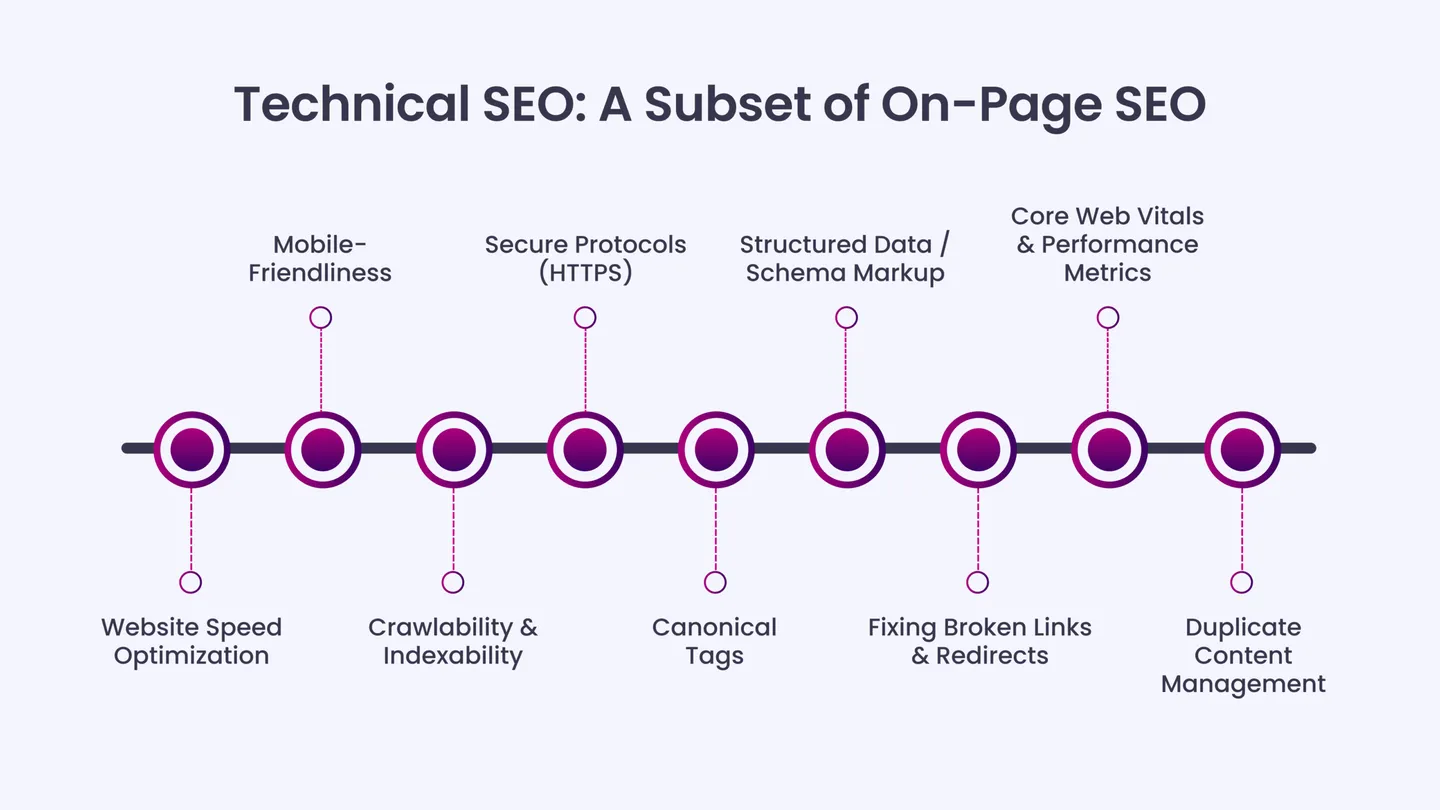
While on-page SEO focuses on content and structure, technical SEO handles how your website performs, specifically, how fast it loads, how easily search engines can crawl it, and whether all essential parts are accessible and functioning correctly.
Technical SEO for car dealerships ensures your inventory, service pages, and location info can be found and indexed. If that foundation isn’t solid, no amount of content or keyword targeting will make it right.
Here’s what to focus on:
Website Speed Optimization: If your site loads slowly, users leave. Car dealership sites often include many photos, but without speed optimization, they can become frustrating to browse.
Fast websites keep users engaged, which supports better SEO for car dealerships.
What to do:
- Compress images without ruining quality
- Remove unused scripts or features that slow down loading
- Use browser caching to reduce repeated load times
Mobile-Friendliness: Mobile compatibility is a core part of SEO for car dealerships as most shoppers browse on their phones. If your site looks awkward or breaks on mobile, they won’t stay.
What to check:
- Text is readable without zooming
- Buttons and links are easy to click.
- Inventory filters and sliders work smoothly.
Crawlability & Indexability: Google can’t rank your pages if it can’t access them. Your site needs to clarify which pages should be crawled and indexed.
Checklist:
- Your robots.txt file should block only what truly shouldn’t be indexed
- Submit an updated XML sitemap via Google Search Console
- Important pages must be indexable, no accidental “noindex” tags
Secure Protocols (HTTPS): Users expect secure sites, and so does Google. If your site still runs on HTTP, it’s overdue for an upgrade.
What to do:
- Install an SSL certificate
- Make sure all internal links point to HTTPS versions
- Redirect HTTP traffic to HTTPS
Canonical Tags: Search engines may get confused if the same car appears under different filtered searches or categories. Canonical tags tell Google which version of the page should count.
Use cases:
- Vehicle pages appearing under multiple categories
- Filtered search results showing the duplicate content under different URLs
This avoids duplicate content problems and helps consolidate ranking power, a clean practice in SEO for car dealerships.
Structured Data / Schema Markup: Schema helps search engines understand your content better and present it with enhanced details in search results. Using schema increases the relevance of your site and strengthens SEO for car dealerships.
Where to apply it:
- Product Schema for individual vehicle listings
- Review Schema for showing customer ratings
- Local Business Schema for your location, hours, and contact info
Fixing Broken Links & Redirects: Broken links make your site more challenging to navigate, and search engines don’t want to waste time on dead ends. Maintaining clean links supports both usability and SEO for car dealerships.
Fixes:
- Scan regularly for 404 pages
- Use proper 301 redirects when URLs change
- Update internal links to reflect current URLs
Core Web Vitals & Performance Metrics: Google uses real user experience metrics to evaluate site performance. While perfection isn’t required, stability and speed matter.
Core metrics:
- LCP (Largest Contentful Paint): How quickly the main content appears
- FID (First Input Delay): How quickly users can interact with your site
- CLS (Cumulative Layout Shift): Whether layout elements shift during loading
Duplicate Content Management: If multiple pages on your site say the same thing, it confuses search engines and weakens your rankings.
Fixes:
- Don’t reuse generic vehicle descriptions across listings
- Avoid copy-pasting content on city-specific pages
- Consolidate similar content or use canonical tags
Off-Page SEO for Car Dealerships
Off-page SEO is about what happens outside of your website but still affects how well you rank. It’s about getting your dealership mentioned, linked, and talked about by other trusted sites. The more reputable signals you build outside your domain, the more credibility you gain with Google.
Here’s where to focus your efforts:
Backlinks from Local Directories: Start with the basics. Make sure your dealership is listed on trusted directories that Google recognizes. These listings help confirm your legitimacy and location.
Examples:
- Cars.com
- Autotrader
- Yelp
- Better Business Bureau (BBB)
- Local.com
- Chamber of Commerce websites
Use consistent names, addresses, and phone numbers across all listings, this small detail makes a big difference in SEO for car dealerships.
Automotive Industry Mentions: Look for guest posting opportunities or media mentions on reputable auto blogs, local news sites, or community platforms. Even a minor local feature can drive traffic and build authority for your site, all great signals for SEO for car dealerships.
Where to try guest posting or pitching:
- The Drive
- AutoRemarketing.com
- Local newspapers or news blogs (e.g., “CityNews Now” or “[Your City] Times”)
- Regional auto enthusiast forums or Facebook groups
Link-Worthy Blog Content: When you publish content that answers fundamental questions or solves real problems, it gets shared. It also earns natural backlinks over time.
Post ideas that attract links:
- “Best Family SUVs Under $30k in [Your City]”
- “Used vs. Certified Pre-Owned: What Should You Consider?”
- “How to Trade in Your Car Without Losing Money”
High-quality blog content supports SEO for car dealerships by making your site more valuable for search engines and buyers.
Social Media Activity: Likes and shares don’t directly impact rankings but help spread your content. When people engage with your posts, more eyes are drawn to your website, blog posts, and inventory pages.
Where to focus:
- Facebook and Instagram: Post walkarounds, price drops, testimonials
- YouTube Shorts or Reels: Quick looks at featured vehicles
- LinkedIn: For business-related updates, fleet sales, or dealership partnerships
The more active and useful you are on social media, the more chances you have to generate backlinks and brand mentions.
Customer Reviews on Third-Party Sites: Reviews build trust, and search engines see them as a strong credibility signal. Focus on collecting reviews across platforms, not just your site.
Review platforms that matter:
- DealerRater
- Cars.com
- Trustpilot
- Google Reviews (under your Google Business Profile)
- Facebook Recommendations
Encourage happy buyers to leave honest feedback, especially on platforms where Google pulls review data. This directly supports your SEO goals for a car dealership.
Brand Mentions (Even Without Links): Even if a site mentions your dealership without linking to it, it still signals to Google that your business is being discussed. These “implied links” can help reinforce your brand’s relevance.
Examples:
- Local news shoutouts
- Community calendar listings or sponsorships
- Mentions in blog posts or forums (e.g., someone praising your service in a Reddit thread or car forum)
While backlinks carry more weight, brand mentions are still part of a healthy SEO for a car dealership strategy.
Local SEO for Car Dealerships
When someone searches “car dealership near me” or “[brand] dealer in [city],” it’s local SEO that determines whether your business shows up in that high-visibility map pack.
You want to be found on Google and in your neighborhood by people ready to visit, test drive, or call.
Here’s how to make that happen:
Google Business Profile (GBP): Your GBP listing is one of the most important pieces of local SEO. The box appears with your hours, address, phone number, photos, and reviews, and it often occurs before your website.
What to include:
- Exact business name
- Phone number and address
- Hours of operation (and keep them updated)
- Photos of your lot, team, and vehicles
- Description of your dealership and services
- Inventory (Google allows integrations via car listing providers)
An optimized GBP helps you show up for “dealerships near me” and builds instant credibility, a crucial point for SEO in the car dealership industry.
Consistent NAP Across the Web: NAP stands for Name, Address, and Phone Number. These must be the same everywhere your dealership appears online, including punctuation.
Where to check:
- Your website
- Google Business Profile
- Yelp, Yellow Pages, Facebook, local directories
Inconsistencies confuse search engines and weaken your local SEO. Clean, consistent listings support stronger SEO for car dealerships in your area.
Local Business Schema Markup: Schema markup adds extra context for search engines. When you use local business schema, you tell Google where you’re located, what you do, and who you serve.
Basic details to include in schema:
- Business type (e.g., auto dealer)
- Business name and location
- Operating hours
- Phone number
- Accepted payment types
This structured data helps reinforce your local presence, a quiet but essential part of SEO for car dealerships.
Service Area Pages: If your dealership serves multiple cities or suburbs, don’t try to force them all onto one page. Create individual landing pages for each area, with content tailored to that location.
Example ideas:
- “Used Car Deals in Fort Worth”
- “Certified Honda Service in Plano”
- “Chevy Dealer Near Garland, TX”
Local Reviews: Reviews help boost conversions and your visibility. Google favors businesses with quality, consistent reviews from real people.
What works:
- Ask happy customers to leave a review right after a sale or service
- Encourage them to mention what they bought and where (e.g., “Bought a 2020 Civic at ABC Honda in Atlanta”)
- Respond to every review, good or bad, it shows engagement.
Reviews with location and product details support your local ranking and overall SEO for car dealerships.
Google Q&A Section: Many dealerships overlook this, but the Q&A on your Google listing is visible to everyone. If someone asks a question, answer it quickly.
Examples of common questions:
- “Do you offer same-day service?”
- “Is financing available for first-time buyers?”
- “Are walk-ins welcome on weekends?”
Local Citations: These online mentions of your business on third-party sites, like directories and business listings, confirm your location and services.
Where to list your dealership:
- Yelp
- Yellow Pages
- Cars.com
- Local.com
- Chamber of Commerce website
These citations reinforce your dealership’s credibility and improve your local SEO for your car dealership.
Map Embeds & Driving Directions: A live Google Map on your website (typically on the Contact or About page) helps users find you and provides search engines with another signal about your physical location.
What to include:
- Google Map embed with your pinned location
- Driving directions from major highways or nearby towns
- Parking info or service entrance details, if helpful
These details improve usability and help local search accuracy.
Localized Content: Your blog or site pages should discuss cars and reflect your connection to the community.
Content ideas that support Local SEO:
- “Holiday Trade-In Events in Jacksonville”
- “Sponsoring Youth Soccer in Hendersonville”
- “Top Picks for Road Trips from Kansas City”
Localized content tells Google (and your visitors) that you’re active in the area, a strong signal for SEO for car dealerships.
You Run the Dealership. Let the SEO Pros Handle the Rest.
Running a car dealership is no small job. You’re managing inventory, handling customers, closing sales, dealing with financing, and keeping things moving. Add SEO into the mix, monitoring rankings, optimizing content, fixing site issues, and it’s enough to burn anyone out.
Your competitors are investing in SEO for car dealerships because they know that’s where buyers start looking, not in newspapers, not by driving around, but online.
So, here’s the choice:
Spend hours each week figuring out SEO while also trying to run your dealership.
Let professionals who live and breathe SEO handle it so you can focus on selling more cars.
If you’re serious about showing up, getting found, and driving real leads, it’s time to let the pros take the wheel.
INSIDEA
Ready to put this into practice?
INSIDEA is an Elite HubSpot Partner rated 4.99 across 500+ verified reviews. Let's map it to your goals.



 How INSIDEA works