

Art galleries have historically relied on word-of-mouth, press coverage, and existing collector networks. Those channels still hold value, but they no longer reach audiences independently.
A 2023 report by Hiscox found that 72% of art buyers say they research works online before purchasing or visiting. That number has risen every year since 2017.
This blog explains how art galleries can build a practical, channel-specific digital marketing strategy to increase visibility, attract new visitors, and support both sales and cultural engagement.
Why Galleries Need a Defined Digital Presence?
An art gallery without a coherent online presence is invisible to a significant portion of its potential audience. This applies to both commercial galleries trying to sell works and non-profit or public galleries building community attendance.
The issue is not just absence, it is inconsistency. Many galleries maintain a website and social accounts but post irregularly, use inconsistent visual standards, or fail to update exhibition information.
To a first-time visitor discovering the gallery through a search or social referral, an outdated or poorly maintained profile signals that the space is inactive or inaccessible.
What a defined digital presence requires:
- An updated website with current and upcoming exhibition details
- Consistent social media activity (minimum 3-4 posts per week on primary channels)
- An accessible contact method and location information on every major platform
- A Google Business Profile is claimed and regularly updated
SEO for Art Galleries: Local and Exhibition-Specific
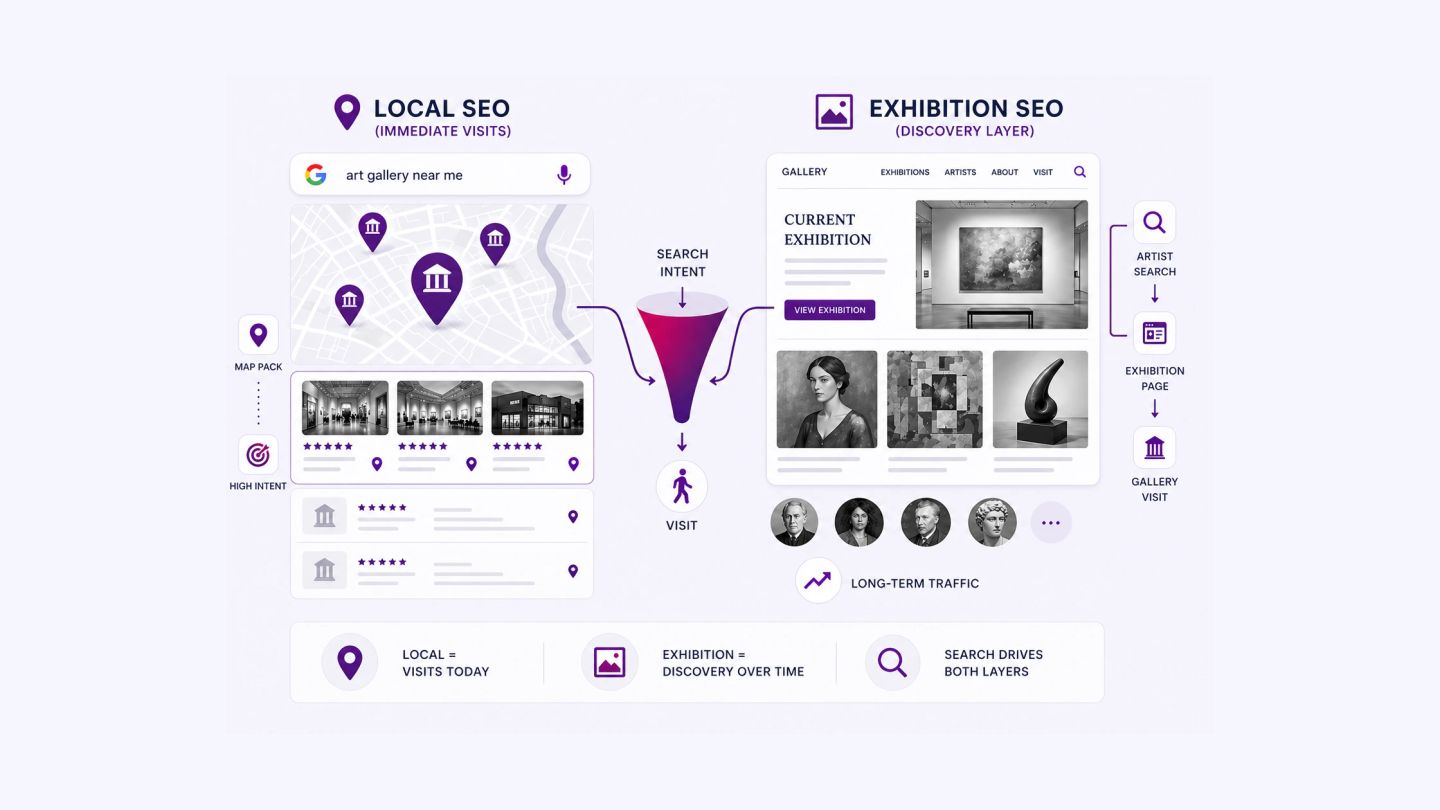
Search engine optimization for galleries operates on two levels: local search and content-based discovery.
Local SEO is the higher-priority. When someone searches for “art gallery near me” or “galleries in [city],” they are likely deciding to visit. Galleries that appear in Google’s local pack, the map-based results at the top of the page, receive significantly more clicks than those buried in organic results.
Steps to improve local search visibility:
- Claim and fully complete your Google Business Profile (include hours, photos, categories, and a description)
- Ensure your Name, Address, and Phone number (NAP) are identical across your website, Google, Yelp, and any directory listings
- Encourage visitors to leave Google reviews; galleries with 10+ reviews rank higher in local results
- Use location-based keywords in your website page titles and headers (e.g., “Contemporary Art Gallery in Manchester”)
Exhibition-specific SEO focuses on capturing interest from people searching for artists, art movements, or specific exhibitions. Each exhibition should have its own dedicated page with:
- The artist’s name and relevant keywords in the title and body copy
- A description of the work that is written for a general audience, not just collectors
- High-quality images with descriptive alt text
- A clearly stated opening date, closing date, and visiting hours
This content has a longer lifespan than social posts and continues to attract visitors through search long after the exhibition has closed.
Social Media: Which Platforms Work and Why
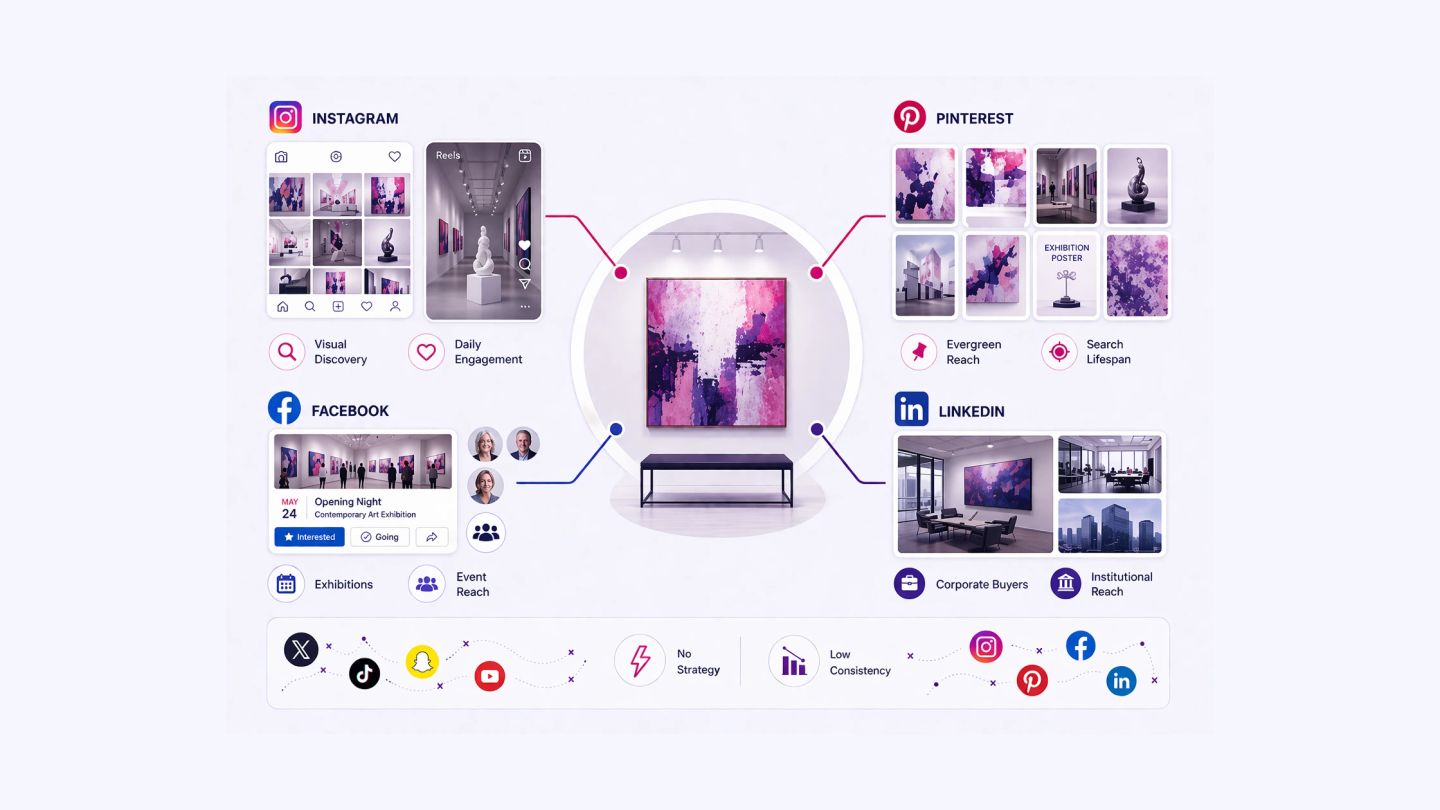
Not every platform performs equally for galleries. The choice of platform should be guided by audience behavior, not habit.
Instagram remains the primary platform for discovering visual art. The format suits galleries well: single images, carousels, and Reels all support the presentation of art. Galleries that perform well on Instagram post consistently, use natural light photography, and engage directly with followers through comments and Stories.
Pinterest is underused by most galleries but has strong long-term value. Pins have a much longer lifespan than Instagram posts and continue to surface in search results months after posting.
Galleries with printable art, posters, or editorial-style photography tend to perform well here.
Facebook remains relevant for event promotion, particularly among older collector and patron demographics. Creating events for exhibitions and private views directly within Facebook increases organic reach for that specific audience.
LinkedIn is relevant to galleries seeking to connect with corporate art buyers, interior designers, and institutional collectors. Content here should be professional and exhibition-focused, not casual.
What to avoid: Spreading across every platform without a clear purpose. It is better to maintain two platforms well than to manage six inconsistently.
Content Strategy: What to Post and When
Content should serve a specific purpose rather than simply filling a schedule. For galleries, the most effective content types are:
- Artist spotlights: Short profiles or interviews that introduce the artist behind a current or upcoming exhibition. These perform well because they are shareable and have search value.
- Behind-the-scenes content: Installation processes, curation decisions, and framing details attract genuine interest from art followers and humanize the gallery.
- Collector and visitor testimonials: Social proof from real visitors or buyers builds credibility, particularly for galleries trying to attract new audiences.
- Educational content: Short posts explaining a technique, movement, or material used in a current exhibition. This type of content performs strongly in saves and shares.
- Exhibition documentation: Professional photography from opening nights and gallery views gives followers a reason to attend future events.
Posting frequency guidelines:
- Instagram: 4-5 times per week (mix of feed posts and Stories)
- Pinterest: 5-10 pins per week
- Facebook: 3-4 times per week, with events created for each opening
- LinkedIn: 1-2 times per week
A monthly content calendar that maps upcoming exhibitions, artist features, and promotional posts prevents last-minute, low-quality content.
Email Marketing for Galleries
Email is the most direct line of communication with an engaged audience. Unlike social media, email reaches subscribers without an algorithm deciding who sees the content.
Galleries should maintain at least two types of email lists:
- General subscriber list: People who signed up through the website or in-gallery, interested in exhibitions and events
- Collector list: Past buyers and serious enquirers, appropriate for private views, first access to new works, and acquisition updates
Email frequency: One monthly newsletter for the general list is standard. Collector communications should be sent only when there is genuine relevance (a new work by an artist they have bought before, a private opening, or a significant new acquisition).
What to include in a gallery newsletter:
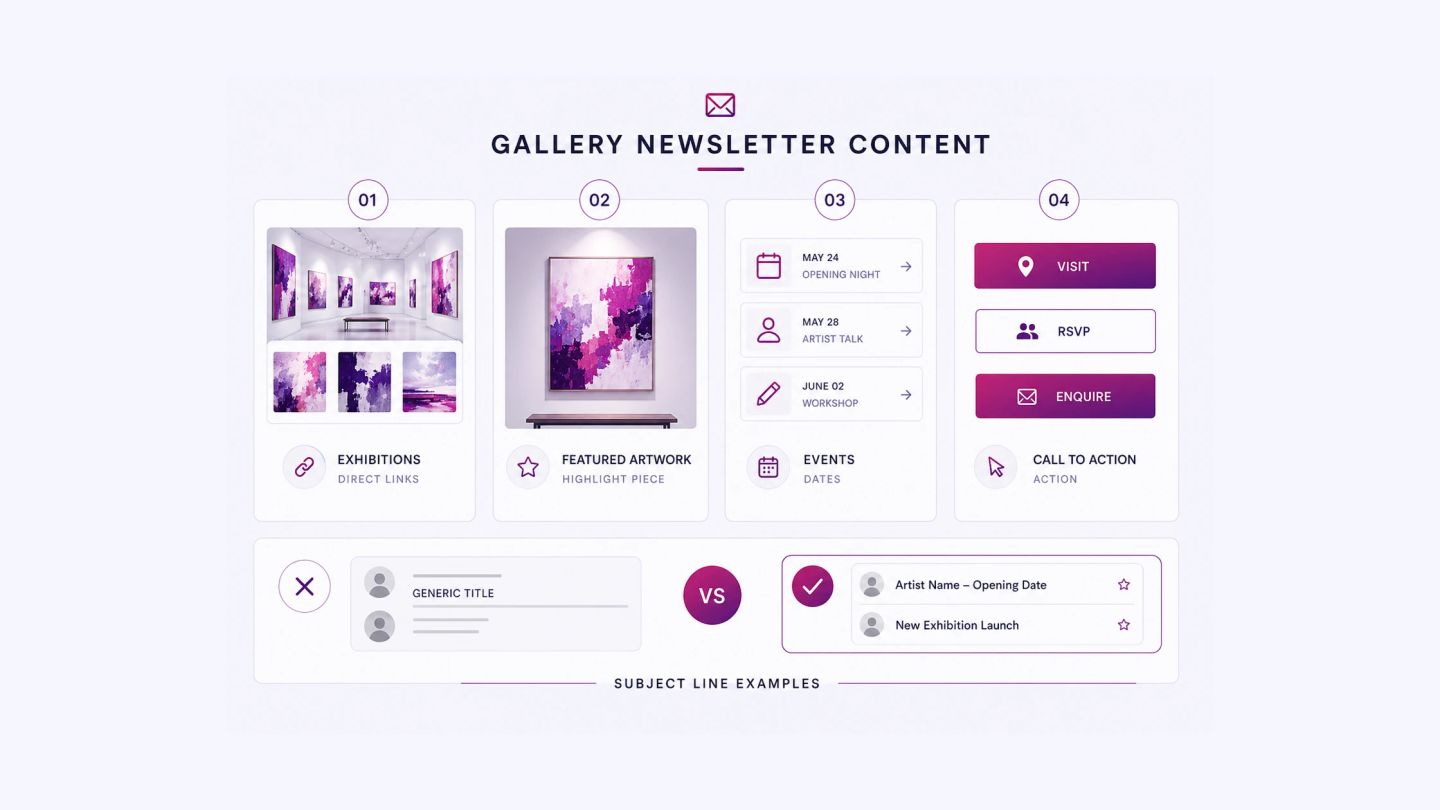
- Current and upcoming exhibitions with direct links to exhibition pages
- One piece of art or collection content
- Event dates (opening nights, talks, workshops)
- A simple, clear call to action (visit, RSVP, or enquire)
Subject lines should be direct and specific. “October at the Gallery” performs worse than “New paintings by [Artist Name], opening 14 October.”
List building tactics:
- In-gallery sign-up forms (tablet-based or paper)
- Website pop-up with a simple prompt (no incentive needed for a interested audience)
- Social media link-in-bio directing to a sign-up landing page
Paid Advertising for Galleries
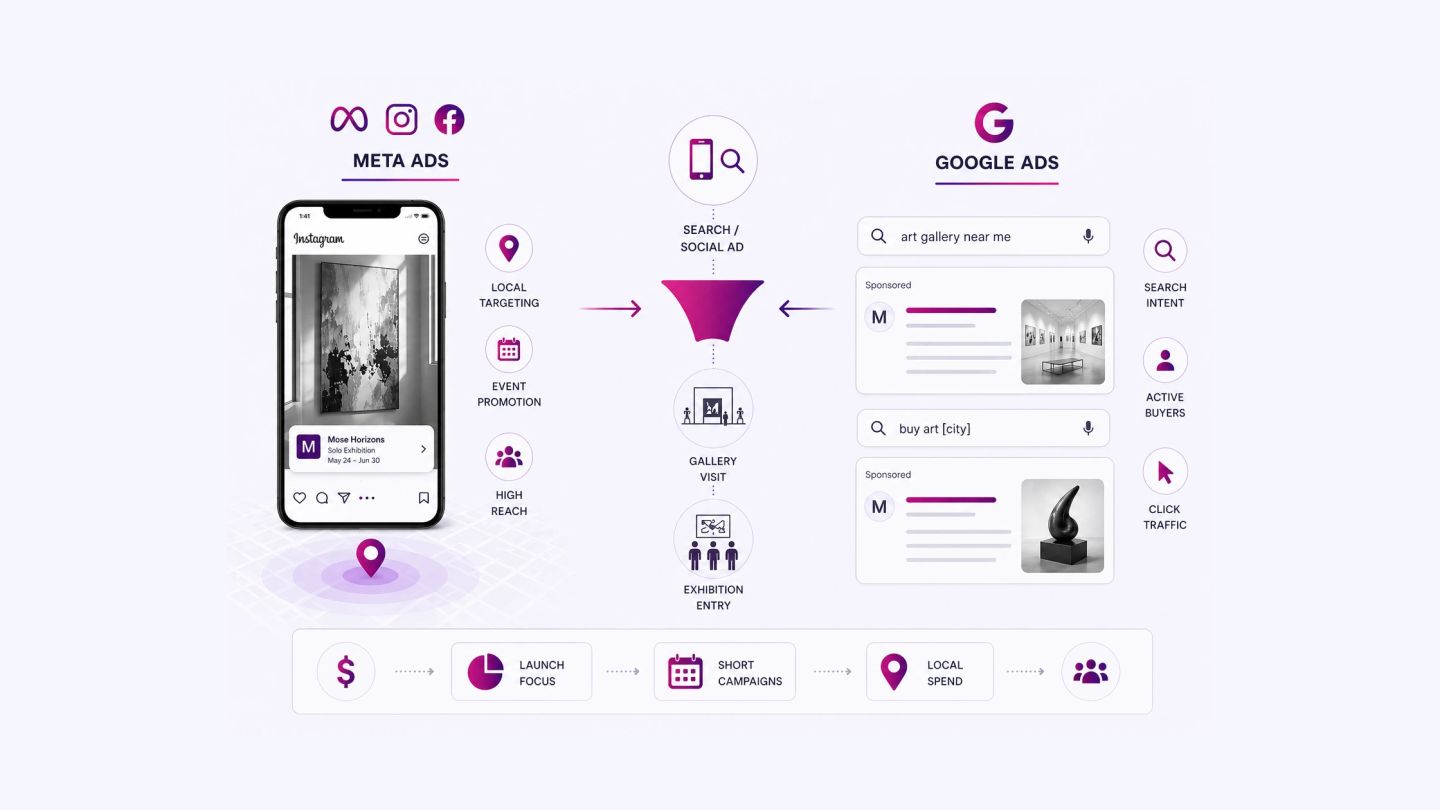
Organic reach is limited, particularly on social media platforms, where the algorithmic reach of non-paid content has declined sharply over the past five years. Paid advertising fills that gap, but only when targeted with precision.
Meta Ads (Facebook and Instagram): The most accessible paid option for galleries. Effective for promoting exhibition openings and events to local audiences. Target by:
- Location (within a specific radius of the gallery)
- Age range (35-65 tends to perform best for collector-oriented galleries)
- Interests (art, interior design, specific artists or movements)
Keep ad creative simple: one strong image of a work, the exhibition name, and the opening date. The objective should be either “Traffic” (driving to the exhibition page) or “Event Responses” for opening nights.
Google Ads: Useful for galleries that receive significant search traffic. Running search ads against terms like “buy original art [city]” or “contemporary art gallery [city]” captures high-intent visitors. The cost-per-click for art-related terms is generally lower than that for retail categories, making this a cost-effective option.
Budget guidance: Galleries with limited budgets should allocate the majority to local Meta Ads during the two weeks before a new exhibition opens. A budget of £200-£500 per exhibition launch is sufficient to generate meaningful local reach.
Measuring What Works
| Channel | Metric to Track |
| Website | Monthly visitors, exhibition page views, contact form submissions |
| Saves and shares (stronger signal than likes), profile visits | |
| Open rate (aim for 30%+), click-through rate, and unsubscribes | |
| Local search impressions, clicks from Google Business Profile | |
| Paid Ads | Cost per click, event responses, and website sessions from ads |
Digital marketing without measurement is guesswork. Galleries should track a small set of meaningful metrics rather than chasing broad vanity numbers.
Metrics that reflect real performance:
Review these monthly. Adjust content focus based on which exhibition pages and posts are generating the most engagement, and redirect budget toward the channels showing the best cost-per-result.
A Practical Approach to Gallery Digital Growth
A gallery’s digital marketing strategy does not need to be complex to be effective. It requires consistency, channel focus, and useful or interesting content for the target audience. The galleries that build strong online presences do so by treating digital channels as an extension of their curatorial identity rather than as a box to tick. Start with a complete Google Business Profile, one well-managed social platform, and a monthly email, then build from there as resources allow.
INSIDEA
Ready to put this into practice?
INSIDEA is an Elite HubSpot Partner rated 4.99 across 500+ verified reviews. Let's map it to your goals.



 How INSIDEA works




