

Digital marketing teams face mounting pressure from all directions. There are more channels to manage, tighter content timelines, higher expectations for personalized messaging, and often limited budgets. Many tools available today address only one part of the workflow, leaving teams to juggle multiple platforms and processes.
Claude is different because it understands context, holds longer conversations, and handles a wide range of marketing and business tasks in a single place. About 49% of jobs now rely on Claude for recurring tasks, showing its growing adoption for structured work across functions.
This guide is written for those who want to use Claude with purpose. If you handle SEO, paid media, email planning, content creation, analytics, customer research, or other business work, the workflows here will save time and improve quality.
We’ll cover Claude’s core capabilities, practical applications across marketing and business, and prompt strategies that deliver actionable results without heavy editing.
How Claude Helps You Handle Marketing Tasks Efficiently?
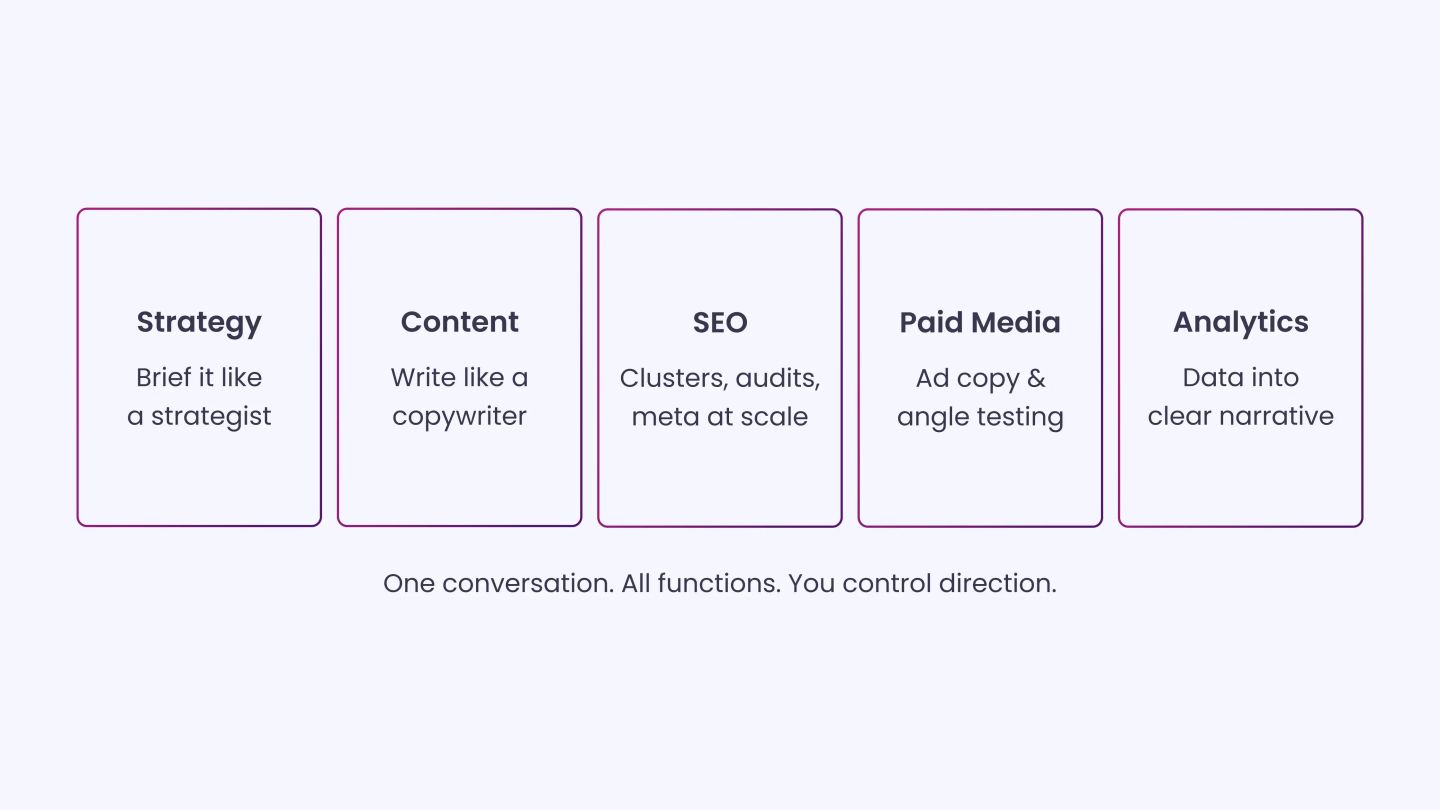
Claude is an AI assistant developed by Anthropic, a company focused on AI safety research. It’s accessible through Claude.ai and via API integrations. Unlike general-purpose chatbots that respond in shallow, generic patterns, Claude is built to handle long documents, nuanced instructions, and complex multi-step tasks without losing track of the original goal.
Here’s what that means for marketing and business work:
- Process and analyze your content: Paste in a 2,000-word blog post, a full email sequence, an ad creative brief, or a competitor’s landing page copy, and Claude will analyze, critique, rewrite, or extract insights from it.
- Maintain context over long conversations: You don’t have to re-explain your brand, audience, or goals in every message. Set the context once and build on it.
- Follow formatting and tone instructions consistently: Tell it you’re writing for a B2B SaaS audience, in a direct tone, with short paragraphs and no jargon, and it stays consistent.
| Did You Know? Claude has a context window that can handle up to 200,000 tokens, roughly 150,000 words, or 500+ pages of material in a single conversation. That’s enough to load an entire content strategy document, a year’s worth of email campaigns, or a full brand style guide and work with it in real time. |
How to Access and Set Up Claude?
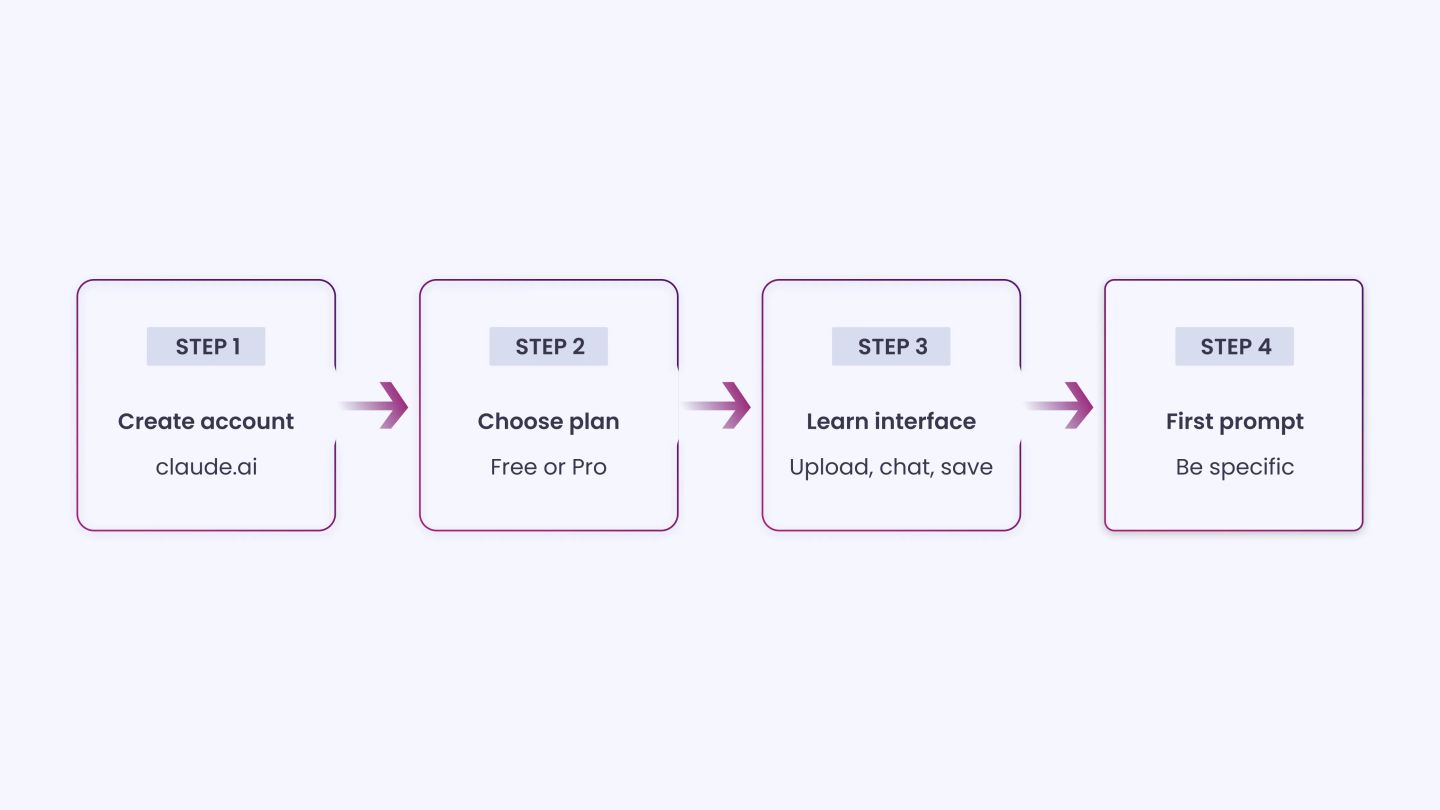
Before anything else, here’s how to get up and running.
Step 1: Go to claude.ai, create a free account using your email. The free tier gives you access to Claude’s standard model with reasonable daily usage limits.
| About the Free Tier Usage Limits
The free Claude plan doesn’t have a fixed daily message count like “50 messages per day.” Instead, it works on session‑based limits that control how much you can interact in a given period. These limits vary depending on:
For most users, sessions reset roughly every 5 hours. Claude will notify you when you’ve reached your session limit, but there isn’t a visible counter showing remaining turns. |
Step 2: Choose the right plan. For professional use, Claude Pro (paid plan) gives you access to more powerful model versions, higher usage limits, and priority access during peak hours. For teams, Anthropic offers API access to integrate Claude with existing tools such as Notion, Slack, and custom dashboards.
Step 3: Learn the interface. The Claude interface is a clean, single chat window. You type your message, hit send, and Claude responds. Things to know:
- You can upload files (PDFs, Word docs, CSVs) for Claude to read and analyze
- You can start a new conversation to reset the context
- Conversations are saved and accessible from the left sidebar
- Claude can write in markdown format, which renders properly in many tools when you copy-paste
Step 4: Write your first marketing prompt. Don’t start vague. Instead of “write me a blog post,” try:
| Write a 900-word blog post for a B2B SaaS company targeting mid-size retail brands. The topic is how to reduce cart abandonment using email automation. Tone: direct, practical, no fluff. Include an H2 structure with 4 sections. |
That level of specificity is what separates useful output from generic filler.
| Quick Callout: The Golden Rule of Claude Prompting. The output quality is directly proportional to input quality. Vague prompts produce vague content. Specific prompts, with audience, tone, format, and objective baked in, produce content you can actually use. |
How to Use Claude Across Marketing and Business Work
Claude works across content, SEO, paid media, email, analytics, and customer research. Here’s how you can put it to work in your daily workflow.
Claude for Content Marketing
Content is where most marketers first explore Claude, and for good reason. It’s fast and adaptable across content types.
Blog Posts and Long-Form Articles
Claude can draft full-length articles, but the smarter approach is to use it structurally:
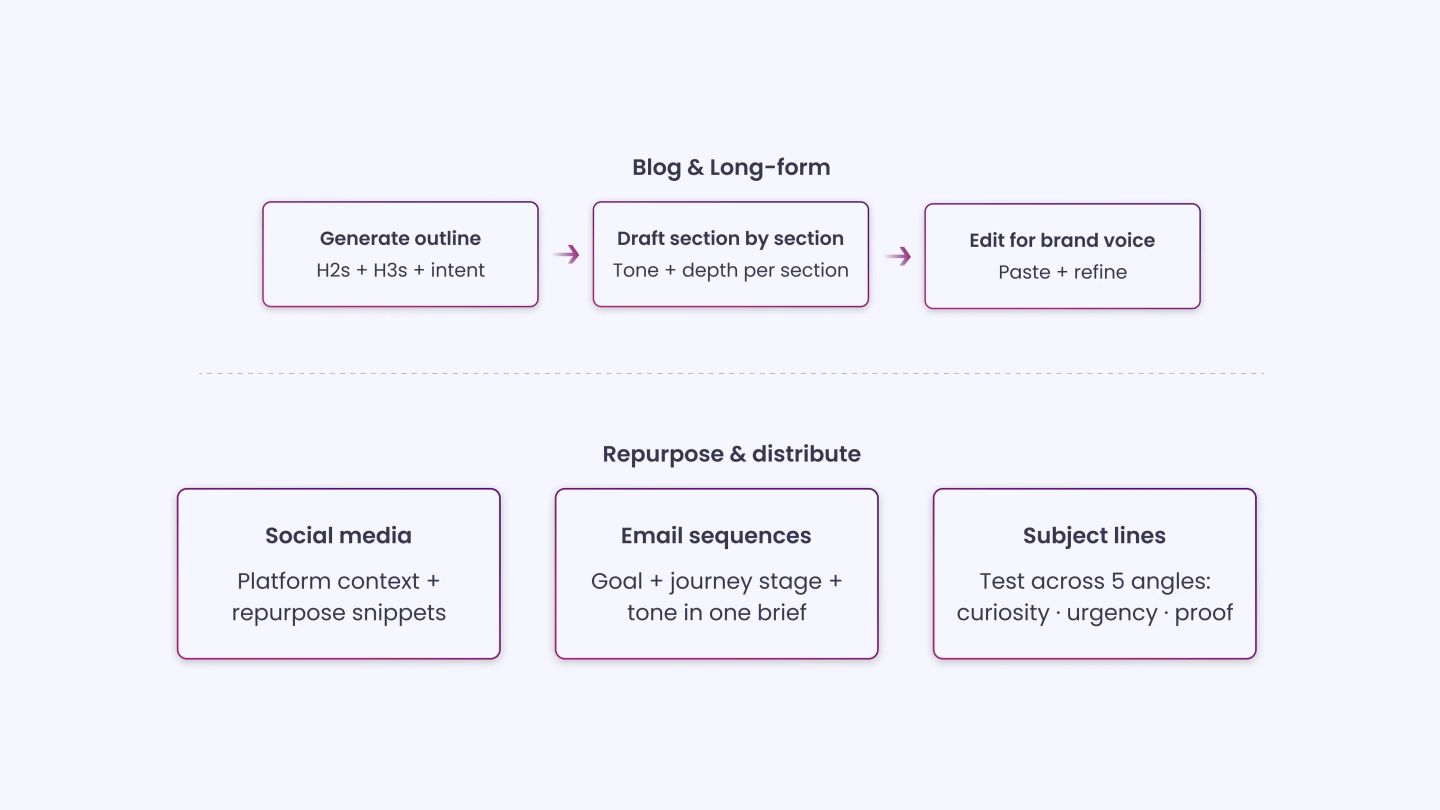
- Generate an outline first: Ask Claude to create a detailed outline with H2s and H3s based on your topic, target keyword, and audience intent. Review and edit it before drafting.
- Draft section by section: Feed the outline back to Claude and ask it to write one section at a time. This gives you more control over the tone and depth of each section.
- Edit for brand voice: Once you have a draft, paste it back in and say: “Rewrite this to match our brand voice: conversational, confident, avoids corporate speak, uses short sentences.” Claude will apply that filter consistently.
Social Media Content
For social media, Claude works best when you give it platform context and a content goal:
| Write 5 LinkedIn posts for a B2B cybersecurity company. Each post should be under 200 words, lead with a counterintuitive statement, and end with a single-line question to drive comments. Topic: Why most security training fails. |
You can also ask Claude to repurpose long-form content into social snippets: “Take this blog post and extract 6 LinkedIn post ideas from it, each focused on a different insight.”
Email Copywriting
Claude handles email sequences well because it can maintain a consistent narrative arc across multiple messages. Give it the full context: the campaign goal, the reader’s stage in the buying journey, the desired action, and the tone.
| Write a 4-email onboarding sequence for a project management tool. The reader just signed up for a free trial. Goal: get them to invite a teammate by day 5. Tone: helpful, human, not pushy. Email length: 150-200 words each. |
| Did You Know?
You can give Claude a sample of your existing emails and ask it to “write in the same voice”; it’ll pick up sentence structure, vocabulary, and tone patterns from just 3-4 examples. |
Claude for SEO
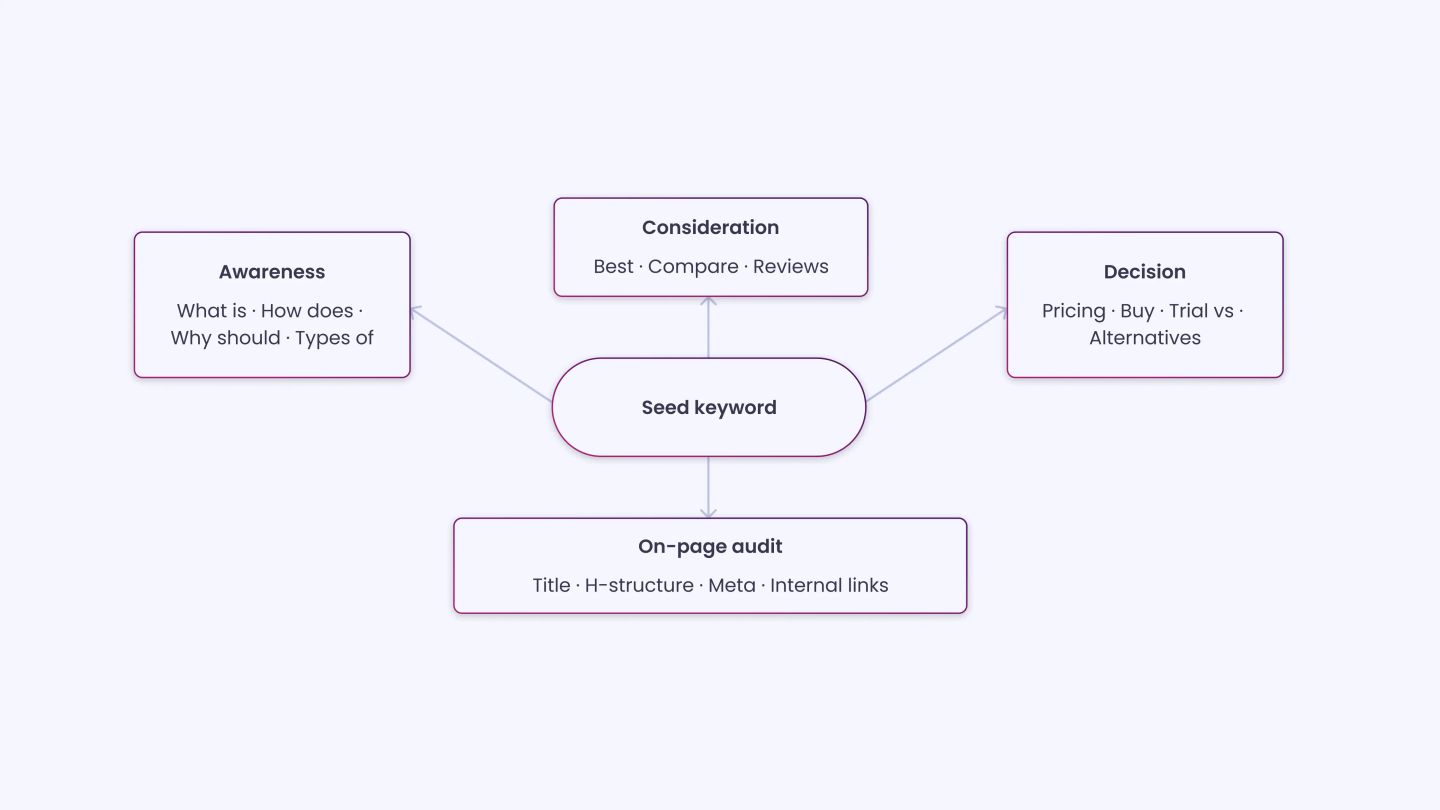
SEO is one of the most impactful areas for Claude in digital marketing. The combination of writing capability, research thinking, and structured output makes it useful for SEO workflows.
Keyword Research and Clustering
Claude can’t pull live search volume data (it doesn’t have live internet access unless connected to a tool that does). But it can help you think through keyword strategy:
| “Given the topic of project management for remote teams, generate a keyword map with 3 clusters: awareness-stage, consideration-stage, and decision-stage. For each cluster, give 5 example keywords and their likely search intent.” |
- Ask it to build topic clusters from a seed keyword list you paste in
- Use it to identify content gaps: “Here are 10 articles our competitor ranks for. What topics are they missing that we could own?”
On-Page SEO Optimization
Paste any piece of content and ask Claude to audit it:
| “Review this blog post for on-page SEO. Check for: title tag strength, H1/H2 structure, internal linking opportunities, keyword density, meta description quality, and readability. Give specific recommendations.” |
It won’t check technical issues like page speed or crawl errors; those need dedicated tools, but for content-level SEO, it’s remarkably thorough.
Meta Tags and Title Tags
Claude is fast at generating title tags and meta descriptions at scale:
| “Write 3 title tag variations and 2 meta descriptions for a blog post about cloud storage for small businesses. Target keyword: best cloud storage for small teams. Keep titles under 60 characters.” |
Claude for Paid Advertising
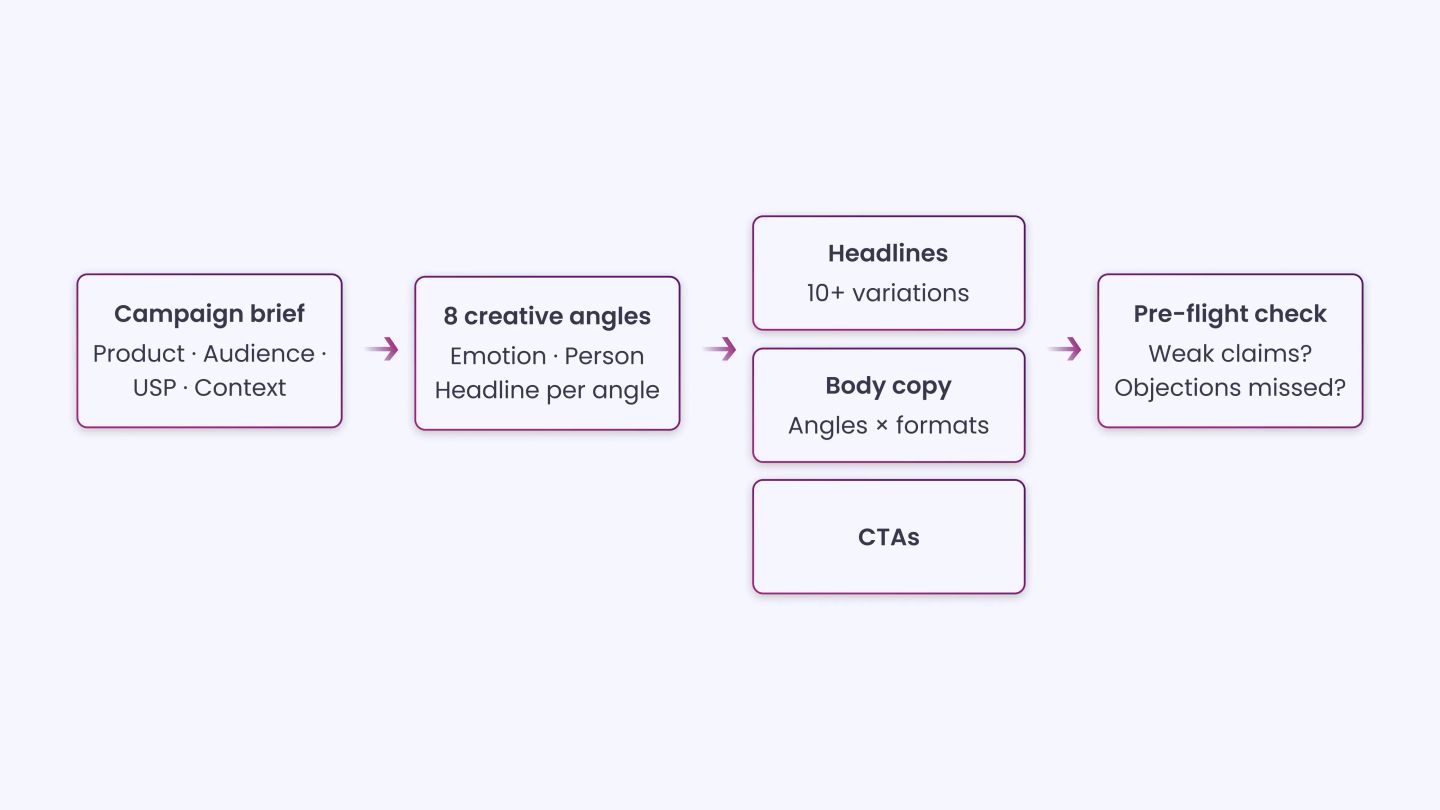
Paid media teams use Claude primarily for ad creative development, ideation, copy variations, and testing frameworks.
Ad Copy at Scale
Running A/B tests requires volume. Claude handles it well:
| “Write 10 Facebook ad headline variations for a weight-loss supplement brand targeting women 35-55. USP: no stimulants, doctor-formulated. Tone: empowering, evidence-based. Each headline under 40 characters.” |
Then ask for body copy variations, CTAs, and angle combinations separately. You get a structured testing library in minutes.
Campaign Angle Brainstorming
Before writing a single word of copy, brief Claude on your product, audience, and competitive context and ask:
| “Suggest 8 different creative angles for this campaign. For each angle, describe the core emotion it targets, the type of person it resonates with most, and give one example headline.” |
This is strategist-level thinking produced at speed.
Landing Page Copy Review
Paste your landing page copy and ask Claude to analyze it against a conversion framework:
| “Review this landing page copy for a B2B HR software. Evaluate: headline clarity, value communication in the hero section, objection handling, social proof placement, and CTA strength. Give a score out of 10 for each and specific suggestions.” |
| Quick Callout: Use Claude as a Pre-Flight Checklist. Before launching any ad campaign, paste your creative into Claude and ask: “What objections might a skeptical reader have about this ad? What claims feel weak or unsubstantiated?” You’ll catch gaps your team has missed. |
Claude for Email Marketing
In addition to writing individual emails, Claude is useful across the full email marketing workflow.
Subject Line Testing
| “Write 15 subject line variations for an abandoned cart email for a premium skincare brand. Test across angles: curiosity, urgency, social proof, directness, and humor. Flag which angle each uses.” |
Segmentation Messaging
Different audience segments need different messages. Brief Claude on your segments and ask it to adapt a single core message for each:
| “We’re promoting our annual subscription upgrade. Write versions of this core message for 3 segments: new customers (less than 3 months), active users who haven’t upgraded, and churned users we’re re-engaging. Keep each under 120 words.” |
Re-engagement Campaigns
Re-engagement is one of the hardest tones to get right: too aggressive and you accelerate churn; too passive and nobody opens. Claude can workshop multiple approaches:
| “Write a 3-email re-engagement sequence for subscribers who haven’t opened in 90 days. Offer: 20% discount. Tone: direct but not desperate. End the sequence with a clear sunset email.” |
Claude for Social Media Strategy
Apart from the individual posts, Claude can help you think through social media strategy at a platform level.
Content Calendar Planning
| “Create a 4-week LinkedIn content calendar for a B2B financial services brand. Include: content type (thought leadership, case study, product, culture), post topic, and the primary goal for each post (awareness, engagement, conversion). Format as a table.” |
Claude will produce a full calendar in seconds. Your job is to review for strategic fit and adapt topics to actual company news and real data.
Competitor Analysis
Paste competitor post copy (from your manual research) and ask Claude to analyze patterns:
| “Here are 20 LinkedIn posts from our top competitor. Analyze: what topics perform best, what tone they consistently use, where their content is weak, and 3 angles we could own that they’re not addressing.” |
Community Management Templates
For brands managing high comment volume, Claude can build response templates for common scenarios:
| “Write 8 community management response templates for a SaaS company: positive review, negative review with a valid complaint, negative review with an invalid complaint, feature request, billing question, general inquiry, press inquiry, and partnership request.” |
Claude for Analytics and Reporting
Claude isn’t a data visualization tool, but it’s powerful for interpreting data and building reporting frameworks.
Translating Data into Narrative
Copy-paste a table of campaign metrics and ask:
| “Here are last month’s email campaign metrics: [paste data]. Write a 3-paragraph executive summary for a non-technical CMO. Highlight what performed above benchmark, what underperformed, and one specific recommendation for next month.” |
Building Reporting Frameworks
| “Create a monthly digital marketing reporting template. Include sections for: traffic overview, SEO performance, paid media summary, email metrics, social media reach, and MQL pipeline contribution. For each section, list the 4-5 KPIs to include and what good vs. concerning benchmarks typically look like.” |
Hypothesis Generation
When metrics look unexpected, Claude helps you think through causes:
| “Our organic traffic dropped 18% in the last 30 days. Here are the top 10 landing pages that lost traffic [paste data]. What are the 5 most likely explanations, and what would you check first for each?” |
| Did You Know?
Claude can analyze raw CSV data when you paste it directly into the chat. It won’t chart it visually, but it can calculate averages, identify trends, flag anomalies, and summarize findings in plain language, useful for quick audits without opening a spreadsheet. |
Claude for Customer Research and Persona Development
Great marketing starts with a sharp understanding of customers. Claude is a strong research thinking partner.
Building Buyer Personas
Give Claude your product description, industry, and any real customer data you have, and ask:
| “Build 3 detailed buyer personas for a B2B project management tool targeting mid-size professional services firms. For each persona: job title, daily frustrations, what they’ve already tried, what would make them switch tools, and how they prefer to evaluate new software.” |
Interview Question Design
| “We’re running 10 customer discovery interviews next week with current users of our email automation platform. Write 12 open-ended questions designed to uncover: why they chose us over alternatives, where they still feel friction, and what outcomes matter most to them.” |
Review Mining and Voice of Customer
Paste in raw customer reviews (from G2, Trustpilot, Amazon, etc.) and ask Claude to extract patterns:
| “Analyze these 40 customer reviews. Identify: the top 5 reasons people love the product, the top 5 recurring complaints, exact phrases customers use to describe the core value, and any consistent language we should use in our own messaging.” |
Advanced Claude Prompting Habits for Marketers
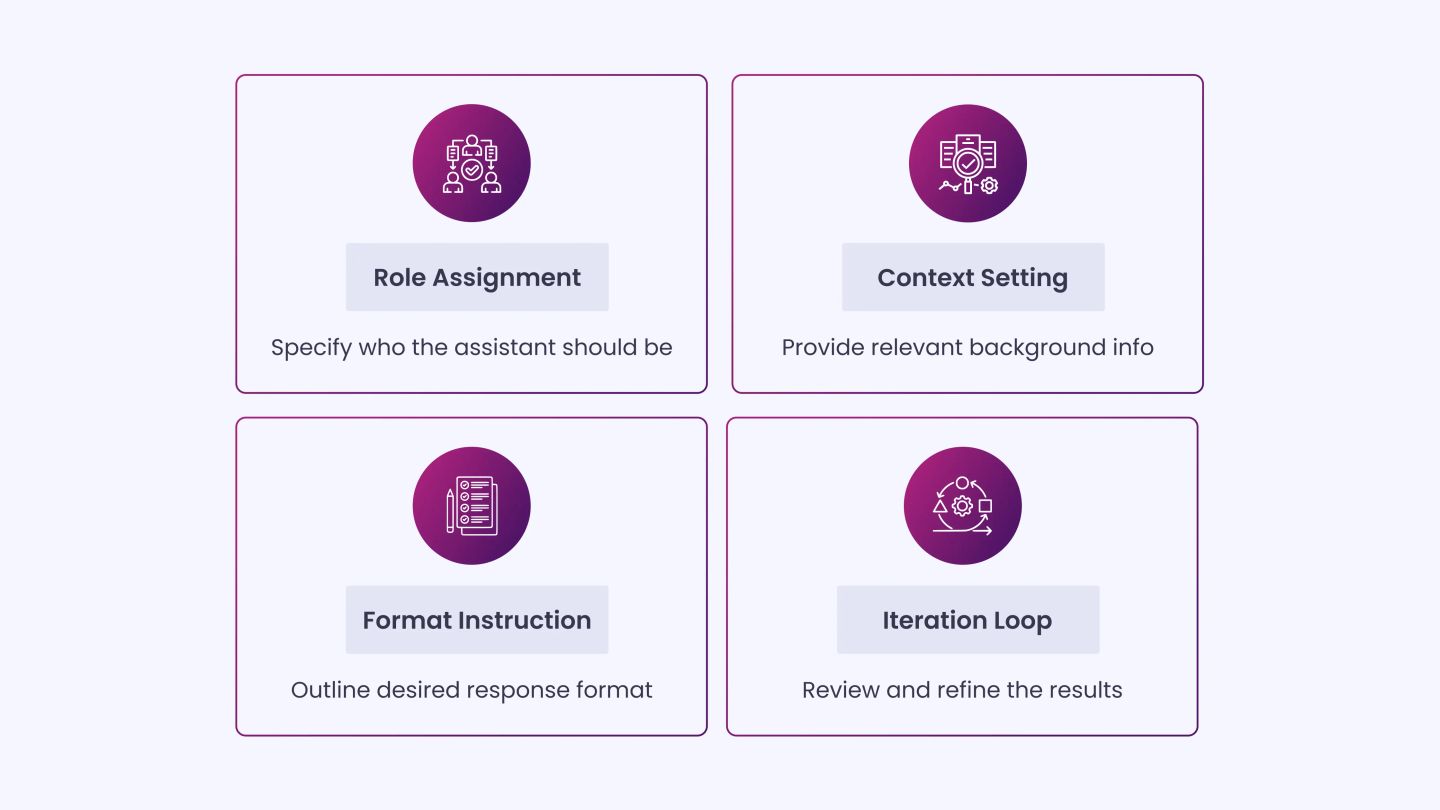
The difference between a marketer who gets mediocre results from Claude and one who gets consistently excellent output usually comes down to four habits.
- Assign a role: Start prompts with a role assignment: “You are a senior B2B content strategist with 10 years of experience in SaaS marketing.” This frames the type of thinking and vocabulary Claude uses.
- Provide a real example: When asking for something in a specific style, paste in 2-3 real examples and say: “Match this tone and structure.” Showing is faster than describing.
- Ask for critique before output: For high-stakes content, ask Claude to review and criticize a brief or outline before writing: “Before writing this, tell me what’s unclear, what assumptions you’re making, and what information would improve the output.”
- Iterate, don’t regenerate: When output isn’t right, don’t start over; give targeted feedback: “The second paragraph is too formal. Rewrite it to sound more conversational. Everything else is fine.” Surgical edits preserve what’s working.
Limitations of Claude and How to Work Around Them
Keep these limits in mind to make Claude work effectively alongside your workflow:
- Claude cannot access the internet in real time (unless paired with a browsing tool or plugin). It doesn’t know what’s ranking on Google today or what your competitor posted last week.
- Claude cannot pull live ad performance data. Connect your ad accounts to your analytics platform first, then paste data into Claude for analysis.
- Claude cannot publish content. It generates text and structured content; your team or automation tools handle publishing workflows.
- Claude can hallucinate statistics. Never publish a specific statistic from Claude without verifying it from a primary source. Ask Claude to flag when it’s uncertain about a fact.
Get More Done with Claude’s Workflows
Claude is one of the most versatile tools available to digital marketing teams right now, not because it replaces any single specialist function, but because it accelerates the thinking, writing, and structuring work that runs through every function.
SEO, content, paid media, email, social, analytics, customer research, there’s a clear, practical Claude workflow for each.
The marketers who get the most value from it are those who learn to brief it effectively. Treat it like a capable colleague who needs clear context, not a magic button that produces perfect output on demand.
Start with one workflow, get comfortable with iteration, then expand across your stack.
INSIDEA
Ready to put AI to work in your business?
Practical automation and AI workflows built on top of your stack, not bolted on.

 How INSIDEA works




