Creating content that ranks and performs in 2026 requires more than just writing. Many marketers rely on ChatGPT without providing clear instructions, resulting in generic outputs that require extensive editing. The challenge is drafting prompts that provide enough context, specific instructions, and a clear objective so the output is actionable and relevant to your audience.
This blog provides 50 ready-to-use ChatGPT SEO prompts organized into seven practical categories: keyword research, content planning, on-page SEO, technical SEO, link building, AI answer optimization, and content updates. Each prompt is structured to guide ChatGPT toward usable results, saving time on ideation and writing.
Paired with tools like Ahrefs, Semrush, or Google Search Console for verification, these prompts give you precise starting points for producing content that ranks and engages readers.
Why Most ChatGPT SEO Prompts Fail
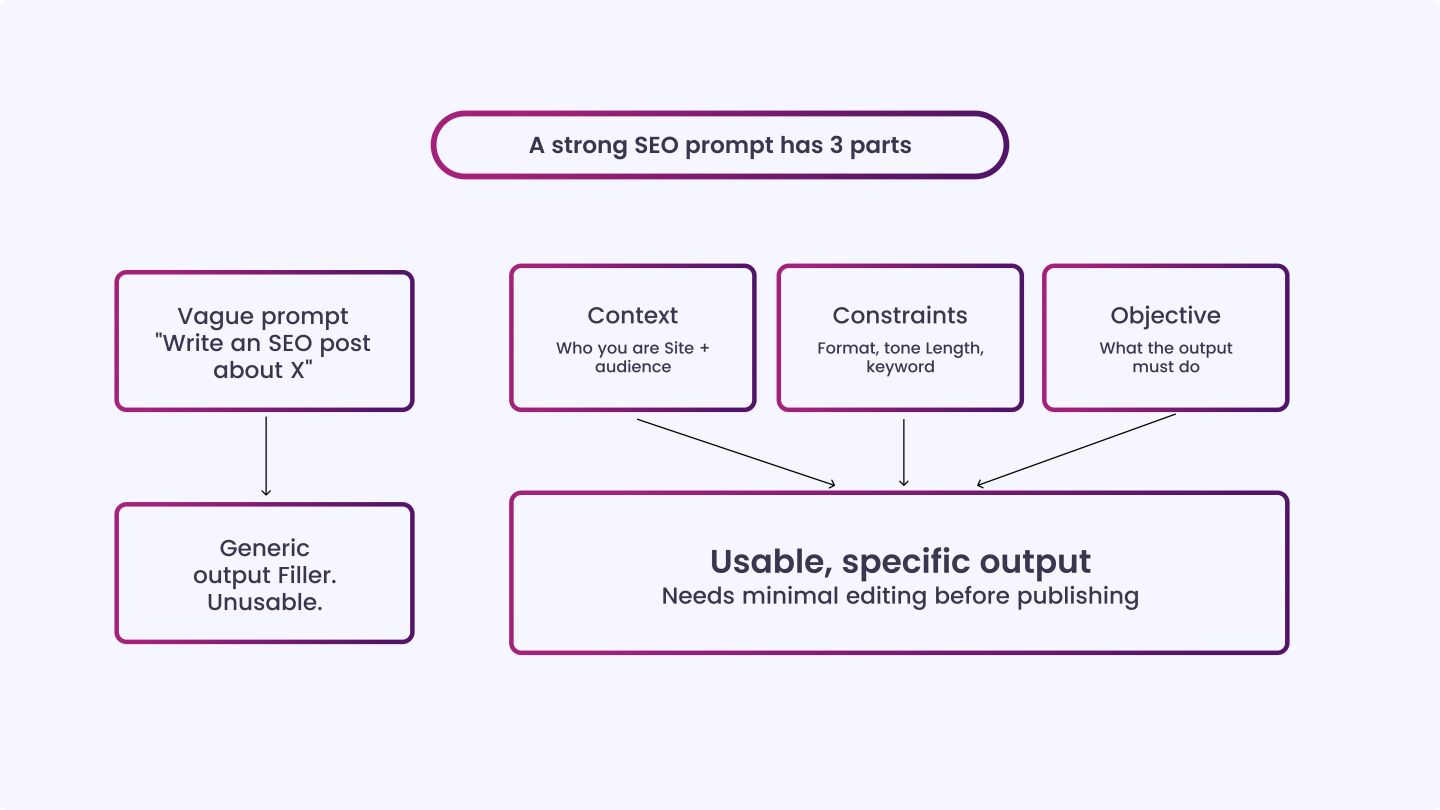
Many people type something like write an SEO blog post about X and wonder why the result feels generic or like a Wikipedia entry. The issue isn’t the tool, it’s the prompt.
A strong SEO prompt has three main components:
- Context: Who you are, what your site does, and who your audience is.
- Constraints: Word count, tone, format, and target keywords.
- Objective: Exactly what you want the output to achieve.
Every prompt in this list follows that structure. Use them as-is or swap in your own variables; the result will be far more usable than starting from a blank prompt.
| Important note: ChatGPT doesn’t have real-time search data. Use these prompts for ideation, structure, and content drafting. Always validate keyword volume and competition in Ahrefs, Semrush, or Google Search Console before finalizing. |
50 ChatGPT Prompts That Help Produce SEO-Ready Content
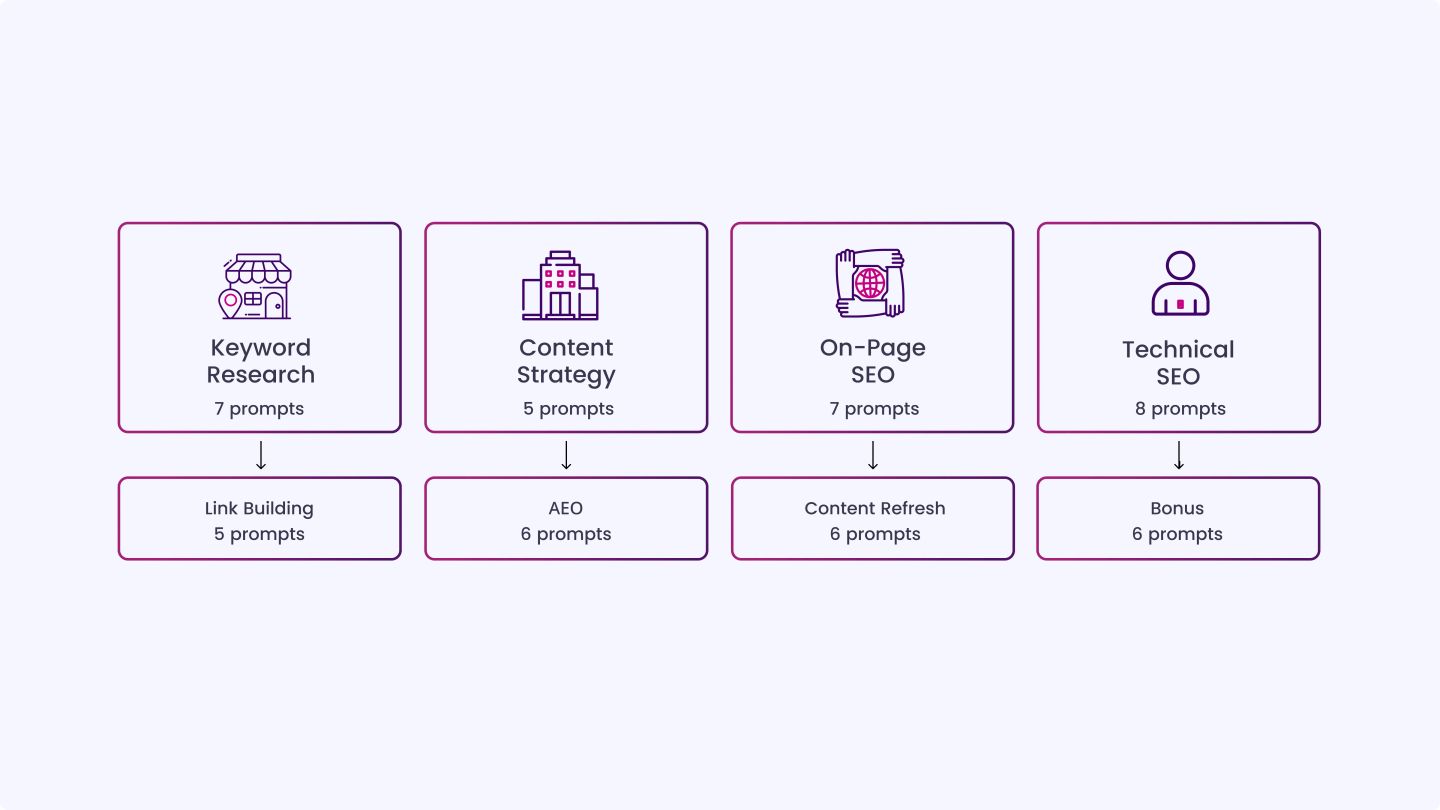
To give you context before exploring the prompts, here’s a category-wise count so you can quickly understand the focus areas:
Keyword Research Prompts
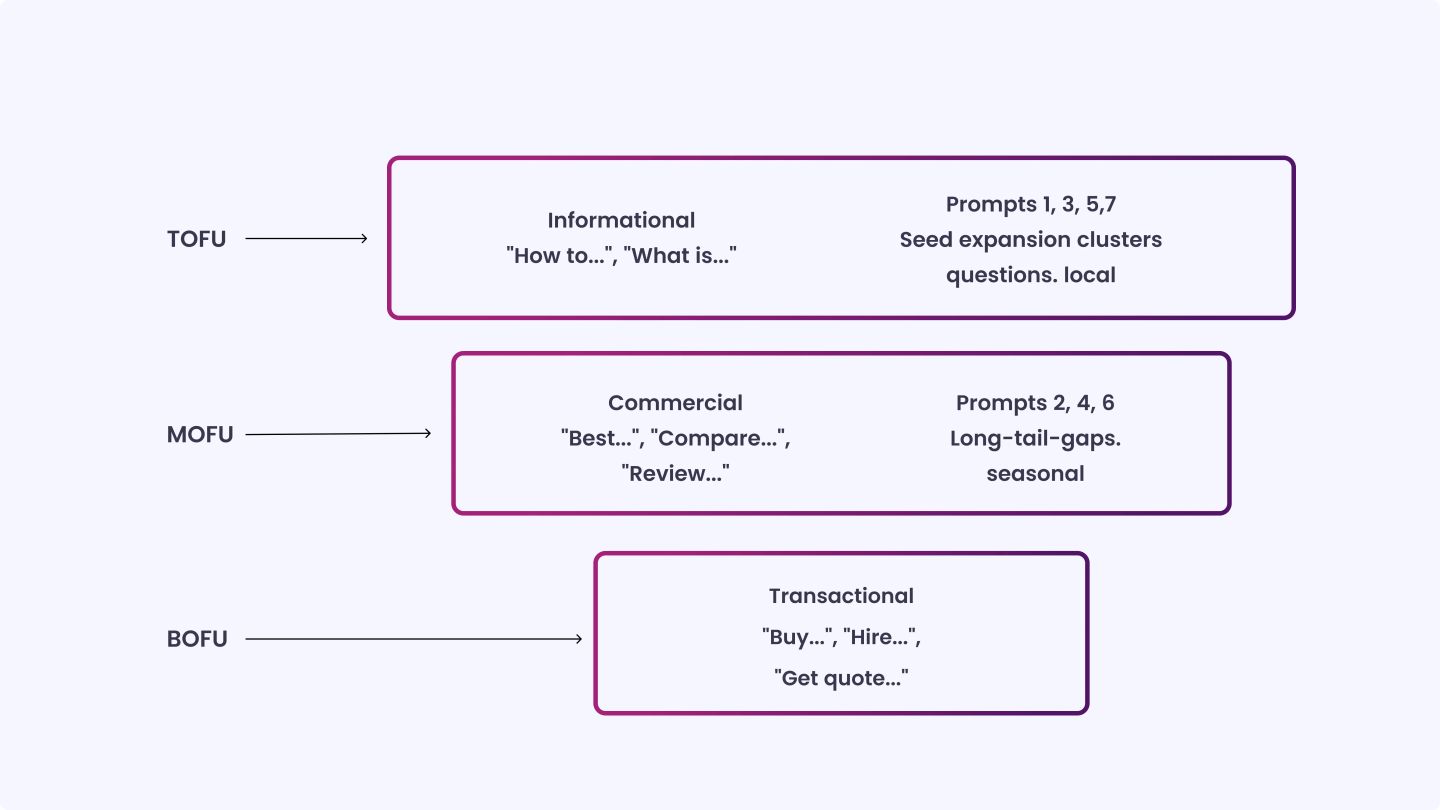
Let’s start with keyword research, the foundation of any SEO effort. These prompts help you identify the right search terms, spot gaps your competitors are missing, and organize your ideas for content that matches real user intent.
1. Seed keyword expansion: Act as an SEO strategist. My business is [describe product or service]. My target customer is [describe buyer persona] in [industry or location]. Generate 20 seed keywords that they would search at different stages of the buying journey. Label each by intent: informational, commercial, or transactional.
2. Long-tail keyword table: Generate a table of 15 long-tail keywords related to [seed keyword]. Include columns for: keyword, search intent, estimated difficulty (low/medium/high), and a potential blog post title for each.
3. Topic cluster builder: I want to build topical authority around [main topic]. Create a topic cluster with one pillar page and eight supporting articles. For each article, include a suggested title, target keyword, and search intent.
4. Competitor keyword gaps: My competitors are [Competitor A] and [Competitor B]. Based on their content, what keyword gaps are they likely missing that I could target? Focus on long-tail, informational keywords with nearby commercial intent.
5. Question-based keyword mining: Generate 20 questions real users ask about [topic]. Format them as they would appear in a Google search, not as polished sentences, but as natural search queries. Group them by intent.
6. Seasonal keyword planning: For a [type of business] in [industry], what SEO topics and keywords tend to spike between [Month] and [Month]? Suggest five content topics for each month with the keyword, likely intent, and a suggested content format.
7. Local SEO keywords: Act as a local SEO specialist. My business is a [type of business] in [City, State]. Generate 15 location-specific keywords I should target, including near-me variants, service-area keywords, and neighborhood-level terms.
Content Strategy and Planning Prompts
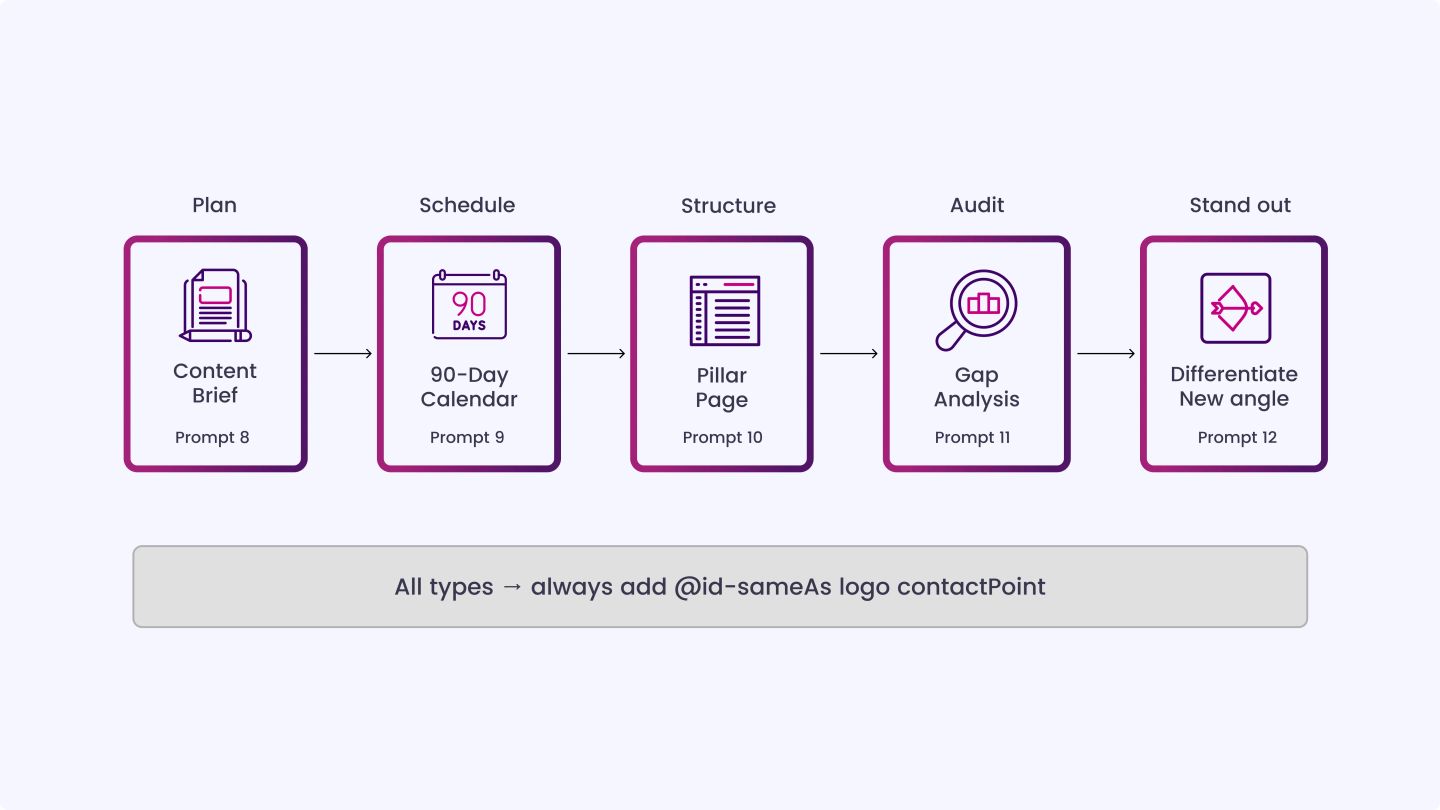
Next, we move to content strategy and planning. These prompts guide you in structuring your ideas, organizing your publishing schedule, and creating content plans that align with your audience’s needs and search intent:
8. Content brief builder: Act as a senior content strategist. Write a full content brief for the keyword [keyword]. Include: primary keyword, secondary keywords, target audience, search intent, suggested H1, H2 structure, word count, key questions to answer, and a unique angle that differentiates this from the top three ranking articles.
9. Content calendar from keywords: I have these 10 keywords: [list them]. Build a 90-day content calendar. Assign each keyword a publish week, content format (blog, guide, comparison, FAQ), and a short note on why that format fits the intent.
10. Pillar page outline: Create a detailed pillar page outline for [main topic]. The page should target [primary keyword] and cover the topic sufficiently to internally link to at least 8 supporting articles. Include all H2s and H3s.
11. Competitor content gap analysis: These are URLs of my top three competitors’ best-performing articles: [paste URLs or titles]. What topics, angles, and questions are they not covering that represent a clear content opportunity for a new entrant?
12. Content differentiation: The top-ranking articles for [keyword] all take this angle: [describe the common angle]. Suggest five differentiated angles I could take that would offer something new, more specific, or more useful to the reader.
On-Page SEO Prompts
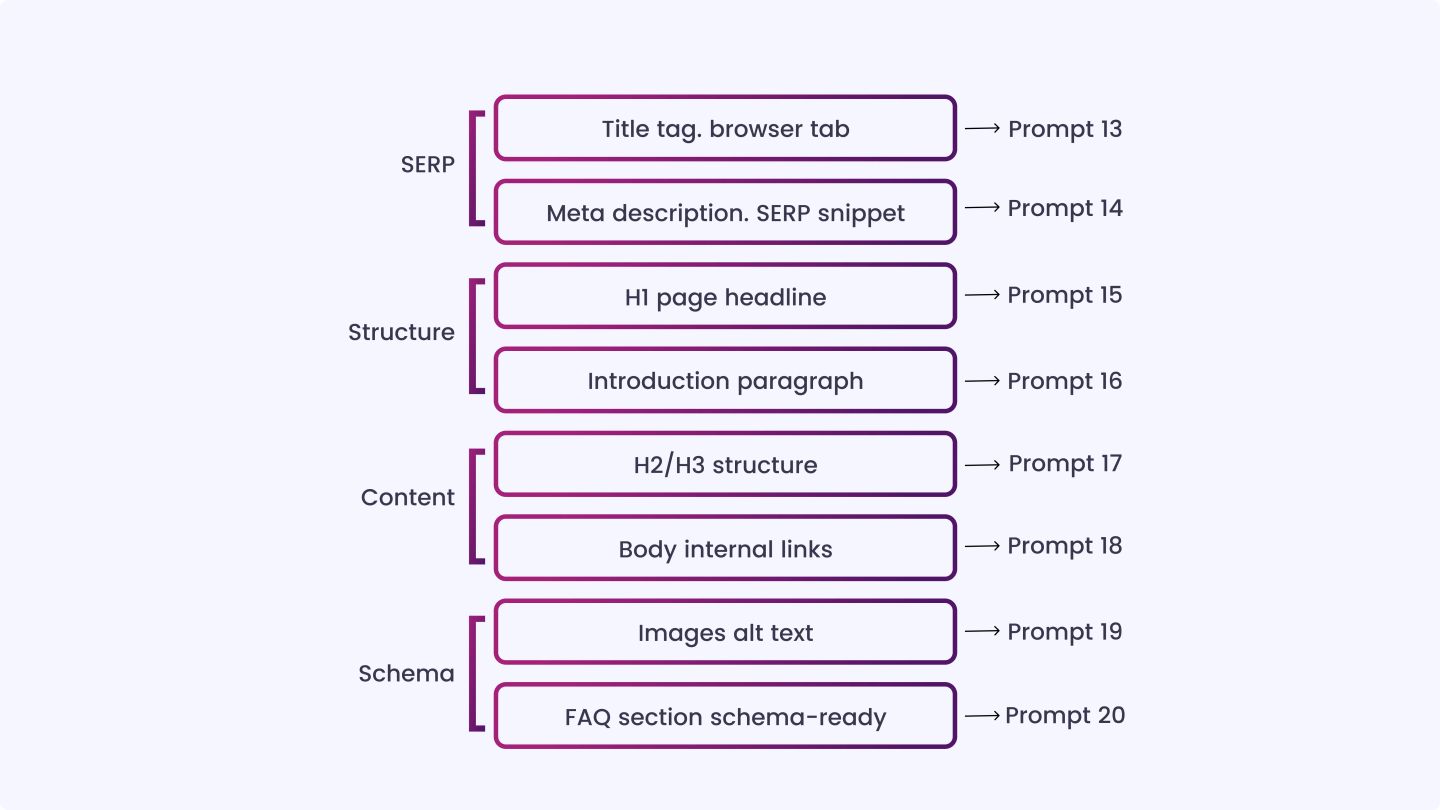
Now we focus on on-page SEO. These prompts help you optimize titles, meta descriptions, headings, and content structure so every page communicates clearly to both users and search engines:
13. Title tag variations: Write five title tag variations for a page targeting [primary keyword]. Each must be under 60 characters, front-load the keyword, and include a differentiation angle, speed, specificity, outcome, or authority. Mark the strongest option for a [B2B / B2C] audience.
14. Meta description set: Write three meta description variations for a page about [topic]. Primary keyword: [keyword]. Each must stay under 160 characters, include an action verb, state a clear reader benefit, and end with a low-friction CTA.
15. H2 and H3 structure for a page: I am writing targeting [keyword] for a [describe target audience]. Generate an H2 and H3 structure that covers the topic fully, matches search intent, and flows logically from one section to the next.
16. Introduction paragraph: Write an opening paragraph for a blog post titled [title]. Primary keyword: [keyword]. Do not start with a question. Do not use filler like ’In today’s world.’ Open with a direct statement of the problem or opportunity, and keep it under 80 words.
17. Internal linking suggestions: Here is a list of my published articles: [paste titles or URLs]. I am writing a new article about [topic]. Suggest five internal linking opportunities, including the source article, suggested anchor text, and where in the new article the link would fit naturally.
18. Image alt text batch: I have these images on my page about [topic]: [describe each image briefly]. Write SEO-optimized alt text for each. Keep each under 125 characters, include relevant keywords naturally, and describe the image accurately.
19. FAQ section from content: Here is my blog post: [paste content]. Extract the five most common reader questions this article answers and write them as a structured FAQ section with concise answers of 40 to 60 words each. Format for FAQPage schema.
Technical SEO Prompts
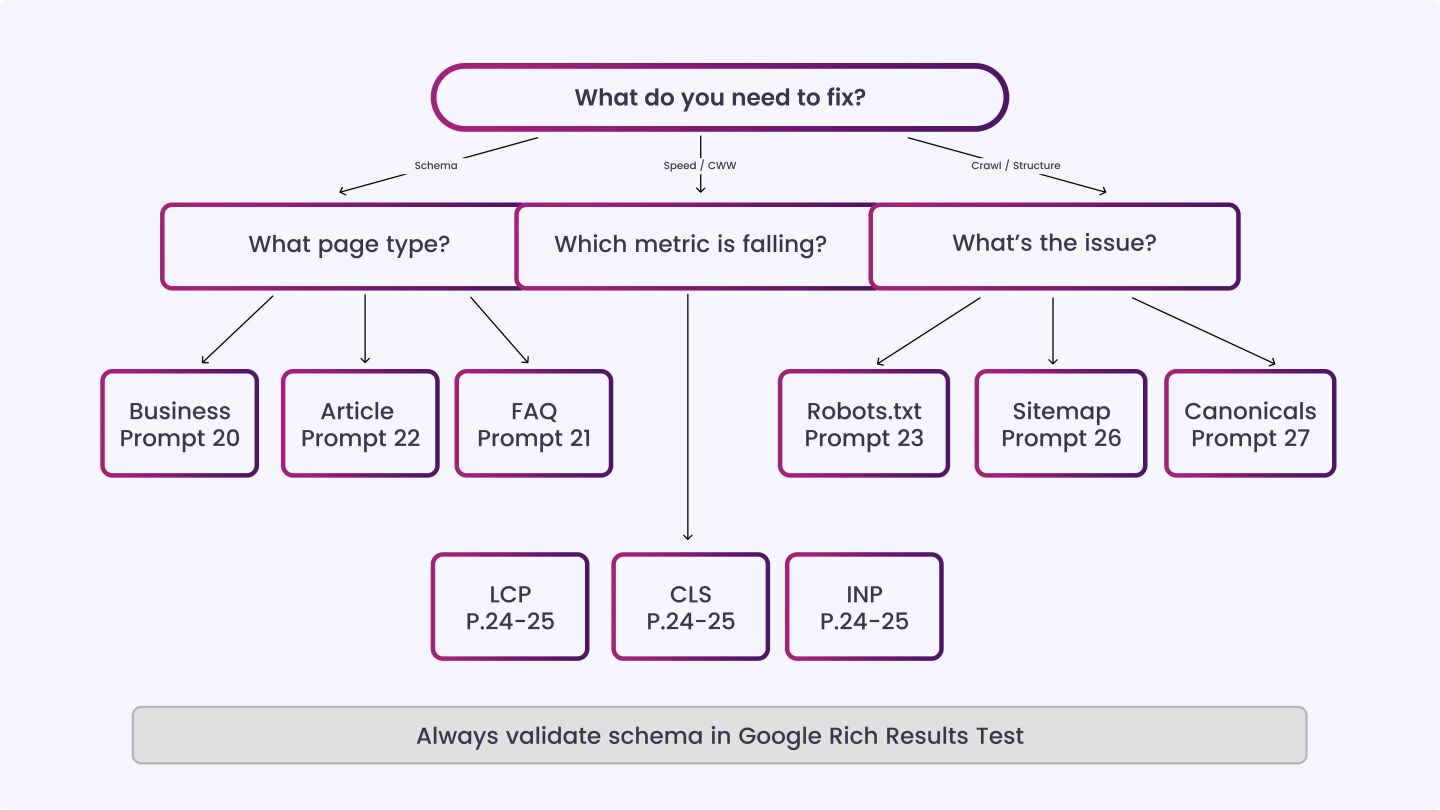
Next, we move into technical SEO. These prompts help you set up schema, audit site files, and identify page performance issues to keep your site running smoothly.
20. Schema markup: Organization Act as a technical SEO specialist. Write valid JSON-LD Organization schema markup for this business: Name: [X], URL: [X], Logo: [X], Phone: [X], Address: [X], Social profiles: [list]. Include sameAs and @id.
21. Schema markup: FAQ Convert these five Q&A pairs into valid FAQPage JSON-LD schema markup: [paste Q&As]. Make sure the format follows Schema.org specifications and is ready to paste into a <script type=’application/ld+json’> tag.
22. Schema markup Article: Write a valid Article schema JSON-LD for a blog post with these details: Title: [X], Author: [X], Date published: [X], URL: [X], Image: [X]. Include all required and recommended properties.
23. Robots.txt audit: Here is my current robots.txt file: [paste]. Review it and flag: any directories that should not be blocked, any missing disallow rules for admin or staging paths, and whether the sitemap is referenced correctly.
24. Page speed issue diagnosis: My page [URL] is scoring [X] on PageSpeed Insights. The flagged issues are: [list them]. For each issue, explain what it means in plain language and the most practical fix for a site running on [WordPress / Shopify / custom].
25. Core Web Vitals explanation: Explain Largest Contentful Paint, Cumulative Layout Shift, and Interaction to Next Paint to a non-technical marketing manager. For each, give one common cause and one practical fix.
26. XML sitemap structure review: I am setting up an XML sitemap for a [describe site: ecommerce / blog / SaaS]. What pages should be included, what should be excluded, and how should priority and changefreq be set for different page types?
27. Canonical tag guidance: My site has these duplicate content issues: [describe scenarios, pagination, printer-friendly pages, parameter URLs]. For each, tell me the correct canonical tag approach and write the actual HTML tag I should use.
INSIDEA
Ready to get found by people and AI?
Search and answer-engine visibility that compounds, built to be cited.
Link Building Prompts
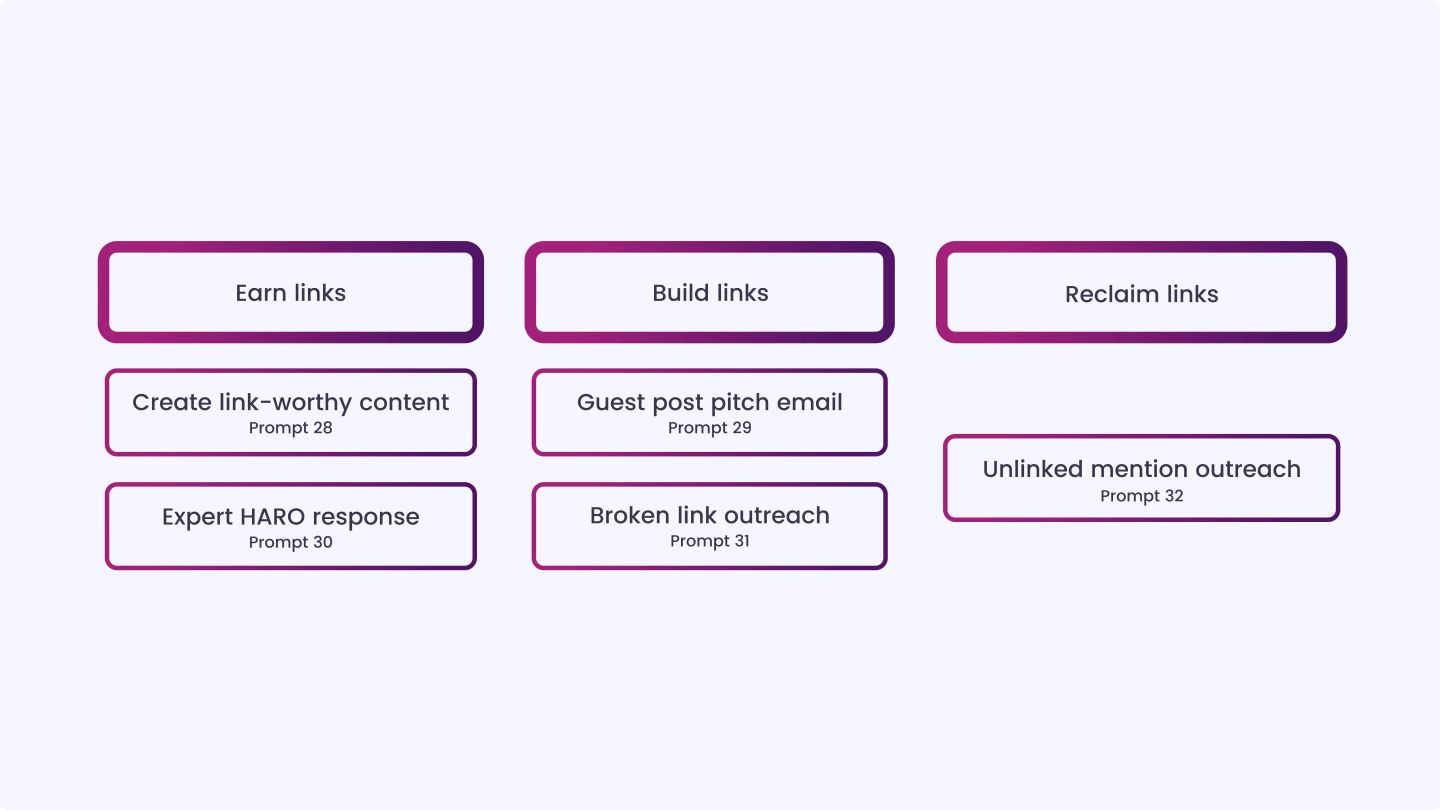
Next, we focus on link building. These prompts guide you in creating content that earns backlinks, reaching out to the right contacts, and turning opportunities into concrete links for your site.
28. Link-worthy content ideas: My site covers [niche]. Suggest eight content formats and specific topic ideas that tend to earn editorial backlinks in this space. For each, explain why it attracts links and from what type of site.
29. Guest post pitch email: Write a guest post pitch email for [target publication]. My angle is [topic]. Keep it under 120 words, make it personalized, reference one specific article from their site, and do not use any template phrases like “I hope this finds you well.”
30. HARO-style expert response: Act as a [job title] with [X] years of experience in [niche]. Answer this journalist’s query in 100 words or fewer: [paste query]. Include a concrete insight, a specific example or data point, and a natural attribution line.
31. Broken link outreach: Write a short outreach email to a site owner telling them one of their links is broken and that my article [URL] is a relevant replacement. Keep it under 80 words. Do not sound automated.
32. Link reclamation outreach: Write an email to a site that mentioned [Brand Name] but did not link to us. Keep it brief, acknowledge their mention specifically, and make a simple, non-pushy request to add the link.
AEO and Answer Engine Prompts
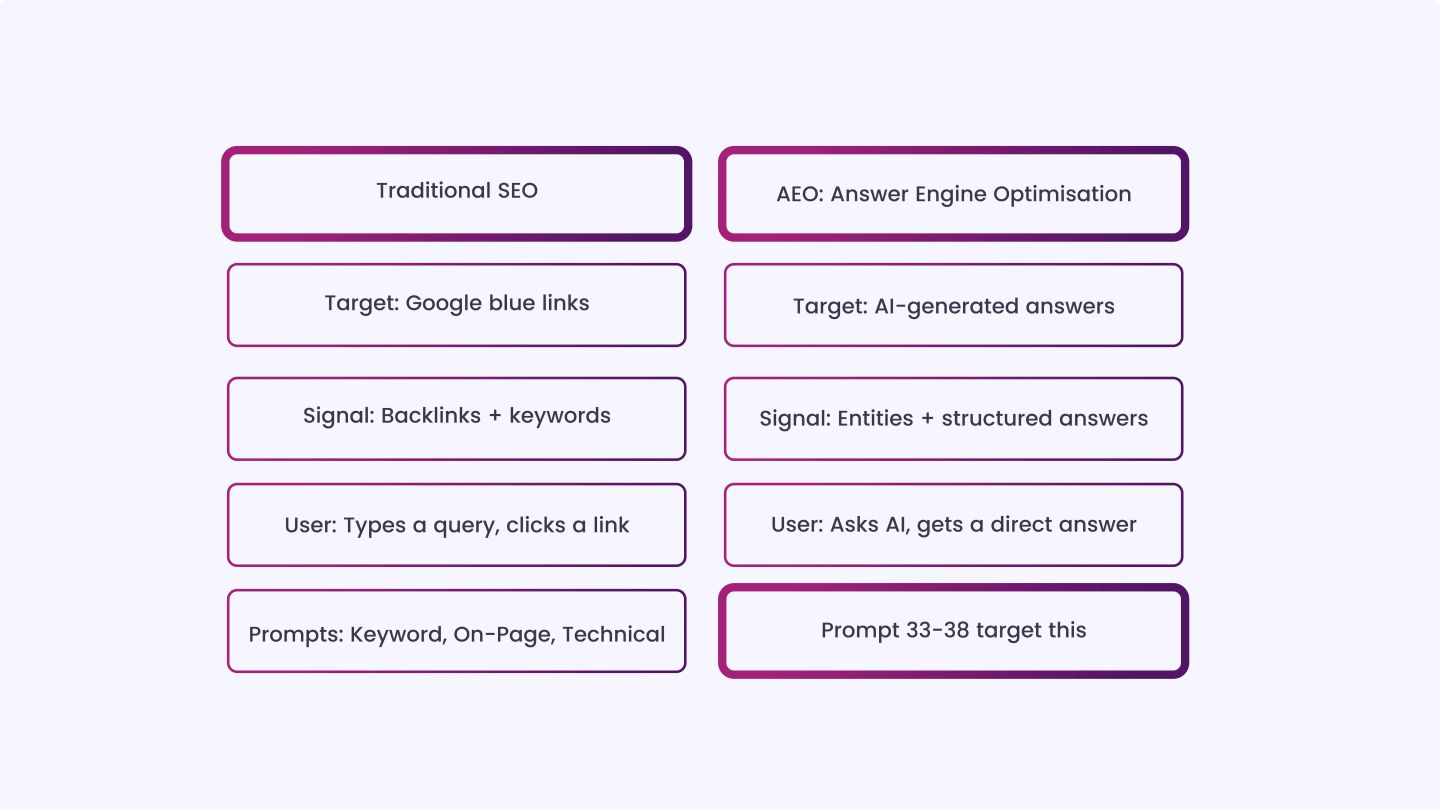
Now, let’s move to optimizing for AI and answer engines. These prompts help you create content that gets directly cited, ranks for featured snippets, and answers the questions your audience is actually asking.
33. Answer-engine-ready paragraph: Rewrite this section of my article [paste section] so it directly answers the question ’[query]’ in 60 words or fewer. Structure it as a direct answer, followed by two supporting sentences. This is for AEO, optimizing to be cited in AI-generated answers.
34. Featured snippet optimization: My page targets the query [keyword]. Rewrite the opening section to be featured-snippet-ready. Use a direct definition, keep it under 50 words, and follow it with a concise supporting paragraph.
35. Entity optimization check: Review this article [paste] and identify the main entities, people, organizations, places, and concepts that should be mentioned to improve semantic relevance for the topic [X]. Suggest where to add them naturally.
36. AEO-focused FAQ set: Generate 10 questions a user might ask an AI assistant about [topic]. For each, write a direct 40-word answer. Format these for an FAQ section optimized for AI citation and featured snippets.
37. Structured data recommendation: I am publishing a [type of content: recipe/how-to/event/product review]. What schema types should I implement? For each, list the required and recommended properties and explain how each helps with AEO visibility.
38. Conversational search optimization: Rewrite this paragraph [paste] so it answers conversational and voice-search queries naturally. Avoid passive constructions. Use the phrasing a person would actually say when asking this question out loud.
Content Refresh Prompts
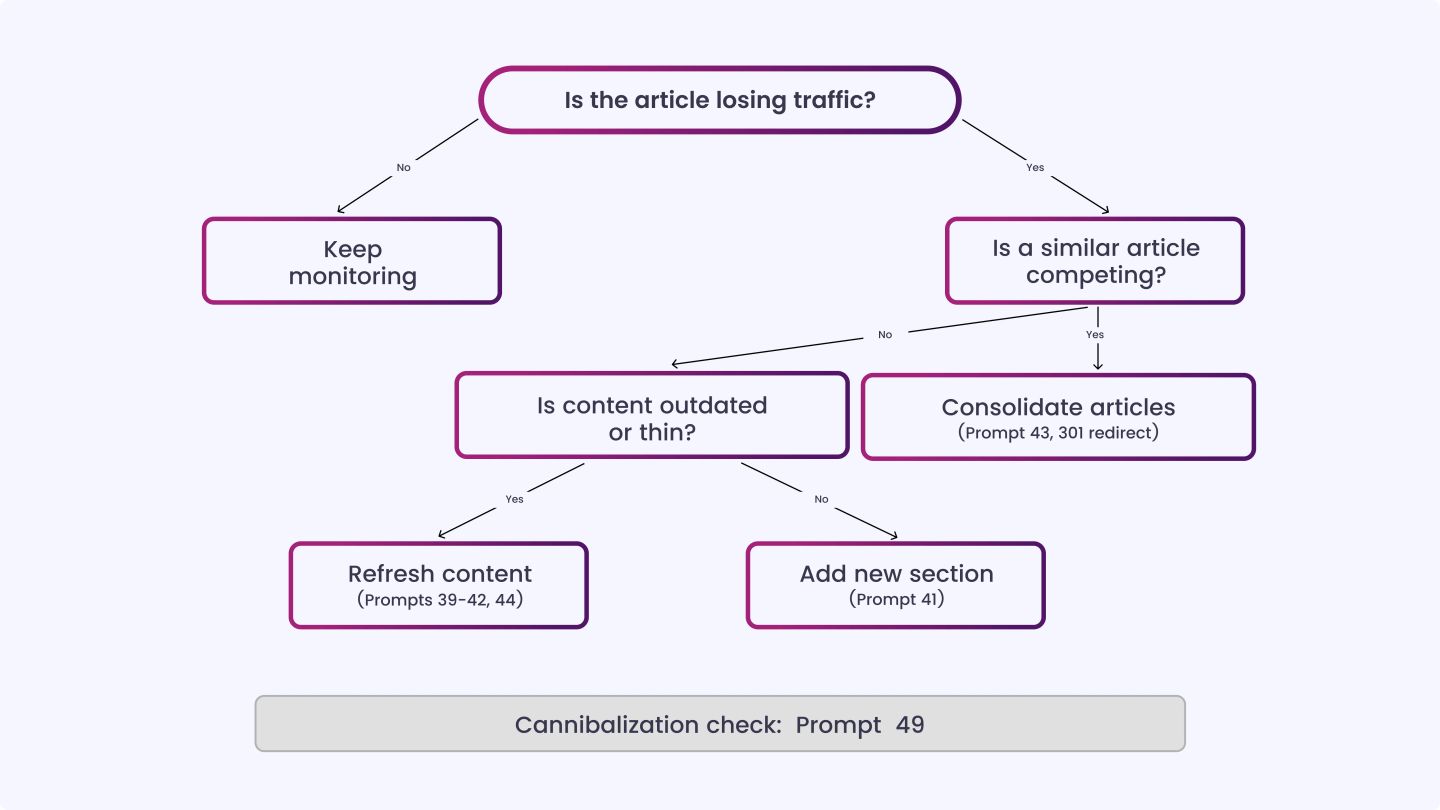
Next, we focus on keeping your content current and complete. These prompts help identify gaps, update outdated sections, and expand shallow content, keeping your pages relevant and useful over time.
39. Content gap audit: Here is my article about [topic] published in [year]: [paste]. List ten specific gaps, missing subtopics, outdated data points, unanswered questions, that a reader in 2026 would notice. Prioritize by importance.
40. Update opening and intro: My article’s introduction [paste] was written in [year]. Rewrite it to feel current in 2026 without changing the core angle. Remove any dated references and add one current context sentence.
41. Add a new section: My article covers [topic] but does not mention [emerging subtopic]. Write a new H2 section of 150 words covering this subtopic in the same tone as the rest of the article. Target the secondary keyword [keyword].
42. Thin content expansion: This section of my article is too shallow: [paste section]. Expand it to 250 words with more specific detail, a practical example, and at least one actionable takeaway. Maintain the same tone.
43. Content consolidation decision: I have two articles on similar topics: Article A [describe] and Article B [describe]. Should I consolidate them or keep them separate? If consolidating, which should be the primary URL, and what content from each should be kept?
44. Meta refresh for old posts: My blog post titled [title] was written in [year] and targets [keyword]. Write a new title tag, meta description, and updated introduction paragraph that reflects the topic in 2026 without changing the URL.
Five Bonus Prompts Worth Using
Finally, these five bonus prompts focus on advanced, practical tasks, analyzing search intent, strengthening authority, preventing content overlap, and summarizing performance, so your SEO efforts deliver clear, actionable results.
45. Programmatic SEO page template: I want to create programmatic SEO pages for [topic + location variable]. Write a scalable page template with placeholder variables for [city], [service], and [data point]. Include H1, intro paragraph, key section headers, and a CTA. Make sure it does not read as templated content.
46. SERP intent analysis: Pretend you are analyzing the Google SERP for the query [keyword]. Based on what typically ranks, guides, product pages, comparison posts, and tools, what is the dominant search intent? What format and angle should I use to compete?
47. E-E-A-T improvement: Review this author bio: [paste bio]. Rewrite it to strengthen E-E-A-T signals, demonstrate experience, credentials, and first-hand expertise, and keep it under 80 words. Write for a human reader, not a crawler.
48. Topical authority gap: My site covers [topic] and has published [X] articles. Based on this list of article titles: [paste], what major subtopics am I missing that would strengthen my topical authority? Prioritize by search opportunity.
49. Keyword cannibalization check: I have these articles targeting similar keywords: [paste titles and target keywords]. Identify which pairs are cannibalizing each other. For each conflict, recommend whether to consolidate, differentiate the angle, or redirect.
50. Monthly SEO reporting summary: Act as an SEO analyst. Here is my traffic data for the past 30 days: [paste data or describe trends]. Write a clear, jargon-free summary for a non-technical client. Highlight what improved, what dropped, and one recommended action for next month.
How to Get Better Output Every Time?
Three things separate a useful ChatGPT SEO output from one you delete immediately:
- Give it a role: Starting with “Act as a senior SEO strategist” or “You are a technical SEO specialist with 10 years of experience” frames the output with the right level of specificity and authority.
- Give it constraints: Open-ended prompts produce open-ended answers. Specify format, length, tone, keyword, and audience. The more specific the brief, the more usable the output.
- Iterate, do not regenerate: If the first output is 80% there, follow up by making the intro more direct or by cutting it to 60 words rather than starting over. ChatGPT responds well to focused edits.
| One final note: always review before publishing. ChatGPT does not know your brand voice, your audience’s reading level, or whether a data point is current. Every output needs a human pass before it goes live. |
Get the Most from ChatGPT SEO Prompts
ChatGPT is a legitimate SEO tool when used properly. These 50 prompts cover the full scope, from the first keyword idea to refreshing content that has lost its ranking.
None of them requires advanced technical knowledge. All of them require you to replace the variables with your actual context.
Start with three or four prompts from the categories that cost you the most time right now. Build a small library of prompts tailored to your niche. Refine them over time. The teams that will get the most out of AI in 2026 are not the ones running the most prompts; they are the ones consistently running the right ones.
Turn Prompts into High-Impact SEO Wins with INSIDEA
Running SEO manually while managing content, rankings, and AEO visibility across a growing site is a heavy lift.
INSIDEA helps digital teams build and execute SEO strategies that produce measurable results, not just traffic reports.
Here is what we help with:
- SEO Strategy and Execution: From keyword research and content planning to on-page optimization and technical audits, built for your niche and your audience.
- AEO and AI Visibility: Structured data implementation, entity optimization, and content structuring to get your brand cited in AI-generated answers.
- Content Production: SEO-optimized, research-backed content that ranks and earns citations across traditional and AI-driven search.
- Monthly Reporting: Clear, actionable reporting that tells you what moved and what to do next, without the noise.

 How INSIDEA works