There are over 135,000 personal injury lawyers in the U.S. All of them want the same thing: more qualified leads and cases that are worth the effort. With so many firms running ads, showing up on billboards, and posting the same things online, getting lost in the crowd is easy. So, how do you make your firm the one people notice?
You need better placement.
That’s where SEO for personal injury lawyers comes in. It’s tangible, measurable, and if done right, it becomes the backbone behind steady, high-intent case inquiries.
Paid ads might get your face in front of people, but SEO puts you in front of people who are already looking.
Clients don’t browse injury law websites for fun. They Google because something happened. A crash. A fall. A loss. And when they do, they trust the firms that appear first and are the easiest to find.
In this blog, I’ll walk you through what works. How to get your firm appropriately listed. How to build a local SEO strategy for law firms that brings real cases. How to use content that speaks to what people are looking for. And what to expect from law firm SEO services if you’re considering hiring help.
Let’s get started.
Importance of SEO for Personal Injury Law Firms
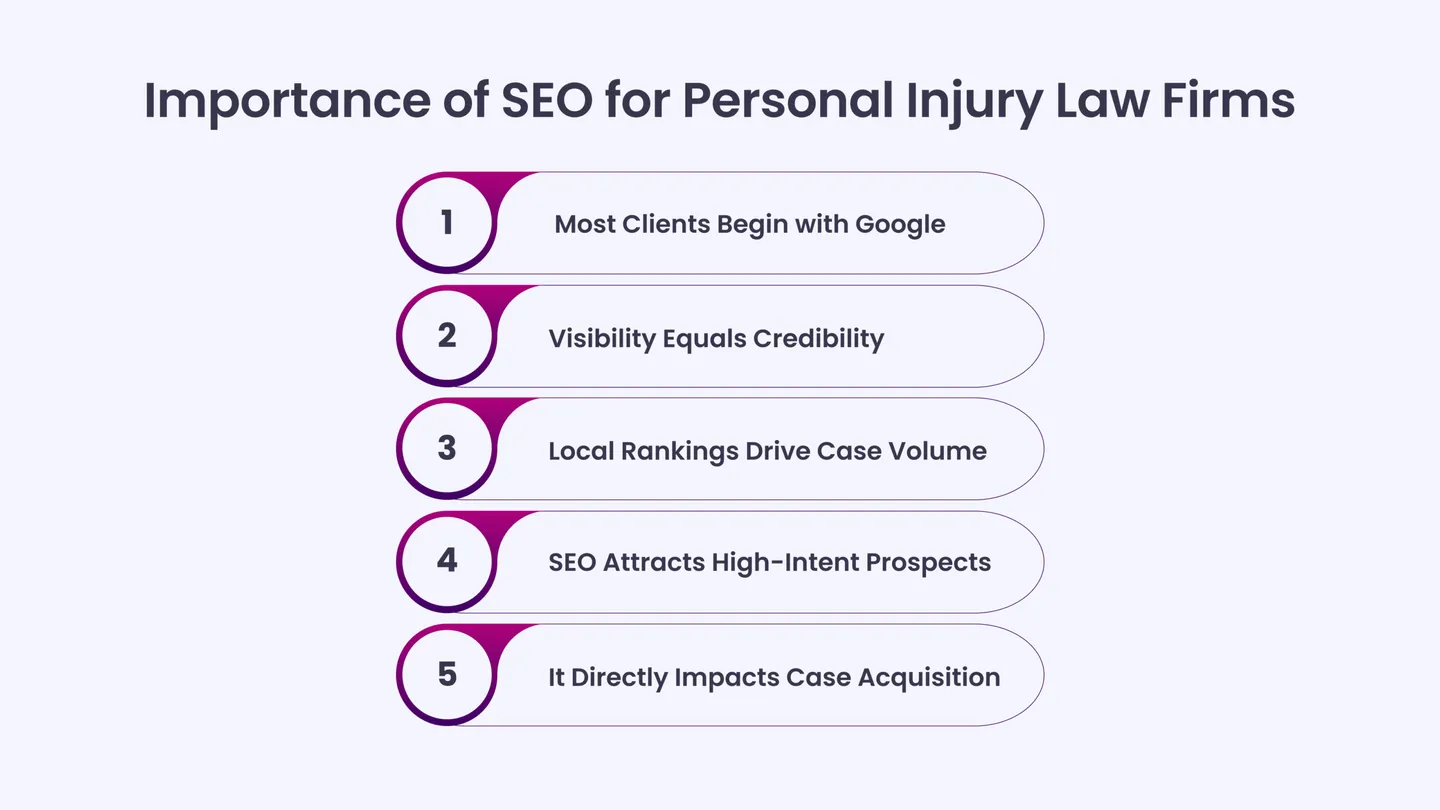
Before anything else, here’s what makes SEO a serious advantage for personal injury firms:
1. Most Clients Begin with Google: After an accident, most people don’t ask around; they search. Queries like “injury lawyer near me” or “car accident attorney in [city]” are the first step. If your firm lacks those results, you’re not of their options.
2. Visibility Equals Credibility: Showing up in top search results builds immediate trust. If your firm is hard to find online, potential clients assume you’re less established, even if that’s false.
3. Local Rankings Drive Case Volume: Injury cases are won or lost on searches with local intent. Ranking in the local pack (Google Maps and nearby listings) is often deciding who gets the call.
4. SEO Attracts High-Intent Prospects: People searching for injury-related terms aren’t browsing casually; they’re looking for help now. SEO helps your firm appear when the need is urgent and the intent is strong.
5. It Directly Impacts Case Acquisition: SEO isn’t about traffic for the sake of it. It’s about being present in the exact moments when someone is ready to hire a lawyer. The firms that invest here consistently capture more and better leads.
SEO for Personal Injury Lawyers: Practical Steps to Get More Qualified Leads
You already know your firm needs to show up when people search for help, that’s not news. The real question is what gets you there. SEO for personal injury lawyers isn’t about checking boxes. It’s about using the right tactics in the right way to show up in front of the right people, especially in a field as competitive as injury law.
SEO generally breaks down into four areas. Each one plays a different role in making your firm visible when it counts:
- On-page SEO: Optimizing the content and structure of your site’s pages so they answer what people are searching for.
- Technical SEO: Making sure your site loads fast, works on all devices, and can be properly crawled by search engines.
- Off-page SEO: Building authority through links, reviews, and other signals outside your website.
- Local SEO: Seeing your firm in local searches, map results, and city-specific queries.
All right, now let’s get into the details.
1. On-Page SEO for Personal Injury Lawyers
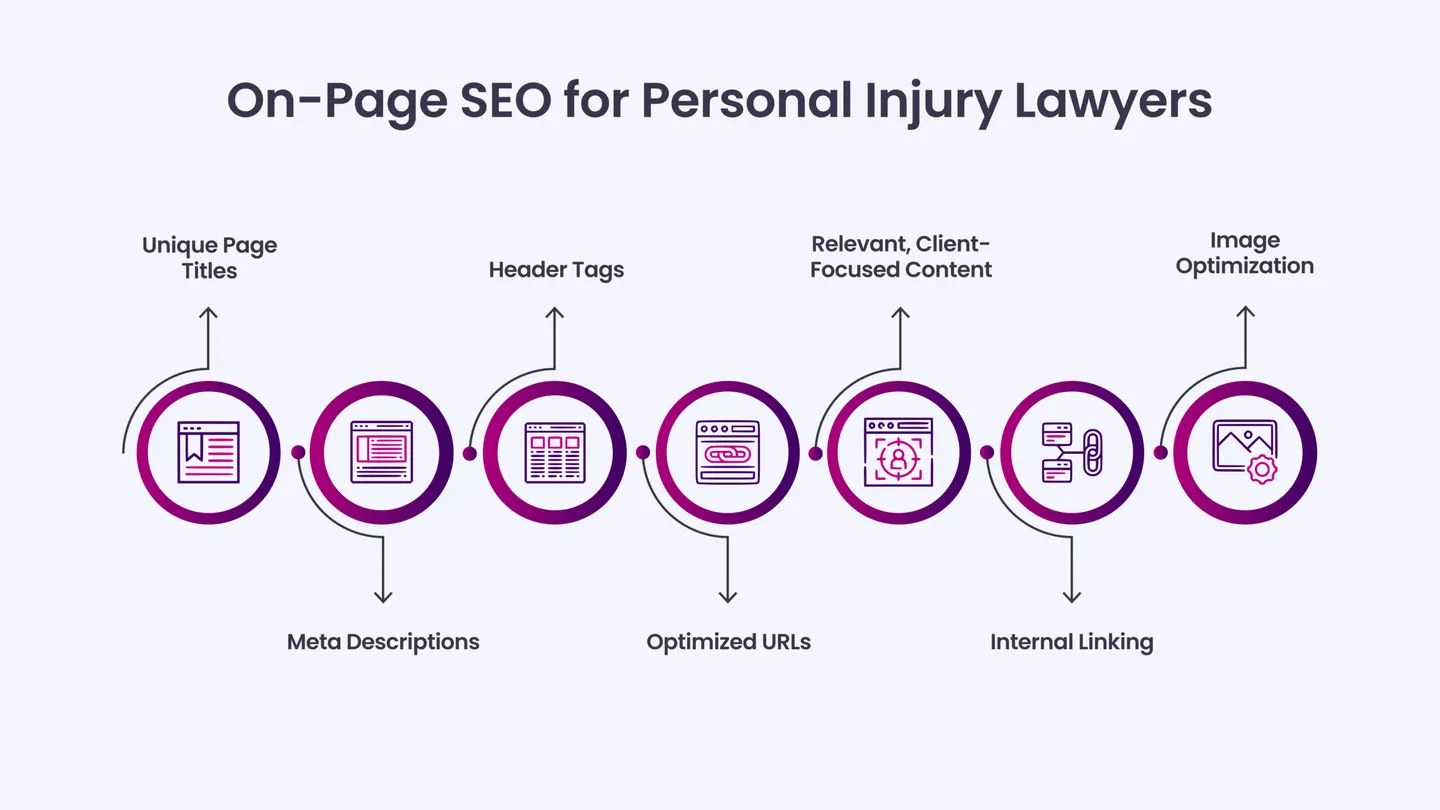
On-page SEO covers your website’s content, layout, and structure. This helps search engines understand what each page is about and helps potential clients find the answers they want.
If your service pages are vague, hard to read, or missing core details, potential clients will click away and call the next firm that looks more trustworthy, clear, and local.
Here’s how to make each page on your site do its job, backed by real examples customized for personal injury practices and part of a strong local SEO strategy for law firms:
Unique Page Titles
Your page titles appear in search results and are one of the first signals Google uses to rank your page. They also shape whether someone clicks or scrolls past.
Examples for law firms:
- Car Accident Lawyer in Miami | Alvarez Legal Group
- Slip and Fall Attorney in Chicago | Free Case Review
- Truck Accident Law Firm - Serving Austin and Nearby Cities
Every page should have a distinct, accurate title reflecting its content. This is foundational to strong SEO for personal injury lawyers.
Meta Descriptions
Meta descriptions don’t directly affect your ranking but can make or break your click-through rate. This is your pitch in short, specific, and client-focused search results.
Examples:
- Injured in a car crash in Dallas? Speak with a top-rated injury lawyer today.
- We handle slip and fall claims in New York, no fee unless we win your case.
- Get legal help for your truck accident injury. Serving Los Angeles and nearby areas.
Write them like headlines. Keep it under 160 characters and aligned with what the page offers. This is where professional law firm SEO services often provide high value, ensuring your listings stand out.
Header Tags (H1, H2, H3)
Headers guide both search engines and real readers through your content. They create structure, improve readability, and help break up heavy topics.
Example for a car accident page:
- H1: Car Accident Lawyer in Atlanta
- H2: What to Do After a Crash
- H2: How We Help Accident Victims
- H3: Medical Bills and Treatment
- H3: Lost Wages and Insurance Claims
There should be only one H1 per page. Use H2s and H3s to break down subtopics and support your broader local SEO strategy for law firms.
Optimized URLs
URLs should be clean, descriptive, and relevant. Skip unnecessary numbers or jargon. Keep it simple and focused.
Examples:
- yourfirm.com/car-accident-lawyer-denver
- yourfirm.com/pedestrian-injury-claims
- yourfirm.com/contact-personal-injury-attorney
Clean URLs are a core part of SEO for personal injury lawyers. They help Google connect your pages to real-world searches.
Relevant, Client-Focused Content
Your content should speak directly to your clients’ concerns, using real language, not legal jargon.
Examples of helpful content:
- How Long Do I Have to File a Claim in Florida?
- What to Do After a Slip and Fall in a Grocery Store
- When Should You Talk to an Insurance Adjuster?
- How Contingency Fees Work in Injury Cases
This is where well-planned law firm SEO services shine, helping you publish content that reflects questions and drives real engagement.
Internal Linking
Internal links help visitors move through your site smoothly, show search engines how your content connects, and keep users engaged longer.
Smart linking examples:
- Link from your homepage to “Motorcycle Accident Lawyer in San Diego”
- Link from a blog post on “Injury Claim Timelines” to your “Free Consultation” page
- Link from “Common Case Types” to your “Medical Malpractice Attorney” page
Internal links strengthen your site’s structure and improve SEO for personal injury lawyers.
Image Optimization
Your images, like photos of attorneys, your office, or visual explainers, must load quickly and tell search engines what they show.
Best practices:
- Use descriptive alt text: Personal injury attorney discussing case with client in NYC
- Compress files to avoid slowing down the page.
- Rename images: car-accident-attorney-houston.jpg” beats “IMG_8439.jpg
This ties directly into usability and performance, essential signals in any solid local SEO strategy for law firms.
2. Technical SEO for Personal Injury Lawyers
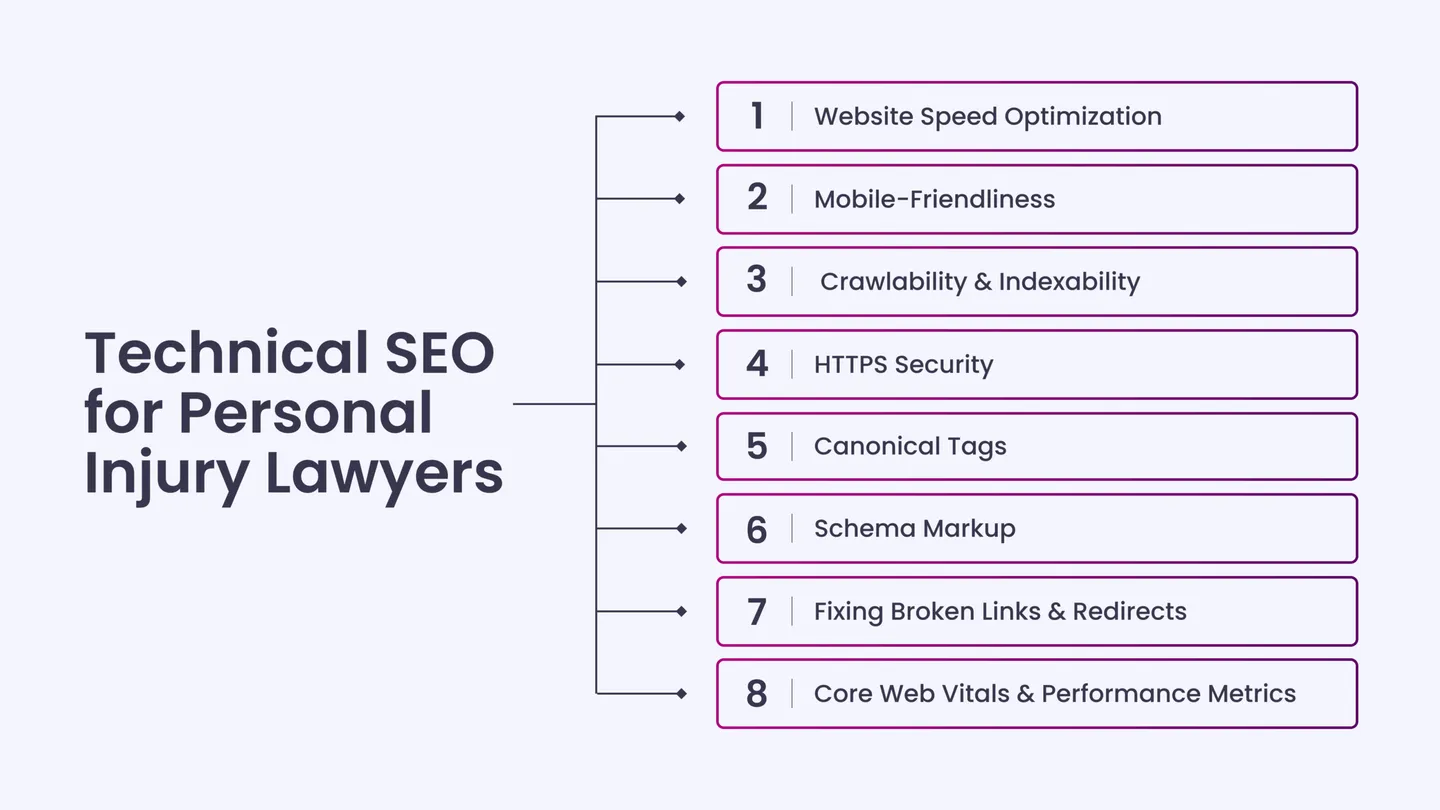
While on-page SEO covers what visitors see and read, technical SEO is about how your website performs, how fast it loads, how cleanly it’s built, and how easily Google can crawl and index your content.
If your site is slow, broken on mobile, or difficult for search engines to understand, you’re losing out, no matter how strong your content may be. Technical SEO, a subset of On-Page SEO, is often the hidden factor behind ranking success, especially in a crowded field like personal injury law.
Here’s where to focus if you’re serious about SEO for personal injury lawyers:
Website Speed Optimization
If your pages take too long to load, people will leave and rarely return. Personal injury sites often have large graphics, videos, or sliders that slow things down. Speed matters for both users and rankings.
Fixes that work:
- Compress images without sacrificing clarity
- Minimize or remove bulky scripts
- Use browser caching and a fast hosting provider
Fast-loading pages help retain potential clients and support stronger SEO for personal injury attorneys.
Mobile-Friendliness
The majority of people searching for legal help do so on their phones. If your site breaks, lags, or feels clunky on mobile, you’re likely to get skipped.
What to check:
- Text must be legible without zooming
- Navigation should be simple, and buttons should be easy to tap
- Contact forms and consultations should work smoothly on smaller screens
Crawlability & Indexability
Search engines won’t rank what they can’t read. Your site structure and settings must allow Google to discover and index the right pages.
Checklist:
- Only block irrelevant sections in your robots.txt file
- Submit a clean, updated XML sitemap
- Make sure priority pages (like case types or contact pages) are indexable
HTTPS Security
A secure website isn’t just a best practice; it’s expected. If your site still runs on HTTP, it sends the wrong signal to users and Google.
What to do:
- Install an SSL certificate
- Redirect all pages from HTTP to HTTPS
- Update internal links to the secure versions
This is a baseline requirement in any modern SEO for personal injury lawyers efforts.
Canonical Tags
It can confuse search engines if you have similar or duplicate content, say, multiple pages explaining types of injuries. Canonical tags tell Google which version to prioritize.
Examples for law firms:
- “Back Injury Claims” page appears under both “Workplace Injuries” and “Vehicle Accidents”
- Similar city landing pages with nearly identical wording
Schema Markup
Schema helps Google understand your site, improving how your pages appear in search. This is a direct boost to visibility, especially for local intent.
Where to use it:
- Local Business Schema: reinforces your address, hours, and contact details
- Review Schema: highlights testimonials and client ratings
- FAQ Schema: allows key legal questions to show up directly in search results
This ties directly into your broader local SEO strategy for law firms and makes your content easier to trust at a glance.
Fixing Broken Links & Redirects
Nothing tanks credibility like a broken page. It’s also a red flag for search engines.
Fixes:
- Regularly scan for 404 errors
- Use 301 redirects when changing page URLs
- Make sure internal links stay up to date
Core Web Vitals & Performance Metrics
Google tracks how users experience your site. These real-world signals affect your ranking and directly reflect how usable your site feels.
Metrics to monitor:
- LCP (Largest Contentful Paint): How fast your main content loads
- FID (First Input Delay): How soon people can interact with your site
- CLS (Cumulative Layout Shift): whether things move around as the page loads
Improving these metrics strengthens your overall SEO for personal injury lawyers, especially on high-traffic pages like case types or consultations.
3. Off-Page SEO for Personal Injury Lawyers
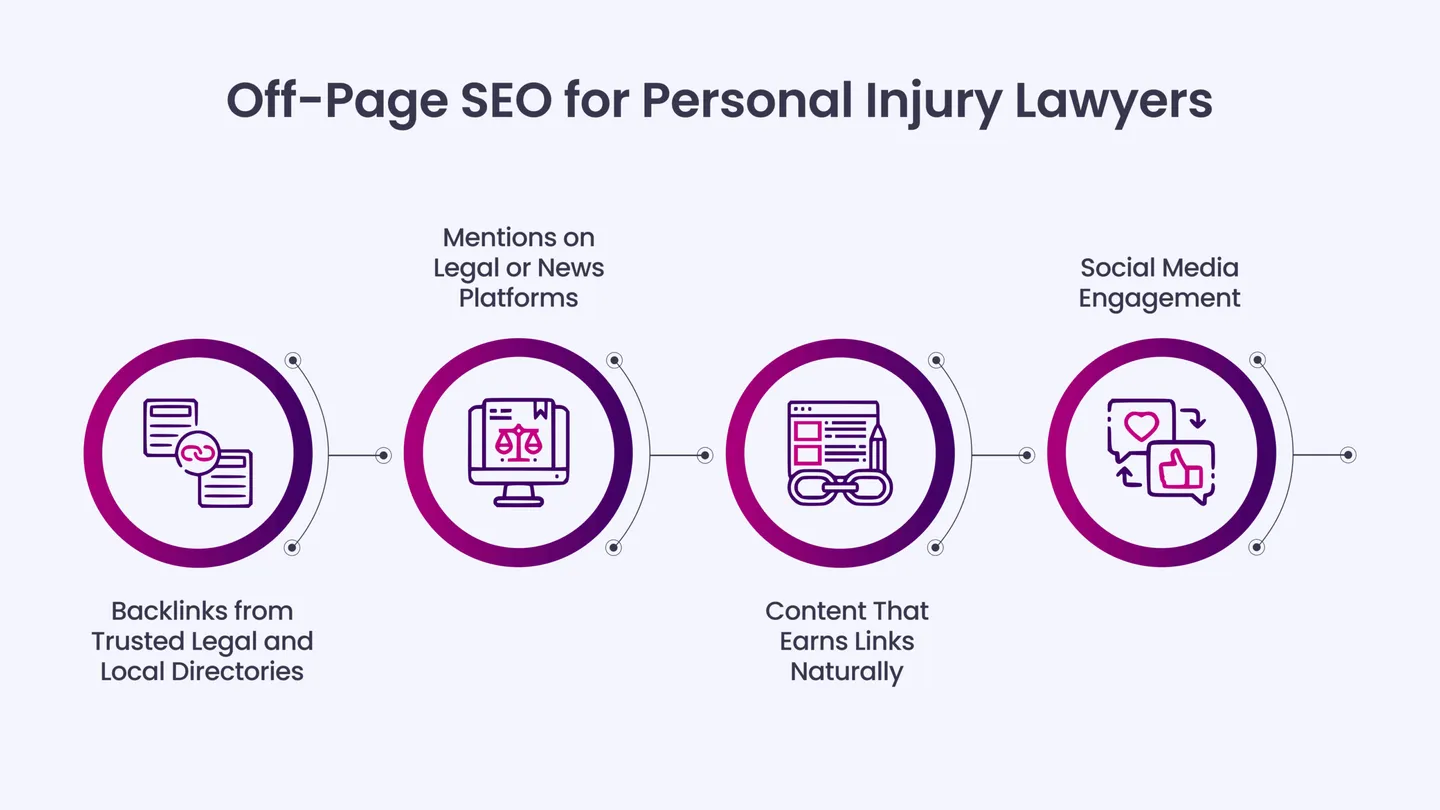
Off-page SEO is everything that happens outside your website but still impacts your ability to rank. It’s about being mentioned, linked, and recognized by other trusted sources. The more credible signals you earn from outside your domain, the more authority your firm builds in Google’s eyes, and the more clients find you.
Here’s where to focus your efforts as part of a strong SEO for personal injury lawyers plan:
Backlinks from Trusted Legal and Local Directories
Start with the essentials. Make sure your firm is listed on trusted directories that Google recognizes. These citations help confirm your legitimacy, location, and specialization.
Directories to prioritize:
- Avvo
- Justia
- FindLaw
- Yelp
- Better Business Bureau (BBB)
- Your local Chamber of Commerce website
Keep your name, address, and phone number (NAP) consistent across all listings. This small detail has a big impact, especially on your local SEO strategy for law firms.
Mentions on Legal or News Platforms
Getting your firm featured or quoted on respected sites helps build domain authority. Whether it’s a local legal news story, a guest article, or a mention on a bar association site, these third-party validations boost trust.
Where to look for mentions or features:
- Legal blogs and bar association newsletters
- Local news outlets (e.g., [Your City] Daily Legal News)
- Community legal resource sites
- Interviews or Q&A features on podcasts or webinars
These are powerful ways to strengthen your SEO for personal injury attorneys, even if the coverage doesn’t always include a backlink.
Content That Earns Links Naturally
When you publish helpful, accurate legal content, other sites and blogs are more likely to reference it. This kind of link-building grows over time with applicable, well-structured content.
Examples of content that attracts links:
- Steps to Take After a Car Accident in [Your City]
- How Injury Settlements Work in [State]
- What to Do If You’re Injured on Public Property
- How to Document a Slip and Fall Accident
Social Media Engagement & Brand Mentions
While social signals don’t directly boost rankings, active engagement helps expand your digital footprint. Even without direct links, brand mentions still show Google that your firm is being discussed and recognized.
Places to stay active:
- Facebook and Instagram: Share case wins, safety tips, and community involvement
- LinkedIn: Post firm updates, legal insights, or attorney thought leadership
- Local Facebook groups or Reddit threads discussing legal services.
When people mention your firm in local forums, event listings, or community blogs, those mentions support your local SEO strategy for law firms, even if there’s no direct link.
4. Local SEO for Personal Injury Lawyers
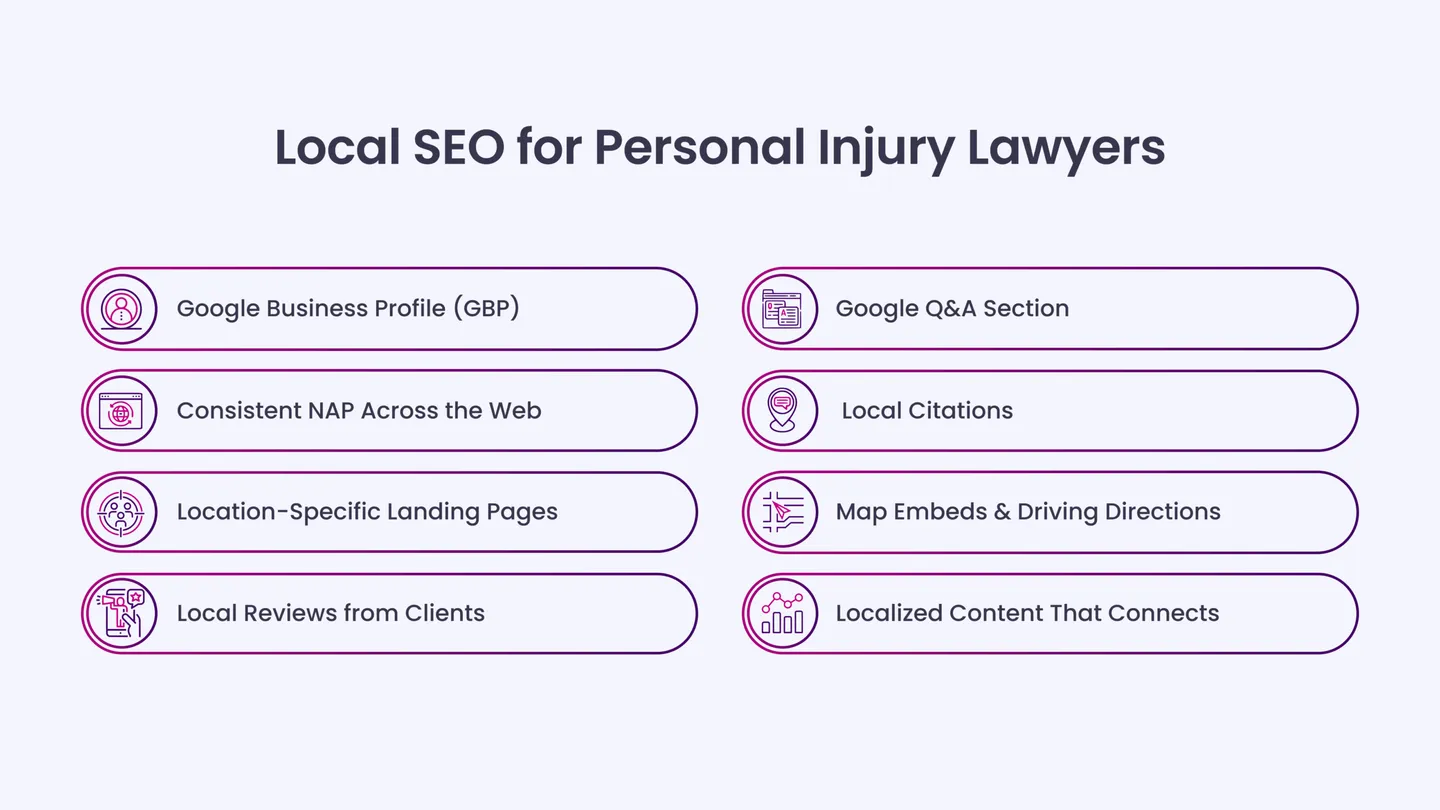
When someone searches “injury lawyer near me” or “car accident attorney in [city],” it’s local SEO that determines if your firm shows up in that high-visibility map pack. These listings appear above regular search results, where most people click first.
You want your firm to show up where your clients are: in local search results, on maps, and in their neighborhoods. Here’s how to make that happen:
Google Business Profile (GBP)
Your Google Business Profile is one of the most essential elements in any local SEO strategy for law firms. This listing appears with your name, address, hours, photos, reviews, and more, sometimes before your website.
What to include:
- Exact firm name (no extras or slogans)
- Current address and phone number
- Updated business hours
- Photos of your office and legal team
- Description of your services (e.g., Car Accident Attorney Serving Detroit)
- Client reviews and answers to FAQs
A well-maintained GBP builds credibility fast and supports visibility for SEO for personal injury lawyers, especially for high-intent local searches.
Consistent NAP Across the Web
NAP = Name, Address, Phone Number. These details must be identical everywhere your firm is listed online, including your website, directories, and social profiles. Even minor inconsistencies (like “Ste.” vs “Suite”) can confuse search engines.
Where to check:
- Your firm’s website
- Google Business Profile
- Yelp, Avvo, Justia, Facebook, and legal directories
Consistency here builds trust with Google and is a quiet but critical factor in successful SEO for personal injury lawyers.
Location-Specific Landing Pages
If your firm serves multiple cities or neighborhoods, don’t put them all on one general page. Create dedicated service pages for each area, with content written for those readers.
Examples:
- Car Accident Lawyer in Sacramento, CA
- Slip and Fall Attorney - Serving Camden, NJ
- Injury Claims in Downtown Phoenix
Local Reviews from Clients
Online reviews matter, for people and Google. Clients discussing your service, results, and location help build trust and relevance.
Best practices:
- Ask satisfied clients to leave reviews on Google, Avvo, or Facebook
- Encourage them to mention location and case type: My attorney helped me settle my rear-end collision case in Baltimore, highly recommend.
- Respond to reviews regularly to show engagement
Quality reviews across trusted platforms reinforce your firm’s credibility and are often prioritized in law firm SEO services packages.
Google Q&A Section
Your GBP listing includes a Q&A section that is visible to anyone searching for your firm. This section is often overlooked, but it allows you to control what potential clients see.
Common questions to pre-answer:
- Do you offer free consultations?
- How quickly can I speak to a lawyer after an accident?
- Do I pay anything upfront for personal injury cases?”
Local Citations
Citations are mentions of your firm on third-party directories and websites. They validate your location and practice area, supporting your local authority.
Where to get listed:
- Avvo
- Justia
- Yelp
- Super Lawyers
- Local legal directories and Chamber of Commerce websites
These citations help Google confirm who you are and where you serve, reinforcing your SEO for personal injury attorneys presence.
Map Embeds & Driving Directions
Add a Google Map to your website (usually on your Contact page) to help users and search engines understand your physical location.
Include:
- Embedded Google Map with your pinned location
- Driving directions from key highways or city landmarks
- Parking details or building entry instructions
Simple details like these support local visibility and improve your UX, an indirect boost to SEO for personal injury lawyers.
Localized Content That Connects
Your blog and service pages should show that your firm is active and knowledgeable about your local area. This helps clients feel seen and helps search engines place your firm where it belongs.
Content ideas:
- What to Do After a Car Accident in Houston
- Top 3 Dangerous Intersections in Fort Lauderdale
- How Slip and Fall Claims Work in Downtown San Diego
This content builds relevance and local trust, two critical signals in any high-performing local SEO strategy for law firms.
You Handle the Cases. Let SEO Experts Handle the Search.
Running a personal injury law firm is already more than a full-time job. You’re meeting with clients, negotiating with insurance companies, managing your caseload, prepping for trial, and keeping your team moving. Add SEO to your plate, optimize pages, track rankings, and clean up technical issues, and there’s no bandwidth left to practice law.
Meanwhile, your competitors appear in search results, not because they’re better lawyers, but because they’ve prioritized SEO. That’s where seo for personal injury lawyers makes all the difference, it helps the right firms get found at the right time.
So here’s the decision:
Spend your off-hours learning SEO, writing content, and managing your site’s visibility.
Or let SEO and marketing experts handle it so that you can stay focused on your clients, cases, and results. With dedicated support in seo for personal injury lawyers, your firm can grow while you concentrate on what you do best.
INSIDEA
Ready to put this into practice?
INSIDEA is an Elite HubSpot Partner rated 4.99 across 500+ verified reviews. Let's map it to your goals.



 How INSIDEA works