76% of people who conduct a local search on their phone visit a related business within a day. For a cafe, that figure directly affects daily revenue. The customer who searches for “cafe near me” at 8:47 AM is not browsing; they have somewhere to be and want coffee now. Whether your cafe appears in that result and how it appears are marketing decisions.
Digital marketing for cafes does not require a large budget or a dedicated team. It requires clarity on which channels work best for local food businesses, how customers find and choose a cafe, and what keeps them coming back.
This blog explains the complete digital marketing approach for cafes, from local search and social content to review strategy, direct channels, and paid advertising.
Marketing for cafes
Rather have this done for you?
Book a 30-minute call with INSIDEA. We look at how customers find you today and send a proposal within 48 hours if we are a fit.
Book a strategy callDigital Marketing Strategy for Cafes That Drives Footfall and Orders
To put this into practice, follow the steps below:
1. Google Business Profile: The Foundation of Local Visibility
Before most customers decide to visit a cafe, they look it up. A Google Business Profile controls what they find, in local search results, on Google Maps, and in the knowledge panel that appears when someone searches your cafe by name. It is free, and for a local food business, it is more valuable than most paid tools.
A complete, accurate, and actively managed profile performs significantly better than a basic listing. The areas that matter most:
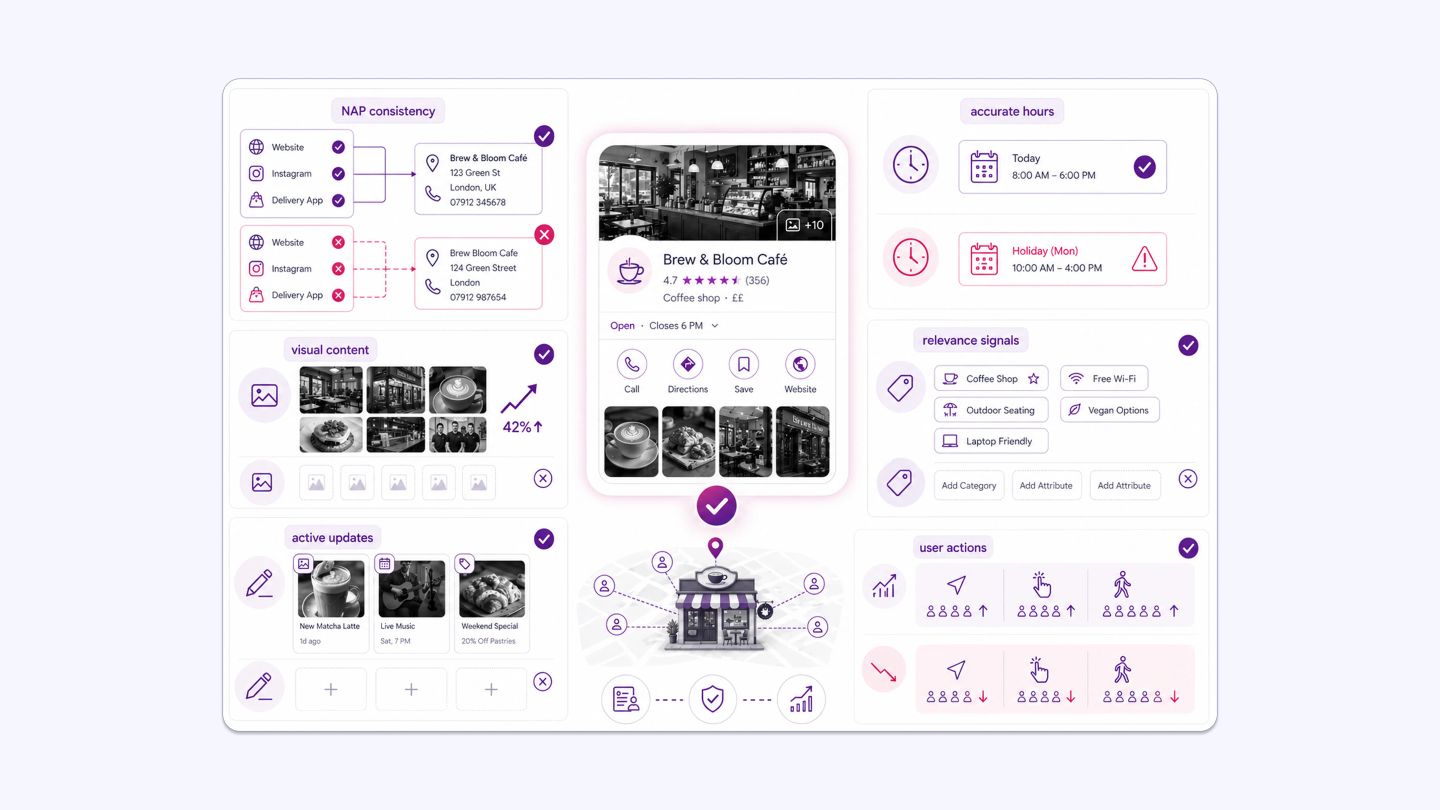
- Business name, address, and phone number: These must be identical across your website, social media bios, and any delivery platforms. Inconsistency reduces local search ranking.
- Opening hours: Keep these current, including public holidays and seasonal changes. Incorrect hours produce negative reviews and lost visits.
- Photos: Google data shows that listings with photos receive 42% more requests for directions than those without. Post at least ten interior, exterior, signature drinks, food items, the counter, and the team.
- Category and attributes: Set the primary category to “Coffee Shop.” Add relevant attributes, such as outdoor seating, free Wi-Fi, vegan options, or laptop-friendliness.
- Google Posts: A short weekly post, a new seasonal drink, a weekend special, and an upcoming event appear directly in your listing, signaling to Google that the profile is actively maintained.
Reviews are the second side of local search performance. A cafe with 200 reviews and a 4.5-star average will consistently rank above one with 30 reviews and a 4.9. Volume and recency both factor into Google’s ranking of local results.
Ask customers to leave a review at the counter, via a QR code on the table, or on printed receipts. Respond to every review, positive and negative. A measured, helpful reply to a complaint shows prospective customers how you handle problems, and that is often more persuasive than the complaint were damaging.
2. Social Media: Which Platforms Work for Cafes and Why
Not every social platform is suitable for a cafe. The three worth investing in are Instagram, TikTok, and, to a lesser extent, Facebook, each for different reasons.
Instagram remains the primary visual discovery platform for food and drink. Latte art, seasonal specials, and well-lit interior shots perform consistently well. Reels generate significantly more reach than static posts because Instagram distributes short video content to non-followers. Three to four posts per week is a sustainable and effective frequency for most independent cafes.
TikTok surfaces content to people who have never heard of your account. A single video, a barista making a pour-over, a morning prep sequence, or the reveal of a new menu item, can reach tens of thousands of people in your city at no cost.
Authenticity works better than production quality on this platform. A short clip filmed on a phone, with ambient sound and no script, typically outperforms polished promotional content.
Facebook has limited organic reach for business pages now, but it remains useful for community groups, events, and audiences skewing slightly older. If your cafe runs events, quiz nights, or live music, Facebook Events still drives meaningful RSVPs in most local markets.
Across all platforms, the content that converts has three qualities: it clearly shows the product, it conveys the space’s atmosphere, and it features the people who run the cafe. Customers choose an independent cafe partly for the coffee and partly for the environment and the staff. Content that reflects both performs better than purely promotional posts.
3. Direct Channels: Email and WhatsApp Lists
Social media algorithms change. A platform that delivered strong organic reach in 2022 may deliver a fraction of that in 2025. Cafes that depend entirely on Instagram or TikTok have no fallback when reach drops. An email list or WhatsApp broadcast channel is a direct line to your customers, one that no platform owns and no algorithm controls.
A digital loyalty program is the most natural way to build this list. Customers sign up with their email or phone number to earn points or receive a free drink after ten visits. The sign-up creates a permission-based contact, and from there:
- Send a short monthly email with new menu items, seasonal changes, or a brief story about the cafe, a new supplier, a staff milestone, or an upcoming change to the space.
- Use WhatsApp Broadcast (not group chats) for time-sensitive offers, a flash special on a slow Tuesday afternoon, or early access to a new menu.
- Keep frequency low. One to two messages per month is enough. Higher frequency increases unsubscribes without a proportional increase in visits.
Free tools like Mailchimp (up to 500 contacts), Brevo, or a basic Typeform linked to a Google Sheet are sufficient to get started. The goal at this stage is to build the list, not invest in sophisticated software.
4. Reviews and User-Generated Content
When a customer posts a photo of your latte and tags your cafe, that image reaches their followers, people who already trust them. This is user-generated content, and it is consistently more credible to a new customer than anything the cafe posts about itself.
Cafes that generate UGC consistently without making it feel forced see a compounding return over time. Practical approaches:
- Create something visually distinct, a signature drink, an unusual food presentation, or seasonal artwork on cups that customers want to photograph.
- Include your Instagram handle on packaging, cups, and receipts.
- Place a small, unobtrusive sign near the cafe’s photogenic areas: “Tag us @yourcafe.”
- Repost tagged content to your own feed with credit. It fills your content calendar and signals to other customers that tagging you pays off.
Google, Tripadvisor, and Yelp reviews function similarly; they are public trust signals that influence every potential customer who finds your cafe through search. A steady flow of new reviews matters more than maintaining a perfect score.
Aim for at least four to six new Google reviews per month, and ensure no month goes without a response to existing ones.
5. Website Essentials for a Cafe
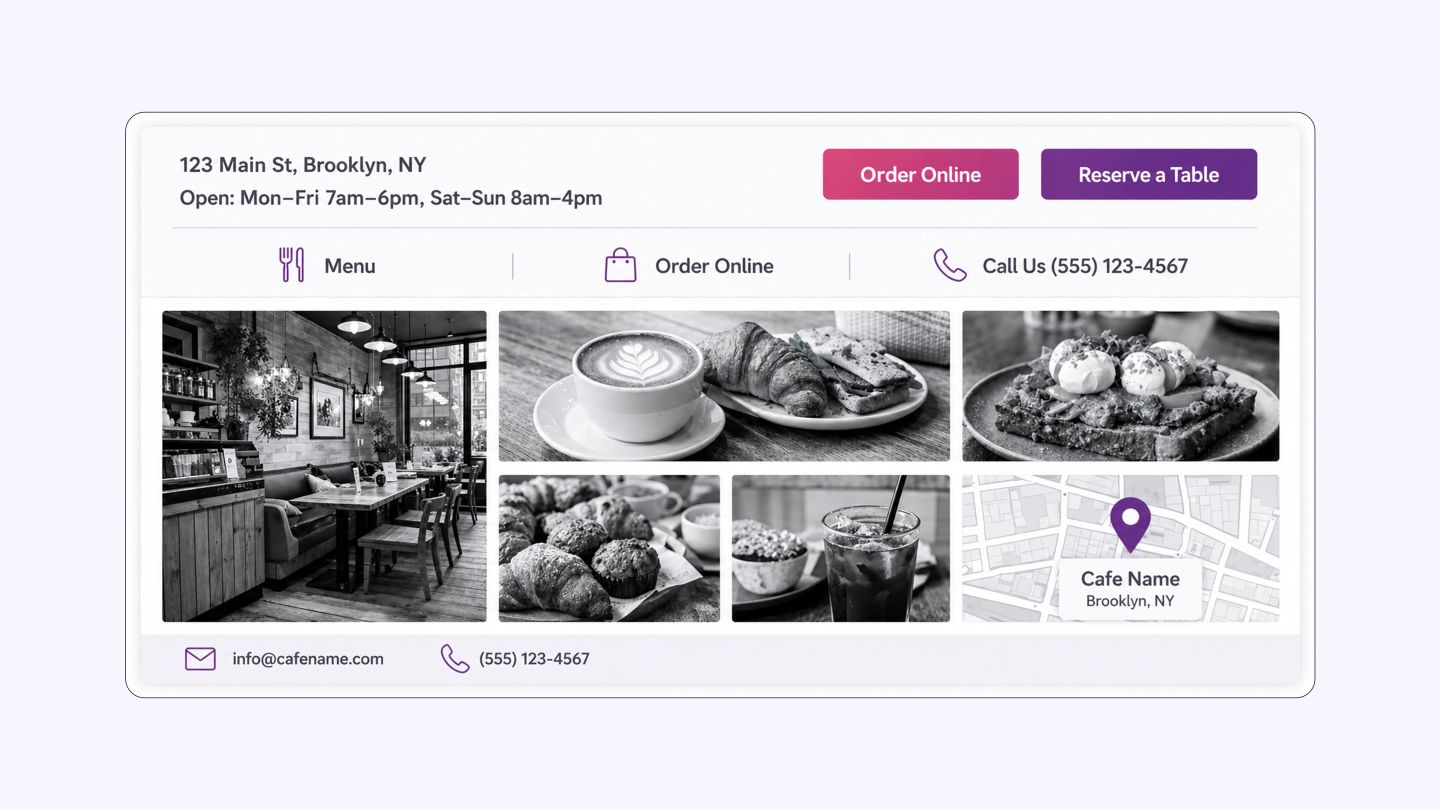
A cafe does not need a complex website. It needs a fast, mobile-friendly page that answers the questions a potential visitor will have before they decide to come: Where are you? What are your hours? What do you serve? Can I order online or book a table?
A minimal but effective cafe website includes:
- Menu: Current, with prices. A PDF is acceptable, but a text-based web page is indexed by Google and performs better in search.
- Location and hours: Visible without scrolling on a mobile screen.
- Photos: Five to eight images showing the space, drinks, and food.
- Online ordering link or delivery platform link: If you use Uber Eats, Deliveroo, or a local aggregator, link to it directly from the homepage.
- Contact: Phone number, email, and an embedded Google Map.
For local SEO, the highest-impact actions are: embedding a Google Map on the contact or location page, including your city and neighborhood name naturally in page content, and ensuring your business name, address, and phone number appear exactly as they do on your Google Business Profile.
This consistency, referred to as NAP consistency, is a confirmed factor in local search rankings.
Page speed matters on mobile. A site that takes more than three seconds to load loses a significant portion of visitors before they see anything.
WordPress with a lightweight theme, Squarespace, or Wix are all adequate platforms for a cafe website. The platform matters far less than accurate, fast, and up-to-date content.
6. When to Use Paid Advertising
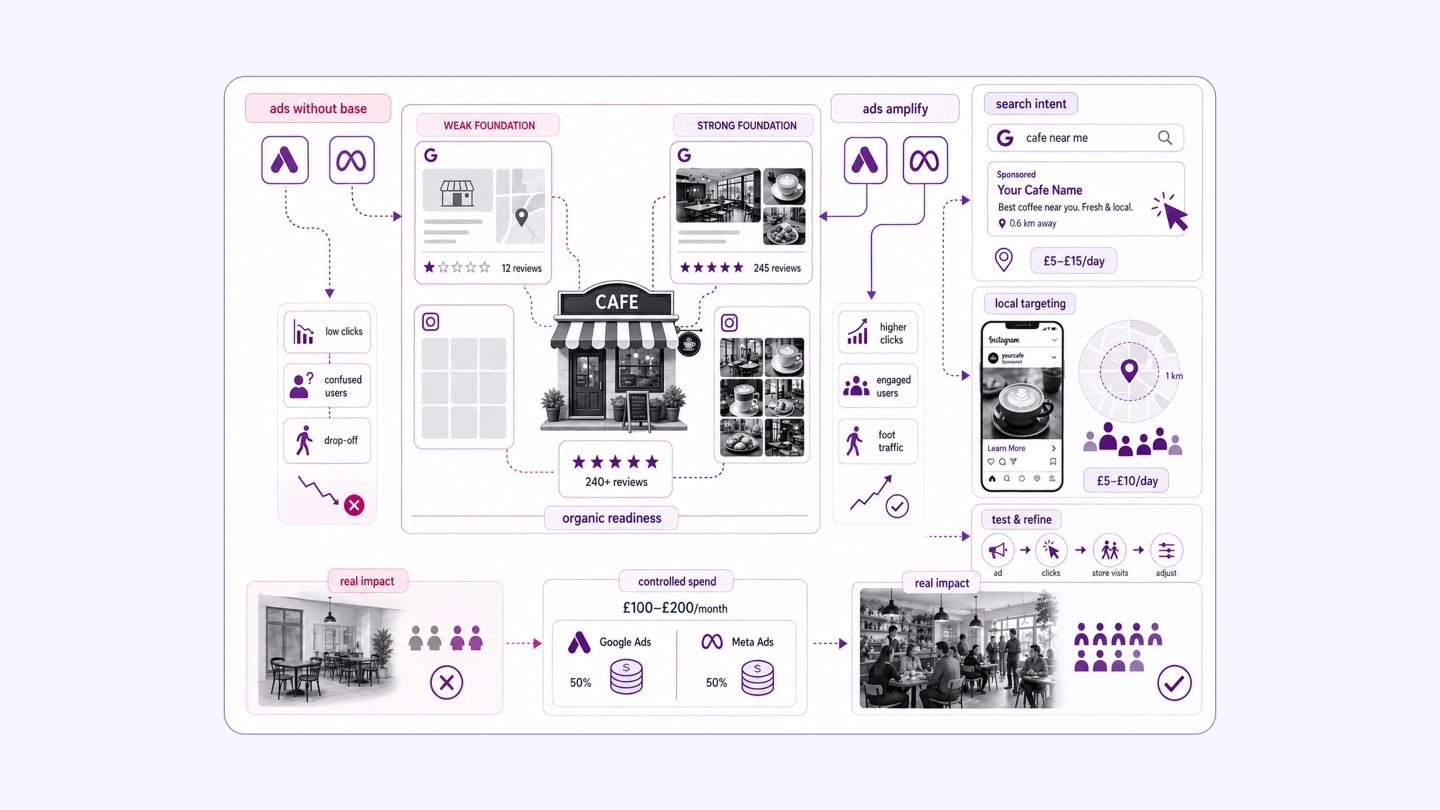
Paid advertising amplifies what already exists. Running ads to a Google listing with no photos and twelve reviews, or to an Instagram account with no content, produces poor results at real cost. The organic foundations, a complete Google profile, consistent social presence, and a solid bank of reviews should be in place first.
Once those are established, two paid channels are practical for cafes:
Google Search Ads appear when someone searches for a cafe in your area: They work on a pay-per-click model; you only pay when someone clicks. A daily budget of £5-£15 targeted to your postcode or neighborhood can drive meaningful results for a local business without requiring large spend.
Instagram and Facebook Ads allow precise geographic targeting: You can show ads to people within one kilometer of your cafe who meet specific interest or demographic criteria. Promoting a new seasonal menu or a weekend event to a tight local radius is cost-effective on a small scale. Start with a £5-£10 daily budget, run for one week, and measure clicks and any observable increase in foot traffic before increasing spend.
For most independent cafes, a monthly ad budget of £100-£200, split between Google and Meta, is enough to generate data and test what works. The objective is precision, not volume, reaching the right people in a specific area at the right moment.
7. Track and Measure Results Consistently
Digital marketing without measurement produces the same results as no marketing, just with more effort. A monthly review of a small set of metrics is enough to know what is working and what is not.
The metrics that matter for a cafe:
- Google Business Insights: How many people searched for you, how many clicked for directions, how many clicked to call. Available free in the Google Business dashboard.
- Instagram reach and profile visits: Reach shows unique accounts that saw your content. Profile visits indicate intent: people check your location and hours before deciding to come.
- Review count and average score: Track monthly. If the count is flat, the review request process needs attention.
- Email open rate: The food and beverage industry average sits around 20-25%. Below that, subject lines or sending frequency need adjustment.
- Foot traffic correlation: Note any spikes in visits after a specific post, offer, or ad. Over several months, a clear pattern emerges about which content types and channels actually drive people through the door.
Set aside 30 minutes at the end of each month to review these. That is sufficient to identify what to continue, adjust, and stop.
The Real Foundation of Cafe Growth
The cafes that stay consistently full are not the ones with the biggest marketing budgets. They are the ones that appear accurately and visibly where customers are already looking, on Google Maps, in local search results, and in the social feeds of people in their neighborhood.
A complete Google Business Profile, a steady flow of reviews, social content that shows the product and the space, and a direct channel to loyal customers through email or WhatsApp, these four things, done consistently, will outperform most paid campaigns run without that foundation.
Paid advertising has a clear role once the organic base is solid, but it is a multiplier, not a substitute. Start with what is free, measure what it delivers, and build from there.
INSIDEA
Ready to put this into practice?
INSIDEA is an Elite HubSpot Partner rated 4.99 across 500+ verified reviews. Let's map it to your goals.



 How INSIDEA works