

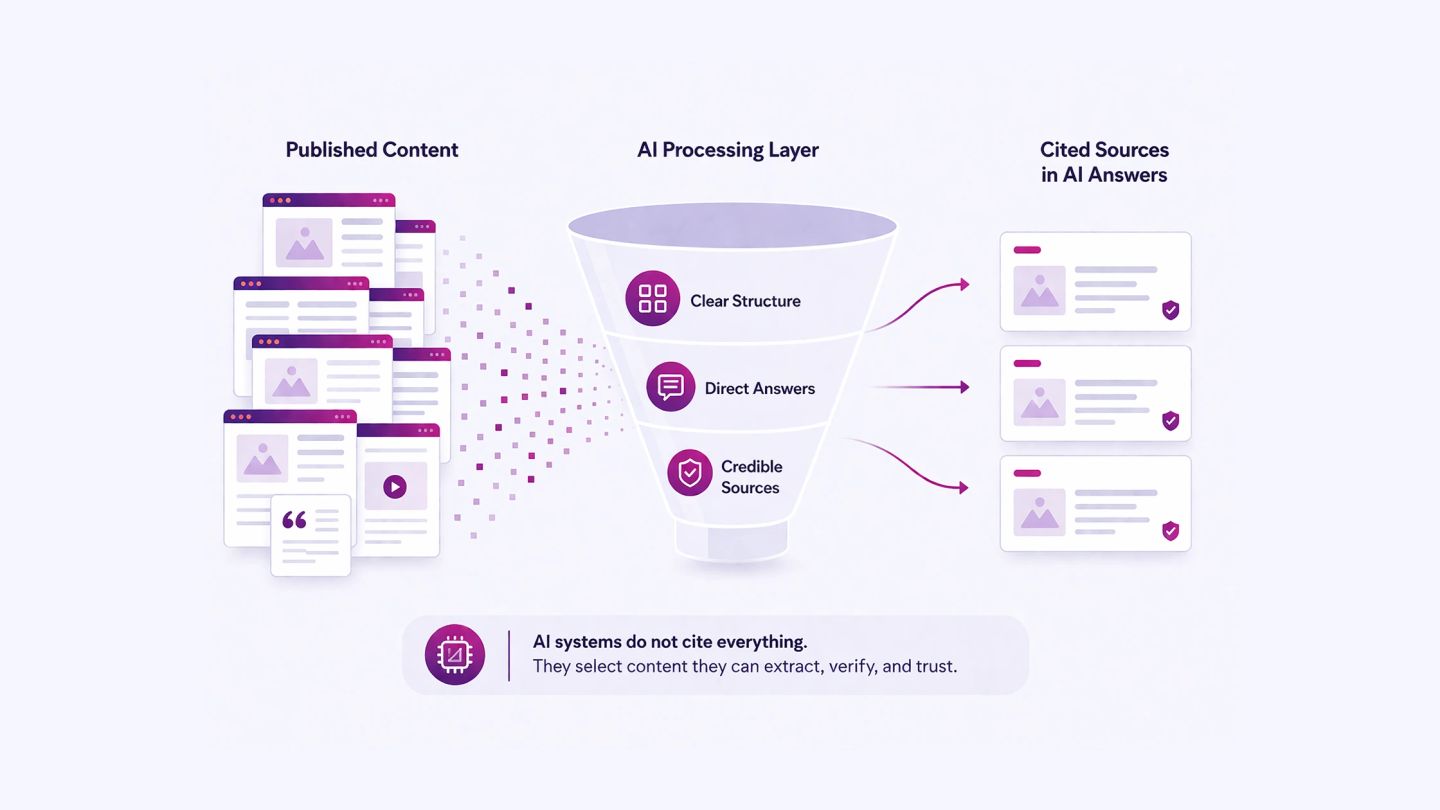
You can publish a well-written article, answer the right question, and still never see it appear in AI-generated answers.
Open ChatGPT, Perplexity AI, or Google AI Overviews and run a few queries. The same types of sources consistently appear, while many others, often just as good, never get referenced at all.
That difference seldom comes down to effort or even quality alone. It comes down to how clearly the content answers the question, how it is structured, and how easy it is for AI systems to extract and validate.
AI citation is not incidental. It follows patterns.
This blog explains those patterns and shows how to structure and write content so AI systems can actually use it and cite it.
How AI Systems Interpret and Select Content?
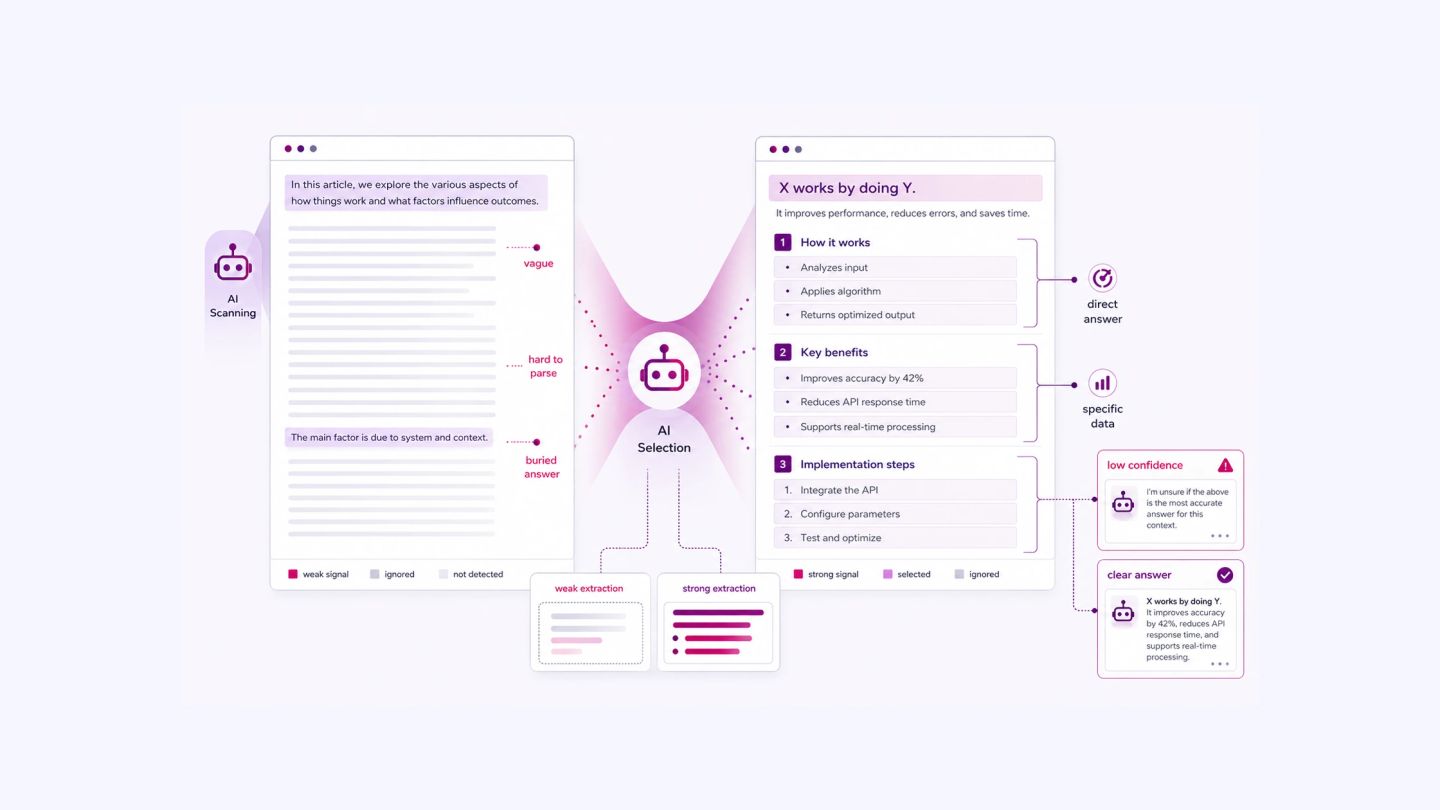
LLMs do not read content the way humans do. They parse it for patterns:
question-and-answer alignment, factual density, and structural clarity. When generating a response, a model looks for content that most directly matches the user’s query intent.
Three things increase the chance your content gets cited:
- Directness: The answer to the implied question appears at the top, not buried in paragraph five.
- Specificity: Concrete numbers, defined terms, and named entities outperform vague claims.
- Structure: Headings, bullet points, numbered lists, and short paragraphs are easier to extract than long prose blocks.
A blog that opens with “In this article, we explore…” signals delay. However, a blog that opens with “X works by doing Y” signals an answer. AI models consistently favor the second format.
How to Structure the Answer-First Format?
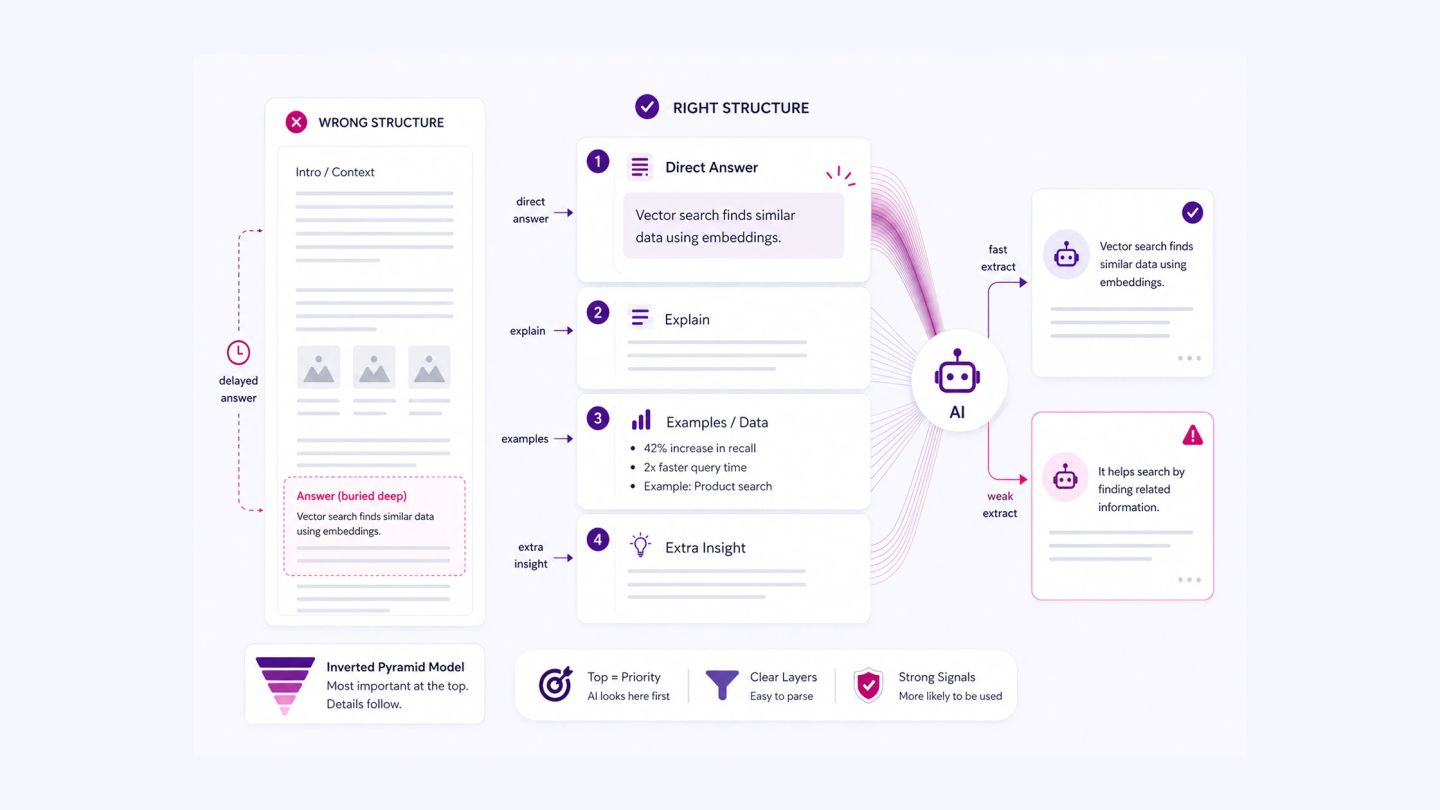
Answer-first content puts the core response before the explanation. This mirrors how search intent actually works. A user who asks “what is vector search?” wants the definition first, then the context.
Practical structure for answer-first content:
- Lead with a one or two-sentence direct answer at the top of each section. This is what LLMs extract.
- Follow with supporting explanation, data, or examples.
- End with a secondary insight or application that adds depth.
This mirrors the inverted pyramid model used in journalism. It also aligns with how AI Overviews surface content. Google’s system tends to pull the first substantive, complete sentence that matches the query from a page.
Applied practically: If your H2 is “What is semantic search?”, your first sentence under it should define semantic search, not describe the history of search engines.
Formatting Choices That Increase Citation Frequency
The format of your content is a signal to AI parsing systems. The following formatting choices consistently increase extractability:
- Use exact-match question headings: Headings like “What is X?”, “How does Y work?”, and “Why does Z happen?” match query patterns directly. AI systems align content to question intent, and headings that mirror questions help establish that alignment.
- Write definitions at the sentence level: A definition buried inside a long paragraph is harder to extract than a two-line definition block. Keep definitions under 30 words where possible.
- Use structured lists for multi-part answers: When a question has four or five valid sub-answers, a bullet list is more parseable than four sentences joined with “and” or “also.”
- Add a summary or TL;DR block at the top: Perplexity and similar tools frequently pull summary content from the beginning of a page. A concise, five-point summary increases the chance that the block is surfaced verbatim or paraphrased with attribution.
- Avoid orphaned ideas in long paragraphs: If a paragraph contains three distinct claims, split them into three short paragraphs or a list. One idea per unit of text is a principle that helps both readers and parsing systems.
Credibility Signals That Affect Whether AI Cites You
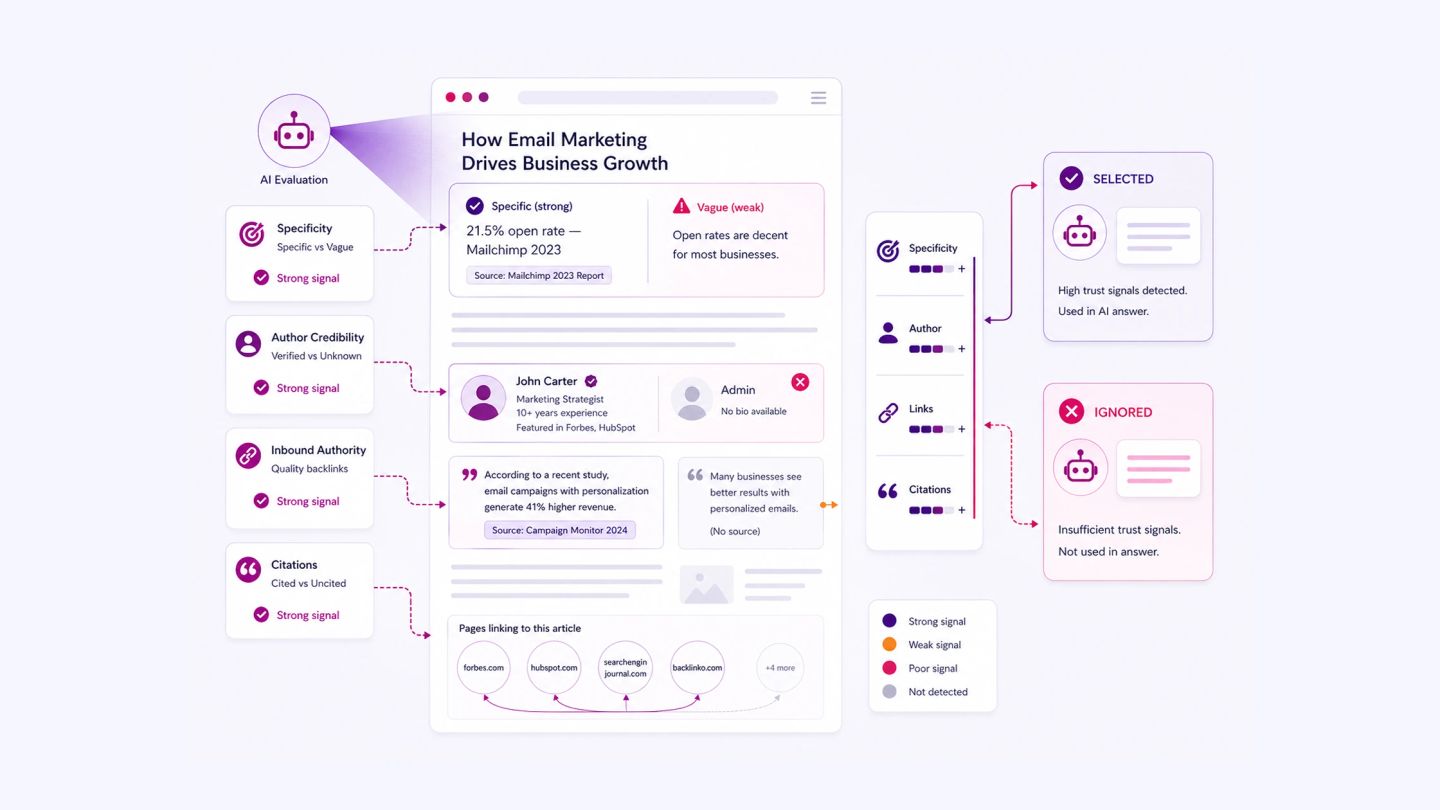
LLMs are trained to weigh authoritative sources more heavily. This is not just a matter of human perception. The data used to train and fine-tune these models reflects trust signals that overlap with those used in traditional SEO.
- Specificity functions as credibility: A claim like “email open rates average 40.55% across industries, according to Mailchimp’s 2023 benchmark report” is more citable than “email open rates are decent.” The first gives the model something concrete to anchor itself to.
- Named authors and credentials matter: Content with a clear author byline, especially one with a linked bio and verifiable credentials, tends to appear more frequently in AI-cited results. Anonymous or corporate-only bylines perform worse.
- Inbound links still matter indirectly: While LLMs do not crawl links in real time, their training data reflects the web’s existing authority hierarchy. Highly linked pages were more likely to be included in training corpora and given higher weight.
- Cite your sources inline: If you reference a statistic, name the source. This not only builds reader trust but also mimics the citation pattern that AI models associate with factual accuracy.
Schema Markup and Technical Signals
Structured data does not guarantee AI citation, but it increases the probability of it. The most relevant schema types for AEO are:
- FAQPage schema: Explicitly marks up question-and-answer pairs. Google uses this directly in its AI Overviews and voice search outputs.
- Article schema: Signals content type, author, publication date, and organization. Freshness is a ranking factor for AI citation in fast-moving topic areas.
- HowTo schema: For procedural content, this schema makes individual steps extractable as units. In addition to schema, page speed, and crawlability, whether your content reaches AI systems at all depends on these factors. A page that loads slowly or blocks Googlebot does not get indexed, and a page that is not indexed does not get cited.
- Keep your technical baseline clean: Fast load time, valid HTML, canonical URLs, and no content hidden behind JavaScript rendering are the minimum requirements.
4 Common Mistakes That Prevent AI Citation
Most content fails to get cited, not because it is low quality but because it is structured poorly:
- Starting sections with context instead of answers: Writing “Background on this topic goes back to the early 2000s…” before giving any useful information trains AI systems to skip that section.
- Using hedged or vague language: Phrases like “it could be argued” or “some experts suggest” without attribution reduce factual confidence scores. Use direct language. If you do not know something precisely, do not pad it.
- Breaking the question-to-heading match: If users search for “how to optimize for AI search” and your heading reads “Thoughts on Modern Search Behavior,” the alignment still fails, even if the content underneath is excellent.
- Repeating the same content across sections: AI models penalize pages that repeat the same information (through dilution, not punishment). Each section should add distinct value.
Write to Get Cited by AI Systems
AI citation is not an individual tactic you layer onto existing content. It is the result of writing content that directly answers questions, structures information cleanly, and builds credibility through specificity and attribution.
The systems pulling from the web for AI-generated answers are not mysterious. They follow parseable patterns. Write for a reader who wants the answer first, structure for a system that extracts it, and cite your sources the same way you’d want to be cited.
INSIDEA
Ready to get found by people and AI?
Search and answer-engine visibility that compounds, built to be cited.

 How INSIDEA works




