

Your website is live, content is published, and search visibility looks stable. Still, when someone asks ChatGPT for recommendations in your category, your brand does not show up. That gap is starting to affect how people discover and compare options.
ChatGPT does not rank websites or rely on backlinks the way search engines do. It forms connections between brands, topics, and credibility signals based on information available across public sources. When those connections are weak or inconsistent, your brand gets left out of responses, even if the product or service is strong.
Forbes notes that AI systems do not respond solely to content volume. They rely more on how consistently a brand appears across credible sources and on how clearly it is described. If those signals are mixed or incomplete, extra content does not improve visibility.
This blog breaks down the main reasons that happen and what needs attention in each area.
How ChatGPT Actually Selects and Mentions Brands
To understand why certain brands appear in AI responses while others don’t, it helps to look at how the system builds its answers. This isn’t a search process, and it doesn’t involve pulling from a live list of companies.
Instead, responses are generated by combining learned patterns with contextual signals available at the time of answering.
1. Pattern Learning from Large-Scale Text
At its core, the system has learned from vast amounts of written content across the internet. What matters here isn’t memorization, but repetition of associations. Over time, it picks up which brands consistently appear alongside specific categories, problems, or comparisons.
Those repeated associations become the foundation for how strongly a brand is linked to a topic.
2. Interpreting Brands as Recognizable Entities
When a question is asked, the system identifies key entities such as brands, tools, and concepts, and tries to understand what each one represents in context.
A brand becomes easier to surface when its identity is stable and consistently framed across different sources. If the way a brand is described varies widely or appears too rarely, the system has less confidence in placing it within a clear category during response generation.
3. Optional Real-Time Information Layer
In some cases, the system may supplement its response with up-to-date web information. When this happens, it tends to prioritize sources that are:
- clearly structured
- directly relevant to the query
- widely referenced or consistently recognized
This layer is used to enhance freshness, but it still depends on how clearly the information is presented and how reliable it appears across sources.
4. Generating the Final Response
The final answer is produced by combining learned associations with any available external information.
There is no fixed ranking of brands. Instead, the system leans toward options that appear most contextually appropriate and most consistently reinforced across signals.
Brands that are clearly defined, repeatedly referenced in the same context, and easy to map to a category are more likely to be included in the response.
10+ Reasons Your Brand Is Missing From ChatGPT Recommendations
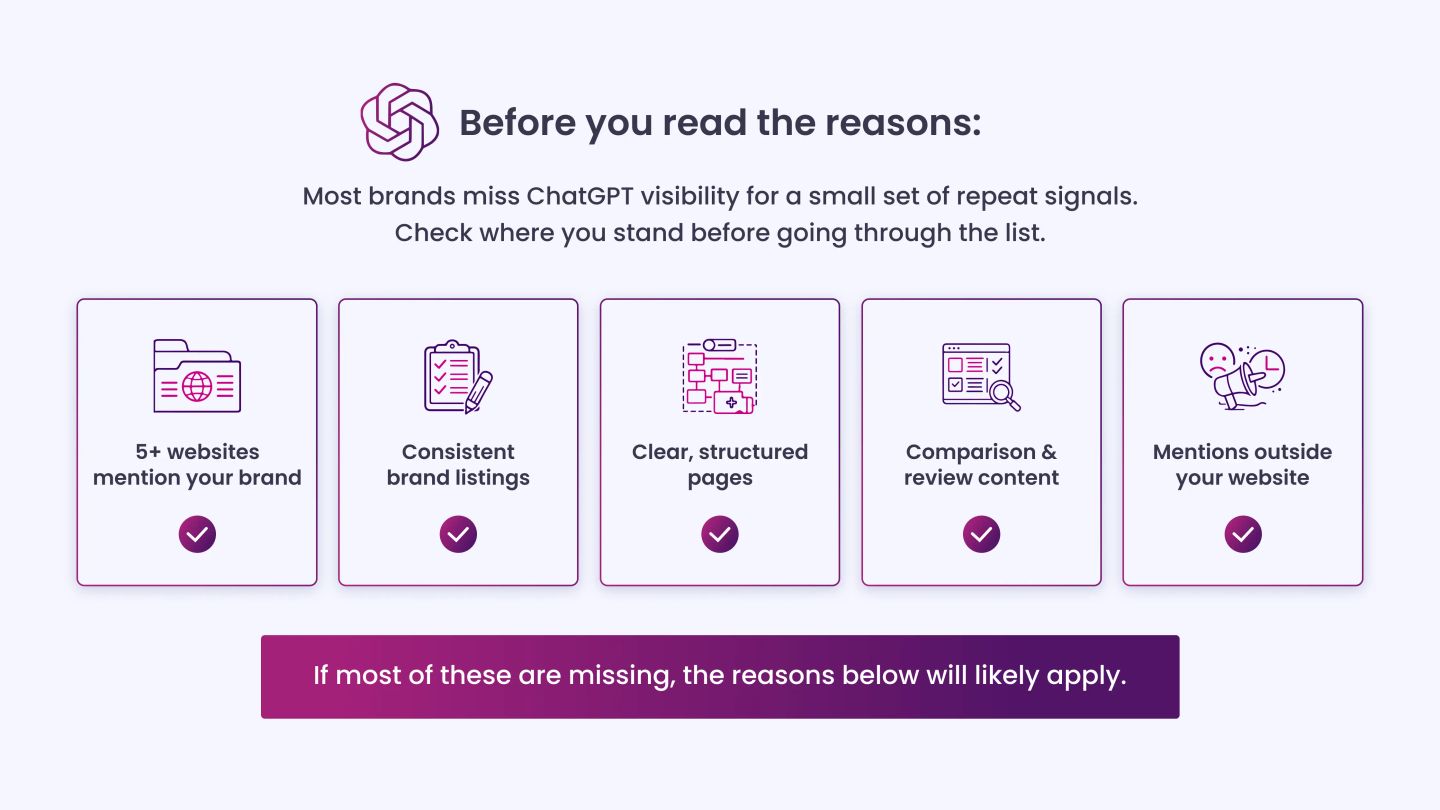
Let’s get started!
1. ChatGPT Does Not Have a Strong Entity Understanding of Your Brand
ChatGPT identifies brands through a concept called entity recognition. It connects your brand name to a category, a product type, and a set of attributes based on how often and how consistently your name appears across the content it has processed.
If your brand has very few mentions outside your own website, or if those mentions don’t clearly describe what you do, ChatGPT has no reliable signal to work with. It doesn’t take a chance on brands it can’t confidently place.
Fix it:
- Get your brand mentioned by name in third-party content that clearly describes your category and offering.
- Build a presence on business directories, review platforms, and niche publications relevant to your industry.
- Make sure every external mention of your brand consistently describes what you do in plain language.
2. Your Brand Exists Only Within Owned Channels
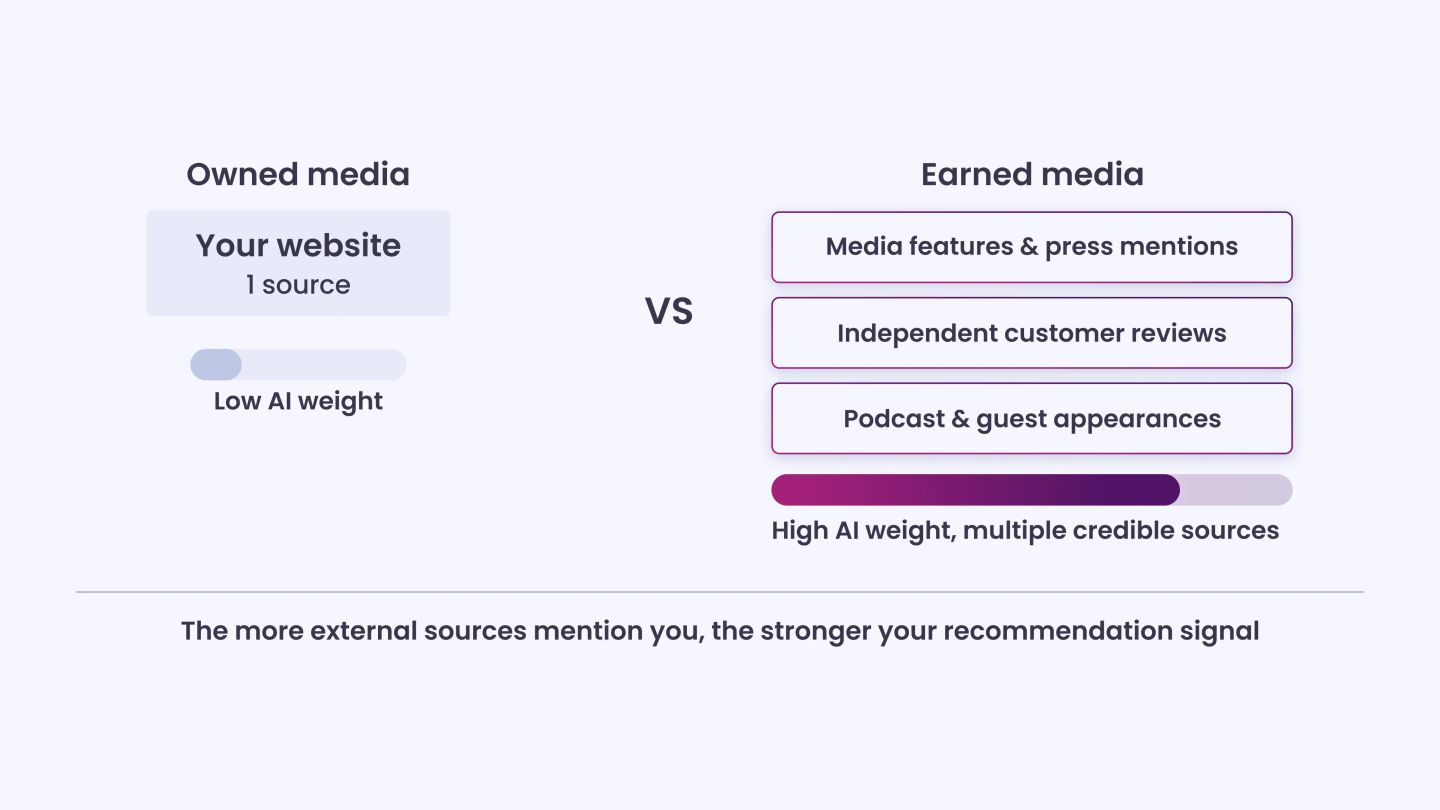
There’s a clear bias in how AI models select sources for recommendations. They lean heavily toward earned media, meaning content written about you by others, over brand-owned content. Your own website is one data point. What the rest of the web says about you carries far more weight.
If a user asks ChatGPT to recommend a product in your space, and your brand only appears on your own domain with no external validation, the model has little reason to surface you over brands that appear across multiple credible sources.
Fix it:
- Prioritize getting featured or reviewed in publications your target audience actually reads.
- Pursue podcast appearances, guest contributions, and co-marketing opportunities that generate external mentions.
- Actively collect and publish customer reviews on independent platforms.
3. Your Content Does Not Match User Intent Formats
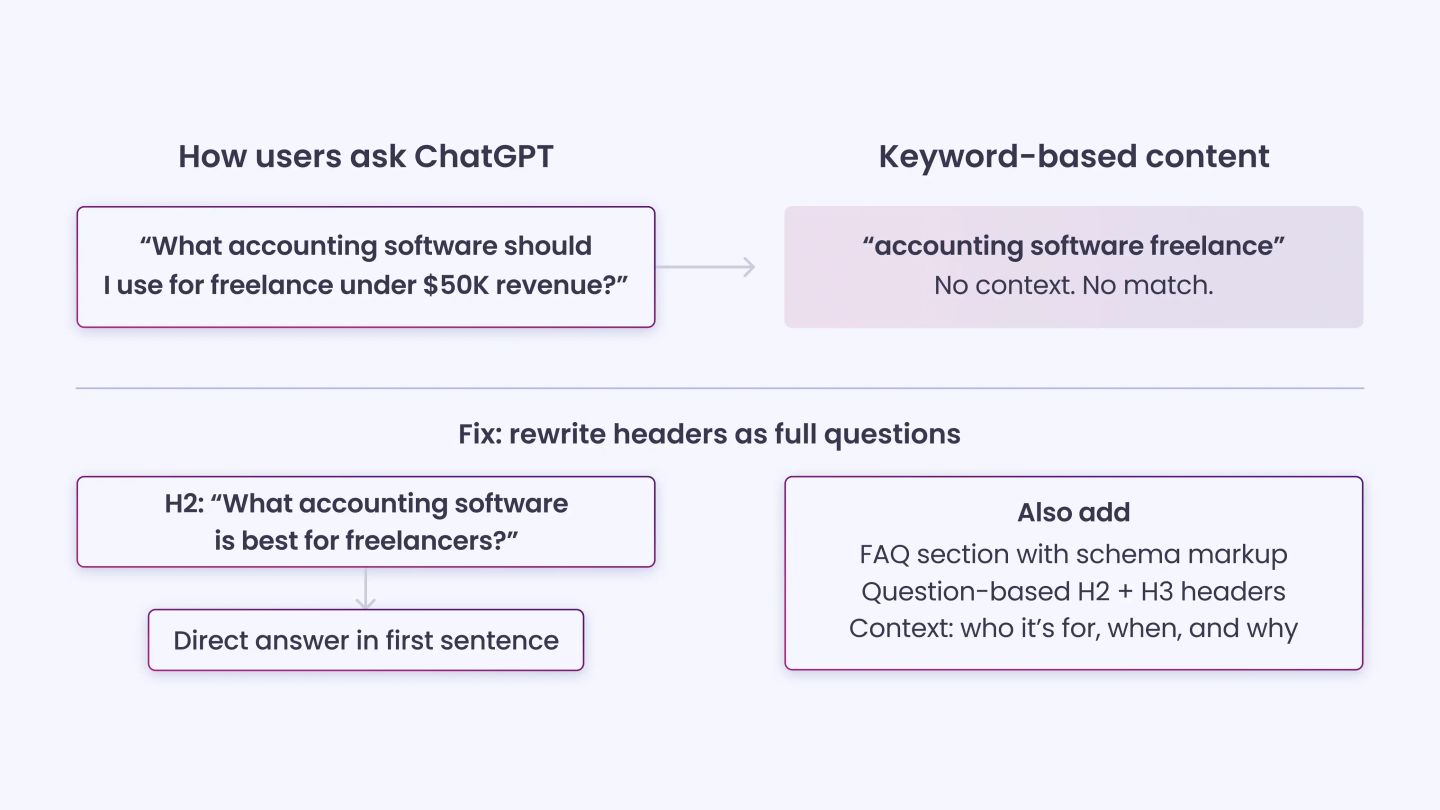
ChatGPT is built to respond to questions. When someone asks for a recommendation, it looks for content that directly addresses that question with a clear, specific answer. Content that talks broadly about your brand’s story, mission, or features doesn’t serve that purpose.
If your pages are built around what you want to say rather than what your audience is actually asking, you’re creating content for your own purposes, not for the retrieval systems that determine AI recommendations.
Fix it:
- Reframe your core pages around specific questions your audience types into AI tools and search engines.
- Use question-based headers (H2, H3) followed by direct, clear answers in the first sentence or two below.
- Add a proper FAQ section to high-priority pages, structured with schema markup.
4. Inconsistent Brand Descriptions Across Platforms
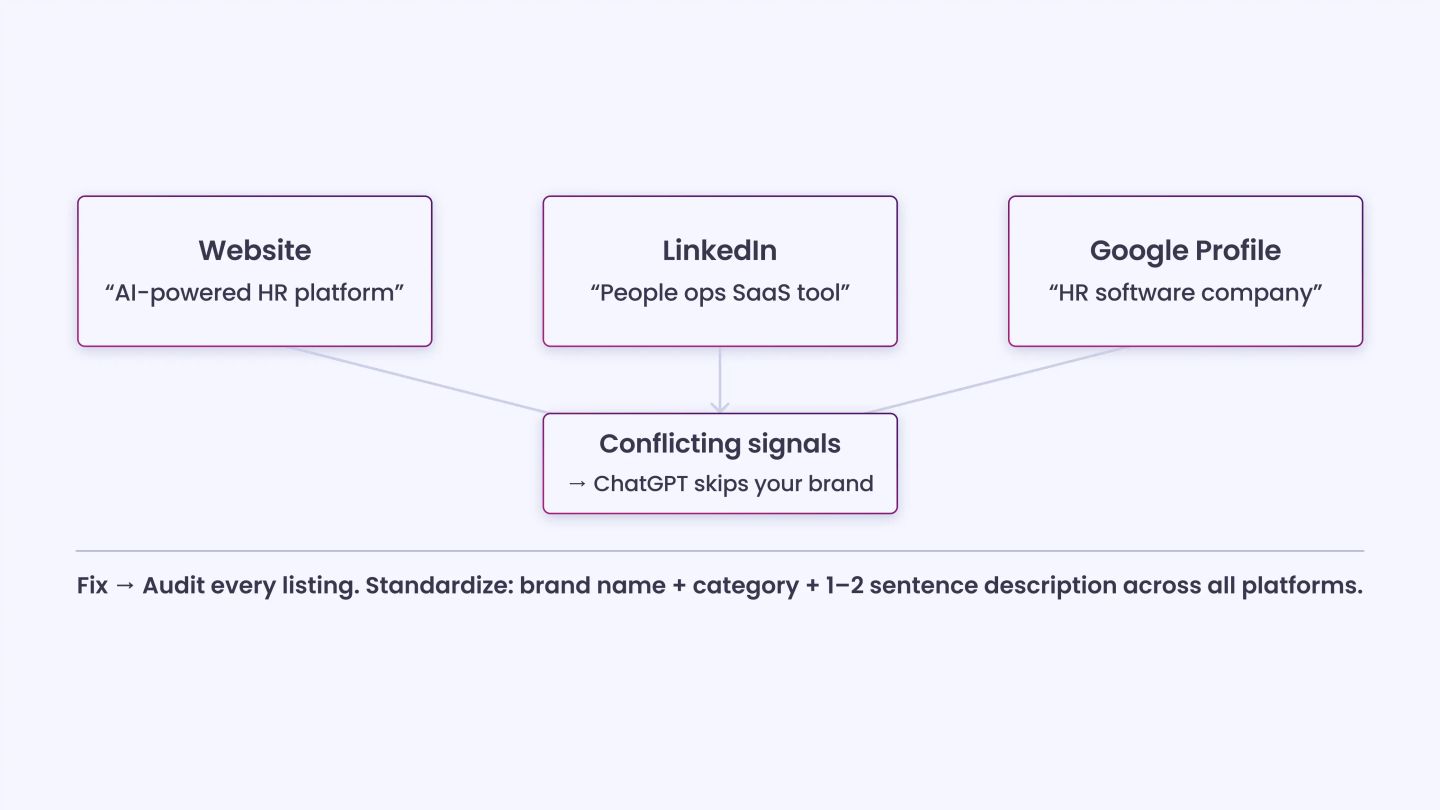
AI models cross-reference multiple sources to build a picture of your brand. When your business description on Google Business Profile says one thing, your LinkedIn says another, and your website says a third, the model encounters conflicting signals.
Conflicting signals make your brand ambiguous. Ambiguous brands get skipped. This is a surprisingly common issue, and it’s almost entirely fixable.
Fix it:
- Audit how your brand is described across every major platform where it appears.
- Standardize your brand name, category, and one- or two-sentence description across all listings.
- Update stale or outdated profiles on directories, review sites, and social platforms.
5. Technical Barriers Limit Content Accessibility
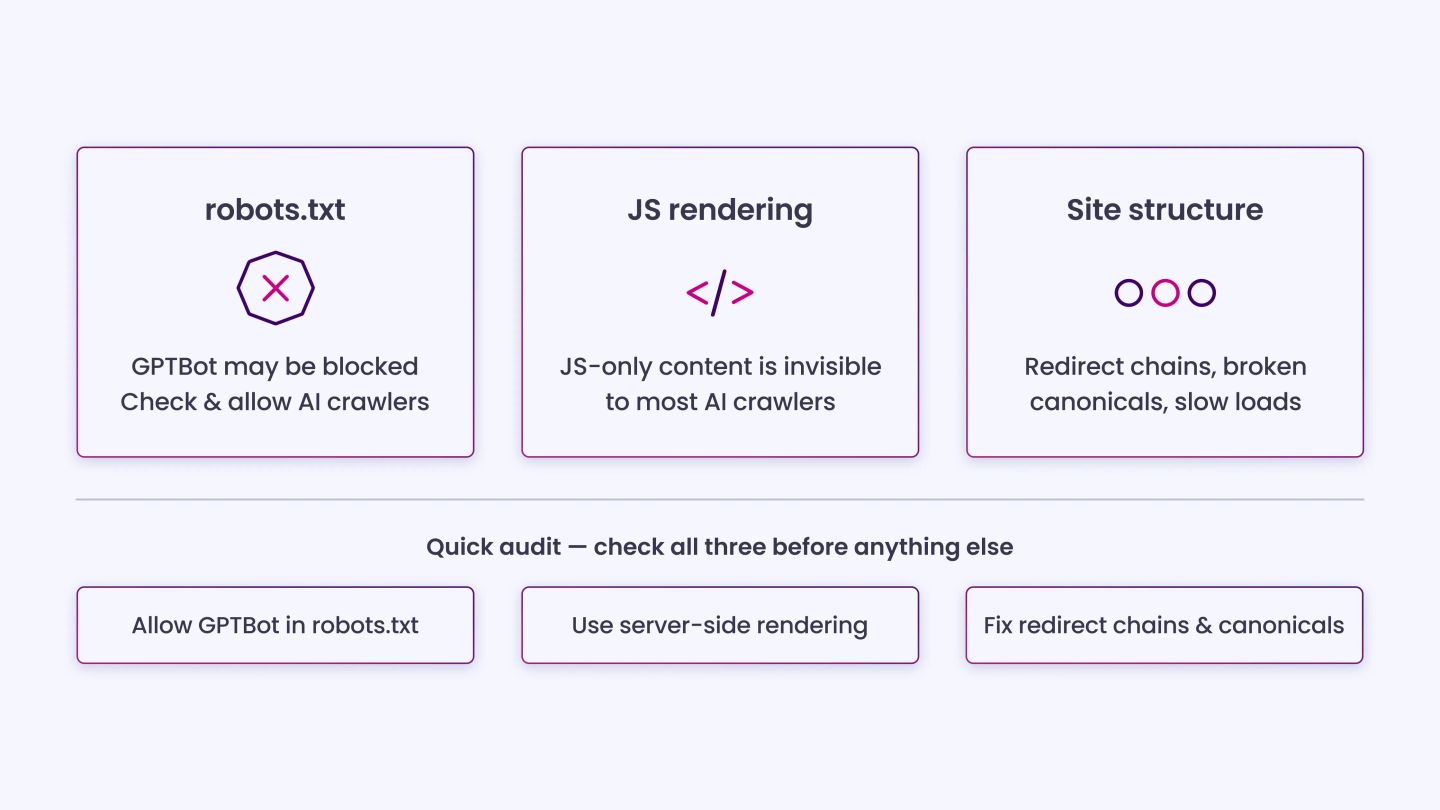
ChatGPT’s web retrieval function uses crawlers to read and index content in real time. If your site is configured to block these crawlers, or if your pages rely heavily on JavaScript to load content, those pages may as well not exist for AI retrieval.
This is a purely technical problem, and it’s one many brands have without realizing it.
Fix it:
- Check your robots.txt file to confirm you haven’t blocked GPTBot or other AI user agents.
- Audit your site for pages that render content only through JavaScript, which most crawlers cannot process.
- Fix broken canonical tags, redirect chains, or slow load times that cause crawlers to drop out before reading your content.
6. Lack of Structured Data Reduces Machine Readability
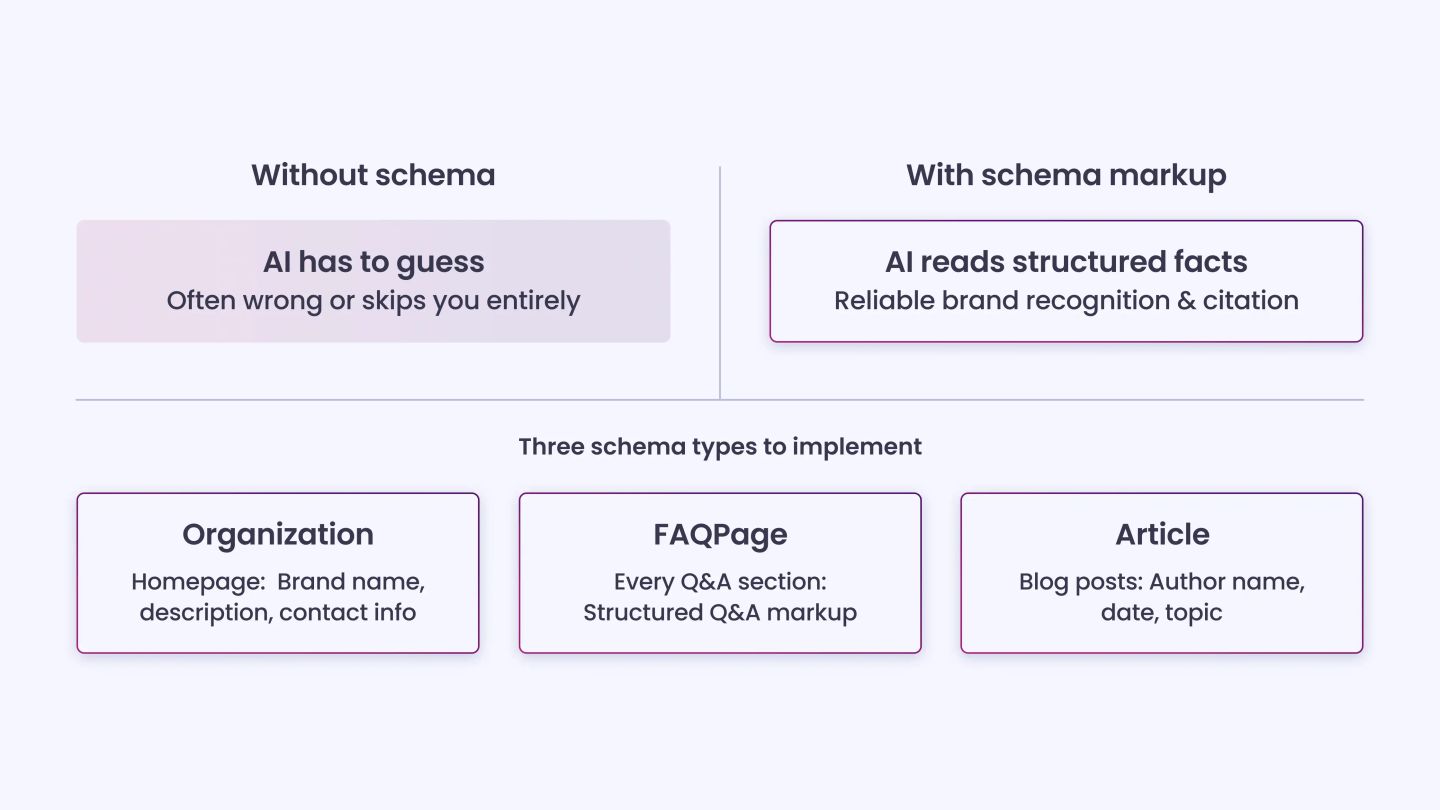
Schema markup is code that tells AI systems, in plain structured terms, what your brand is, what it offers, and how different pieces of content relate to each other. Without it, AI models have to infer all of that from unstructured text, and they often get it wrong or skip you in favor of sources that are easier to interpret.
This is one of the more technical fixes on this list, but it has a measurable impact on how reliably AI models identify and cite your brand.
Fix it:
- Implement the Organization schema on your homepage to include your brand name, description, and contact information.
- Add the FAQPage schema to any page that includes a question-and-answer section.
- Use Article schema on blog posts and editorial content, including author name, publication date, and topic.
7. Weak External Demand Signals for Your Brand
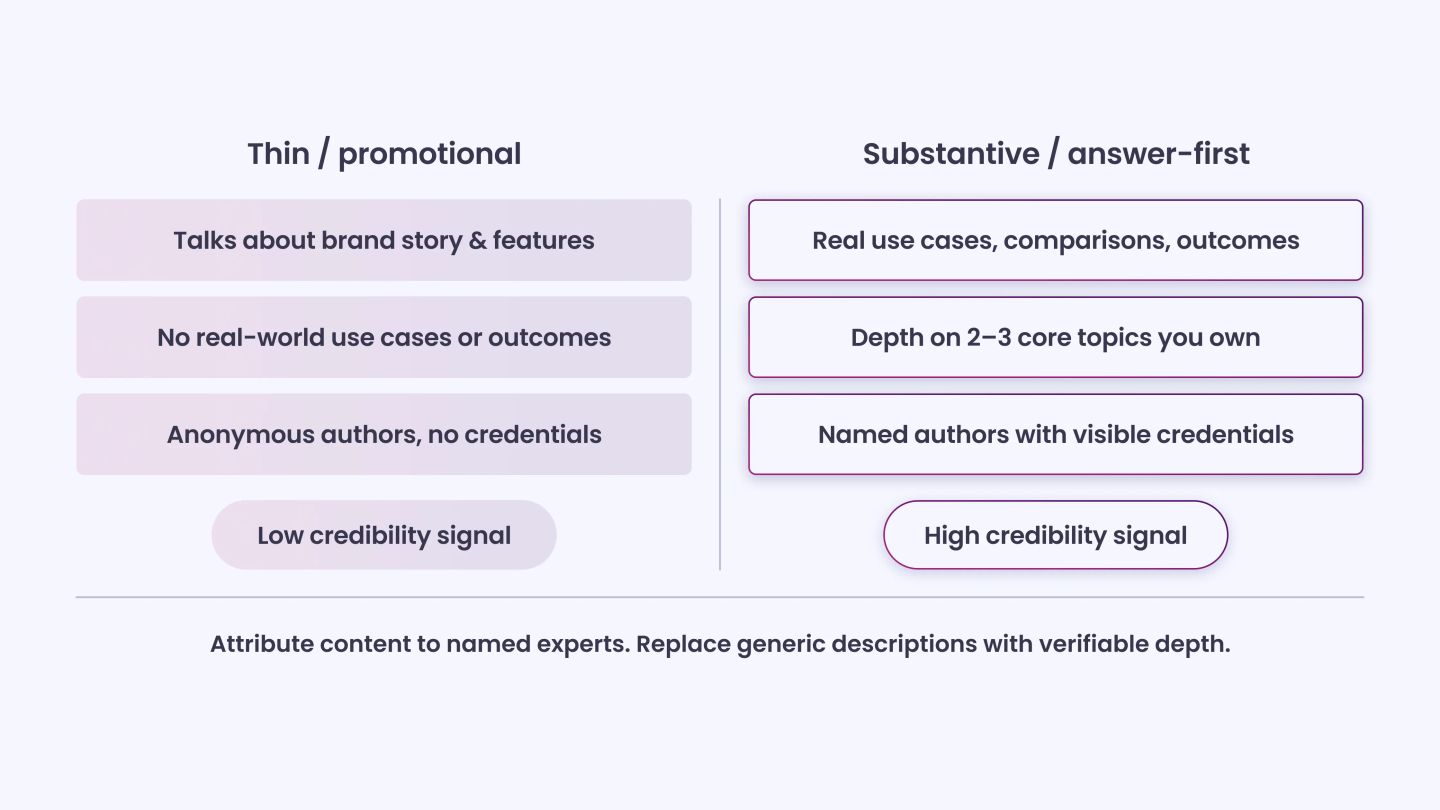
AI models are calibrated to favor content that is useful to the person asking a question. Content that reads like a sales pitch, lacks depth, or doesn’t go beyond surface-level information doesn’t meet that bar.
Thin content also sends a weak signal about your brand’s expertise. If the most detailed thing you’ve published about your core topic is a 300-word overview, that’s not enough for a model to confidently cite you as an authority.
Fix it:
- Identify the two or three topics where your brand has depth and expertise, then publish content that reflects that depth.
- Replace generic product descriptions with content that explains real use cases, comparisons, and outcomes.
- Attribute content to named authors with visible credentials. Anonymous content scores lower for credibility in AI systems.
8. Content Lacks Recency or Ongoing Updates
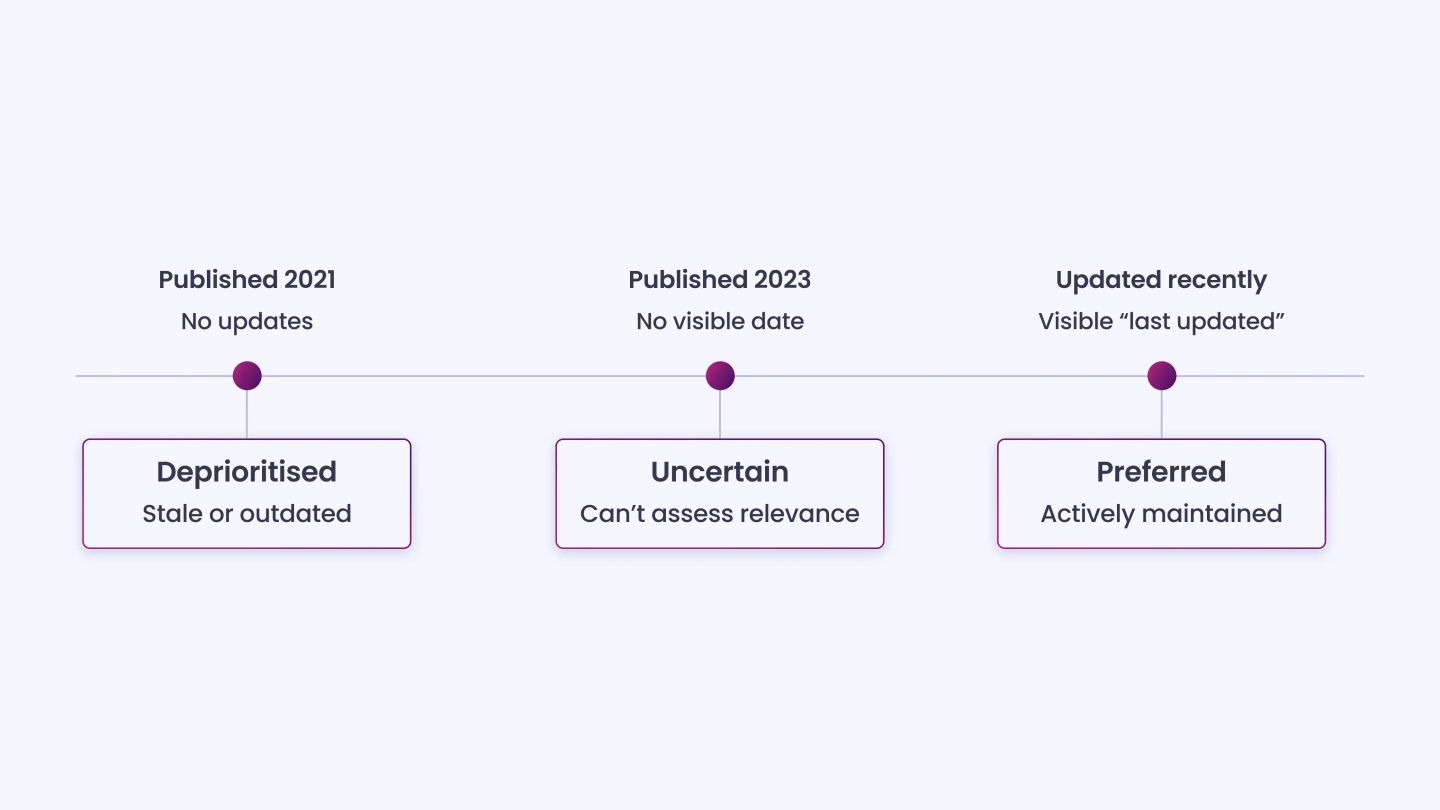
AI retrieval systems favor fresh content. Not because older content is wrong, but because recently updated content signals that a source is actively maintained and currently relevant. If your most substantive pages haven’t been touched in years, or if they carry no visible publication date, AI systems may deprioritize them.
This doesn’t mean you need to publish constantly. It means the content you do have should reflect current information and show it clearly.
Fix it:
- Update high-value pages periodically with accurate, current information and a visible “last updated” date.
- Add new sections to existing strong content rather than always creating from scratch.
- Make sure your most important pages are indexed and accessible with accurate timestamps.
9. Missing Presence in Comparative and List-Based Content
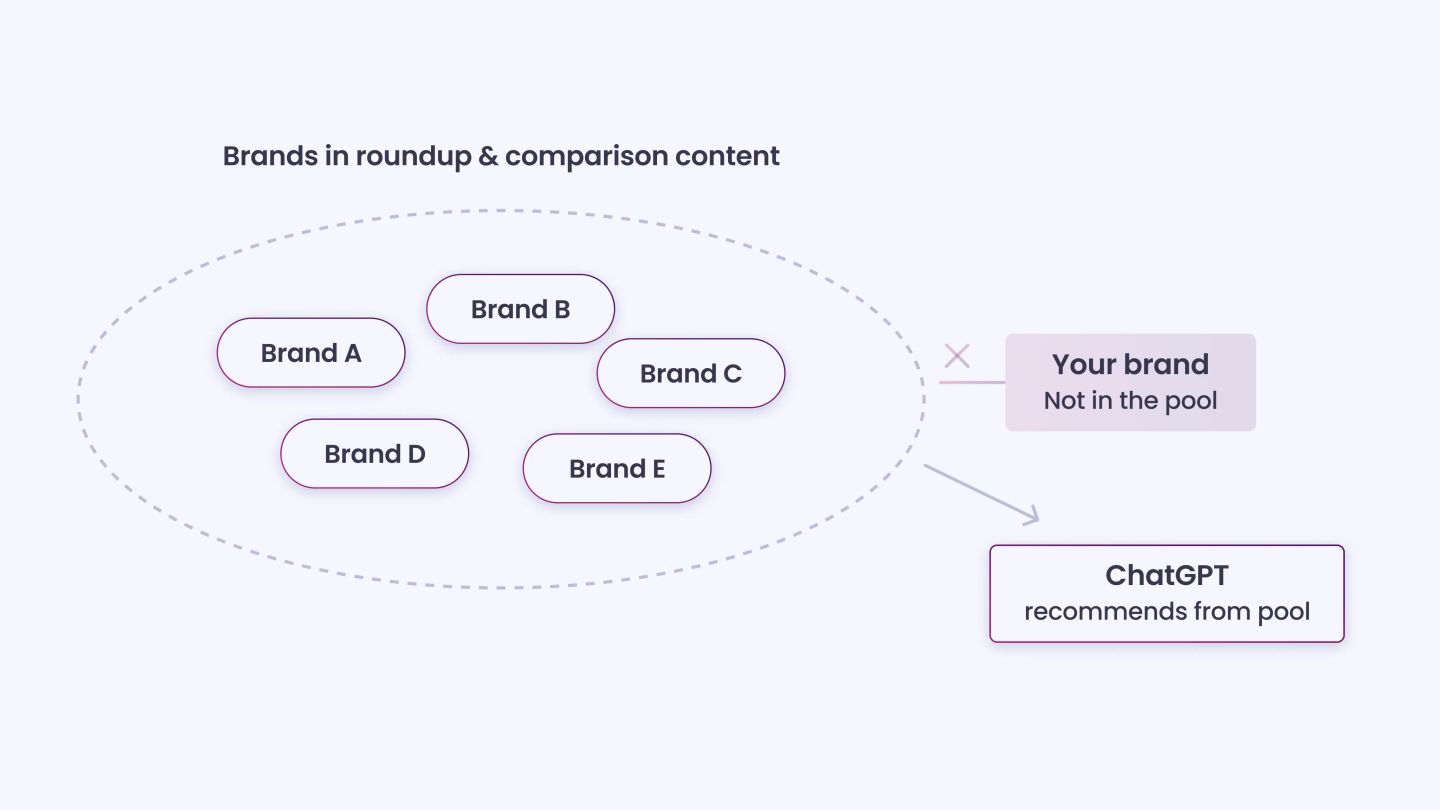
When users ask ChatGPT for recommendations, the model frequently draws from roundup and comparison content: “best tools for X,” “top platforms for Y,” “recommended services for Z.” These formats are how AI models identify which brands belong in a recommendation set.
If your brand doesn’t appear in list-based content across credible external sources, you’re not in the pool of options ChatGPT draws from when it generates a recommendation response.
Fix it:
- Identify which publications and websites publish comparison content in your category, and actively work on getting included.
- Build relationships with content creators and journalists who cover your space regularly.
- Create your own well-researched comparison content that includes your brand alongside others, which itself becomes a citable source.
10. Your Credibility Signals Are Weak
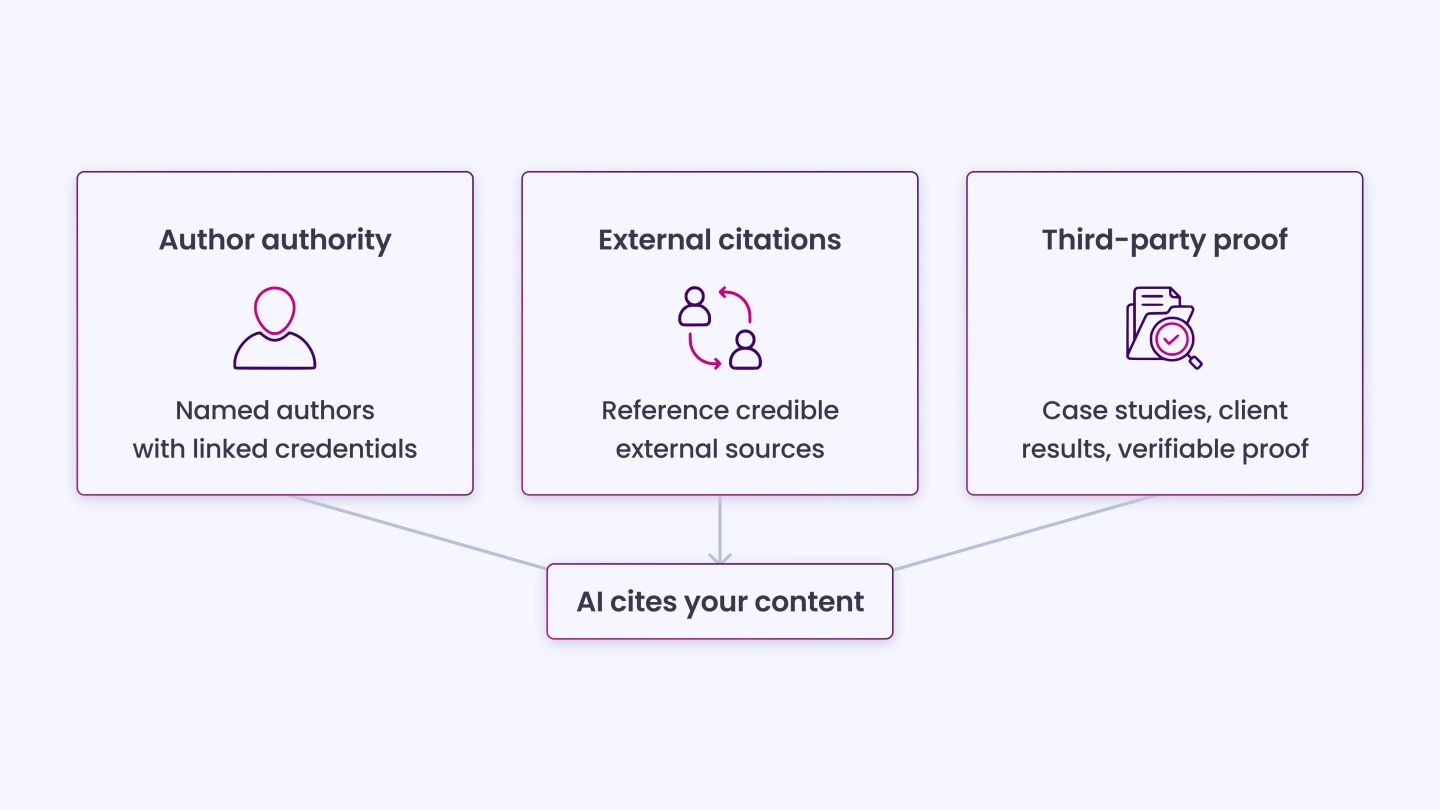
AI models assess whether a source is worth citing based on signals that reflect real expertise and trustworthiness. Unnamed authors, no citations, no evidence of real-world results, and no external validation all weaken how a model perceives your content’s credibility.
This isn’t a vague concept. It translates directly into whether your content is pulled into an AI-generated response or bypassed in favor of stronger-signal content.
Fix it:
- Name the authors on your content and link to their professional background or credentials.
- Reference credible external sources within your content where claims warrant it.
- Feature verifiable outcomes, client results, or case studies to back up what your brand claims to do.
11. Content Built Around Keywords Instead of Natural Queries
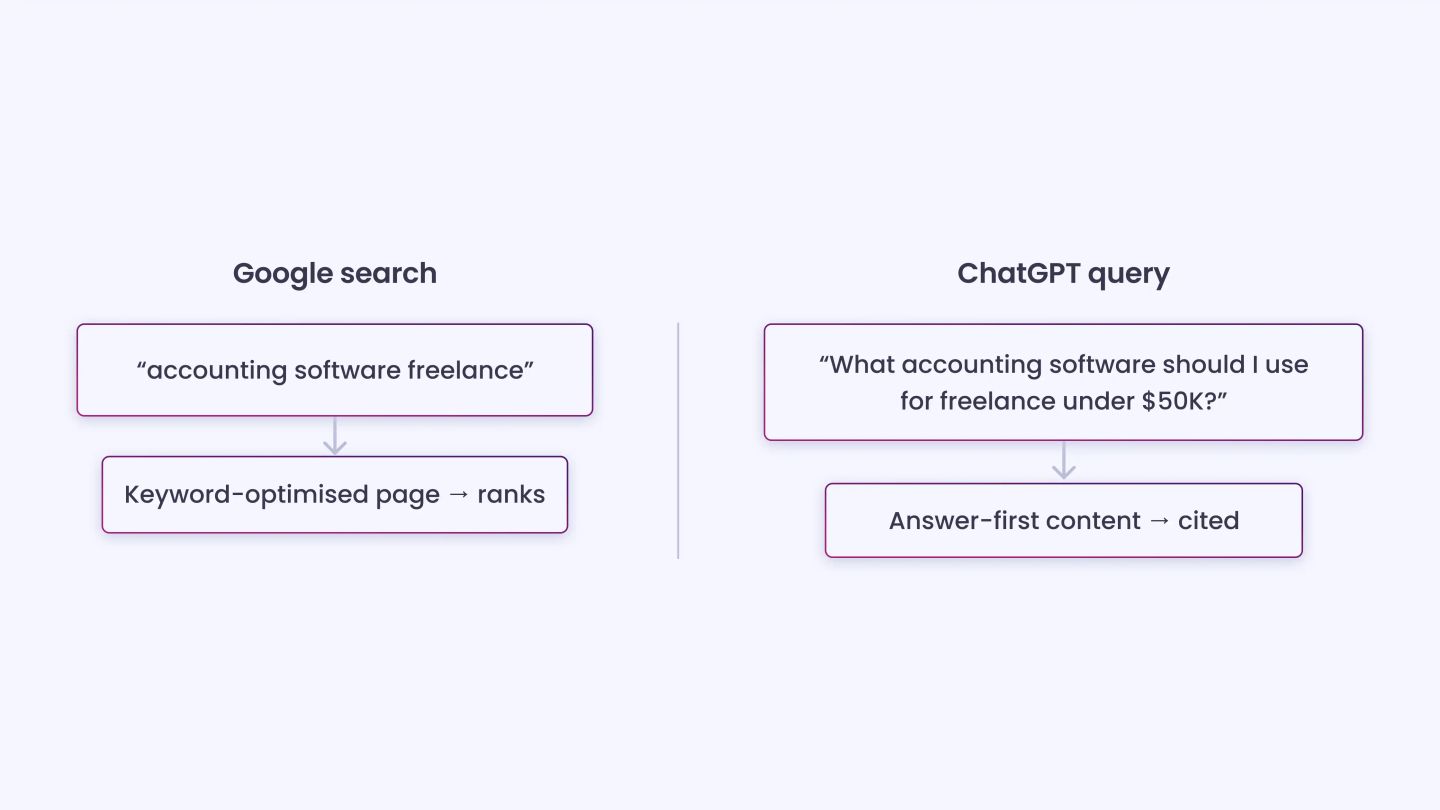
Search engines were trained on keyword-based queries. AI tools are not. When someone types into ChatGPT, they ask in full sentences, with context, and with nuance. “What accounting software should I use for a freelance business under $50K revenue?” is a real ChatGPT query. Content optimized for “accounting software freelance” doesn’t naturally map to that.
If your content was built entirely around short keyword phrases and doesn’t reflect how people actually talk about their problems, it will consistently miss the mark when ChatGPT processes recommendation queries.
Fix it:
- Rewrite the main headers as full questions, the way your audience would actually phrase them.
- Answer those questions directly and specifically in the content that follows, without burying the answer.
- Cover the context around your topic, including who it’s for, when it applies, and what alternatives look like.
12. No Active Monitoring of AI Visibility
Most brands have analytics, SEO audits, and competitor tracking set up. Almost none have checked what ChatGPT says about them when asked a relevant question. That’s a significant blind spot.
You can’t address AI visibility problems you haven’t identified. And the specifics matter: whether ChatGPT knows your brand at all, how it describes you, where it places you relative to competitors, and what queries trigger a mention of your name, all of this is measurable and actionable.
Fix it:
- Run a simple audit today: ask ChatGPT to recommend brands in your category and see if you appear.
- Ask follow-up prompts using your brand name directly and note how it describes you, accurately or otherwise.
- Track this monthly and use what you find to guide your content and visibility efforts going forward.
The Real Factor Behind AI Brand Recommendations
ChatGPT doesn’t skip brands randomly. It reflects patterns built from how clearly, consistently, and widely a brand appears across reliable sources.
Across all 12 reasons, the signal is the same: AI systems surface brands they can confidently recognize and place in context.
That confidence is built over time through consistent messaging, strong external presence, clear content structure, and reliable technical foundations.
Start with the weakest gap, fix it properly, and build from there. Visibility in AI systems compounds; brands that begin early create an advantage that becomes harder to match later.
INSIDEA
Ready to get found by people and AI?
Search and answer-engine visibility that compounds, built to be cited.

 How INSIDEA works




