In 2026, the landscape of virtual assistants has reached new heights, and this blog is dedicated to unraveling the latest virtual assistant stats that are shaping this exciting field.
As we witness an era where artificial intelligence blends seamlessly into our daily routines, understanding the current trends and statistics of virtual assistants becomes crucial. Among these considerations is - What is the employment outlook on virtual assistants? This question is particularly relevant as businesses globally are increasingly leveraging virtual assistants to enhance efficiency and reduce costs.
Virtual assistants have evolved, not just as a novelty but as essential tools. Let’s take a deep dive into the numbers and trends that illustrate the significant role virtual assistants are playing in our technologically driven world.
The Latest Virtual Assistant Stats: A comprehensive Overview
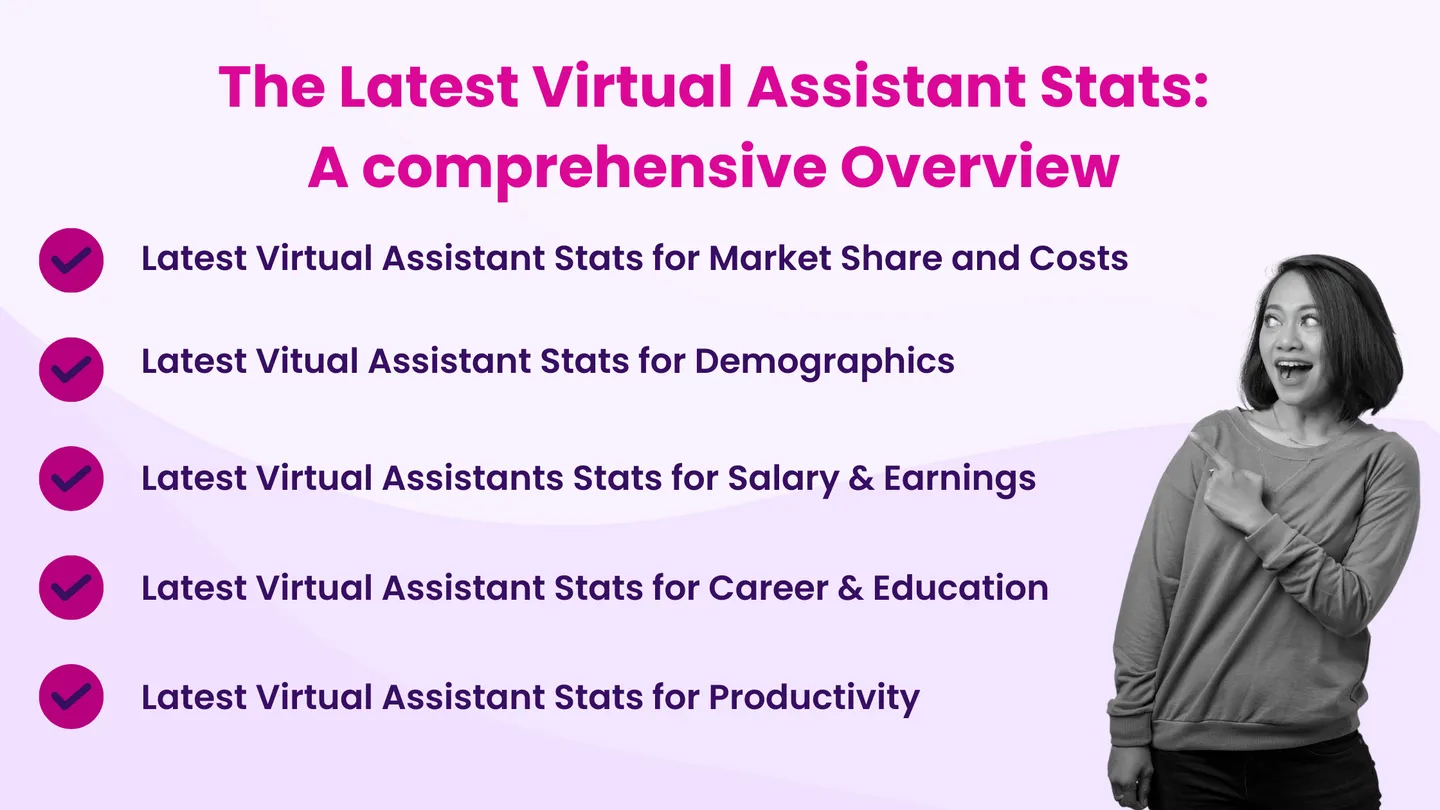
In 2026, the virtual assistant landscape is evolving rapidly. This segment offers a snapshot of the latest virtual assistant stats, providing key insights into market shares, costs, demographics, salaries, and their impact on productivity. These figures are vital for understanding the current and future trends in the virtual assistant industry, especially the employment outlook on virtual assistants.
I. Latest Virtual Assistant Stats for Market Share and Costs
Check out the latest virtual assistant stats focusing on market share and costs:
- Hiring full-time virtual assistants could save an employer in the U.S. more than $11,000 per year.
- Hiring virtual assistants can reduce a company’s operational expenses by 78%. (Best of Budgets)
- The market size of the virtual assistant industry is projected to reach $25.63 billion by the year 2026.
- 50% of all businesses report that implementing chatbots and virtual assistants has helped reduce expenses.
- The worldwide market for virtual assistants is projected to expand at an annual growth rate of 30% by 2026.
- There are approximately 12 million freelancers registered on Upwork, around 20 million on Freelancer, and about 3 million on Fiverr. According to Wikipedia, the count of individuals identifying as “Virtual Assistants” is estimated to be near 25,000.
- Virtual assistants are 78% more cost-effective than full-time, on-site employees.
II. Latest Vitual Assistant Stats for Demographics
Here are some must-know latest virtual assistants stats focusing on global demographics:
- White individuals represent the largest ethnic group among virtual assistants, comprising 66.5% of the total virtual assistant workforce.
- 16% of virtual assistants identify as Hispanic or Latino, while 9.1% belong to the Black or Afro-American community.
- 87.6% of virtual assistants are women, and 12.4% are men.
- A gender pay gap exists in the Virtual Assistant profession, with women earning 93 cents for every dollar earned by men.
- Among virtual assistants, those of Asian ethnicity command the highest average salary, while their White counterparts earn the lowest, with an average annual income of $43,074.
- The average age of virtual assistants is 40+ years, representing 78% of the virtual assistant population.
- A majority of 69.3% of virtual assistants are married.
III. Latest Virtual Assistants Stats for Salary and Earnings
Have a look at the latest virtual assistant stats focusing on their salary and earnings:
- The average annual salary for a Virtual Assistant in the United States is approximately $39,915.
- The average hourly pay for a Virtual Assistant in 2024 is around $19.19
- The yearly salary of an Entry-Level Virtual Assistant is approximately $29,000
- Virtual assistants’ hourly rates in the US typically range between $13 and $25.
- Virtual assistants earn the highest salaries in Hawaii ($53,760), Washington ($53,236), and Alaska ($52,452).
- Virtual assistant salaries at IBM are the highest compared to any other company.
- Virtual assistants are the highest-paid in the US.
- 87.7% of virtual assistants receive compensation on an hourly basis.
- 68% of freelance virtual assistants frequently work with multiple employers, handle various jobs, or simultaneously engage in several contract projects.
IV. Latest Virtual Assistant Stats for Career & Education
Check out the latest virtual assistant stats focusing on their career and education:
- Data entry is the most common skill found on resume samples for virtual assistants. It appears on 9.3% of virtual assistant resumes.
- A virtual assistant’s second most common hard skill is customer service, which appears on 7.8% of resumes.
- The third most common virtual assistant skill is email management, found on 7.6% of resumes.
- Three common virtual assistant soft skills are interpersonal, organizational, and writing.
- The average virtual assistant resume is 412 words long
- The average virtual assistant resume is 0.9 pages long, based on 450 words per page.
- The most common degree for virtual assistants is a bachelor’s, with 54% of positive holdings. The second and third most common degree levels are associate degree at 22% and high school diploma at 9%.
- The Philippines and India are key hubs for recruiting VAs due to their cost-effective plans starting from $400 per month, making this price range suitable for most Americans.
- US experts virtual assistants earn more than $4,000 per month.
- 41% of users say that the biggest challenge of hiring a VA is finding a trustworthy and reliable one.
- A majority, 59%, of virtual assistants are engaged in full-time employment.
- Nearly half of virtual assistants, specifically 45%, hold a bachelor’s degree.
V. Latest Virtual Assistant Stats for Productivity
Here’s a compilation of latest virtual assistant stats focusing on how they impact productivity and the employment outlook on virtual assistants:
- 13% of employees are more productive when working from home. (Virtudesk)
- 85% of virtual workers reported feeling more productive when working from home. (IWG)
- While virtual assistants have flexible working hours, industry data indicates that most typically work around 20 hours weekly.
- 92% of Virtual Assistants report high satisfaction with the flexibility of their work.
- On average, companies save 22 minutes of time each day by utilizing virtual assistants.
- Over 20% of virtual assistant users delegate calendar management.
- Virtual assistants can improve workforce efficiency by 35%.
- Virtual assistants have the potential to enhance workforce productivity by up to 35%.
INSIDEA
Ready to take the busywork off your plate?
Trained virtual assistants who plug into your tools and your workflow.



 How INSIDEA works