

RevOps

Navigating Compliance in RevOps_ Key Tips for Revenue Teams
Jigar Thakker

Navigating Compliance in RevOps: Key Tips for Revenue Teams

Missed revenue targets are painful, yes—but they’re repairable. What’s far more damaging? Finding out your revenue systems were never compliant in the first place. Legal risk, regulatory fines, and eroded stakeholder trust can sink even your most promising growth momentum. Picture this: You’ve just closed a successful Series B. The pipeline is humming, teams are ramping fast—and then your CRM audit reveals mishandled customer data across three departments. Just like that, your trajectory involves risk mitigation instead of growth acceleration, and your investor confidence takes a hit. RevOps isn’t just an alignment play. It’s the operational backbone of your revenue engine. And systems like that can’t afford to leave compliance as an afterthought. So how do you build RevOps workflows that are agile and compliant by design? That’s what you’ll walk away with here. Whether you’re standing up your RevOps function from scratch or refining it at Series D, this guide provides the clarity, structure, and modernization strategies to lead with confidence. We’re unpacking what absolute RevOps compliance entails, where fast-moving teams often stumble, and how you can reinforce your systems—without needing to firefight later. And when you need extra hands, INSIDEA is here to make it frictionless. What Is RevOps
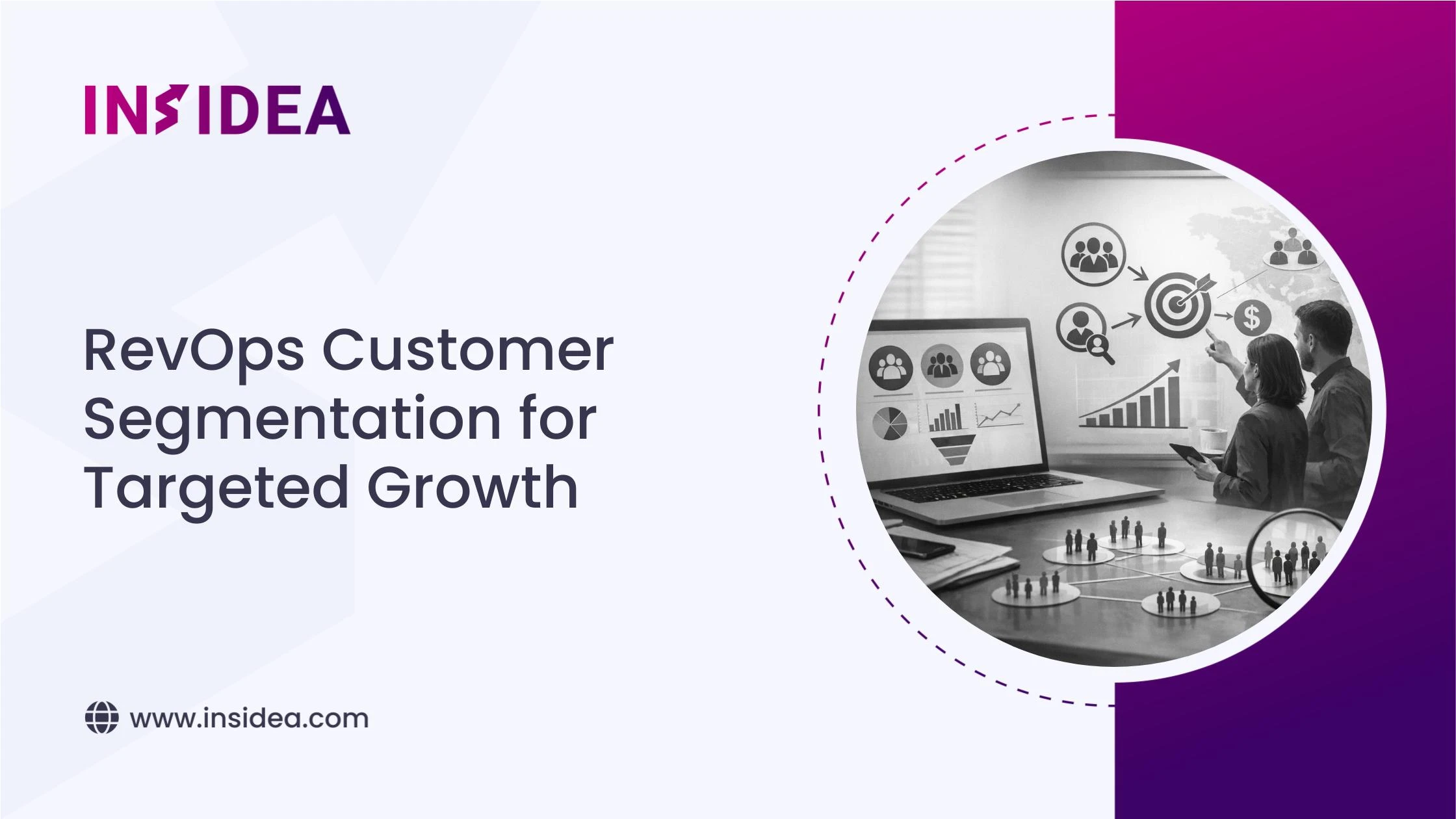
RevOps Customer Segmentation for Targeted Growth
Jigar Thakker

RevOps Customer Segmentation for Targeted Growth

Picture this: your SaaS company is growing fast. New customers are rolling in, revenue is up, and teams are sprinting full speed. But something’s off beneath the surface. Your sales reps keep chasing dead-end leads. Marketing keeps turning up the volume, but not the precision. And your customer success team is drowning in churn risks they didn’t see coming. You’re not lacking effort—you’re missing alignment. The breakdown often starts with how you segment your customers. Or more accurately, how your segmentation is fragmented across departments. When sales has one idea of your Ideal Customer Profile (ICP), marketing uses another, and CS is classifying accounts again in their own way, you get drag instead of lift. To grow efficiently and predictably, you need a shared segmentation strategy baked into every part of your revenue engine. That’s where RevOps customer segmentation becomes a core growth lever—not just a categorization exercise, but a strategic advantage. Let’s unpack how to make this shift and identify where most B2B teams commonly go wrong. What Is RevOps Customer Segmentation? RevOps — short for Revenue Operations — is about building operational muscle across your sales, marketing, and customer success teams. When it works well, RevOps teams don’t just

Using Predictive Analytics to Supercharge Your RevOps Initiatives
Jigar Thakker

Using Predictive Analytics to Supercharge Your RevOps Initiatives

Let’s start with something familiar — and frustrating. It’s Monday morning. You’re in the weekly revenue sync. Sales missed quota and points to cold leads. Marketing insists the leads were fine. Customer success chimes in: “We could’ve saved that account if we had known the risk sooner.” Everyone’s working hard, yet revenue feels stuck in neutral. Sound familiar? This kind of misalignment doesn’t just stall growth — it burns time, creates tension, and silently erodes your pipeline. The fix isn’t more tools or louder meetings. It’s precision. That’s where Revenue Operations (RevOps) steps in to unify revenue-driving teams behind shared, data-backed goals. And when you layer in predictive analytics? You gain the clarity and foresight to scale faster — and smarter. If you’re a growth-stage founder, a go-to-market leader, or steering a B2B org with stretched teams and stale reporting, predictive analytics can give your RevOps strategy the momentum it’s missing. Here’s how. What Is RevOps — and Why Should You Care? RevOps isn’t a buzzword. It’s a practical shift in how high-performing companies fuel revenue growth. At its core, Revenue Operations aligns your go-to-market teams — sales, marketing, customer success, and ops — around unified processes, systems, and KPIs. Instead

Why Enterprise Organizations Are Investing in RevOps Solutions
Jigar Thakker

Why Enterprise Organizations Are Investing in RevOps Solutions

Imagine this: your enterprise has a seasoned sales team, extensive brand recognition, a CRM loaded with prospects, and a substantial marketing budget. But despite those advantages, revenue targets are still slipping. Leads stall mid-funnel. Sales and marketing don’t see eye to eye. Your systems don’t fully sync. If this sounds familiar, you’re not alone. This kind of friction isn’t a strategy failure—it’s a systems problem. And it’s one more reason why enterprise leaders like you are turning to RevOps to untangle the chaos. Revenue Operations—or “RevOps”—is far more than a trend. It’s becoming the architectural foundation for how modern companies scale: efficiently, accurately, and in sync with the customer journey. If you’re a founder, CXO, or senior operator trying to drive focused, sustainable growth across departments, RevOps might be the critical shift you’ve been missing. Let’s unpack why enterprise companies are going all-in on RevOps-as-a-Service and how you can use it to build a more aligned, data-backed revenue machine. What Is RevOps for Enterprise Organizations? Think of RevOps as the connective tissue that links your sales, marketing, and customer success efforts. It’s not a platform you buy. It’s an operating model built around alignment, transparency, and orchestration across your go-to-market functions.

Jigar Thakker

RevOps Transformation for Smarter Revenue Processes

You’ve launched the campaigns, the leads are flowing, and your sales reps are booking meetings like clockwork. However, the revenue is somehow not keeping pace. You know something’s off — the symptoms are loud and familiar. Marketing insists they’re delivering qualified leads. Sales says otherwise. Customer success is blindsided by deals that clearly weren’t set up to succeed. Everyone points fingers, but nothing gets fixed for long. You solve one team’s issue only to spot another breakdown a week later. Here’s the hard truth: your problem isn’t local — it’s systemic. That’s where RevOps transformation makes the difference. Instead of siloed teams misfiring in parallel, you get a coordinated, data-driven engine with one shared goal — driving revenue with precision and consistency. Let’s unpack what that transformation looks like — and why more companies are partnering with INSIDEA to make it happen fast, and scalably. What Is RevOps Transformation — And Why You Can’t Afford to Wait Imagine your entire revenue process as a supply chain — every stage from first contact to deal close to renewal must work together without friction. Revenue Operations, or RevOps, aligns your sales, marketing, and customer success efforts around one shared strategy, powered by unified

1 - Ensuring RevOps Scalability_ Strategies for Teams Ready to Grow
Jigar Thakker

Ensuring RevOps Scalability: Strategies for Teams Ready to Grow

A few months back, one of our clients—a fast-scaling SaaS company with under 40 employees—hit a plateau. Sales were strong. Marketing campaigns delivered steady leads. But something felt off. Despite all that input, growth had slowed. Their HubSpot setup looked less like a CRM and more like a bowl of spaghetti. The issue wasn’t effort. Everyone was working hard. It was a lack of scalable RevOps infrastructure. If you’re a B2B leader—founder, CXO, or someone responsible for putting fuel in the revenue engine—you might be in the same spot without realizing it. Revenue keeps moving, but it’s grinding rather than accelerating. Here’s the good news: scalable Revenue Operations is well within reach. And you don’t need a massive budget or a three-layer ops team to get there. Let’s walk through exactly what RevOps scalability means, why it stalls without the right systems, and how you can build it the right way—efficiently and sustainably. What Is RevOps Scalability—and Why Does It Matter? Revenue Operations (RevOps) aligns your sales, marketing, and customer success functions around a single operating model. It unifies people, data, and tools into one cohesive workflow designed to produce repeatable growth. Scalability within that model means you can keep growing

RevOps Partner Enablement_ Empowering Channels for Revenue Success
Jigar Thakker

RevOps Partner Enablement: Empowering Channels for Revenue Success

You wouldn’t field a quarterback without a playbook. Yet many companies do something just as risky: they hand off channel partnerships with little more than good intentions and sparse documentation. No unified systems. No shared metrics. No cross-team accountability. Then they wonder why partner-driven revenue stalls. Sound familiar? If your partners feel disconnected or deliver lackluster results, the issue isn’t the partner—it’s the lack of infrastructure supporting them. Without a system that aligns your internal teams and partner motions, deals fall through the cracks, content goes unused, and everyone ends up working harder for smaller outcomes. That’s where RevOps partner enablement changes the game. It moves partners from being a side project to a core part of your revenue machine—and gives you the tools to treat them that way. In this guide, you’ll see what a real RevOps partner enablement strategy looks like, why it matters for long-term growth, and how a specialized partner like INSIDEA can help operationalize it as a scalable system. What Is RevOps Partner Enablement? Revenue Operations, or RevOps, brings marketing, sales, and customer success together under the same operational framework—one that’s driven by shared systems, data, and accountability. Partner enablement, on the other hand, focuses on

RevOps Cost Optimization_ Save Money While Driving Growth
Jigar Thakker

RevOps Cost Optimization: Save Money While Driving Growth

You’re investing heavily in growth—handpicking sales tools, growing your SDR team, and layering in another analytics platform. But despite the spend, your revenue curve has flattened. What gives? You’re not the only one asking that question. For many B2B founders and CXOs, the instinct is to throw more money at lead gen and top-of-funnel tactics when growth stalls. But the root issue is often deeper—and quieter. Revenue operations (RevOps) may be where the real breakdown is happening, silently undercutting performance and draining budget before leads even convert. RevOps is more than an operational trend—it’s the behind-the-scenes framework that aligns your teams, sharpens your tools, and creates scalable, cost-efficient growth. When done right, it reduces waste at every stage of your revenue engine. This guide will show you how to apply RevOps cost optimization to drive smarter growth without bloating your spend—and how partners like INSIDEA can help you implement it faster. What Is RevOps Cost Optimization? Let’s cut through the jargon. Revenue Operations (RevOps) merges your marketing, sales, and customer success functions into a single, integrated model. Instead of teams rowing in different directions, everyone operates with shared data, unified KPIs, and coordinated workflows—all focused on generating and expanding revenue. RevOps

Building a Scalable Global RevOps Strategy
Jigar Thakker

Building a Scalable Global RevOps Strategy: Align, Scale, Thrive

Picture this: your GTM teams are running full tilt. Marketing’s driving pipeline, sales are booking solid wins, and customer success is upping renewals on repeat. On paper, things are humming. But somehow, the numbers still aren’t compounding the way they should. That disconnect is usually not about talent—it’s about misalignment. Each team is doing its best work, just not in sync. You’re leading a group of high performers, but without a unified system, it doesn’t convert into reliable, scalable revenue. This is where a Global Revenue Operations (RevOps) strategy makes the leap from a nice-to-have to a business-critical asset. It doesn’t just tidy up your process—it rewires how your entire revenue engine works. If you’re a startup exec or GTM leader aiming to scale predictably across regions, it’s time to look beyond isolated dashboards. You need cross-team execution powered by a unified strategy. Here’s why RevOps can be your growth catalyst—and how a partner like INSIDEA can make that transformation stick. What Exactly Is RevOps—and Why Is It Mission-Critical? If RevOps is still just a vague concept inside your org, let’s simplify. Revenue Operations brings marketing, sales, customer success, and GTM operations under one umbrella—driven by shared metrics, aligned workflows, and

The New Rules of RevOps Leadership_ Key Qualities for Success
Jigar Thakker

The New Rules of RevOps Leadership: Key Qualities for Success

Picture this: your B2B startup is generating hundreds or even thousands of leads every month. Your marketing team is thrilled. But your sales reps are frustrated—those leads don’t convert. Customer success is scrambling to onboard unhappy clients. Operations is buried under a pile of underutilized tools, each one promising ROI that never materialized. You aren’t falling short because your people aren’t talented. You’re falling short because your teams are misaligned. This is exactly where strong RevOps leadership transforms the game. Revenue Operations has outgrown its backstage role. Today, it’s a strategic discipline that brings your go-to-market teams under one umbrella—with shared goals, shared data, and a shared playbook for growth. Where old-school RevOps revolved around reporting and CRM cleansing, modern RevOps leadership focuses on upstream strategy, downstream accountability, and putting your customer’s journey at the center of everything. If you’re a B2B founder or revenue leader piecing together siloed teams and wondering why your funnel keeps leaking, this is where you need to focus next. Here’s what sets outstanding RevOps leadership apart today—and how a partner like INSIDEA can help you activate that leadership from day one. Understanding RevOps Leadership: More Than Just Alignment RevOps at its best unites marketing, sales,

RevOps Reporting Best Practices for Revenue Insights
Jigar Thakker

RevOps Reporting Best Practices for Revenue Insights

You’ve probably sat through one of those revenue meetings where the air gets heavy and quiet—someone asks, “What happened?” and suddenly, dashboards are flying, spreadsheets are open, and no one has a straight answer. Just a swirl of conflicting numbers and finger-pointing. It’s frustrating. And you’re not the only one dealing with it. For most growth-stage B2B companies, data is anywhere but aligned. Tools don’t talk to each other. Teams track metrics in silos. And amidst all the reporting effort, actual decision-making slows down or goes sideways. Here’s the truth: RevOps reporting isn’t just about metrics. It’s about creating a shared language for your revenue engine—so that marketing, sales, and customer success finally stop guessing and start executing in sync. Whether you’re a founder trying to understand if your pipeline’s healthy or a revenue leader bogged down in weekly spreadsheet rituals, here’s how you build reporting systems that actually drive growth. And if you’ve hit a breaking point with scattered data and reactive planning, we’ll also show how INSIDEA’s RevOps as a Service gives you clarity—without the lift. What Is RevOps Reporting and Why Is It Different? Think of your revenue process like a factory line: prospects come in, get qualified,

RevOps for Start-Ups_ Getting Your Revenue Engine Right from Day One
Jigar Thakker

RevOps for Start-Ups: Getting Your Revenue Engine Right from Day One

Picture this: you’ve just closed your seed round. Product feedback is solid, sales are happening, and your team is growing fast. Today’s focus is on tightening investor decks for Series A. Tomorrow’s is tracking down where your next customer will come from—and why churn is creeping up. Everything was moving. Now it feels stuck. You’re not alone. This is the inflection point most early-stage B2B start-ups hit—when early traction collides with operational inefficiencies. And what often stalls growth isn’t a product problem; it’s a revenue engine that wasn’t built to scale. That’s where Revenue Operations—RevOps—can quietly become your superpower. If you’re a founder, CXO, or operator betting on sustainable growth, embedding RevOps into your start-up from day one may be the best early hire you make—even if it’s not a person. What Is RevOps, and Why Start-Ups Can’t Afford to Ignore It RevOps (Revenue Operations) is the strategic alignment of sales, marketing, and customer success across processes, data, and tools. The goal? A frictionless revenue engine with full-funnel visibility. When you’re early-stage—especially in SaaS or B2B—the stakes are higher. Each handoff and every touchpoint magnifies. Without RevOps, your teams often optimize around their own KPIs (think: MQLs, activities, or net promoter

The Award-Winning Team Is Ready.

Are You?

“At INSIDEA, it’s all about putting people first. Our top priority? You. Whether you’re part of our incredible team, a valued customer, or a trusted partner, your satisfaction always comes before anything else. We’re not just focused on meeting expectations; we’re here to exceed them and that’s what we take pride in!”

Pratik Thakker

Founder & CEO

Company-of-the-year

Featured In

Want to See Your Digital Ideas
Come to Life?

Book a demo and discovery call to get a look at:


By clicking next, you agree to receive communications from INSIDEA in accordance with our Privacy Policy.





