RevOps

Enhancing Revenue Transparency Through RevOps Practices
Jigar Thakker

Enhancing Revenue Transparency Through RevOps Practices

data, improves forecasting, and gives B2B teams visibility to scale with confidence. Picture trying to scale your B2B business while blindfolded. You’re pouring money into marketing, expanding your sales team, investing in customer success—and yet, you can’t see what’s actually working. The numbers don’t add up, upstream decisions fog downstream results, and no one agrees on what qualifies as success. That’s what it’s like to run a go-to-market motion without RevOps transparency. If you’ve ever struggled with disconnected systems, conflicting reports, or misaligned KPIs between your Sales, Marketing, and CS teams, you’re not alone. Growth-stage B2B companies often encounter this barrier. The data is there—but clarity isn’t. That’s where tightening your Revenue Operations (RevOps) practice, especially with a partner like INSIDEA, can transform how you scale. Here’s how unlocking revenue transparency gives you control, predictability, and the ability to grow with confidence.   What is RevOps Transparency, Really? RevOps is more than a tech stack or process improvement initiative—it’s a cross-functional operating system for your revenue engine. It brings Sales, Marketing, and Customer Success teams under one strategic umbrella to enable data-driven decision-making and consistent performance. So when we talk about RevOps transparency, we mean giving you and your team the
Jigar Thakker

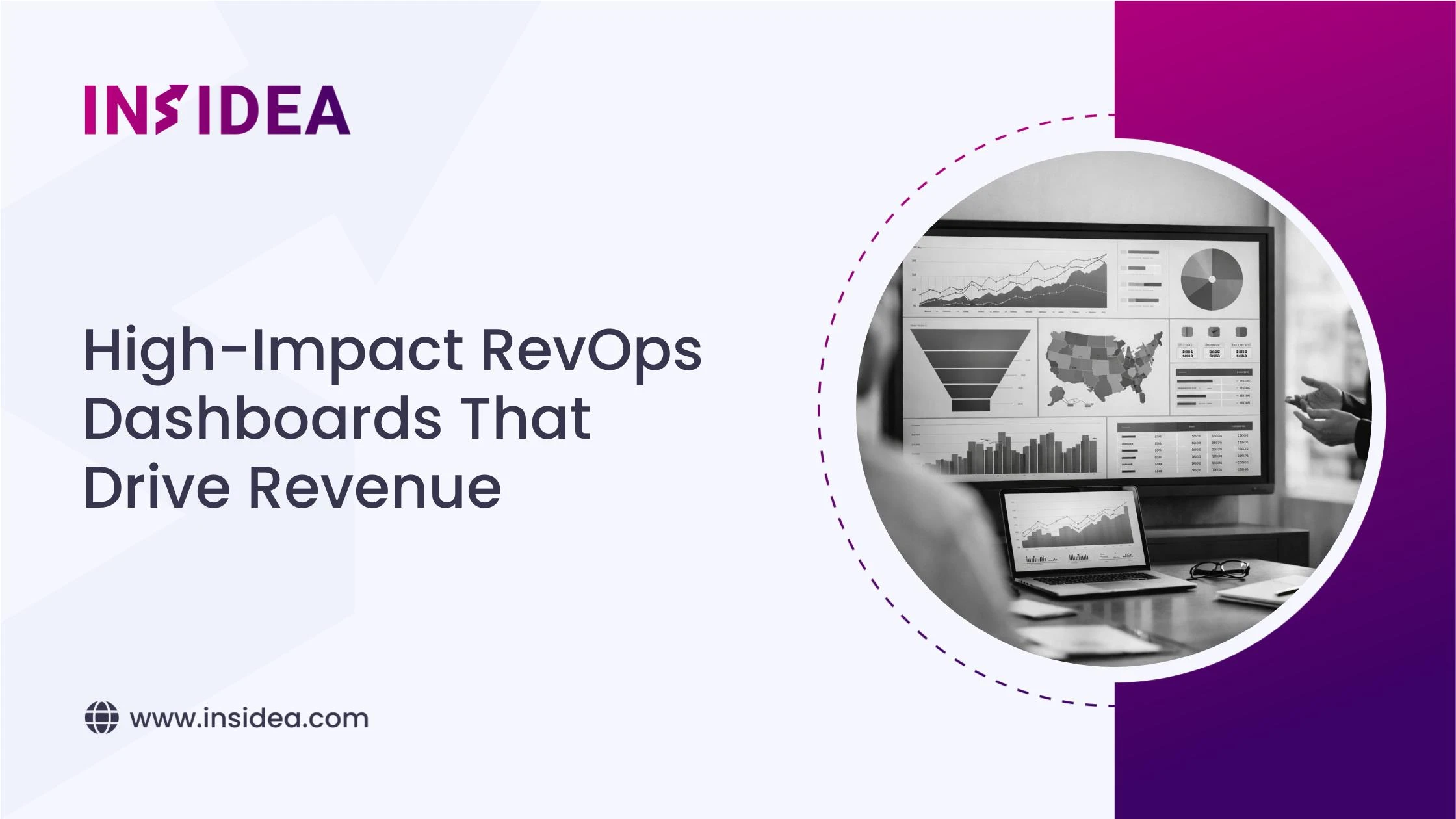
High-Impact RevOps Dashboards That Drive Revenue

Think about flying a commercial plane with no cockpit instruments. No altimeter, no GPS, no fuel gauge. Just clouds and your instincts to guide you. It sounds reckless — and yet that’s exactly how many B2B companies operate their revenue engines. You’ve probably seen it firsthand: Marketing is pulling in leads, Sales is pushing to close, and Customer Success is firefighting churn issues. But without an integrated view of what’s driving (or draining) revenue, each team is working hard but steering blindly. RevOps performance dashboards offer a fix — and not the clunky spreadsheets you’ve cobbled together for Monday’s meeting. We’re talking about dynamic, centralized dashboards that surface pipeline bottlenecks, uncover revenue leaks, and align every team around a shared growth target. And no, you don’t need a massive analytics team or enterprise-level budget to pull this off. With the right strategy and tools, you can build dashboards that don’t just report data — they drive action. Here’s how to make that happen. What Are RevOps Performance Dashboards, Really? By now, you’ve likely heard the buzz around Revenue Operations (RevOps). But beyond the jargon, RevOps is about aligning Sales, Marketing, and Customer Success under a single, cohesive strategy — utilizing unified

How RevOps Drives Success in Subscription-Based Businesses
Jigar Thakker

How RevOps Drives Success in Subscription-Based Businesses

You’ve built a subscription business that’s starting to hum. Monthly recurring revenue is climbing steadily. Sales and retention numbers are improving quarter by quarter. On the surface, your engine appears to be running just fine. But behind the scenes, you’re constantly firefighting. Finance is unsure when revenue will actually land. Sales complains about lead quality. Marketing insists it’s driving pipeline. Customer success is juggling spreadsheets and missed renewal alerts. Forecasts feel more like hopeful guesses than data-backed projections. If this sounds familiar, you’re likely facing a revenue disconnect—not a growth problem. Here’s the fix you’re missing: a strategic RevOps foundation built for your recurring revenue model. Let’s dig into why Revenue Operations (RevOps) isn’t just a buzzword, but the structure your subscription business needs to scale with clarity and confidence. What Is RevOps—and Why Should Subscription-Based Businesses Care? RevOps—short for Revenue Operations—brings together sales, marketing, customer success, and finance under a single, aligned function. The purpose? To streamline how revenue flows through your business by eliminating silos, syncing data, and optimizing cross-functional processes. If you’re running a subscription-based business, RevOps quickly becomes non-negotiable. Unlike companies that rely on one-time purchases, your growth depends on delivering consistent value across the entire customer

Talent Development Strategies for Building a Strong RevOps Team
Jigar Thakker

Talent Development Strategies for Building a Strong RevOps Team

Picture this: your business is a high-performance race car. You’ve invested heavily in the engine (Sales), tuned the grip of the tires (Marketing), and fine-tuned the steering (Customer Success). But without precision coordination across all of them, you’re not crossing that finish line ahead of the competition. That’s where Revenue Operations (RevOps) becomes your secret advantage. Think of it as your race engineer, keeping every system in sync and accelerating forward momentum. But here’s the catch: most companies focus on building RevOps systems—and miss entirely the talent development needed to make those systems actually work. You can’t just hire a RevOps unicorn and expect magic. You need a strategy for building competency and confidence across a team that thinks holistically and drives measurable impact. Smart RevOps leadership begins with cultivating individuals who can see across silos—and know how to integrate the GTM engine. If you’re leading a growth-stage B2B company and want scalable, sustainable revenue growth, RevOps talent development isn’t optional. It’s non-negotiable. Here’s how to get it right. Why RevOps Talent Development Is More Than Hiring Too often, you’ll hear this from well-meaning leaders: “We’ll just hire someone to run RevOps.” But RevOps isn’t a job title—it’s a mindset. And

Effective Budget Planning for RevOps Teams
Jigar Thakker

Effective Budget Planning for RevOps Teams: A B2B Leader’s Guide

Imagine trying to grow your business while Sales, Marketing, and Customer Success all sprint in different directions—each using separate tools, chasing separate metrics, and competing for limited funds. Cash burns fast. Frustration builds faster. And worst of all, your revenue strategy fractures because no one’s on the same page. This is what happens in many B2B companies before they adopt Revenue Operations (RevOps). And it’s exactly why RevOps budget planning isn’t a nice-to-have—it’s the blueprint for scaling with precision. If you’re leading a startup, overseeing GTM functions, or managing a fast-growing team, this guide will show you how to turn budget planning into a revenue-driving engine—aligning cross-functional teams, reducing waste, and making every dollar work harder. Let’s walk through what smart RevOps budgeting looks like, where companies go wrong, and how to build a budget that actually fuels growth—not just funds activity. What RevOps Budget Planning Really Means At its core, Revenue Operations is about bringing clarity and coordination to everything that impacts revenue. That includes your GTM strategy, the systems that support it, and—most critically—how you allocate your resources. So when you think about RevOps budget planning, you’re not just setting spend limits. You’re intentionally investing across Sales, Marketing, and

Revolutionizing Revenue with RevOps Process Automation
Jigar Thakker

Revolutionizing Revenue with RevOps Process Automation

Picture this: you’re leading a high-growth B2B startup. Your sales team is closing deals. Marketing is cranking out solid campaigns. Customer success is based on client feedback. Yet somehow, revenue isn’t tracking with all that hustle. Pipelines are overflowing with unqualified deals. Attribution is fuzzy at best. Internal metrics clash. Your CRM is a cluttered maze of outdated records. The result? Missed targets and stalled momentum. You’re not the only one dealing with this frustration. These symptoms often indicate a deeper issue: misaligned revenue operations that are dragging down performance behind the scenes. Here’s the good news—this is precisely where RevOps process automation becomes a game-changer. Far from being a shiny buzzword, it’s the structural advantage your business needs to scale efficiently. Let’s break down what RevOps automation really solves, what it looks like in practice, and how INSIDEA helps you activate that potential. What Is RevOps—and Why It’s the Revenue Engine You Didn’t Know You Needed RevOps (short for Revenue Operations) is about fusing sales, marketing, and customer success into one cohesive ecosystem. It gives your business shared metrics, insight into the full customer lifecycle, and operational consistency that doesn’t crumble under pressure. If you’ve ever felt like each go-to-market

Mapping the Customer Journey Through the Lens of RevOps

You’re doing everything right on paper: marketing is generating leads, sales is sprinting to close deals, and customer success is battling churn. Still, your revenue targets feel just out of reach. You’re stuck wondering why the math doesn’t add up. Here’s the hard truth: disconnected efforts—even with the best intentions—don’t scale. If your customer experience is fragmented, your growth will be too. Imagine your teams as expert musicians, each playing flawlessly—but not in sync. What could be music becomes noise. That’s what happens when siloed departments try to manage a nonlinear, continuous buyer journey. This is where Revenue Operations (RevOps) changes the game. By layering RevOps onto customer journey mapping, you give your business an operational strategy that aligns every function around how revenue is actually generated—and sustained. Let’s dig into how you can connect the dots, sharpen visibility, and unlock scalable growth. What Is RevOps, and Why Does It Matter for Customer Journey Mapping? Think of RevOps as your business’s coordination engine. It doesn’t replace your go-to-market teams—it unifies them. With RevOps, marketing, sales, and success aren’t siloed departments running on different agendas; they’re aligned units pulling toward a common goal: sustainable, predictable revenue. Traditionally, each team chases its own

Boosting Operational Efficiency with RevOps Frameworks
Jigar Thakker

Boosting Operational Efficiency with RevOps Frameworks

Your revenue funnel shouldn’t feel like gambling — where leads vanish without explanation, teams misfire on handoffs, and budgets bleed into disconnected tools. But when sales, marketing, and customer success operate in silos, that’s often the reality you’re stuck navigating. If you’re overwhelmed by patchworked systems, vague forecasts, and finger-pointing between departments, you’re not alone. This is precisely where Revenue Operations (RevOps) steps in. As a B2B leader, you’ve likely built capable teams. But without operational clarity and a unified strategy, those teams struggle to scale efficiently. RevOps isn’t just a trend — it’s a proven framework to reduce friction, align efforts, and drive results across your entire go-to-market engine. Let’s break down how to make it work for your business — and how INSIDEA can help you put a RevOps framework into action without hiring an in-house army. What Is RevOps, Really? If RevOps sounds like yet another buzzword floating around your leadership meetings, you’re hardly alone. But here’s the difference: RevOps isn’t just jargon — it’s a structural solution to systemic inefficiencies. At its core, Revenue Operations (RevOps) connects your sales, marketing, and customer success teams within a unified operational framework. That means working from shared data, syncing on

Using Predictive Modeling in RevOps for Decision-Making
Jigar Thakker

Using Predictive Modeling in RevOps for Decision-Making

Your business doesn’t just need to grow—it needs to succeed in a way you can predict, repeat, and scale without burning out your teams or budgets. But here’s the kicker: most companies attempt to grow by adding more—more campaigns, more hires, more tools—without aligning how everything functions together. Think about it like mid-air engineering. Marketing is bolt-on, building the wings. Sales is overhauling the cockpit. Customer success is scrambling to keep the tanks full. You’re moving forward, but the turbulence—and the risk—keeps building. Now, picture an integrated system that works across your go-to-market engine—pinpointing exactly where to focus next, based on real-time intelligence. That’s what you unlock when you combine Revenue Operations (RevOps) with predictive modeling. In this guide, you’ll discover how predictive RevOps helps you make smarter, faster business decisions by unifying teams around shared data, identifying your best opportunities, and taking the guesswork out of growth. But first, let’s take a hard look at what’s standing in your way. What’s Broken: The Decision-Making Disconnect in Modern Companies You already have all the usual dashboards. Your CRM logs every touch. Your marketers track conversions. Your customer success team collects feedback on a regular basis. So why, when you’re choosing where

How RevOps Fosters Cross-Team Collaboration for Revenue Growth
Jigar Thakker

How RevOps Fosters Cross-Team Collaboration for Revenue Growth

You’ve built a capable sales team. Marketing is churning out creative campaigns. Customer success is dedicated to retaining and expanding your accounts. But despite everyone’s effort, something’s off. Leads stall after the first contact. Deals close, but customers churn within months. Key feedback often fails to reach the people who need it most. It feels like your teams are each running at full speed—but not in the same direction. If this sounds familiar, you’re not alone. Most go-to-market teams aren’t failing due to a lack of effort. They’re failing because they’re working in silos. And when your business growth depends on tight coordination from first click to renewal, that disconnect becomes expensive. This is where Revenue Operations (RevOps) steps in. It’s not just a support function—it’s the connective system that brings your revenue engine into sync. With the right RevOps strategy, you create alignment, clarity, and accountability across departments that traditionally operate in isolation. And with growing pressure to improve margins and reduce inefficiencies, this kind of collaboration is no longer optional—it’s a competitive advantage. What Exactly Is RevOps? RevOps is the strategic unification of your sales, marketing, and customer success functions under a single operational framework. Rather than letting each

Jigar Thakker

Close the Gap with Sales and Marketing Alignment in RevOps

Here’s a common—and costly—reality: your marketing team is celebrating a wave of new leads, while your sales reps are barely making quota. Everyone’s working hard, but the numbers don’t line up. That misalignment isn’t just a headache—it’s quietly draining your growth engine. Take a moment and ask yourself: do your sales and marketing teams actually agree on what a qualified lead looks like? How often are they collaborating, beyond a monthly pipeline review? If the answer makes you squirm, you’re not dealing with a surface-level coordination issue—you’re facing a more profound structural disconnect. The good news: there’s a proven way to fix it. It’s called Revenue Operations, or RevOps. Not a trend, not just another role—RevOps is a strategic shift that brings sales, marketing, and customer success into true sync around a single shared goal: predictable, sustainable revenue. Let’s walk through how RevOps brings that alignment to life—and how INSIDEA can help you implement it without missing a beat. Understanding the True Cost of Misalignment Before diving into how to fix the problem, you need to clearly grasp what’s at stake when sales and marketing function in silos. Marketing may pass off leads that sales doesn’t recognize—or dismisses outright. Sales ends

Top Analytics Tools Every RevOps Team Needs for Decisions
Jigar Thakker

Top Analytics Tools Every RevOps Team Needs for Decisions

Trying to grow revenue without visibility is like flying blind through turbulence. You might be hitting your numbers, but if you can’t explain what’s working—or why something’s falling flat—then success is just luck dressed up as strategy. That’s where Revenue Operations, or RevOps, changes the game. It isn’t just a framework—it’s how you connect the dots between data, decisions, and dollars at every stage of the customer journey. Whether you’re leading a startup, scaling post-Series A, or managing GTM teams across functions, this guide isn’t about listing tools for the sake of it. You’ll find the platforms that matter most—and how they directly address the real bottlenecks that hold growth back. Let’s sharpen your revenue engine and remove the guesswork. What Exactly Is RevOps—and Why Should You Care? RevOps unifies sales, marketing, and customer success under a single operational strategy—with a unified set of tools, metrics, and truths. Instead of working in silos, your teams are aligned around a single objective: repeatable, insight-led revenue growth. But alignment doesn’t magically appear. It takes accurate, accessible data. The right RevOps analytics tools bring that data out of hiding—from your CRM, your pipeline, and your post-sale outcomes—so you can see what’s helping or hurting

The Award-Winning Team Is Ready.

Are You?

“At INSIDEA, it’s all about putting people first. Our top priority? You. Whether you’re part of our incredible team, a valued customer, or a trusted partner, your satisfaction always comes before anything else. We’re not just focused on meeting expectations; we’re here to exceed them and that’s what we take pride in!”

Pratik Thakker

Founder & CEO

Company-of-the-year

Featured In

Want to See Your Digital Ideas
Come to Life?

Book a demo and discovery call to get a look at:


By clicking next, you agree to receive communications from INSIDEA in accordance with our Privacy Policy.