

Did you know that Google officially accepts content created with AI? However, the real issue is not the use of AI, but the production of content that prioritizes rankings over delivering value. This is why most penalties happen when content lacks originality, insight, or human expertise.
Data shows that after the March 2024 update, sites removed from search results often had high volumes of AI-generated content with little editorial oversight. The main factor is intent and quality, not the production method.
This guide explains what Google has actually stated about AI content, how its major updates have targeted low-value content, and how the E‑E‑A‑T framework applies. It shows how AI can be used responsibly to create content that ranks well and delivers genuine value to readers.
Google’s Official Position on AI-Generated Content
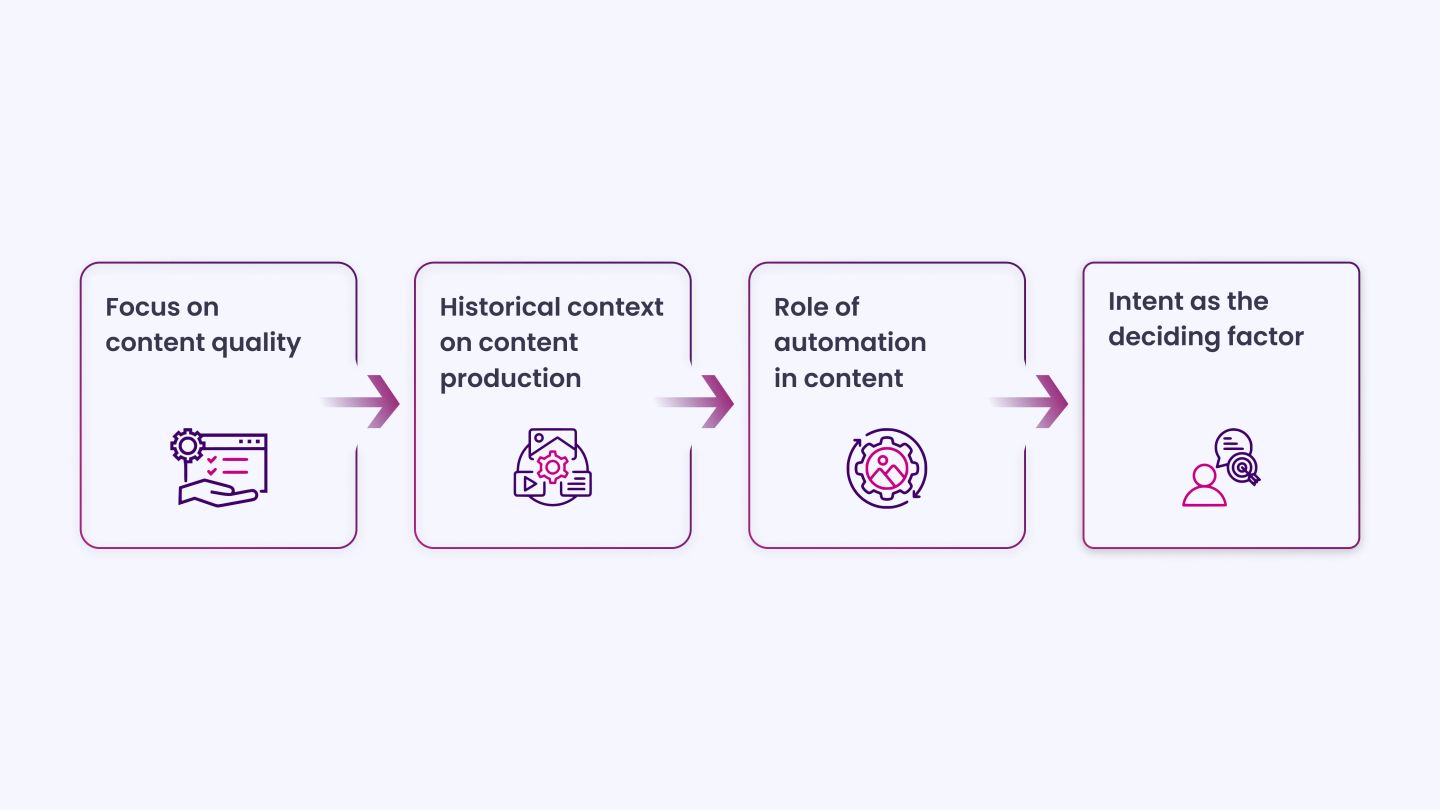
Google’s official position on AI content, published on its Search Central blog, is direct:
- Focus on content quality: Google’s ranking systems aim to reward original, high-quality content that demonstrates qualities of E-E-A-T: expertise, experience, authoritativeness, and trustworthiness. The focus on the quality of content, rather than how content is produced, is a useful guide that has helped deliver reliable, high-quality results to users for years.
- Historical context on content production: Google also addressed the historical parallel directly. About ten years ago, there were understandable concerns about a rise in mass-produced yet human-generated content. No one would have thought it reasonable to declare a ban on all human-generated content in response. Instead, it made more sense to improve systems to reward quality content. The same logic now applies to AI.
- Role of automation in content: Automation has long been used to generate helpful content, such as sports scores, weather forecasts, and transcripts. AI can power new levels of expression and creativity and serve as a critical tool to help people create great content for the web.
- Intent as the deciding factor: The clearest statement of intent comes from Google’s own FAQ: if you see AI as an essential way to help you produce content that is helpful and original, it might be worth considering. If you see AI as an inexpensive, easy way to game search engine rankings, then no.
That is the dividing line. Production method is not the issue. Intent and output quality are.
AI Content Adoption and Usage Data
Before getting into what Google penalizes, it’s worth grounding this in the actual extent of AI content use across marketing teams today.
Content Marketers Embracing AI in Content Creation
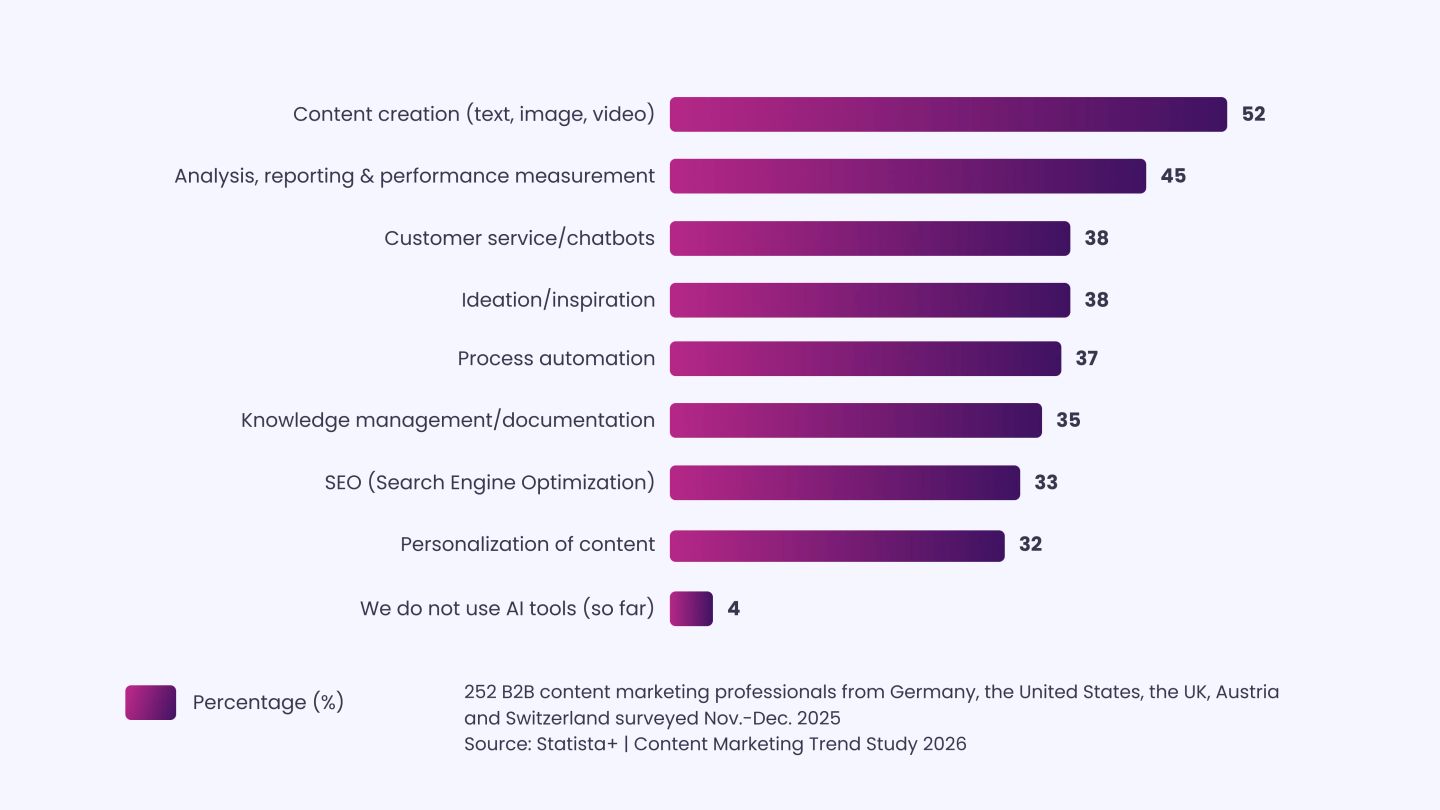
This chart from Statista, available under Creative Commons License CC BY-ND 3.0, shows the main usage of AI tools among content marketers in the US in 2025.
Data points from that chart and related research:
- Approximately 42% of marketing and media leaders worldwide reported using AI tools daily or a few times per week for writing or generating content as of early 2024.
- 97% of content marketers plan to use AI to support content marketing efforts in 2026, up from 90% in 2025, 83.2% in 2024, and 64.7% in 2023.
- Only 1% of content marketers say their work is 100% generated by AI.
That last number matters. The vast majority of marketers using AI are using it as a production tool, not a replacement for human authorship. The 1% producing fully AI-generated content is, unsurprisingly, the group Google’s systems are designed to address.
March 2024 Google Update and Its Impact on Content Quality
The March 2024 core update was the most significant enforcement action Google had taken on content quality to that point. Understanding what it targeted and what the data showed matters for anyone making decisions about AI content production.
How Google Redefined Low-Quality Content
Google introduced three new spam policies alongside the March 2024 core update: expired-domain abuse, scaled-content abuse, and site-reputation abuse.
The scaled content abuse policy builds on Google’s previous spam policy on automatically generated content, ensuring that action can be taken on more types of low-quality content, regardless of whether it was produced through automation, human effort, or a combination of both.
The policy shift here was deliberate. Previously, Google’s spam policy specifically targeted automatically generated content. The expanded policy removed that qualifier. Producing thin content at scale is a violation, whether it was produced by a human team or an AI model.
Deindexing Data from the March 2024 Update
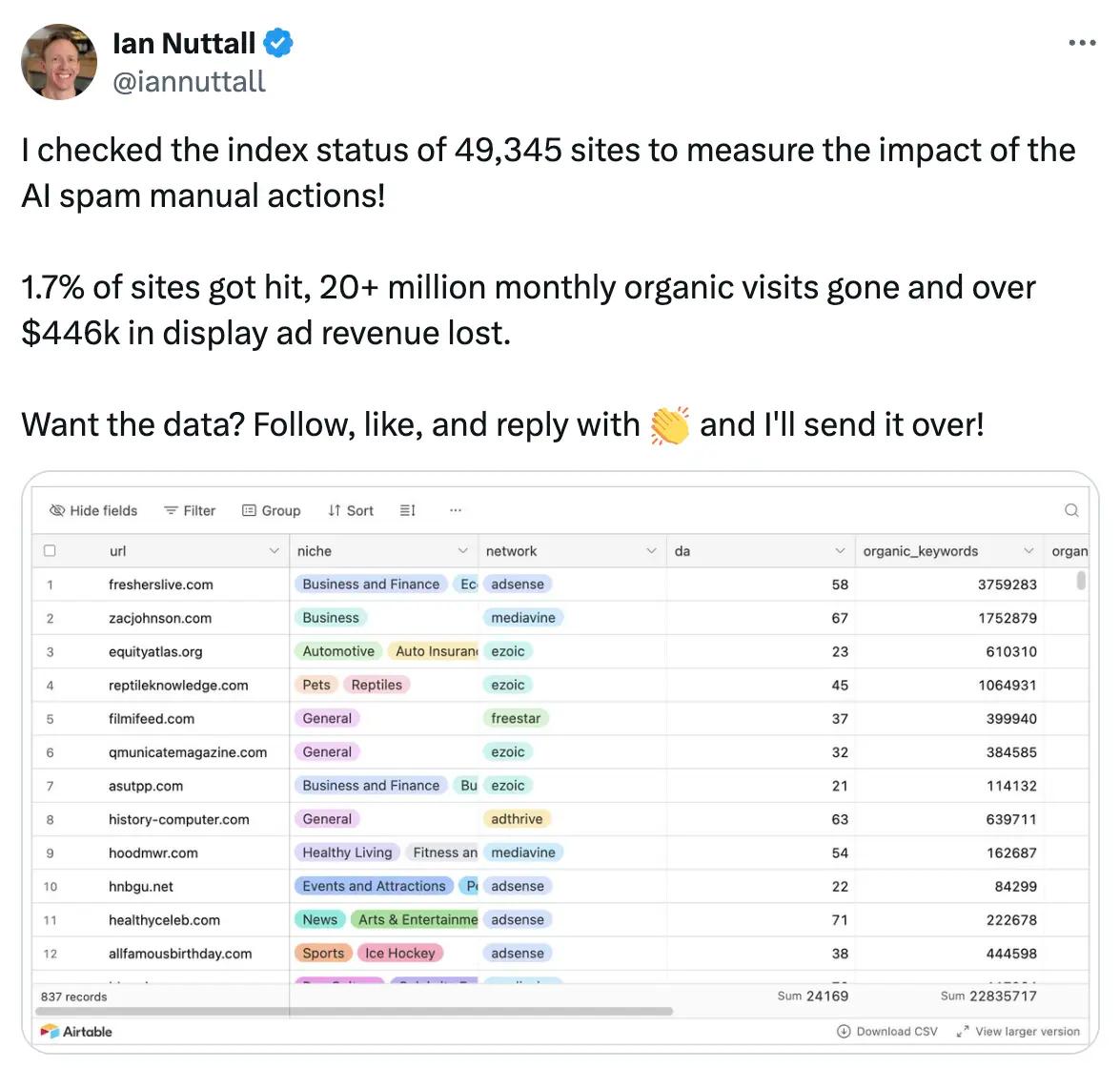
The above data comes from SEO researcher Ian Nuttall’s analysis of 49,345 tracked websites
Figures from that analysis:
- As the updates rolled out, 837 (1.7%) of 49,345 monitored sites were deindexed, or entirely removed from Google’s search index. That represents over 20 million monthly organic visits gone overnight.
- The study found that 100% of affected sites exhibited signs of AI-generated content, with 50% of them having 90-100% of their posts generated by AI.
- The 837 deindexed sites accounted for over $446,000 in estimated lost display ad revenue.
One pattern visible in the data: the sites hit were not producing niche, carefully researched, AI-assisted articles. These sites flooded search results with content that superficially matched queries but offered little value. Google confronted mounting concerns about AI’s potential to displace human creativity by targeting fabricated content.
| What Happened After March 2024? Google ran three core updates in 2025, and the message stayed consistent.
|
How Google Evaluates Content Quality: E-E-A-T in Practice

E-E-A-T stands for Experience, Expertise, Authoritativeness, and Trustworthiness. It is not a score or a direct ranking factor. It is the framework Google’s quality raters use to assess whether content deserves to rank, and it directly informs how the underlying algorithms are calibrated over time.
Experience: The Signal AI Cannot Replicate
Experience refers to first-hand knowledge of a subject. Someone who has actually done the thing they are writing about, not someone synthesizing what others have published about doing it.
Google has now added another factor in determining whether content is untrustworthy and has the lowest E-E-A-T: content generated by AI, outdated, and not error-free.
This is the structural limitation of pure AI output. An AI tool can produce a plausible-sounding article on almost any topic. It has no first-hand experience of any of them.
Expertise: Depth That Shows in the Writing
In 2025,65% of companies say AI-generated content improved their SEO performance. But success still depends on quality, user intent alignment, and technical optimization. AI can scale faster than humans, but its impact depends on smart prompts, editing, and experience-based inputs that align with Google’s evolving ranking signals.
Expertise shows up in the specificity of claims, the accuracy of details, the handling of edge cases, and the judgment applied in deciding what to include and what to leave out. These qualities come from subject-matter knowledge and are visible in the final content, regardless of whether AI assisted in producing it.
Authoritativeness: Credibility That Can Be Verified
Authoritativeness is built by clearly demonstrating who is behind the content and why they are qualified to speak on the topic. Creating author pages, detailed bios, and showcasing credentials helps establish legitimacy and reinforces content ownership.
Even when using skilled ghostwriters, highlighting the team’s expertise and experience adds a layer of credibility that both search engines and users recognize. Consistent attribution and transparency strengthen authority signals over time and contribute to a more trustworthy content ecosystem.
Trustworthiness: Accuracy Users Can Rely On

Trustworthiness is rooted in accuracy, transparency, and reliability. AI models are prone to factual errors, and publishing unreviewed content increases the risk of misinformation, which can directly impact credibility and rankings.
For sensitive topics such as health, finance, or legal information, the expectations are significantly higher. Google places stronger emphasis on reliability signals in these areas, making human review, fact-checking, and editorial oversight essential to ensure the content meets the required standards.
How AI Adoption Impacts SEO Performance?
AI is becoming an integral part of content marketing, but adoption does not always guarantee results. While many marketers are using AI tools for writing and SEO, the impact on search performance varies widely.
Understanding the relationship between AI usage and content quality shows where risks and opportunities lie. The following data points illustrate how marketers are using AI and the outcomes they report.
The disconnect visible in adoption data is significant:
- 63% of marketers said most of their content in 2024 would come from generative AI. More than half of marketers (56%) claim generative AI content outperforms human content.
- Yet nearly 30% of marketers reported decreased search traffic as consumers turn to AI tools, suggesting that publishing volume is not correlating with organic performance for a large segment of the market.
- 67% of small businesses use AI for content marketing and SEO. 65% of companies report better SEO results when using AI.
The gap between those two sets of numbers reflects what Google’s own data confirms: the difference in outcome is not about whether you use AI, it is about how editorially rigorous the output is.
Where AI Content Performs Well vs. Where It Fails?
The pattern across Google’s updates and observed ranking data is consistent enough to draw clear conclusions.
Content That Gets Penalized
If you have articles that are primarily AI-generated with no unique insights, expert knowledge, or genuine value, they are candidates for removal from search results. In some cases, sites in this category were fully de-indexed after the March 2024 update.
The common characteristics of penalized content:
- High-volume publishing with no editorial investment per article
- No named author with verifiable credentials
- Content that answers queries at a surface level without original analysis
- Factual errors that indicate no human review before publication
Content That Ranks Well
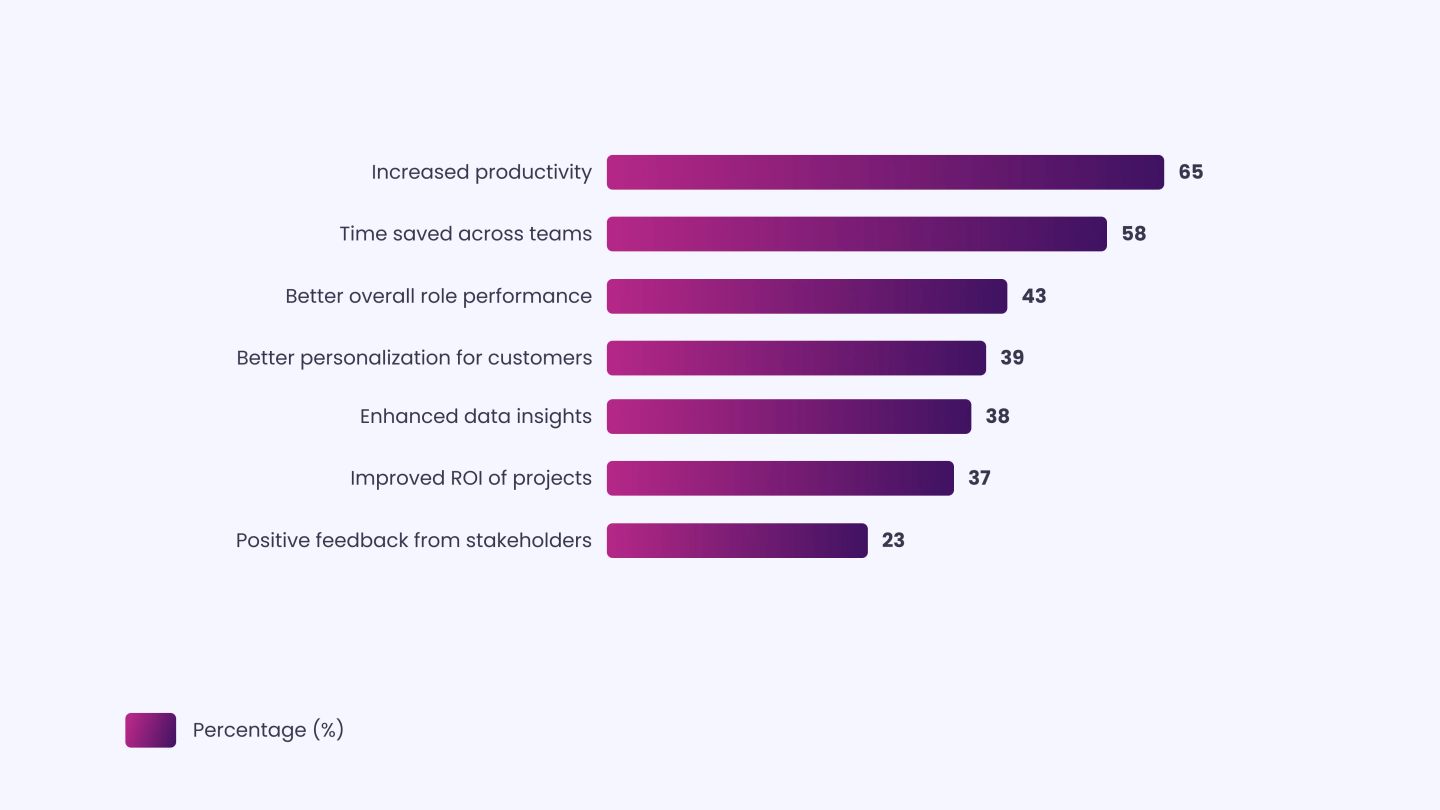
74% of content marketers use AI for content ideation, 61% for outlining, and 44% for drafting content. Only 1% say 100% of their work is AI-generated. The high-performing majority are using AI at specific stages, not as a full replacement for production.
The pattern for content that maintains or grows rankings after major algorithm updates: subject matter experts use AI for research synthesis and structural efficiency, then apply their own analysis, examples, and voice before publication.
AI or automation disclosures are useful for content where someone might think: how was this created? Consider adding these when it would be reasonably expected.
| AI Overviews
Google’s AI Overviews (AIOs) now affect whether your content gets seen, not just whether it ranks.
What this means for AI content: Poor-quality AI content gets penalized twice, excluded from organic rankings, and from the AIO appearing above them. How to get cited in AIOs: Strong E-E-A-T signals + structured answers (lists, bullets) + traditional ranking authority. |
How to Use AI in Content Production Without Risk
There is no prohibition on using AI tools in content production. The question is what human contribution accompanies the AI output before publication.
Use AI for research synthesis, draft structure, first drafts that get substantively rewritten, improving readability of human-written sections, generating FAQ variations, and metadata.
Apply human expertise for every factual claim, the analysis drawn from data, the examples that come from actual experience, the voice that distinguishes your content from competing articles, and the final editorial review before publication.
As explained, however content is produced, those seeking success in Google Search should look to produce original, high-quality, people-first content that demonstrates E-E-A-T.
INSIDEA
Ready to get found by people and AI?
Search and answer-engine visibility that compounds, built to be cited.

 How INSIDEA works




