


TL;DR
|
Most teams haven’t noticed the shift yet. Rankings look stable in Google Search Console, impressions are steady, and pages still sit in the top three. But traffic from informational queries continues to drop. The gap shows up in reporting before anyone can explain it.
Around 60% of searches now end without a click, with AI-generated answers taking over a large share of informational queries. With Google AI Overviews, users often get a complete answer on the results page. Platforms like Perplexity AI, ChatGPT Search, and Google Gemini follow the same pattern: fewer links, more synthesized responses, and selective citations.
This changes what visibility means. Ranking first still matters, but it no longer guarantees attention. AI systems pull from a limited set of sources, rewrite the answer, and often remove the need to visit the original page.
At a technical level, these systems use retrieval pipelines that fetch content, break it into chunks, and pass it into large language models to generate responses. If your content is not retrieved, structured clearly, and trusted, it does not appear.
So the goal splits into two: ranking in blue links and getting cited in AI-generated answers. A page can rank well and still be ignored, or get cited without ranking at the top. This blog focuses on the technical side of that shift: how AI systems crawl, process, and select content, and how to structure pages so they get used.
The Fundamentals of Technical SEO for AI Search
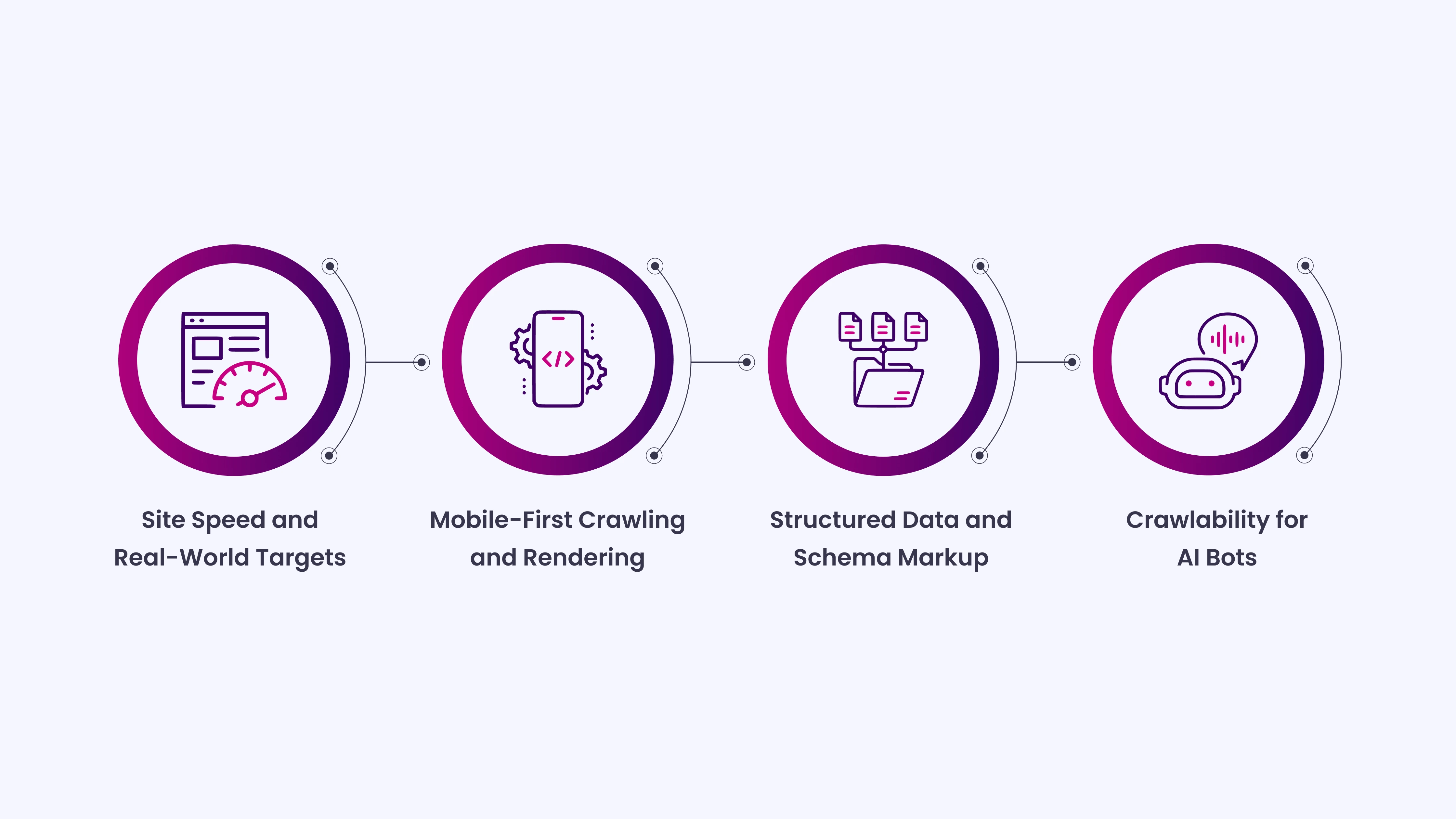
Optimizing for AI search requires attention to the technical elements AI systems prioritize. These go well past the regular SEO metrics, focusing on performance, accessibility, and structured comprehension:
Site Speed and Real-World Targets: AI crawlers deprioritize slow pages, and user experience now drives visibility. Core Web Vitals remain critical: aim for Largest Contentful Paint (LCP) under 2.5 seconds and Interaction to Next Paint (INP) under 200ms, which replaced First Input Delay in 2024.
Test performance using Google PageSpeed Insights for lab data and confirm real-world experience through Chrome UX Report (CrUX) in Search Console, as AI systems increasingly weigh actual user interactions.
Mobile-First Crawling and Rendering: Google completed mobile-first indexing across all sites in 2024. Pages that serve different content on mobile versus desktop risk being underrepresented in AI search results. Since AI engines index the mobile version, content hidden on mobile may never be cited.
Regularly audit mobile rendering via Search Console > Crawl Stats and ensure all critical content is accessible.
Structured Data and Schema Markup: Schema markup translates content into a format AI systems can parse, making pages eligible for rich results and AI citations. In 2026, the most relevant schemas include Article, FAQPage, HowTo, Organization, and SpeakableSpecification.
SpeakableSpecification is especially relevant for AI assistants and voice queries. Sites that ignore schema risk are invisible to AI extraction, even if they rank well in traditional search.
Crawlability for AI Bots: Modern AI search uses specialized crawlers such as GPTBot, ClaudeBot, and PerplexityBot. Blocking these bots in robots.txt can prevent content from being retrieved for AI-generated answers.
Manage directives carefully: allow indexing of essential content while selectively restricting low-value or sensitive pages. Understanding each bot’s crawl behavior ensures AI systems see the content you want cited.
Additional Considerations
- Server Response and Stability: Pages must load reliably under variable traffic, as AI crawlers may deprioritize intermittent failures.
- Canonicalization and URL Consistency: Proper canonical tags prevent AI systems from indexing duplicate content incorrectly.
- Internal Linking and Contextual Hierarchy: Clear site architecture helps AI models understand content relationships, which supports better retrieval and citation.
Focusing on these fundamentals ensures your content is discoverable, retrievable, and structurally understandable by AI search systems, forming the foundation for citation and visibility in the new search paradigm.
Content Signals That Influence AI Citations
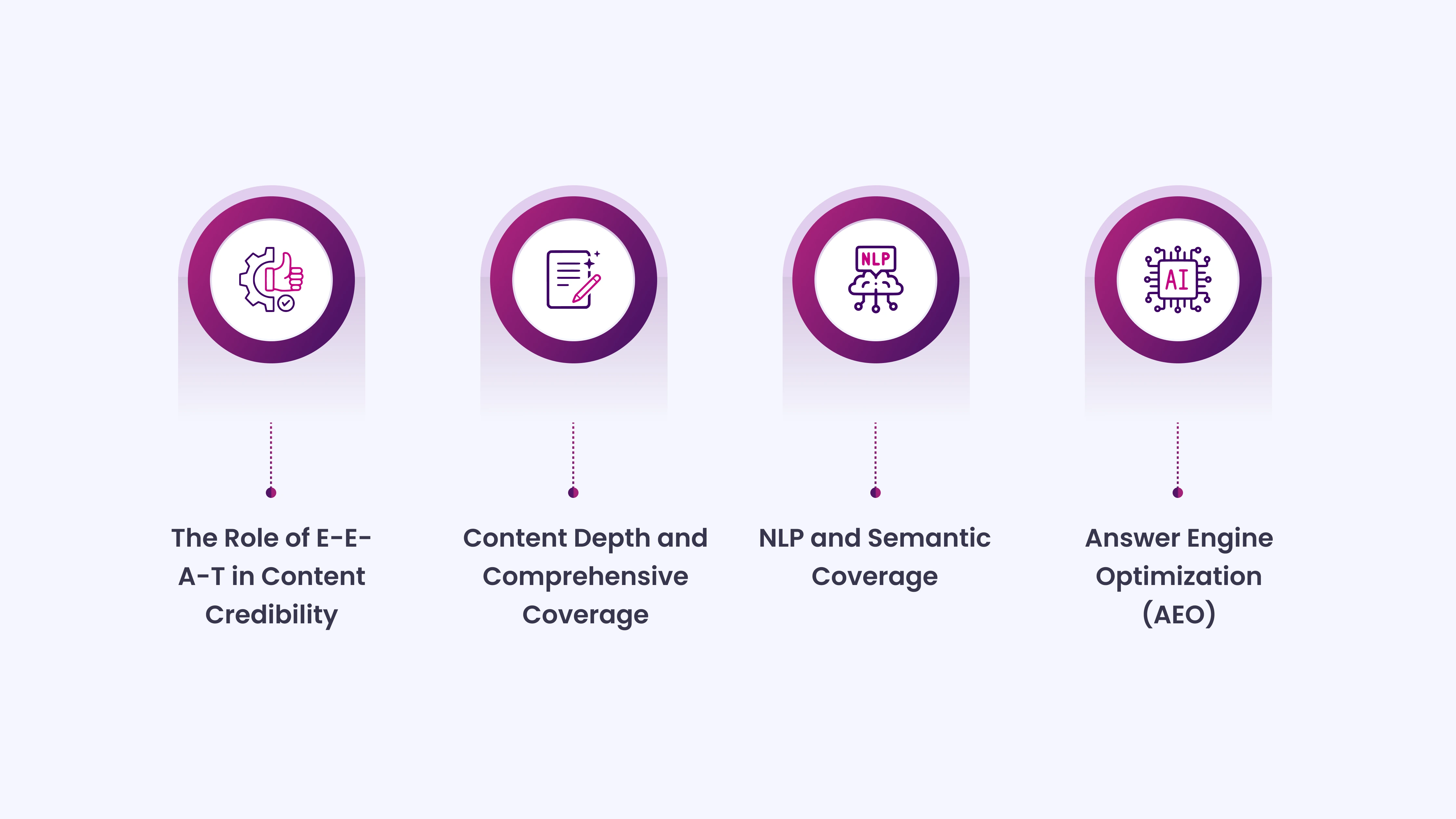
AI systems use specific signals to decide which content gets cited in generated answers. Understanding these factors helps ensure your content is selected and trusted.
- The Role of E-E-A-T in Content Credibility: Experience, Expertise, Authoritativeness, and Trustworthiness (E-E-A-T) guide AI systems in filtering sources. Improve E-E-A-T by including author bylines with verifiable credentials, showing first-hand experience, linking to authoritative sources such as Wikipedia or Wikidata, and earning citations from reputable domains.
- Content Depth and Comprehensive Coverage: AI evaluates how fully the content addresses the main question and related sub-questions. To gauge gaps, run your target query in Perplexity or a similar AI search platform and note any follow-up questions. Addressing these ensures your content meets AI expectations for thoroughness.
- NLP and Semantic Coverage: Modern AI rankers use dense vector embeddings rather than simple keyword matching. Cover related concepts, synonyms, and supporting evidence to provide semantic depth. Tools such as Clearscope and MarketMuse can highlight gaps and help establish topical authority.
- Answer Engine Optimization (AEO): AEO focuses on being cited in AI-generated answers rather than just ranking in blue links. Effective strategies include providing a concise answer within the first 100 words, using H2 and H3 headings formatted as questions, adding a Quick Answer block at the top of the page, and citing authoritative sources throughout your content.
These practices increase the likelihood that AI systems will extract and reference your content, rather than ignoring it, even if it ranks well in traditional search.
How AI Search Systems Select and Rank Content in 2026?
AI search systems use specific algorithms to evaluate and rank content. Understanding these systems is key to optimizing for them.
How RAG-Based Answer Engines Work
Most AI search engines use Retrieval-Augmented Generation (RAG), where content is chunked, retrieved, and processed by an LLM (Large Language Model) to generate an answer. Key factors in this process include freshness, source authority, semantic coherence of content chunks, and how well the content matches the user’s query intent.
Generative Engine Optimization (GEO)
GEO is focused on optimizing content for AI systems that generate answers. Adding authoritative statistics, citing credible sources, and writing quotable content increases the likelihood of being cited by AI search systems.
The Ranking Signals AI Systems Use
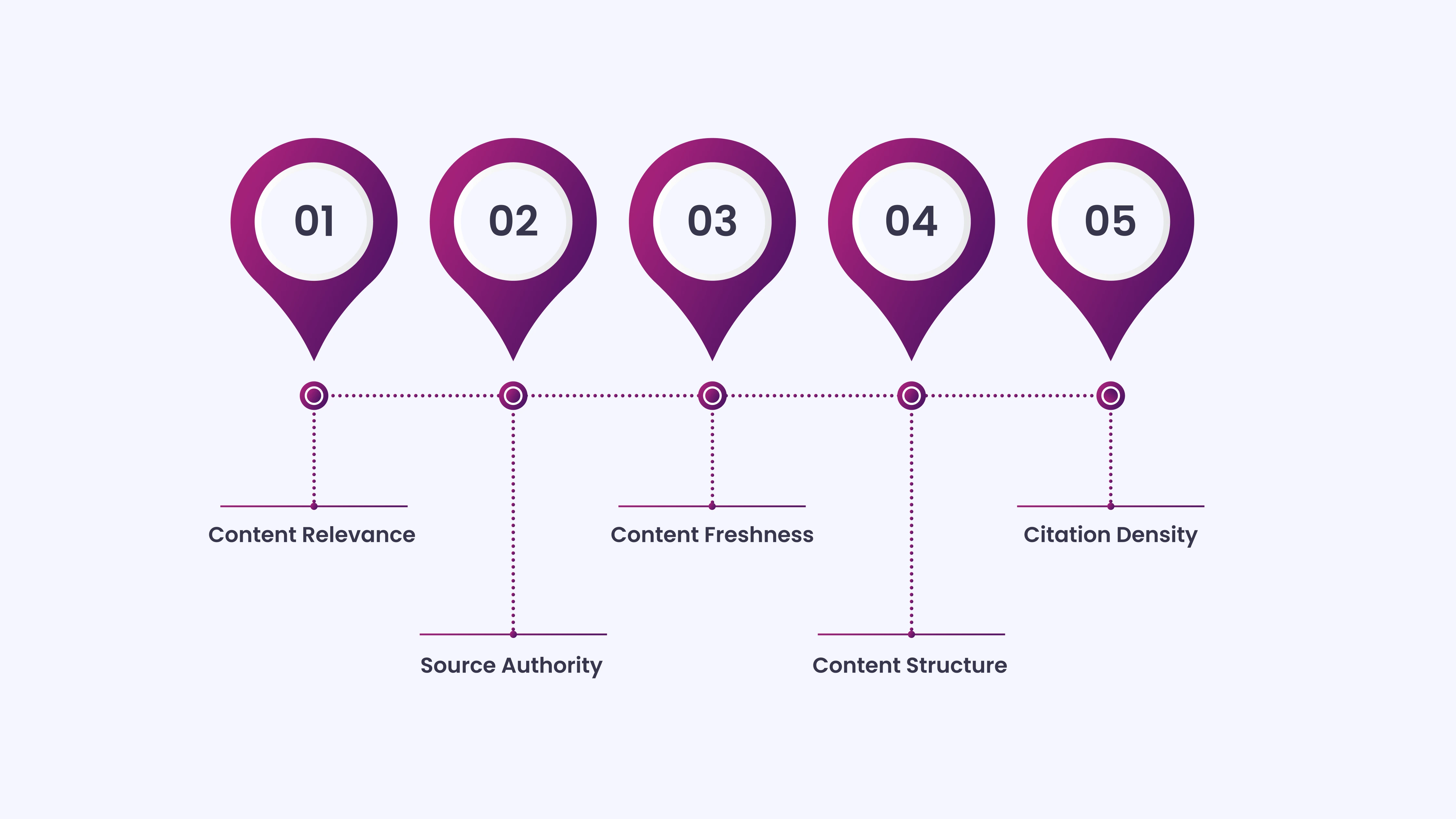 AI systems consider several ranking signals:
- Content Relevance: Semantic match to query intent.
- Source Authority: Domain trust and quality backlinks.
- Content Freshness: Important for fast-moving topics.
- Content Structure: Well-structured, chunked content is easier for AI systems to extract.
- Citation Density: Being cited by authoritative sources signals trust.
| What AI Systems Cannot Detect About Engagement?
AI search engines do not use bounce rate or time on page directly. Instead, they rely on implicit satisfaction signals, such as follow-up searches or refined queries that indicate user dissatisfaction. |
Tools and Techniques for AI Search Optimization
Optimizing for AI search requires the right tools to track performance, audit technical issues, and ensure content is structured for citation:
Monitoring Your AI Search Presence
Google Search Console now reports AI Overview impressions separately. Track AI Overview share, click-through rates from AI citations, and which queries trigger appearances. Platforms like Perplexity AI and ChatGPT Search provide additional monitoring, though some manual tracking may be needed to capture full visibility across systems.
Technical Audit Stack
A structured audit ensures your site meets AI search requirements.
Recommended tools include:
- Screaming Frog / Sitebulb: Crawl analysis and error detection
- Ahrefs / SEMrush: Backlink audits and source authority evaluation
- Google Search Console: Core Web Vitals and mobile crawling data
Run audits in sequence to identify crawlability, performance, and citation risks.
Semantic Content Tools for Topical Authority
AI rankers rely on semantic completeness. Tools like Clearscope and MarketMuse highlight missing terms, entities, and related concepts, helping your content cover the topic comprehensively before publication.
Case Study: Optimizing for AI Overview CitationA mid-authority page ranking third in traditional search results was underrepresented in AI-generated answers. Analysis revealed the content lacked a concise top-level summary and structured metadata for AI extraction. To address this:
After these adjustments, performance was monitored through Google Search Console’s AI Overview reports. The page began appearing in AI-generated citations more consistently, while traditional rankings remained stable, demonstrating that structural and schema optimizations can improve AI visibility without relying solely on higher rankings. |
Advanced Techniques for AI Search Optimization
AI search now evaluates content on multiple dimensions, requiring pages to be structured and formatted for accurate extraction and citation.
Voice and Conversational Search
Voice queries tend to be longer and more naturally phrased. Optimizing for voice requires answer blocks that read smoothly when spoken aloud. Avoid tables or bullet points in voice-targeted sections and implement the SpeakableSpecification schema to make content accessible for AI assistants.
Featured Snippets vs. AI Overviews
AI Overviews differ from featured snippets, but content that performs well in both includes short-paragraph answers, numbered lists, and tables. Use clear formatting and headings so AI systems can parse the content accurately.
Local SEO in AI Search
For location-specific queries, AI Overviews pull information from Google Business Profile data and relevant local pages. Optimize your GBP Q&A and LocalBusiness schema with geo-coordinates and service area definitions to improve visibility in AI-generated answers.
Topical Authority and Content Clustering
AI systems evaluate content at the domain level rather than individual pages. Building pillar pages with supporting cluster content and interlinking demonstrates comprehensive coverage, signals depth to AI models, and improves the likelihood of citations.
Critical Mistakes to Avoid in AI Search Optimization
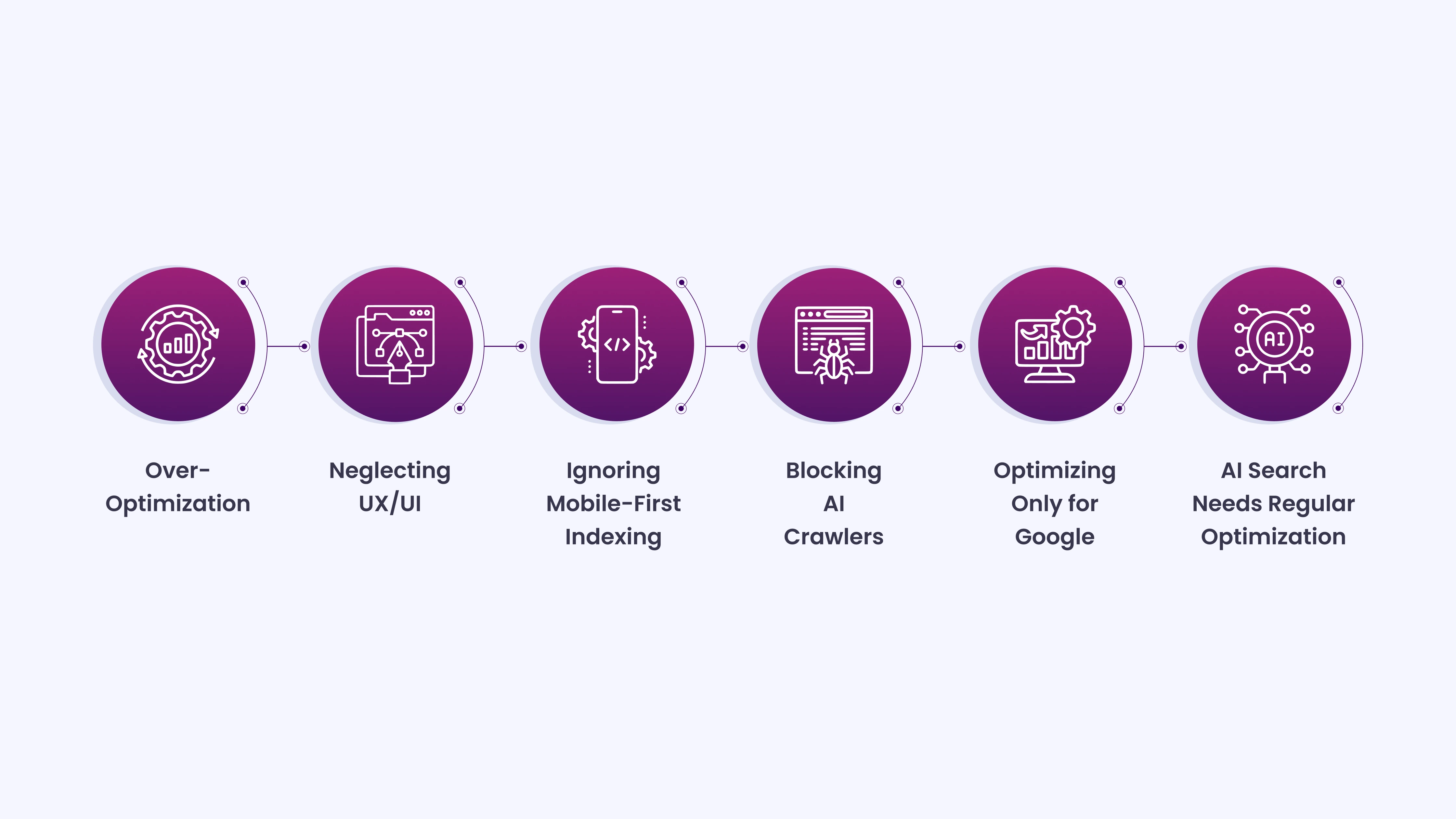
Certain common errors can limit the visibility of your AI search. Avoiding these ensures your content is both citable and discoverable:
- Over-Optimization: Keyword stuffing and excessive optimization degrade content quality. AI search systems detect unnatural patterns, which can reduce the likelihood of being cited. Focus on writing for human experts first, and optimize later.
- Neglecting UX/UI: Poor user experience, such as intrusive pop-ups or poor mobile design, harms AI rankings. Ensure your site provides a smooth, engaging experience for users.
- Ignoring Mobile-First Indexing: Content hidden behind tabs or accordions on mobile is not indexed by AI search systems. Regularly audit your site using Google’s Mobile-Friendly Test and compare mobile versus desktop rendering.
- Blocking AI Crawlers: Blocking AI crawlers without understanding the consequences can severely limit your visibility. Be intentional about which bots you block and understand the business consequences of each decision.
- Optimizing Only for Google: AI search is expanding beyond Google. Track your presence in platforms like Perplexity and Bing Webmaster Tools to monitor brand citations across different AI systems.
- AI Search Needs Regular Optimization: AI search optimization requires ongoing attention. Regularly audit your AI search performance, update content, and adapt to evolving AI algorithms.
The Future of SEO with AI Search
AI is changing how content is discovered, cited, and acted upon. Understanding these shifts helps websites stay visible and relevant as AI-driven search continues to change:
Agentic Search and Optimizing for AI Actions
AI agents increasingly perform tasks such as booking appointments, comparing products, and completing purchases. Pages that provide machine-readable structured data, clear page architecture, and accurate pricing or availability are more likely to be selected for these automated actions.
Multimodal Search and Optimizing Visual Content
AI systems can now interpret images, video, and other non-text content. Descriptive alt text, captions, and schema markup allow AI models to understand and cite visual content. Optimizing visuals ensures your pages appear in AI-generated answers for image- or video-based queries.
Balancing Traditional SEO with AEO and GEO
Transactional queries still rely on standard SEO signals, but informational queries are increasingly served via Answer Engine Optimization (AEO) and Generative Engine Optimization (GEO). Maintaining both ensures your content is visible across conventional search results and AI-driven answers.
The 90-Day Execution PlanThis plan provides a structured approach to optimizing your site for AI search over three months, covering technical fixes, content updates, and monitoring. Month 1: Technical Foundation
Month 2: Content Optimization
Month 3: Monitoring and Refinement
Outcome: Following this 90-day plan ensures the site is technically solid, semantically complete, and structured for maximum visibility in AI search results. Continuous monitoring supports adaptation to evolving AI behavior. |
Transitioning Your SEO Practice into AI Search Optimization
AI search is changing how content is discovered and cited. Success depends on shifting focus toward optimizing for AI citations, building topical authority across the site, and tracking performance across multiple AI platforms.
Effective websites combine technical accuracy with clear, authoritative content. Structured data, semantic coverage, and organized content create a solid foundation, while high-quality writing ensures AI systems reference content reliably.
INSIDEA helps organizations implement technical updates, refine content strategies, and monitor AI search visibility, ensuring content remains authoritative, accurate, and actionable.
Optimize Your Site for AI Search with INSIDEA
Traditional SEO alone no longer guarantees traffic. Pages can rank highly yet be ignored in AI-generated answers, and informational queries are increasingly ending without clicks. Many teams struggle to structure content, implement appropriate schemas, and ensure that AI systems cite their work.
We help organizations make content AI-ready while maintaining search performance. We implement technical fixes, optimize pages for AI citation, and monitor visibility across multiple AI platforms so your content is both discoverable and authoritative.
Here are the services we provide:
- AI Search Optimization: Technical SEO updates, schema implementation, and structured content strategies to ensure AI systems retrieve and cite your pages.
- Answer Engine Optimization (AEO): Quick Answer blocks, top-level summaries, and semantic content structuring for higher chances of AI citations.
- Performance Monitoring: Track AI Overview impressions, citation share, and multi-platform visibility to measure impact and adjust strategies.
- Content Structuring & Clustering: Build a pillar-and-cluster content architecture to signal domain authority and improve AI extraction accuracy.
- Voice and Visual Search Optimization: Implement SpeakableSpecification schemas and optimize images, video, and multimedia for AI-driven responses.
With INSIDEA handling the technical execution and AI-specific optimization, your team can focus on creating high-quality content and delivering measurable results.
FAQs
1. What makes technical SEO different for AI-driven search?
Technical SEO for AI search goes well past the regular ranking. The focus is on making content accessible, structured, and interpretable by AI systems. This includes fast-loading pages, mobile-friendly layouts, and structured data to enable AI models to retrieve and cite your content accurately.
2. Do schema and structured data actually help AI systems use my content?
Yes. Schema markup labels content elements so AI models can read them. Using formats like Article, FAQPage, HowTo, or SpeakableSpecification makes it easier for AI to extract answers for generated responses, increasing the likelihood that your content will be referenced in AI-powered summaries.
3. How do I know if my content is appearing in AI-generated answers?
AI visibility isn’t always obvious in traditional analytics. Google Search Console now shows AI Overview impressions, while third-party tools can indicate where platforms like Perplexity or ChatGPT cite your pages. Testing queries manually also helps confirm which content AI systems reference.
4. Can traditional SEO practices still support AI search visibility?
Foundational SEO remains essential. Fast page speeds, clear site hierarchy, internal linking, and crawlable content still impact whether AI systems can access and evaluate your pages. AI search builds on these basics, adding requirements for content structure and semantic clarity to ensure it can be cited effectively.
5. Will answering specific questions help AI systems reference my content more often?
Yes. Structuring content around clear questions, including concise answers, examples, and FAQ sections, makes it easier for AI models to extract information. Providing well-organized, answer-ready blocks increases the chances your pages will be selected for AI-generated responses.