One can build a fast, well-developed site and still struggle to get pages indexed or cited. In many cases, the issue starts before content, links, or keywords. It comes down to how your pages are delivered to crawlers. If the first response is an empty shell that depends on JavaScript to load content, search engines and AI systems may delay, miss, or skip it.
Next.js takes a different approach. Pages are served with actual HTML on the first request, which means crawlers see real content immediately. That directly affects how pages are indexed and how often they get picked up as references in AI-generated answers.
Adoption has grown from 9% of developers in 2018 to over 50% by 2024, with companies like GitHub and CNN using it in production. But usage alone does not answer the real question.
This blog examines whether Next.js holds up where it counts for both SEO and Answer Engine Optimization, and where it falls short, depending on the site type and the team behind it.
How Your Framework Choice Affects What Bots Can Read?
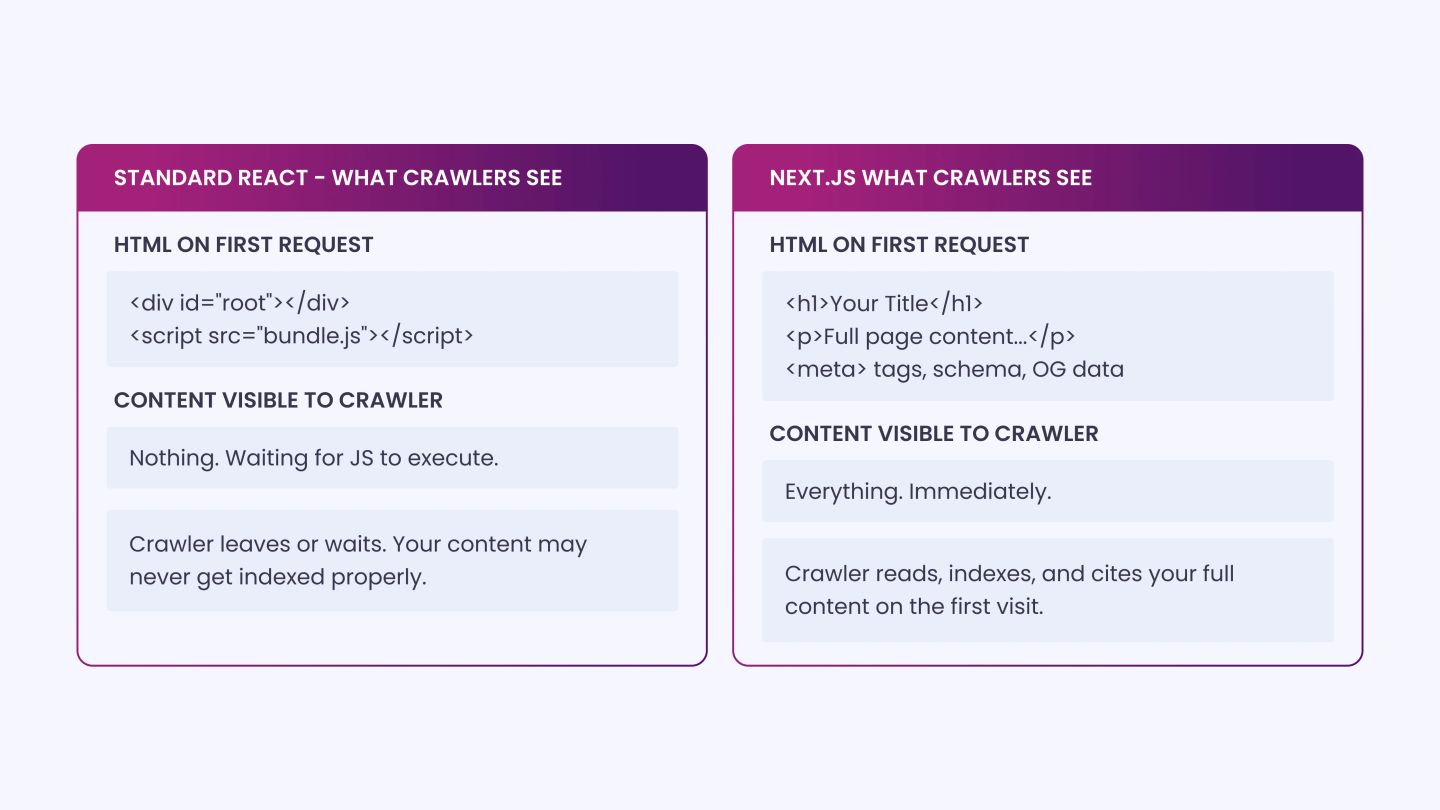
Search engines and AI crawlers need one thing before anything else: access to your content.
Standard React apps render in the browser. When a crawler requests the page, it receives an empty HTML shell. The actual content only appears after JavaScript runs. Some crawlers wait. Many do not.
Next.js changes what gets delivered on that first request.
- Pages are served with meaningful HTML
- Content is visible immediately
- No dependency on JavaScript execution
That single difference affects whether your pages are indexed reliably or missed entirely.
For AI systems, the gap is even clearer.
- Around 46% of ChatGPT bot visits start in reading mode
- Reading mode strips out JavaScript, CSS, and images
- Only raw HTML is processed
A Next.js page serves usable content in that scenario. A client-rendered React page often does not.
This is the baseline. If your content is not visible at the first request, the rest of your SEO or AEO work has limited impact.
| Quick Crawler Check Test Your Site See what search engines and AI bots actually see:
Result
|
What Next.js Does Right for SEO with Real Numbers
With Next.js, several core features work behind the scenes to make your pages fast, crawlable, and ready for search and AI. Here’s how each one contributes:
Flexible Page Rendering
Most frameworks enforce a single rendering method across your site. Next.js lets you pick the right approach per page:
- Server-side rendering (SSR) for dynamic content like product pricing
- Static site generation (SSG) for blog posts or content that doesn’t change often
- Incremental static regeneration (ISR) for pages that need frequent updates without rebuilding the entire site
- Partial prerendering for hybrid cases
This flexibility ensures content is both fresh and crawlable. Each page gets exactly what it needs for performance and indexing.
| What Rendering Means
Rendering is the process of building and delivering a web page to a browser or a crawler.
|
Core Web Vitals Performance
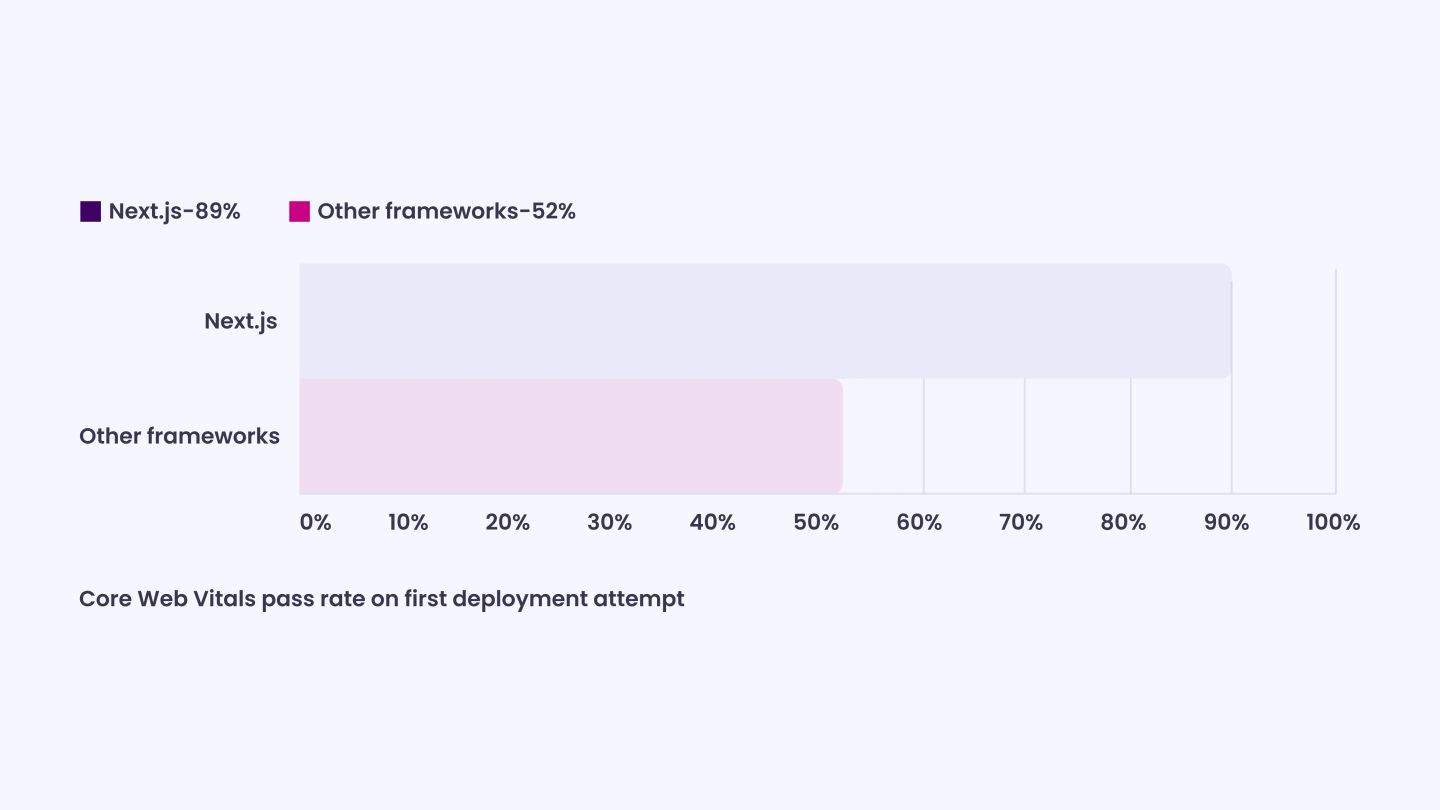
Next.js defaults give measurable performance advantages:
- 89% of teams using Next.js passed Google’s Core Web Vitals thresholds on their first deployment
- Teams using other frameworks only hit 52%, a 37-point difference
- One site improved mobile INP by 66%, directly boosting search rankings
These gains come from framework-level optimizations, not content tweaks. The technical foundation matters first.
Metadata Management Made Simple
Managing metadata manually at scale is error-prone. Next.js provides a built-in Metadata API that makes titles, structured data, and Open Graph tags programmatic:
- Works across hundreds or thousands of pages
- Eliminates missing metadata errors common in large sites
- Consistently applies titles, descriptions, canonical tags, and structured data
Automatic Image Optimization
Images are a frequent cause of Core Web Vitals failures. Next.js handles it automatically:
- Compression
- Device-specific resizing
- WebP conversion
- Lazy loading
One configuration step removes an entire category of SEO risk, improving speed and ranking potential.
| Quick Audit for Existing Next.js Sites
If you’re already on Next.js, audit your rendering modes first:
This single check often uncovers the most impactful technical SEO issue for Next.js sites. |
How Next.js Helps With AEO and Where It Stops
AI Answer Engine Optimization (AEO) is about structuring your content so that AI systems, such as ChatGPT, Google AI Overviews, or Perplexity, can cite it in their answers. AI-referred sessions grew 527% year-over-year through mid-2025, making citations nearly as important as ranking on page one.
Next.js contributes in specific ways, but the framework alone is not a magic solution. Here’s what it does and where its impact ends:
AI Crawlers Get What They Need Automatically
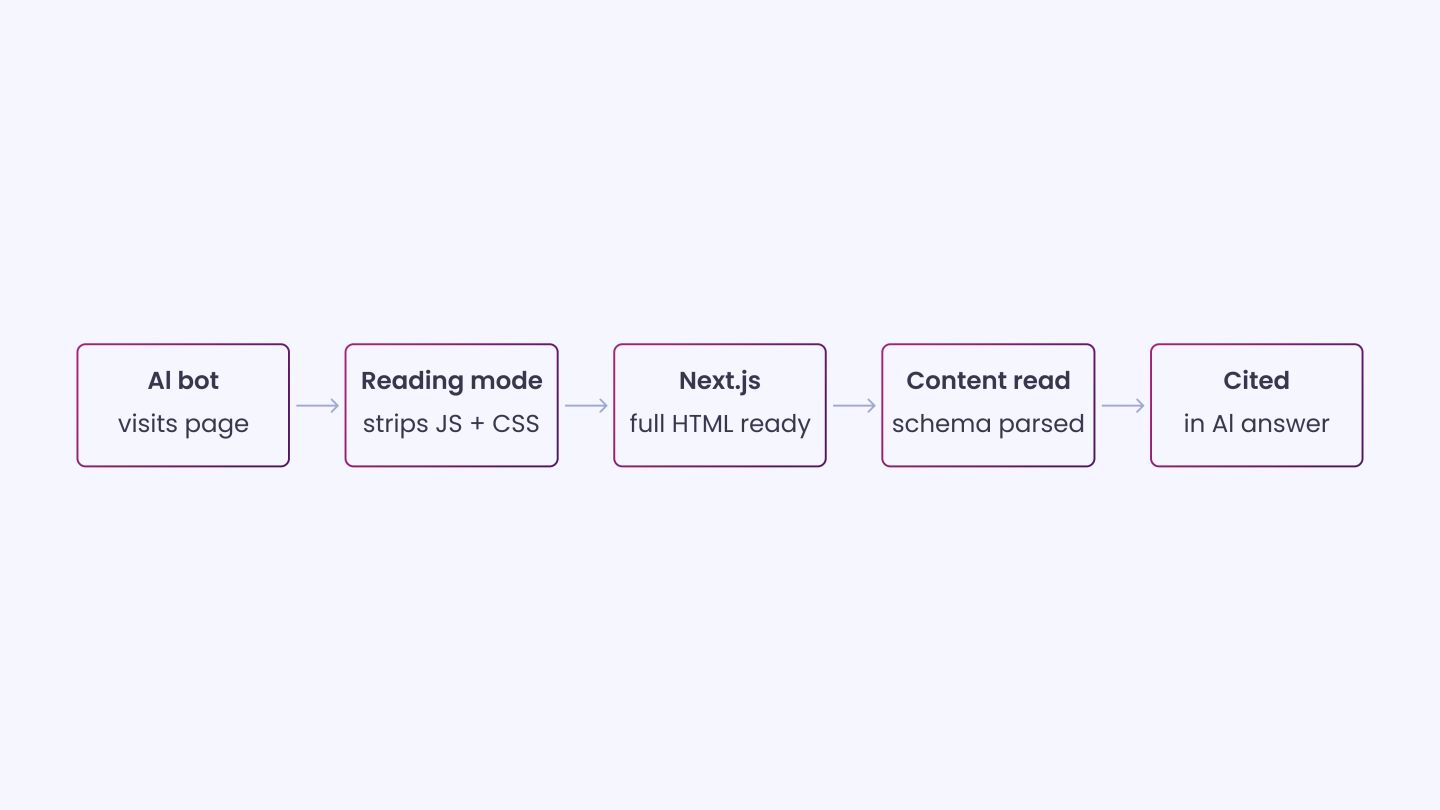
Many AI bots start in reading mode, requesting plain HTML without running JavaScript or CSS.
- 46% of ChatGPT bot visits follow this pattern.
- Next.js App Router server components deliver complete HTML to these requests.
- Client-rendered React pages, by contrast, may appear invisible to these crawlers.
Impact: Being server-rendered means your pages are in the pool that can be cited. Client-only rendering risks exclusion.
Schema Across Your Entire Site
Structured data significantly improves the chances of AI citations. Pages with comprehensive schema are roughly one-third more likely to be cited. Next.js makes this achievable at scale:
- Use JSON-LD schema in shared layout components.
- Automatically include relevant schema per page type:
Article for blogs
FAQPage for support pages
Product for product listings - Applies across hundreds or thousands of pages, not just manually marked-up ones.
Impact: Consistent schema boosts the likelihood that your content appears in AI-generated answers.
Keep Content Fresh Without Manual Republishing
AI citations decay quickly; most occur within 2-3 days of publishing. Next.js ISR lets you automate updates:
- Set automatic revalidation per page.
- High-value articles refresh every few hours without rebuilding the whole site.
- Keeps your AI citation window open and ensures content relevance.
Impact: Maintains freshness signals, increasing the chance of being cited by AI.
Real Outcomes
- AI-referred traffic accounted for over 10% of all conversions, its fastest-growing acquisition channel.
- Success came from content structure, definitive statements, clear data points, and question-and-answer formatting.
- Next.js enabled scalable delivery, but the framework itself didn’t automatically generate citations.
Takeaway: Next.js sets up the technical conditions for AEO, but content quality and structure drive results.
The Limit
|

Situations Where Next.js Adds Complexity

Not every project benefits from Next.js. The framework has real overhead, and in some cases, simpler options deliver better results.
Simple Static Sites or Small Blogs
- If your site has fewer than 50 pages, no dynamic content, and your team lacks React experience, Next.js adds unnecessary complexity.
- Astro’s partial hydration model often produces excellent Core Web Vitals on static content with much less configuration.
- For purely static sites, Astro or even well-optimized static site generators can outperform Next.js in benchmarks.
Teams Without React Experience
- The App Router introduces architectural changes that can confuse teams unfamiliar with server vs client components.
- Misconfigurations can result in client-side rendering, which would have been better handled on the server, harming SEO.
- Next.js rewards teams that invest in learning its architecture and penalizes misunderstanding.
Urgent Content Launches
- If your priority is getting content live quickly, Next.js can slow you down because of its configuration requirements.
- In the short term, a well-configured WordPress site with caching may serve your SEO goals more efficiently.
A Direct Comparison of Next.js and Other Frameworks
Here’s how Next.js measures up when stacked against other common frameworks:
| Framework | Server rendering | AEO-ready by default | Metadata control | Best suited for |
| Next.js | SSR, SSG, ISR, PPR | Strong via App Router server components | Built-in Metadata API | Dynamic, content-heavy apps |
| Nuxt.js | SSR, SSG, ISR | Strong, similar model | Built-in | Same as Next.js, for Vue teams |
| Astro | SSG, partial hydration | Very strong for static | Built-in | Static sites, blogs, documentation |
| Gatsby | SSG only | Partial, static only | Plugin-based | Simple static content |
| Vanilla React | Client-side only | Weak, needs full JS execution | Manual | Apps where SEO is not a priority |
For dynamic, content-heavy applications, Next.js and Nuxt.js are the strongest choices. For purely static content where raw speed is the priority, Astro is a serious competitor that often wins on Core Web Vitals alone. Vanilla React is not a viable foundation for any project where organic search or AI citation matters.
Your Next.js SEO and AEO Readiness Checklist
Having Next.js in place gives you a strong foundation, but your SEO and AEO results depend on the technical and content setup. The following guide highlights what matters most.
Technical Foundations
Make sure your site’s structure and core features are correctly configured to avoid common SEO pitfalls:
- Use SSR, SSG, or ISR for all content pages; never rely solely on client-side rendering.
- Configure the Metadata API with unique titles and descriptions for each page.
- Use next/image for all images, automatic WebP conversion, compression, and lazy loading help Core Web Vitals.
- Generate a sitemap.xml and robots.txt via next-sitemap to guide search engines.
Structuring for AI Optimization (AEO)
AI citation depends on clear, structured content. Consider these practices:
- Implement JSON-LD schema per page type, FAQPage, Article, HowTo, Product, or Organization as relevant.
- Serve an llms.txt file from your public directory to guide AI crawlers.
- Structure content answer-first, lead each section with the direct answer, followed by context and supporting details.
- Use ISR revalidation intervals on high-value pages to keep content fresh and citation-ready.
Content Authority and Accuracy
Your content’s credibility directly affects both SEO and AI citations:
- Include author schema with visible bios and credentials on all content pages.
- Link all statistics and claims to primary sources and refresh them regularly (within 12 months).
- Validate schema in Google’s Rich Results Test before publishing to avoid errors.
- Ensure content delivers answer-first clarity, followed by depth and context.
So, Is Next.js Good for SEO and AEO?
Yes, with the right conditions attached.
For SEO, Next.js provides a strong technical foundation. Its flexible rendering, built-in metadata management, and automatic image optimization handle most common technical SEO challenges, giving your site a reliable structure for search visibility.
For AI-driven experiences (AEO), Next.js sets the stage but does not do the work for you. Fully rendered HTML, scalable schema implementation, and automatic content freshness make your pages accessible to AI crawlers, but content still needs to be structured for extractability, answer-first, and factually verifiable.
If you’re building a content-heavy, dynamic application with a React-savvy team, Next.js is a strong choice. For static blogs or teams less familiar with React, simpler frameworks may be more practical. The real insight isn’t a simple “yes”; it’s understanding the conditions under which Next.js delivers.
INSIDEA
Ready to get found by people and AI?
Search and answer-engine visibility that compounds, built to be cited.

 How INSIDEA works