

The typical approach goes like this: open ChatGPT, type “Give me keyword ideas for [topic],” copy the list, and start writing content. The result is a collection of obvious, high-competition terms that any beginner could brainstorm in five minutes, with no volume data, no difficulty context, and no connection to what your site actually ranks for or competes in.
That is not how ChatGPT adds value to keyword research. The tool’s real strength is not in generating keywords out of thin air. It is organizing, interpreting, and expanding information you already have, or helping you think about a topic more systematically than a keyword planner would.
ChatGPT is exceptional at semantic expansion, finding topic clusters and search intent patterns that keyword tools alone miss. The SEOs seeing the best results treat it as an analyst that works with data you feed it, not as a database that already contains what you need.
This blog covers the specific ways ChatGPT helps with keyword research, including prompts you can use immediately, and where it falls short, so you know when to switch back to your dedicated tools.
ChatGPT’s Strengths and Limits for Keyword Planning
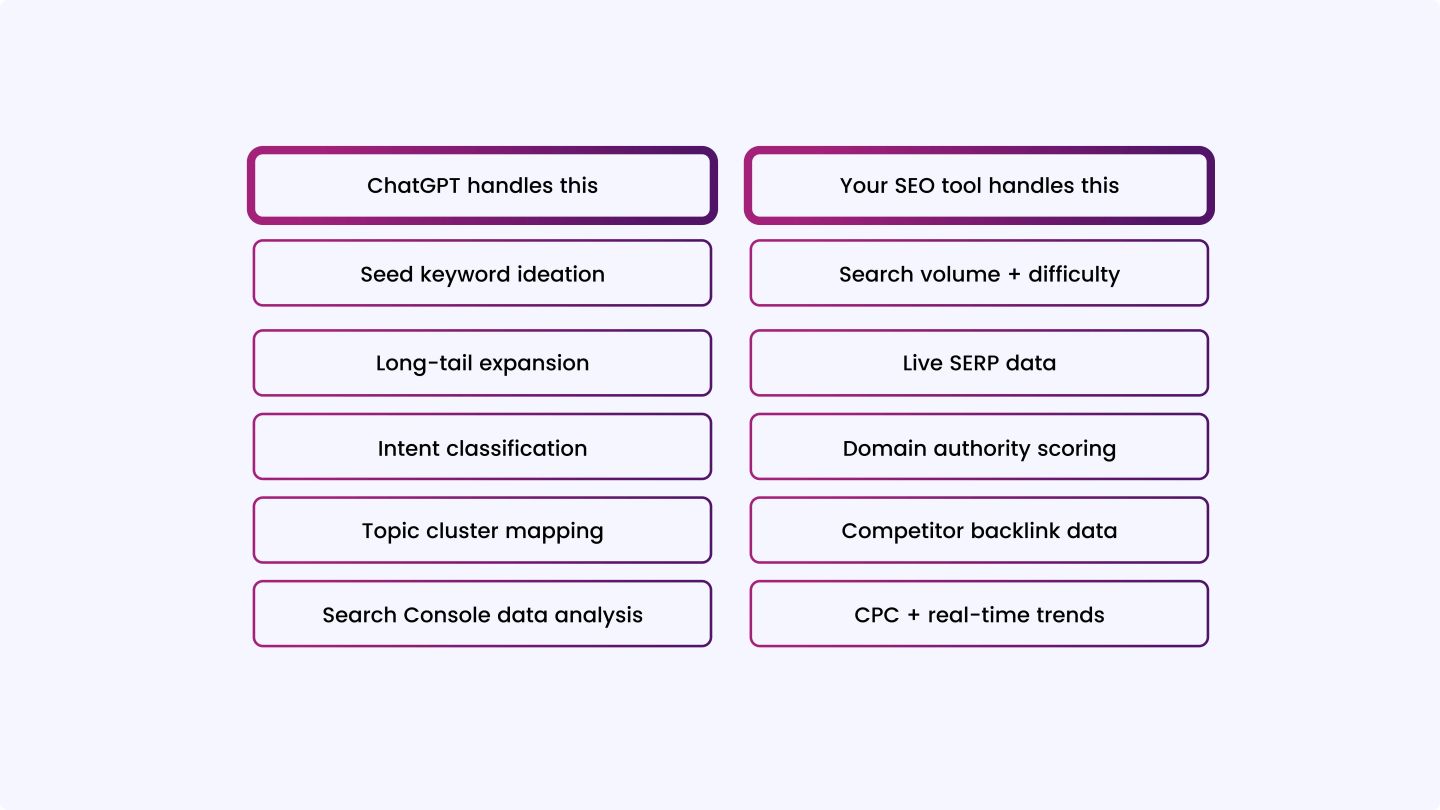
Being clear about this upfront saves a lot of wasted effort.
What ChatGPT does well
- Generate seed keyword variations from a topic or product description
- Expand a short keyword list into long-tail variations
- Classify keywords by search intent: informational, commercial, or transactional
- Group keywords into topic clusters for content planning
- Identify related questions your audience is likely asking
- Analyze a competitor’s content angle and suggest keyword gaps
- Build a content brief structure around a target keyword
What ChatGPT cannot do
- Provide real search volume, keyword difficulty, or CPC data
- Access live SERP data or show who currently ranks for a term
- Assess your domain authority or tell whether a keyword is realistically winnable
- Replace the SERP analysis step that determines whether a keyword has commercial value
ChatGPT cannot replace traditional keyword research tools like Ahrefs and Semrush, but it excels at keyword clustering, ideation, and understanding search intent. The most effective workflow uses ChatGPT for analysis and your tools for validation.
Step-by-Step ChatGPT Workflow for SEO Keyword Research
Follow these steps to generate seed keywords, expand into long-tail phrases, identify audience questions, and build topic clusters for effective content planning:
Step 1: Generate Seed Keywords With a Structured Prompt
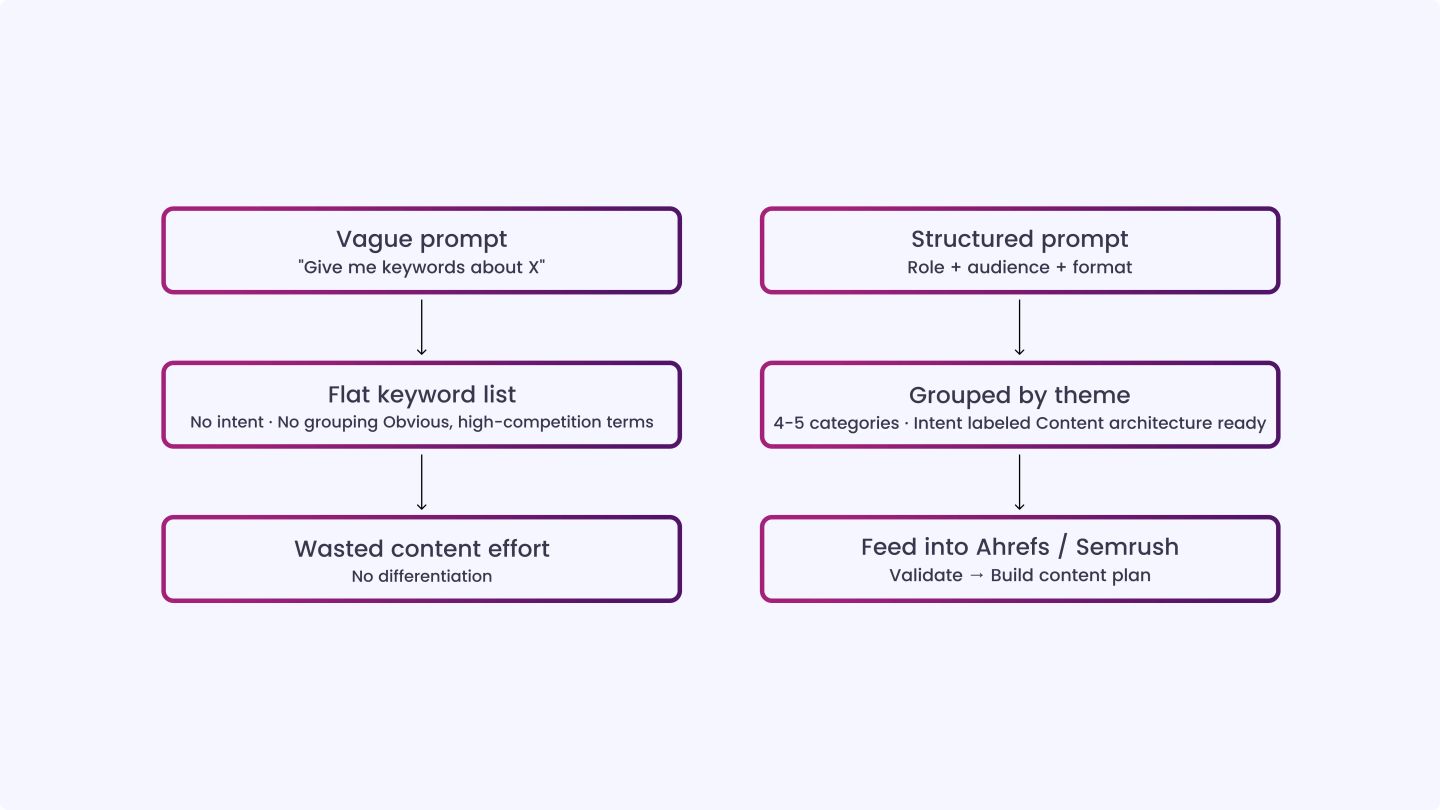
Seed keywords are the short, broad terms that define the core topics in your niche. They are the starting point for everything that follows: topic clusters, long-tail variations, and content planning.
Rather than asking ChatGPT to “Give me keywords about X,” a structured prompt produces far more usable output.
| Prompt: “Act as a senior SEO strategist. I run a [type of business] targeting [specific audience]. My main product/service is [describe it]. Generate 20 seed keywords that represent the core topics my audience searches for. Group them into 4 to 5 thematic categories and label each category.” |
The grouped output gives you something a raw keyword list does not: a content architecture. You can immediately see which themes have multiple seed keywords (strong content opportunities) and which have only one or two (potential gaps to investigate).
Feed the output into Ahrefs or Semrush to check volume and difficulty on each seed keyword before you build anything around them.
Step 2: Expand Into Long-Tail Keywords by Intent
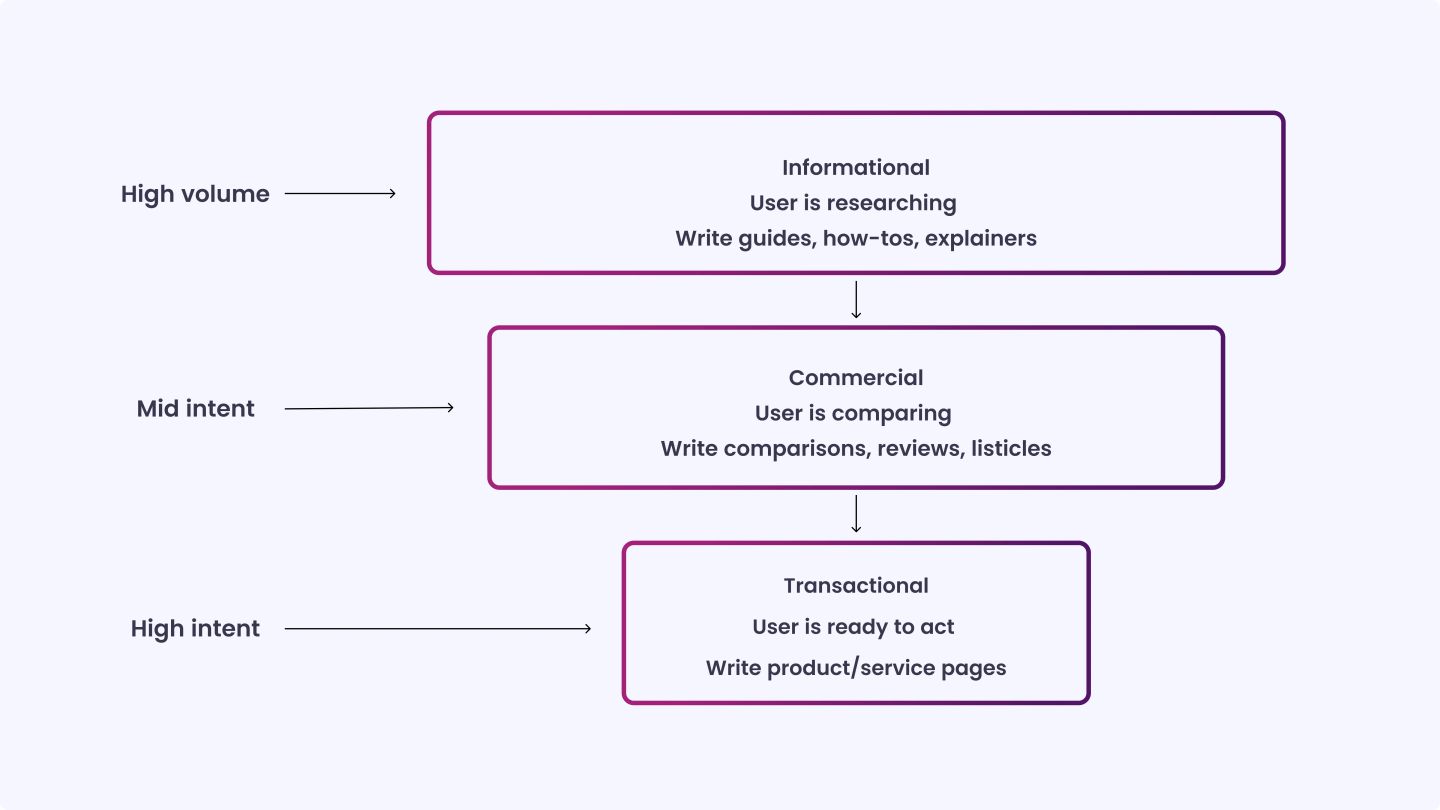
Once you have your seed keywords, the next step is to find the specific long-tail phrases your audience actually uses at different stages of the buying or research journey.
In 2026, search engines prioritize semantic depth over keyword frequency. Covering a topic cluster yields better results than repeatedly targeting a single keyword. ChatGPT is built for exactly this kind of expansion.
| Prompt: “Act as a senior SEO specialist. My seed keyword is ’[your seed keyword]’. Generate 25 long-tail keyword variations. Organize them into three groups: Informational (user is researching), Commercial (user is comparing options), and Transactional (user is ready to act). Present this as a table with columns: Keyword, Intent, and Funnel Stage.” |
The table format forces ChatGPT to produce organized, actionable output rather than a flat list. More importantly, the intent classification tells you what type of content to create for each keyword, a guide for informational terms, a comparison page for commercial terms, a product or service page for transactional ones.
The long-tail list from this prompt goes straight into your keyword tool for volume and difficulty validation. Any keyword with meaningful volume and manageable difficulty becomes a content target.
Step 3: Find Questions Your Audience Is Actually Asking
Question-based keywords power featured snippets, FAQ schema, People Also Ask placements, and AEO citations. They are also the keywords your audience uses when they are trying to solve a problem , which means content targeting them has high intent behind it.
| Prompt: “You are an SEO content strategist. My target topic is ’[your topic]’. Generate 20 questions that someone researching this topic would type into Google at different stages of awareness: beginner questions, intermediate questions, and advanced questions. Label each question with its awareness stage and the best content format to answer it (blog post, FAQ page, comparison guide, video).” |
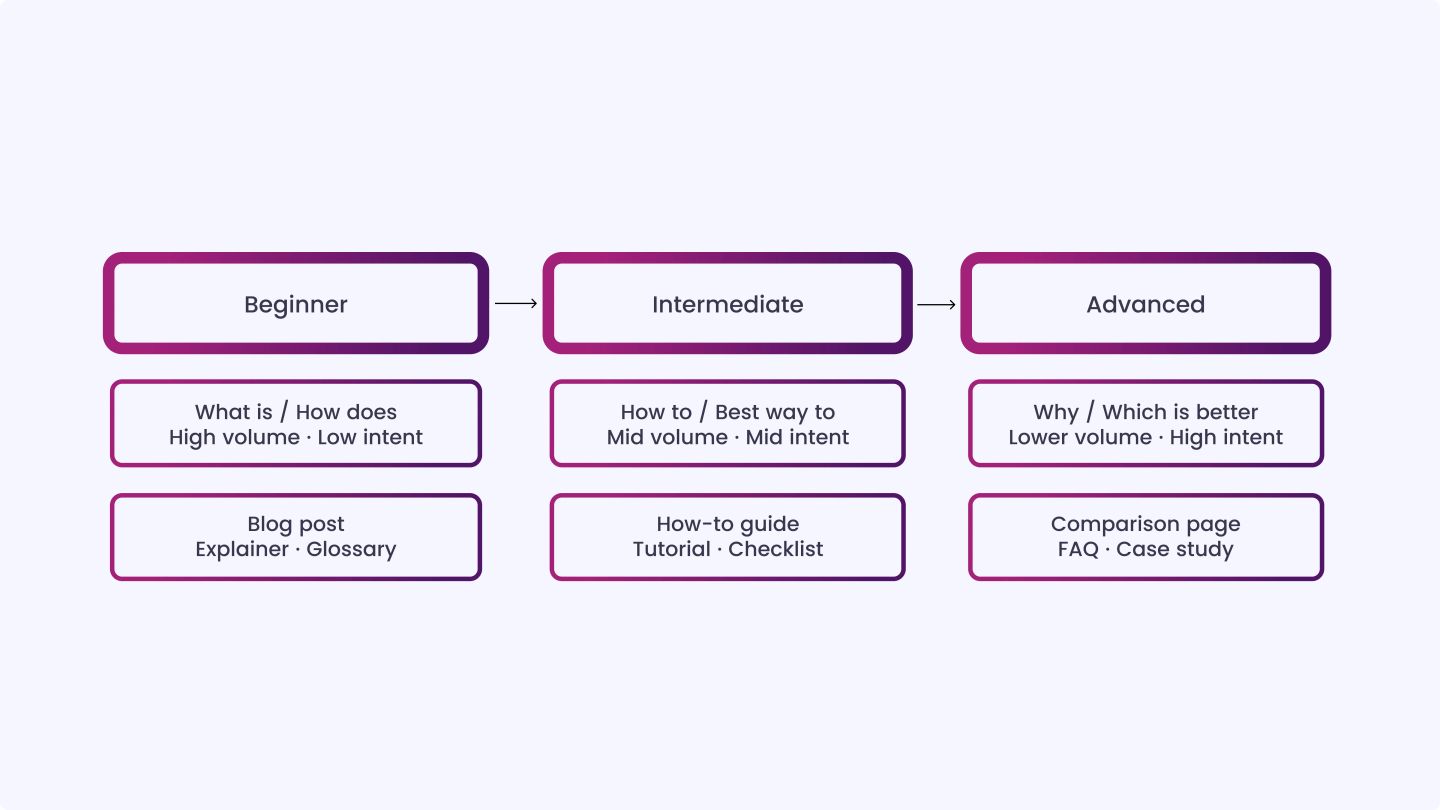
The awareness stage labeling is a useful element here. Beginner questions point to top-of-funnel content that builds traffic. Advanced questions often have lower volume but higher purchase intent; these are the terms that generate leads, not just visits.
Cross-reference the question list against Google’s “People Also Ask” section for your main topic. Any question that appears in both ChatGPT’s output and in PAA is validated; real users are typing that exact question, and Google has already decided it is worth surfacing.
Step 4: Build Topic Clusters for Content Planning
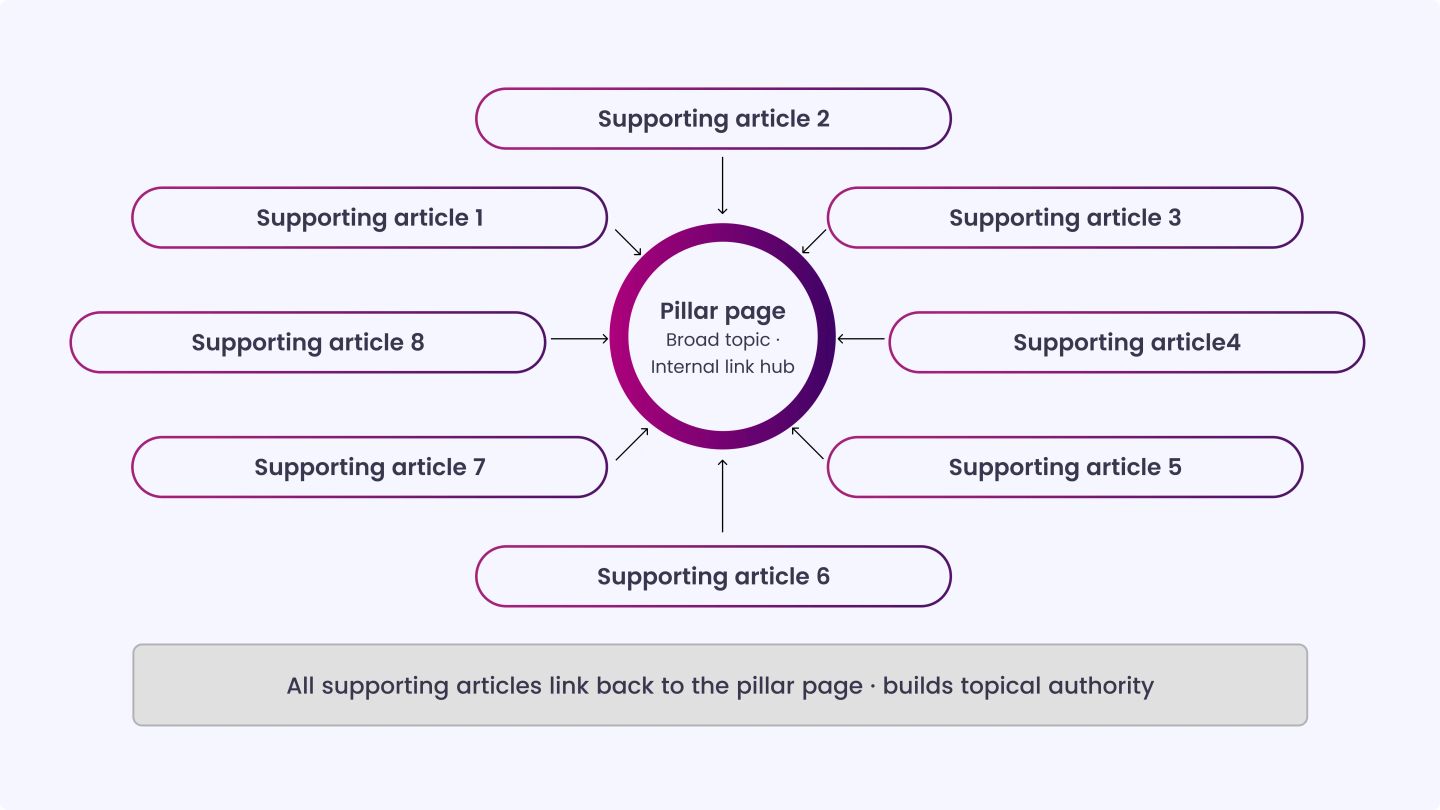
A topic cluster is a group of related pages, a central pillar page covering a broad topic, surrounded by supporting pages that each cover a specific subtopic in depth. Internal links from supporting pages to the pillar page signal topical authority to search engines.
ChatGPT builds these faster and more comprehensively than brainstorming manually.
| Prompt: “Act as an information architect specializing in SEO. Build a topic cluster for the pillar topic ‘[your main keyword]’. Define the pillar page focus and title. Then suggest 8 supporting articles, each targeting a specific subtopic. For each supporting article, provide the article title, primary keyword, target search intent, and one specific internal link instruction, which page it should link back to, and why.” |
The internal link instruction is the detail that makes this prompt useful. It forces ChatGPT to think about how the cluster works as a system, not just as a list of titles. The output maps out a content site structure you can start building immediately.
Validate each supporting article topic by checking whether competitors have written about it and whether the primary keyword has search volume worth pursuing.
Step 5: Feed Your Google Search Console Data In
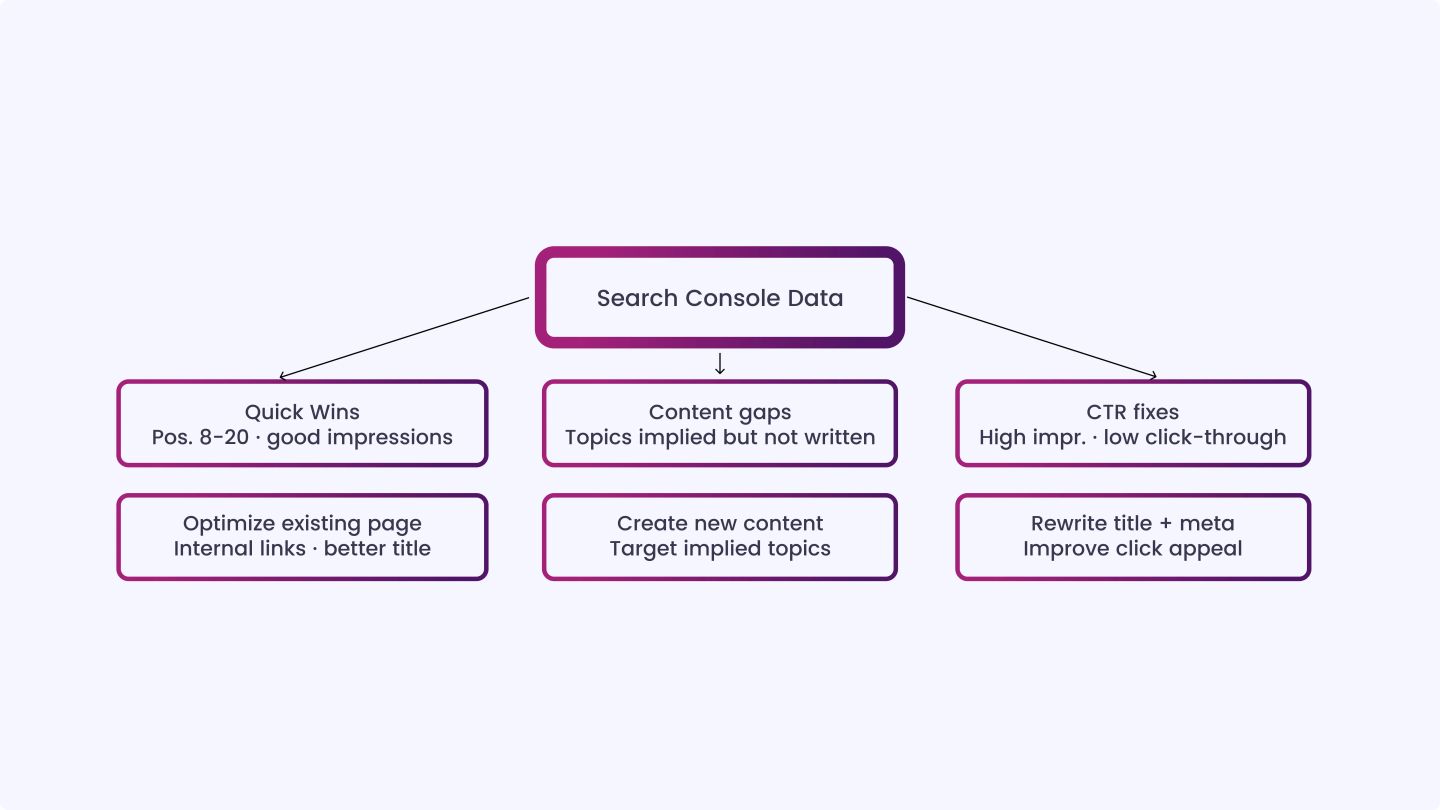
This is the most powerful and most underused approach. When you export your Search Console data and feed it into a structured ChatGPT prompt, the AI can cross-reference patterns you would never spot manually, particularly keywords ranking in positions 8 to 20, which are your fastest potential wins.
Export your performance data from Google Search Console, at a minimum, the keyword, position, clicks, and impressions columns. Paste that data into ChatGPT with the following prompt.
| Prompt: “I am sharing my Google Search Console keyword data below. Analyze it and identify:
(1) Keywords ranking positions 8 to 20 that have meaningful impressions but low clicks; these are my quickest ranking opportunities. (2) Topic gaps, subjects implied by what I rank for that I have not yet written dedicated content about. (3) Keywords with high impressions but very low click-through rates, where my title or meta description is likely underperforming. Format your response as three separate tables with specific recommended actions for each.” |
The output from this prompt consistently identifies opportunities that months of manual review would miss. Keywords on page two of Google can reach page one with targeted optimizations , better title tags, internal links, or content updates , rather than brand new content creation.
Step 6: Analyze Competitor Keyword Gaps
Knowing what your competitors rank for that you do not is one of the most direct routes to new keyword opportunities. You can run this analysis in Ahrefs or Semrush, but ChatGPT adds a layer that those tools do not; it can interpret why a competitor is ranking for certain terms and what angle their content takes.
| Prompt: “Act as an SEO competitive analyst. I will describe my business and my two main competitors. My business: [describe yours]. Competitor 1: [describe them and their URL]. Competitor 2: [describe them and their URL]. Based on what you know about their content positioning, what keyword categories are they likely prioritizing that I may not be targeting? What content angles would differentiate me from their approach on those topics?” |
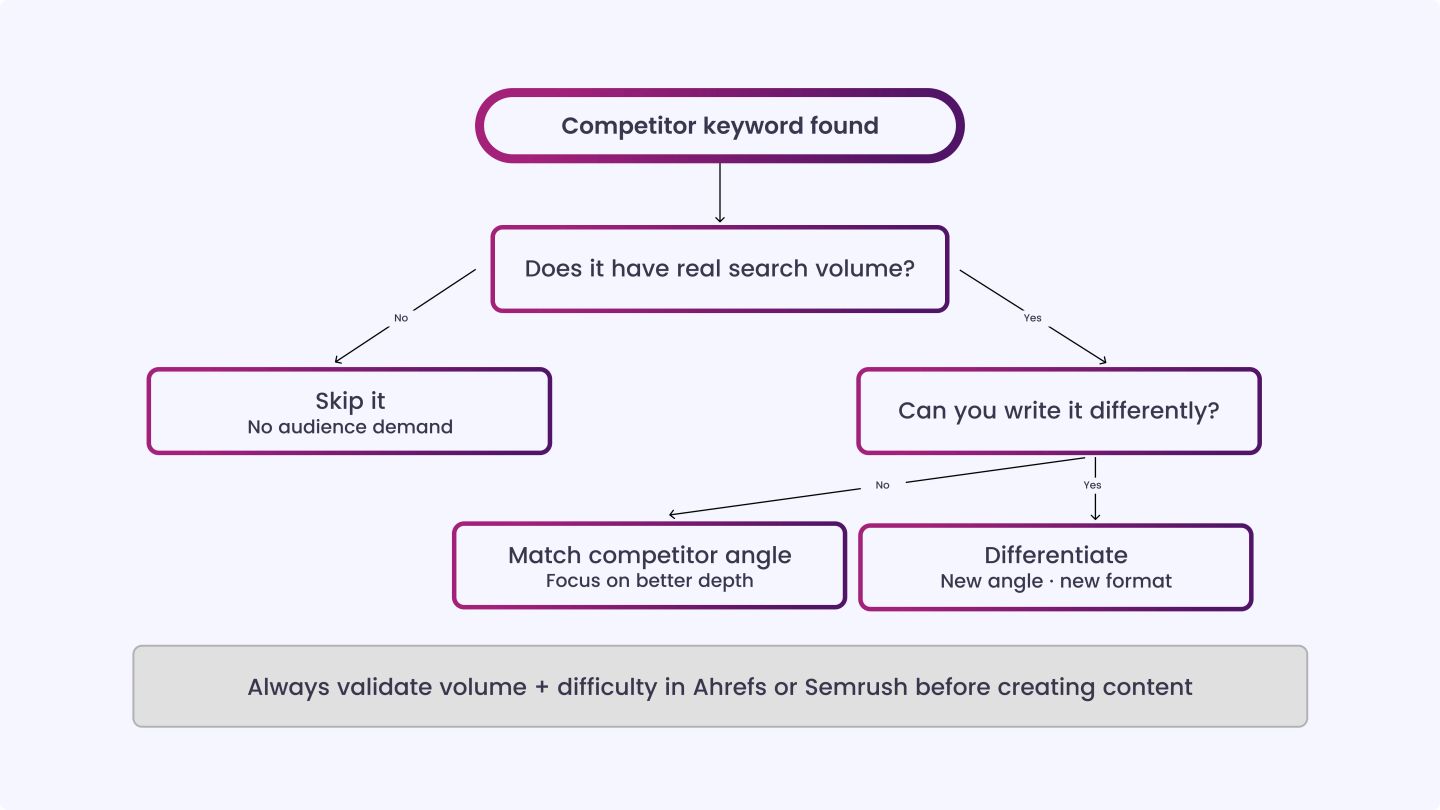
Pair this with a proper competitor gap analysis in your SEO tool, and pull the actual keywords they rank for that you do not rank for. Bring that list back into ChatGPT for intent classification and content planning.
Why ChatGPT Requires Human Validation?
Even with structured prompts and careful planning, ChatGPT can generate keyword suggestions that sound logical but may not have real search demand. It does not have access to:
- Current search volume or difficulty: Keywords may appear promising, but could have zero monthly searches or be dominated by sites you cannot compete with.
- Competitor performance context: It cannot see which keywords competitors are ranking for or how their content performs in real time.
- Your site-specific authority: Without context from your analytics, ChatGPT cannot determine which keywords your site can realistically rank for.
- Latest algorithm updates: ChatGPT’s knowledge is not updated in real time, so its SEO advice should be a starting point, not a final decision.
| Action Step: Use ChatGPT for ideation, clustering, and intent classification, but validate every keyword and strategy with dedicated SEO tools like Ahrefs, Semrush, or Google Search Console before creating content. |
Combine ChatGPT and SEO Tools for Complete Results
ChatGPT has a defined, valuable role in keyword research and a clear boundary beyond which its usefulness ends.
Within that boundary, it produces faster and more structured output than manual brainstorming on seed keywords, long-tail expansion, intent classification, topic cluster mapping, and question generation.
Outside that boundary, volume data, difficulty scoring, SERP analysis, and real-time search behavior, you still need your dedicated tools.
The workflow that works treats them as complements. ChatGPT for the thinking and structuring. Ahrefs, Semrush, or Google Search Console for the validation. Neither replaces the other. Used together, they reduce the time it takes to conduct keyword research while producing a more complete picture of your content opportunities than either approach alone.
The prompts in this blog are built to be adapted to your specific niche and business context. The more specific your inputs, the more useful the outputs.
Turn ChatGPT Insights Into Verified SEO Results with INSIDEA
Keyword research is just the first step. Turning the insights you generate with ChatGPT into content that ranks, earns traffic, and converts visitors into clients is where the impact really happens.
INSIDEA helps brands build SEO strategies that turn data into measurable results: from keyword mapping and topic cluster planning to technical SEO and AEO optimization.
Our services include:
- SEO and Keyword Strategy: Complete keyword research, intent classification, topic cluster mapping, and content gap analysis aligned with your business goals.
- AEO and Structured Data: Implement schema markup, FAQ optimization, and structured content to increase visibility in AI-powered search results.
- Content Marketing: Create SEO-driven content that ranks on traditional search engines and AI answer platforms.
- Technical SEO: Audit your site for crawlability, page speed, and structured data to ensure search engines can access your content.
- Ongoing Monitoring and Optimization: Track rankings, citation patterns, and content performance with monthly reporting.
Every strategy starts with understanding your business context, current content performance, and competitors. INSIDEA helps you convert ChatGPT insights into verified, actionable SEO results.

 How INSIDEA works




