




TL;DR
|
When someone asks ChatGPT, “What’s the best email marketing tool for a small business?”, it doesn’t return a list of blue links. It responds with a short set of options, often naming specific brands and giving reasons for each one.
Search-style ranking disappears at that moment. What replaces it is selection and mention inside the answer itself.
That shift changes how visibility works online. The goal is no longer just to get traffic from search results, but to get your brand included in the answer.
One detail often missed: not all mentions carry the same weight. In some cases, ChatGPT names a brand directly. In others, it describes a solution without naming it. Both appear in responses, but they shape discovery and trust in very different ways.
This blog breaks down what branded and unbranded mentions mean, why the gap between them matters, and what it takes to influence both.
What Are Branded Mentions in AI Responses?
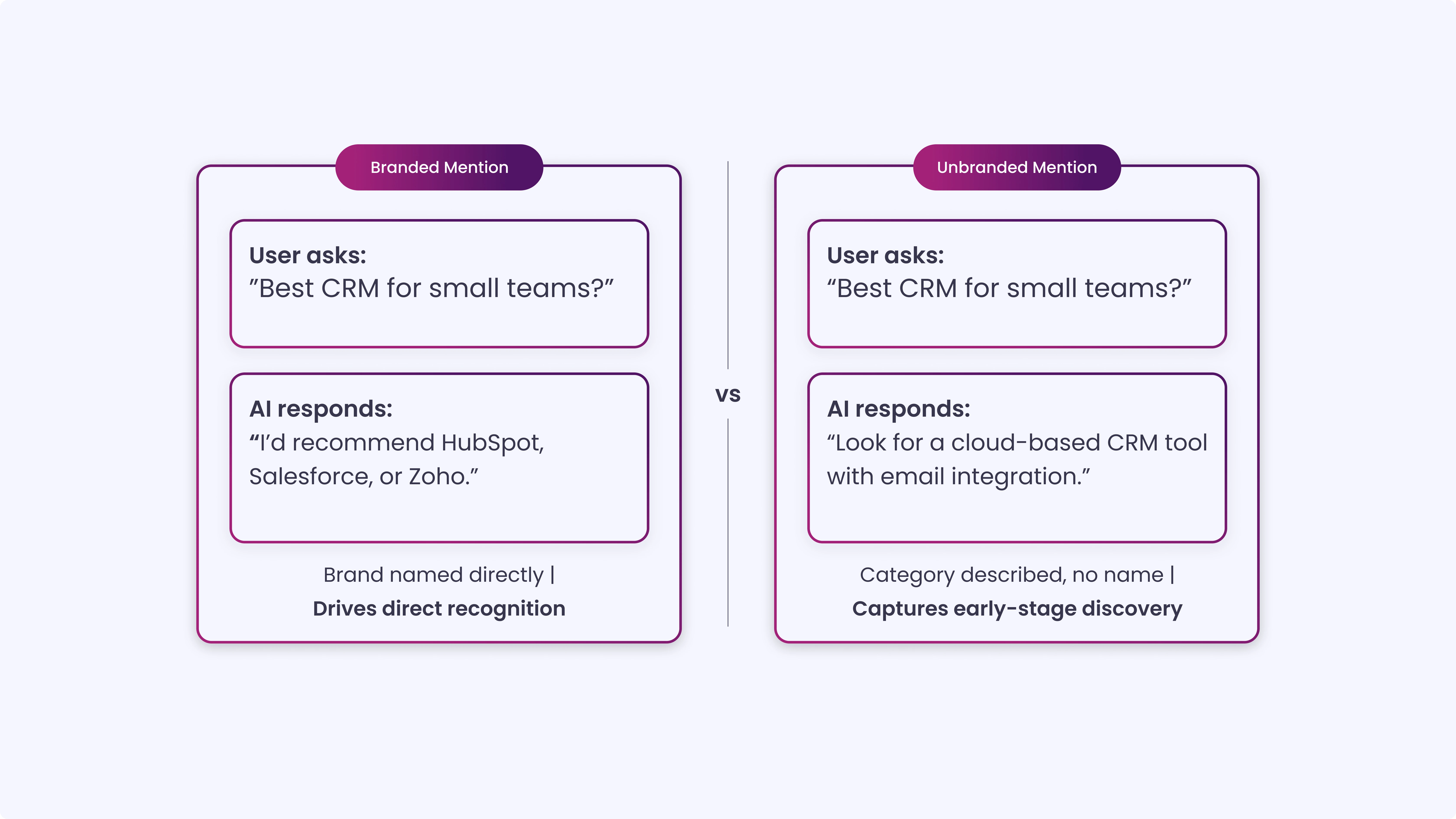
Branded mentions happen when an AI model explicitly names a company, product, or service in its response.
A few examples of how this looks in practice:
- “For project management, I’d recommend Asana, Trello, or Monday.com.”
- “Salesforce offers stronger enterprise features, while HubSpot is better suited for small businesses.”
- “Companies like Nike have used influencer marketing effectively.”
In each case, the brand name appears directly in the AI’s answer. The user learns about that specific brand through AI, without necessarily visiting a search engine or clicking any link. Research by BrightEdge reveals that ChatGPT mentions brands 3.2x more often than it cites them with links, which tells you just how significant these conversational brand mentions are compared to traditional citation links.
Branded mentions tend to happen when:
- A user asks for a direct recommendation in a product category you’re part of.
- A user asks AI to compare tools, and your product is in the mix.
- A user asks a question about a specific problem your product solves.
- A user directly asks about your brand by name.
What Are Unbranded Mentions in AI Responses?
Unbranded mentions describe a solution, capability, or category without naming a specific brand.
These are answers where AI describes the type of product, approach, or service a user needs, but doesn’t name anyone specifically. For example:
- “You’ll want a cloud-based CRM that integrates with your email platform.”
- “The best approach here is using an automation tool that handles multi-step workflows.”
- “Most enterprise teams rely on a centralized documentation platform for this.”
Your brand might fit every one of those descriptions perfectly, but if ChatGPT doesn’t name you, you’re not in that conversation. The user will look for something that matches that description, and you may or may not appear in their next search.
Unbranded mentions matter because they reflect how well AI understands the category you’re part of and whether your brand is visible enough to be pulled in when the topic comes up naturally.
What This Tells You About Your Brand?
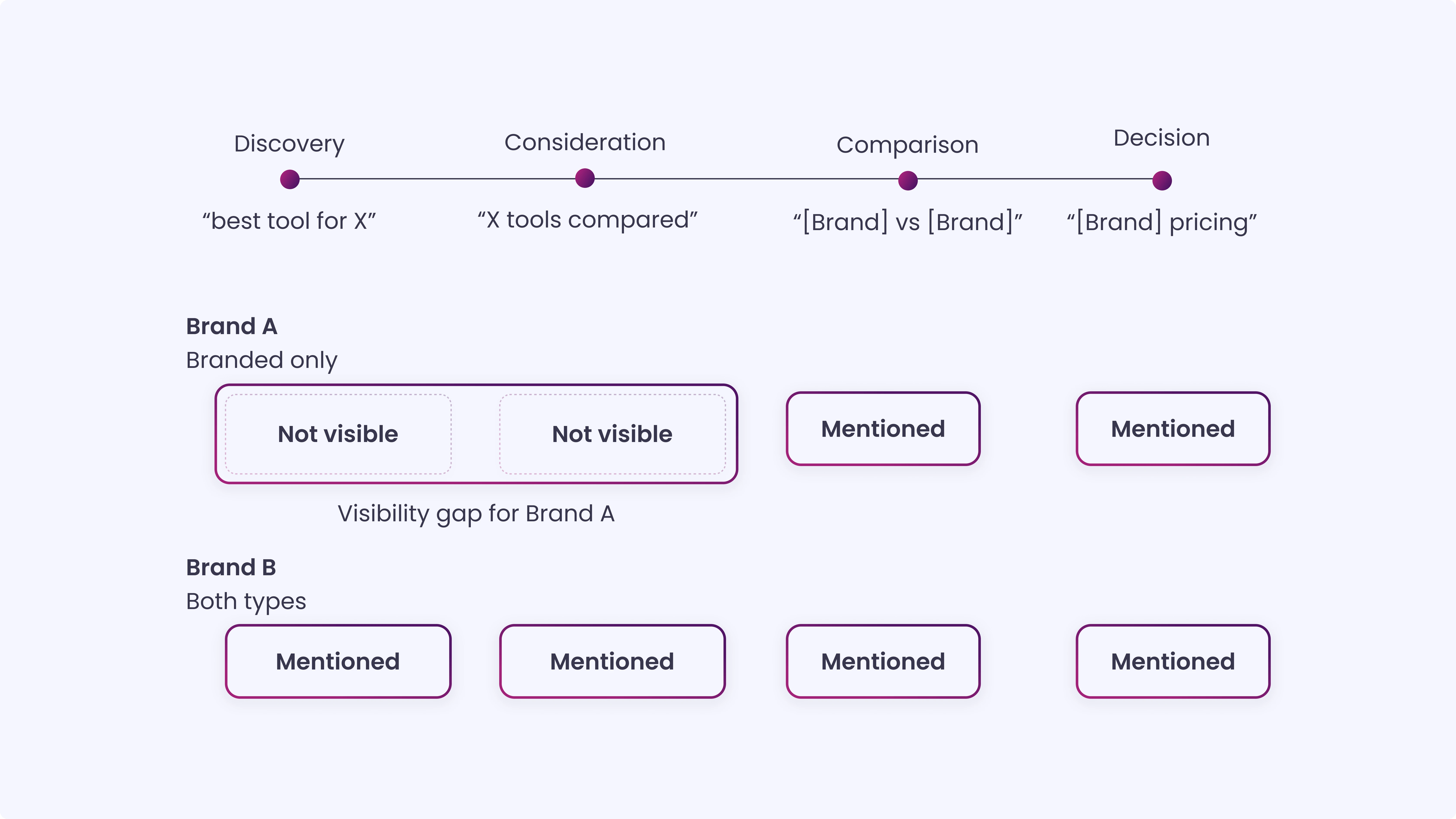
If your brand appears only when it’s asked for directly, visibility depends on existing awareness. If it also appears in category-level answers, it starts reaching people earlier in the decision process. A gap between the two usually indicates a simple pattern: the brand exists in AI memory but not in AI recommendations. That’s where most visibility is missed. |
How ChatGPT Selects the Brands?
Understanding why some brands are named and others aren’t starts with how AI processes brand information. ChatGPT doesn’t “know” your brand the way a human does. It has never visited your website, read your marketing materials, or experienced your product.
Instead, it has encountered statistical patterns about your brand during training on massive datasets scraped from the web. If your brand appears frequently in authoritative contexts across the training data, the model builds strong associations between your brand and specific topics, use cases, or problem statements.
For branded mentions, the main signals are:
- How often does your brand name appear across credible web sources?
- Whether that coverage links your brand to specific, consistent use cases.
- The authority of the sites where your brand gets discussed.
For unbranded mentions, the signals are slightly different:
- How well your content covers the category your brand belongs to.
- Whether your content answers the general questions users ask before they know which brand they want.
- How much topical depth have you built across related content?
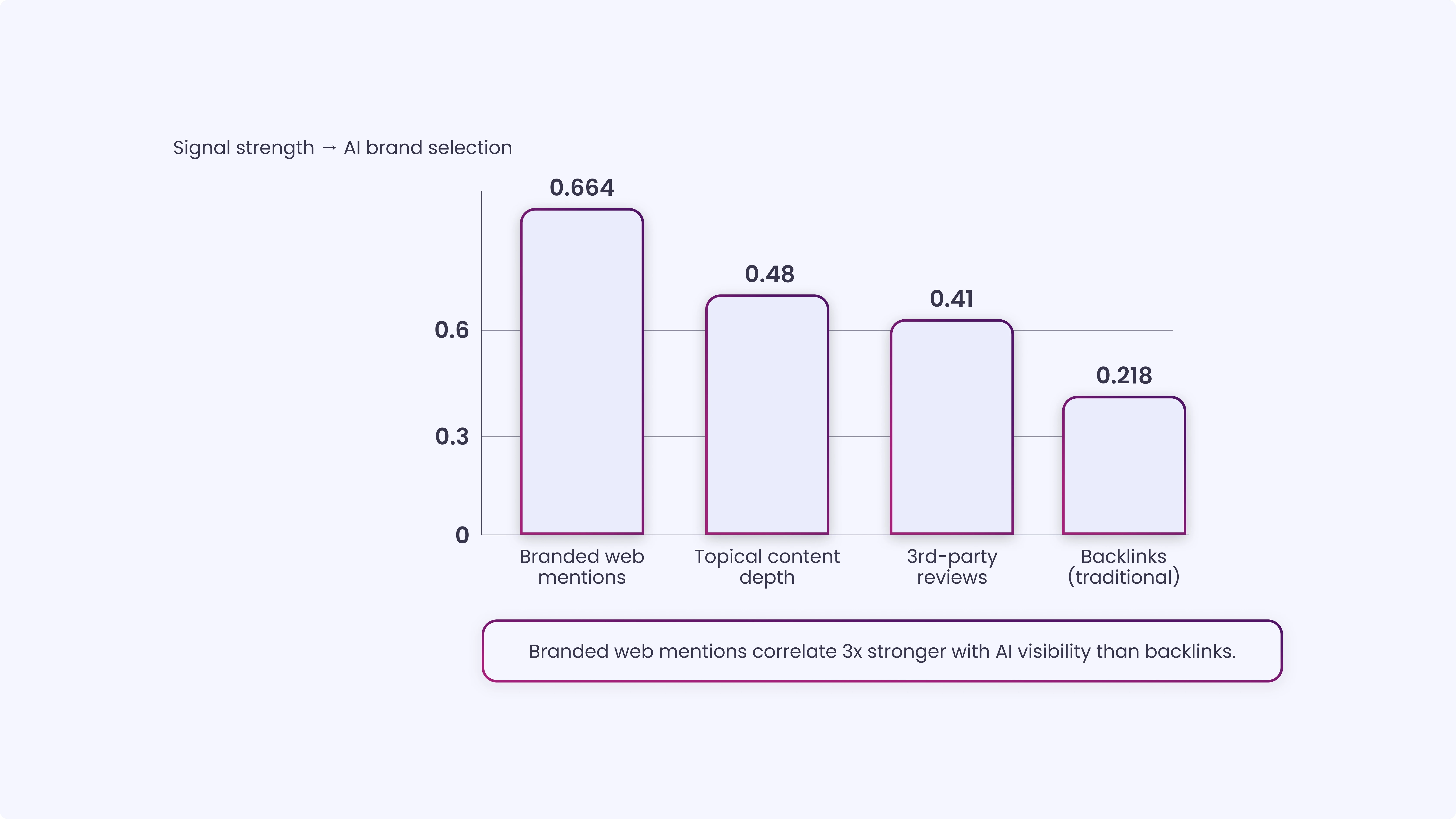
Branded web mentions have the strongest correlation with AI Overview appearances at 0.664, far higher than backlinks at 0.218. That’s a significant data point. It means AI visibility is more about being talked about across the web than about having many inbound links.
Optimizing for Branded Mentions
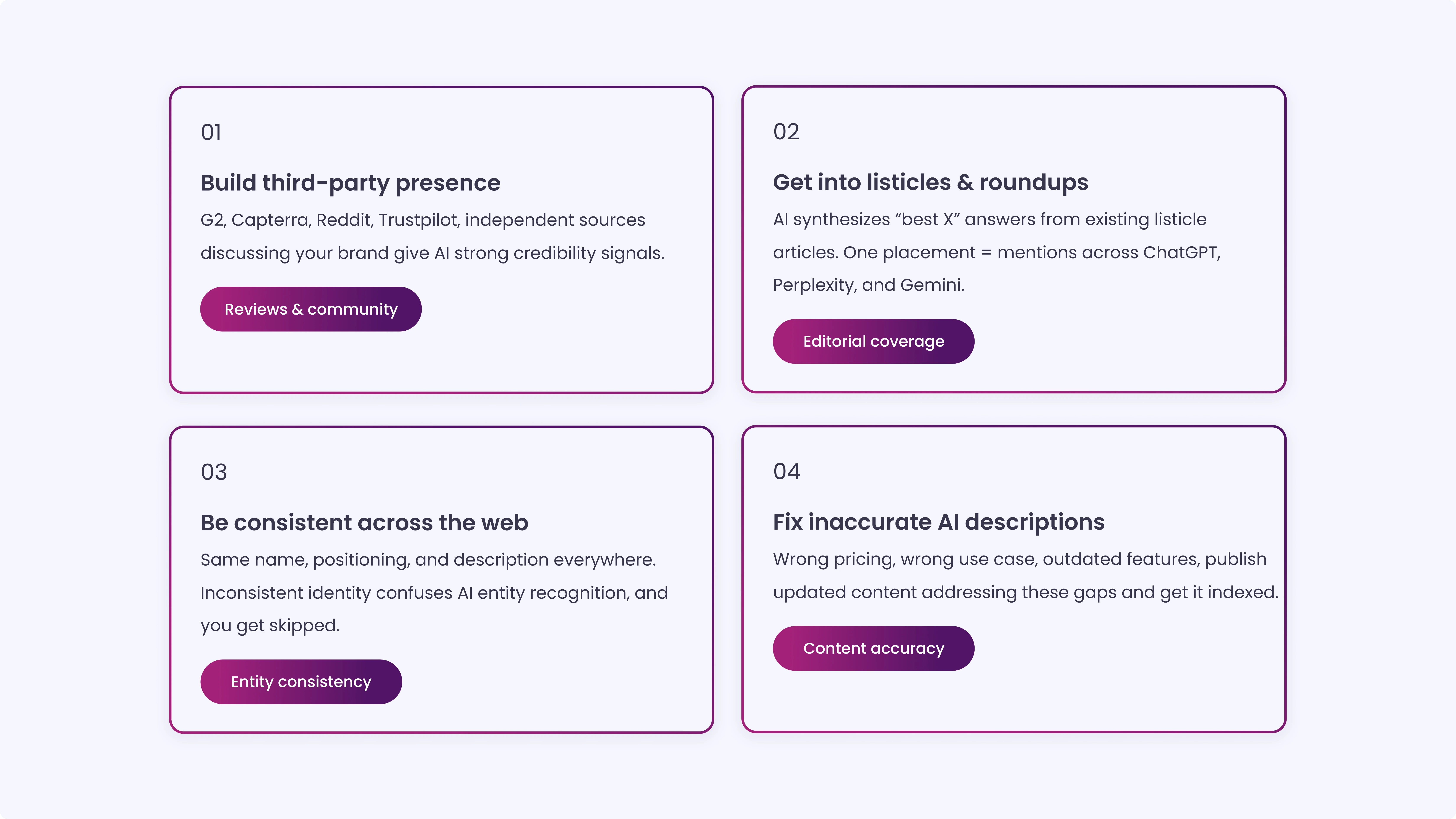
Getting your brand name into ChatGPT responses comes down to consistently being present in the places where AI pulls information.
- Build third-party presence: Earned mentions are references to your brand that you don’t directly control. Customer reviews on G2, Capterra, or Trustpilot describe real experiences with your product.
Industry journalists mentioning your company in news articles provide third-party validation. Community discussions on Reddit or Quora where users recommend your solution show authentic sentiment. When multiple independent sources discuss your brand in relevant contexts, AI systems have clearer signals to interpret your credibility.
- Get into listicles and roundups: When users ask AI engines for recommendations like “best project management tools,” the AI doesn’t generate that list from scratch. It synthesizes from existing listicle articles on authoritative websites. A single placement in a well-ranking listicle can get your brand recommended across ChatGPT, Perplexity, and Google AI Overviews simultaneously.
- Be consistent across the web: LLMs build brand understanding from repeated, consistent identity signals. When your name, positioning, products, or people appear differently across the web, entity confidence drops, making your brand less likely to be selected during answer generation. Use the same brand name, description, and positioning everywhere: your website, social profiles, press mentions, and listings.
- Fix inaccurate AI descriptions: If ChatGPT mentions you but gets something wrong, that’s a separate problem. A SaaS company might be described with pricing from two years ago. A service business might be positioned for the wrong industry. A product might be characterized by features it never had or no longer offers. The fix is to publish clear, updated content that directly addresses those gaps and to get it indexed and cited.
Optimizing for Unbranded Mentions
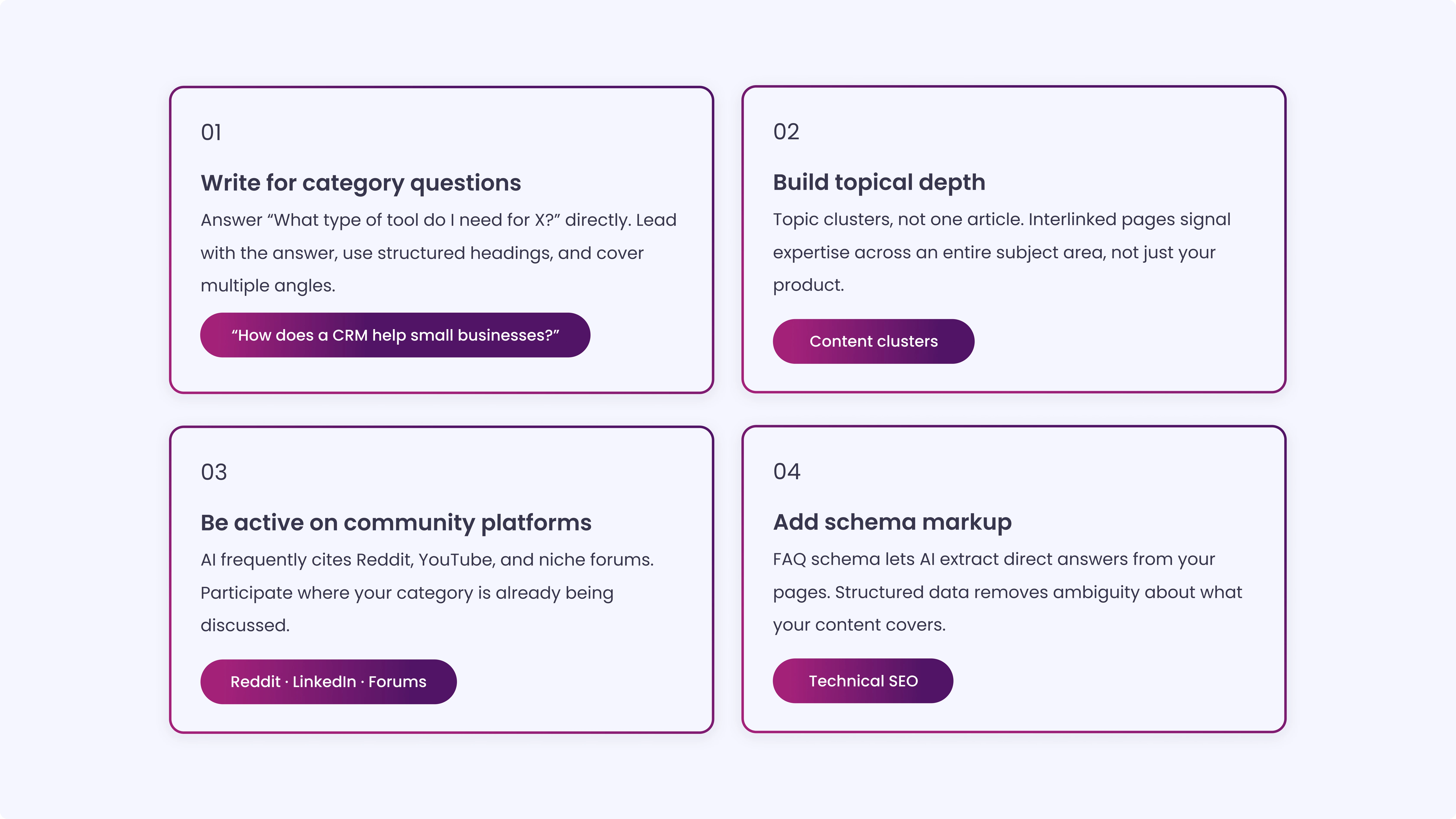
This is where content strategy does the heavy lifting:
- Write for category-level questions: Unbranded queries sound like “what type of tool do I need for X?” or “how does Y work?” Write content that answers those questions directly and thoroughly. Lead with the answer, use structured headings, and cover the topic from multiple angles. AI pulls from content that definitively answers what a category of solution does, not just what your brand specifically does.
- Build topical depth: One article covering your core topic won’t be enough. Group related topics to show AI your expertise. Organize your content into topic clusters. Link related pages to reinforce your expertise and help AI engines understand how your content pieces fit together. The broader your coverage of a topic, the more likely AI is to reference your content when that topic comes up in any form.
- Be active on community platforms: AI engines frequently cite Reddit, YouTube, and category-specific forums. Experts recommend brands identify which sites their target AI engine cites most and develop a real presence there. Participate in relevant subreddits, publish on LinkedIn, and contribute to forums where your category is being discussed.
- Add schema markup: Structured data helps AI quickly identify what your content is about without ambiguity. FAQ schema, in particular, lets AI extract direct answers to common category-level questions straight from your pages.
How to Track Branded vs Unbranded Visibility
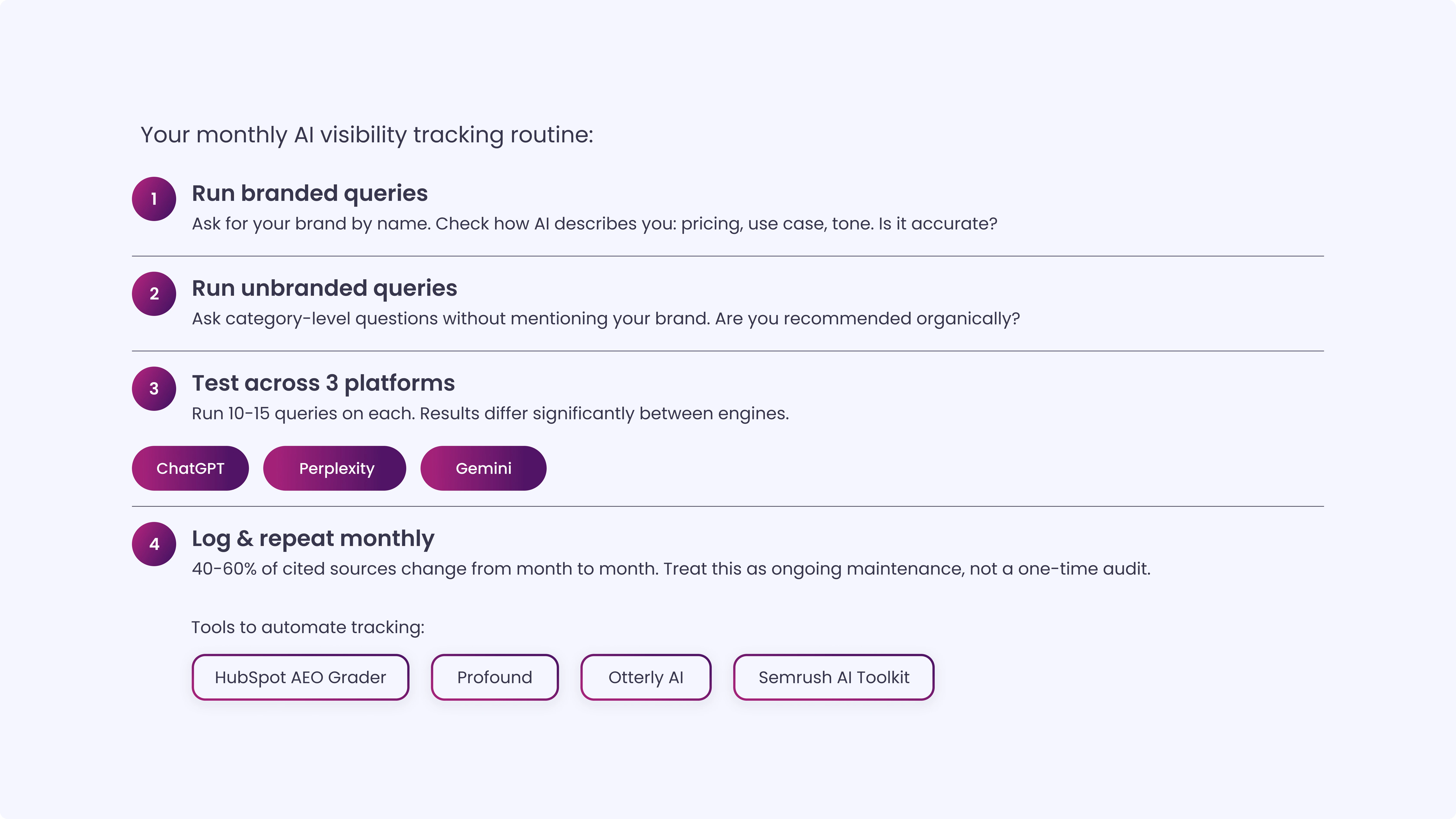
You can’t improve either type if you don’t know where you stand. The tracking process is straightforward.
Test both branded queries, where your name appears in the prompt, and unbranded queries, where it doesn’t. Branded queries show how AI describes your brand when asked directly. Unbranded queries reveal whether AI recommends you organically when users don’t know you exist yet.
Run at least 10 to 15 queries of each type across ChatGPT, Perplexity, and Gemini. Log which platforms mention you, in what context, and how you’re described. Do this monthly, since AI responses shift as models update and new content gets indexed.
For free tracking, HubSpot’s AEO Grader gives you a quick baseline across major AI platforms. For more detailed tracking, tools like Profound, Otterly AI, and Semrush’s AI Visibility Toolkit monitor mentions across multiple AI engines automatically and track sentiment alongside frequency.
Become the Top Cited Brand in Your Category with INSIDEA
Most brands assume strong content is enough. Then they check ChatGPT and realize competitors are being named while they are missing, even in the same category.
That gap usually comes from how AI systems read the web. They don’t just look for relevance. They look for clear connections between a brand, its category, and trust signals across multiple sources. When those signals are weak or inconsistent, the brand is skipped in AI responses, even when the content is present.
INSIDEA works on fixing that exact gap between content and inclusion.
We focus on four areas that decide whether your brand shows up in AI responses:
- AI visibility audit: We map where your brand is missing in AI answers and identify what is breaking the connection between your content and AI systems.
- Content restructuring for AI extraction: We restructure the main pages so answers, definitions, and comparisons are easy for AI systems to pull and reuse in responses.
- Entity consistency across platforms: We align how your brand appears across your website, profiles, and listings so that AI systems treat it as a single, clear, and reliable entity.
- Authority signal strengthening: We improve how your brand is represented across third-party sources so AI systems have enough external validation to include it in answers.
FAQs
| 1. Can a brand have strong branded mentions but weak unbranded mentions, or vice versa?
Yes, and it’s more common than you’d think. A well-known brand with lots of press coverage may consistently appear when users ask about it by name, but get skipped in open category queries because its content doesn’t cover the broader topic well enough. The reverse also happens: a brand with strong educational content in its space gets cited in general category answers, but rarely by name because it hasn’t built enough third-party recognition signals. Both scenarios are fixable, but they require different approaches. |
| 2. Does sentiment matter in branded mentions?
It does, and it’s often underestimated. AI doesn’t just mention brands; it characterizes them. If your brand appears in AI responses but is described as “a cheaper alternative” or “better for small teams only,” that framing shapes user perception before they’ve even visited your site. Monitoring the tone and context of your branded mentions, not just their frequency, tells you whether the AI’s portrayal is helping or hurting you. |
| 3. How do reviews on platforms like G2 and Reddit affect AI mentions?
Significantly. Reviews on G2, Capterra, Reddit, and Trustpilot are among the sources AI actively pulls from, especially for product recommendations and comparisons. Authentic, detailed reviews that describe specific use cases give AI strong signals to associate your brand with particular problems and user types. A consistent body of positive, specific reviews across multiple platforms builds the kind of third-party validation that AI treats as a credibility signal. |
| 4. Is it possible to appear in unbranded AI mentions without ranking on Google?
It’s possible, but harder. AI platforms, especially those that use real-time web data, such as Perplexity, often draw on content that already performs well in organic search. That said, training data includes community platforms, forums, and publications that don’t always align with Google rankings. Brands with strong Reddit presence, active LinkedIn publishing, or mentions in niche industry publications can appear in unbranded AI mentions even without strong Google rankings, though building both simultaneously is the more reliable path. |
| 5. How often does AI mention pattern changes, and does that affect my strategy?
More often than most people expect. Between 40% and 60% of cited sources change month-to-month across Google AI Mode and ChatGPT, making visibility far less stable than organic search rankings. This is why monthly tracking is important; what’s working today may shift after a model update or as new competitor content gets indexed. The brands that maintain consistent visibility treat this as ongoing maintenance rather than a one-time project. |









