

Your competitor’s crew shows up late, scuffs the floors, and still walks away with a five-star review. Meanwhile, you’ve spotless trucks and friendly staff, but half your schedule is sitting empty.
Why? Because when someone searches “movers near me,” guess who shows up first? Not you.
Approximately 78% of local mobile searches result in an offline purchase, often within hours. That means people are ready to book right now. But they can’t book what they can’t find.
The hard truth is it’s not about being the best mover. It’s about being the most visible mover.
And that’s where local SEO for moving companies makes a difference.
When done right, local SEO puts your moving business at the top of Google Maps, at the top of regional results, and directly in front of people who are already looking to hire. No guessing. There are no cold leads. Just real customers with packed boxes and credit cards in hand.
Most moving companies still treat their websites like digital brochures from 2007. That’s your edge. This is your shot to out-rank, out-book, and out-earn everyone who’s sleeping on search.
In this blog, I’m going to share 10+ solid, proven, and zero-fluff strategies for mastering local SEO for moving companies, so your phones stay busy and your calendar fills up quickly.
Marketing for moving companies
Rather have this done for you?
Book a 30-minute call with INSIDEA. We look at how customers find you today and send a proposal within 48 hours if we are a fit.
Book a strategy callThe Importance of Local SEO for Moving Companies
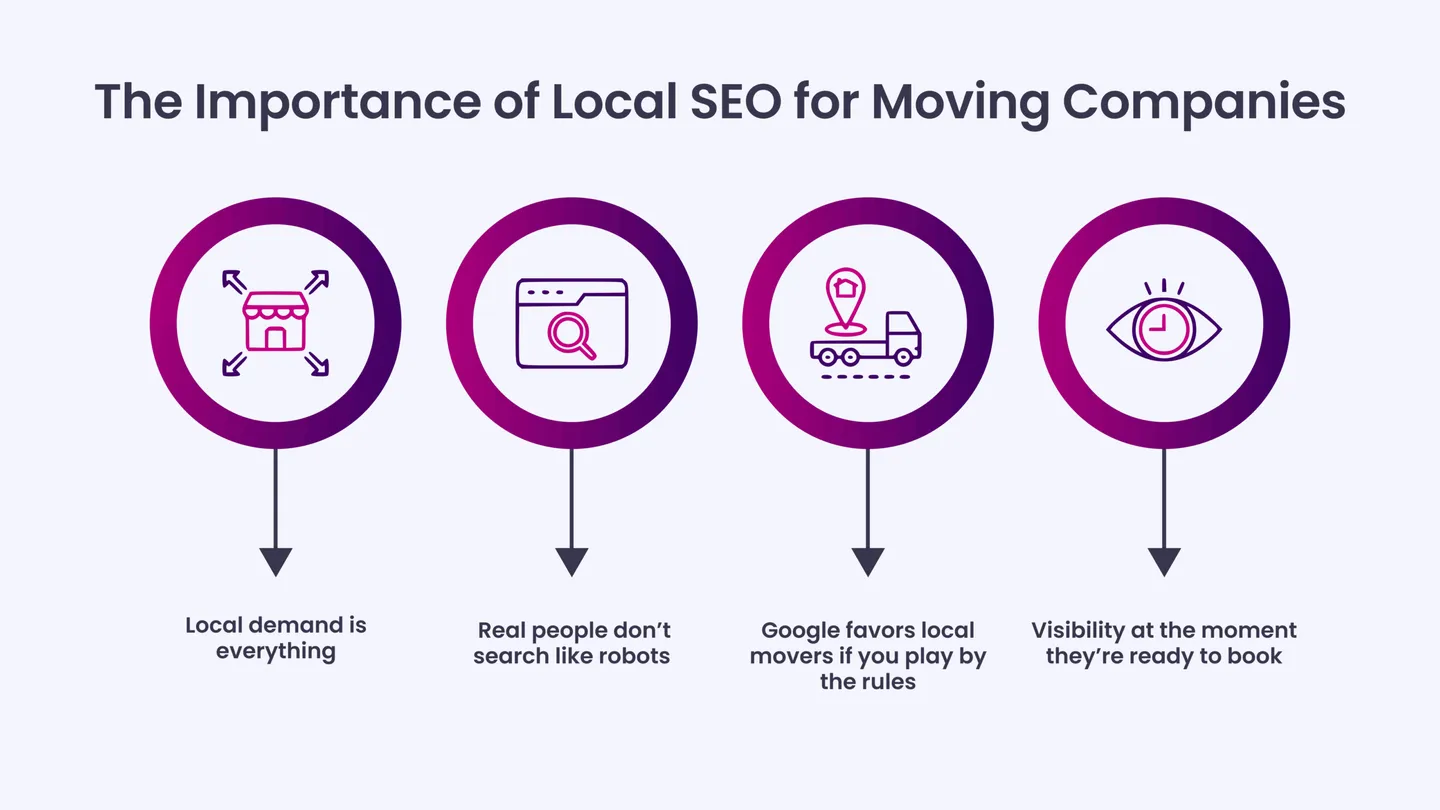
Before we get into the actionable strategies, let’s get one thing straight: local SEO for moving companies isn’t optional, it’s essential. Here’s why it matters more than ever:
- Local demand is everything: Most moves occur within a tight radius, across town, to the next city over, or perhaps a couple of counties at most. People don’t want to call a mover two hours away. They want someone local, fast, and trusted. If you’re not showing up when they search nearby, you’re already out of the running.
- Real people don’t search like robots: Nobody types “highly rated regional relocation services.” They type “moving companies near me” or “movers in [city].” And what do they see in those top local results? That’s where the business goes. If you’re not there, you’re invisible.
- Google favors local movers if you play by the rules: Google’s algorithm loves proximity, relevance, and trust signals. If your listings are accurate, your reviews are solid, and your presence is consistent across the web, you get bumped up. If not? You’re buried below companies that may not even be half as good as you.
- Visibility at the moment they’re ready to book: People looking for a mover are usually on a timeline. They’re not browsing. They’re booking. Strong local SEO ensures your business appears right when they’re ready to make that call, especially on mobile and in Google’s Map Pack (those top 3 listings with contact buttons).
In short, local SEO for moving companies puts your name in front of people who are actively looking for what you do right now. If you’re not showing up, someone else is reaping the benefits.
Local SEO for Moving Companies: 10+ Proven Strategies to Get More Calls and Booked Jobs
If you’re serious about showing up first and getting more calls, these aren’t optional. These are the 10+ core local SEO for moving companies that will get your moving company found by the right people at the right time:
1. Own Your Google Business Profile
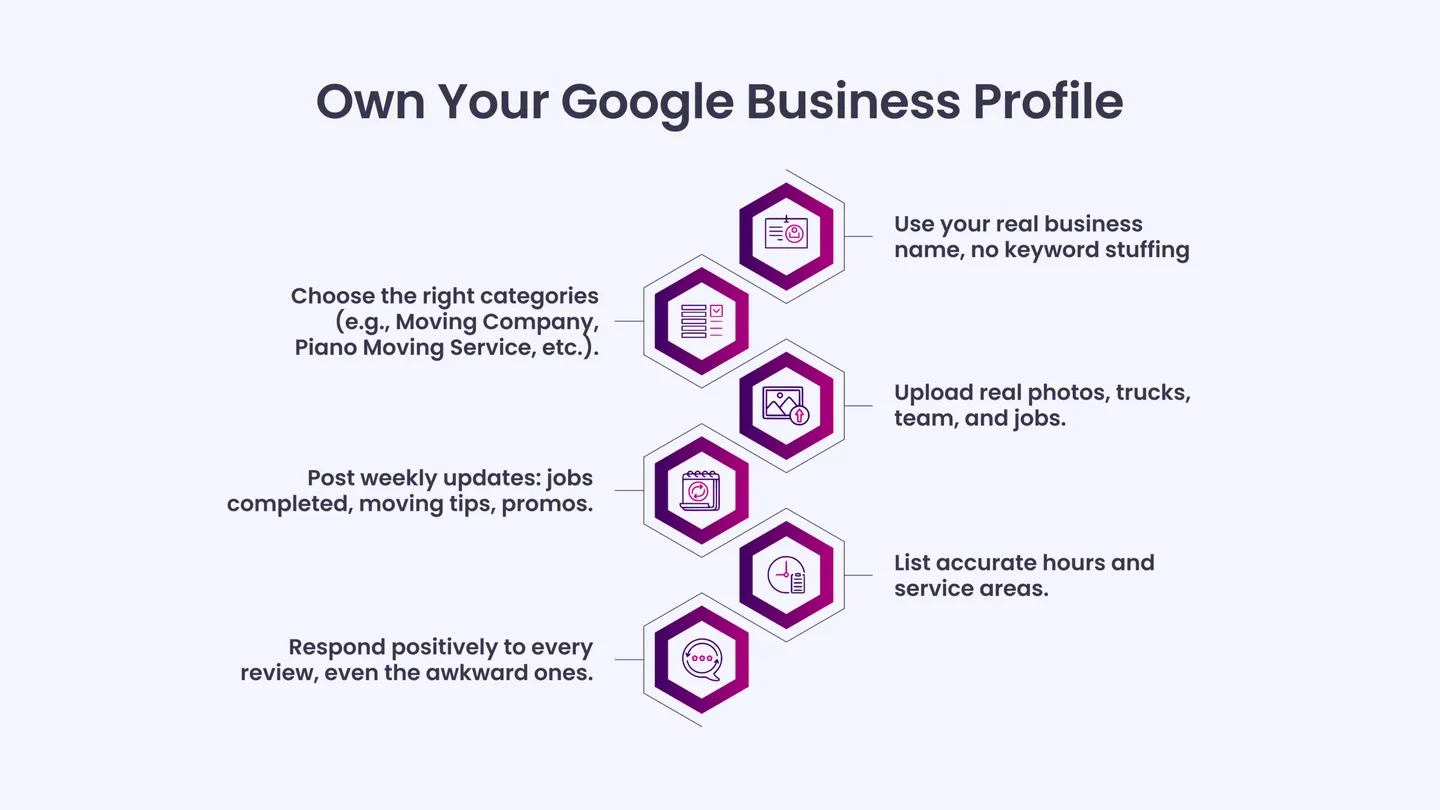
If your Google Business Profile (GBP) isn’t fully optimized and active, you’re handing leads to your competitors. Claim it, verify it, and fill it out like it’s your homepage.
Do this:
- Use your real business name, no keyword stuffing.
- Choose the right categories (e.g., Moving Company, Piano Moving Service, etc.).
- Upload real photos, trucks, team, and jobs.
- Post weekly updates: jobs completed, moving tips, promos.
- List accurate hours and service areas.
- Respond positively to every review, even the awkward ones.
Why it matters: Google prioritizes profiles that are complete, up-to-date, and active. This is your front window. Make it count.
2. Consistency Is King: Keep Your NAP Aligned Across the Web
Let’s break a common mistake most movers make: they treat their online business listings like an afterthought. You’ve got your info on Google, but on Yelp, it’s formatted a little differently. Your Facebook page still has the old address from two years ago. And your Angi listing? Don’t even remember setting it up.
That’s a problem, because for Google, inconsistency = confusion = invisibility.
NAP stands for Name, Address, Phone Number, and it’s one of the bedrock signals Google uses to verify your business identity. If your NAP info isn’t exactly the same across every listing, Google starts to doubt whether you’re legit.
And in the world of local SEO for moving companies, trust is everything.
Here’s what to get right:
Use the same version of your business name: If your Google profile says “Swift Haul & Movers LLC,” don’t list yourself as “Swift Hauling Services” or “Swift Movers” anywhere else. Google doesn’t assume those are the same company; it assumes you’re someone else.
Standardize address formatting: Choose one version and adhere to it consistently. If you use “Street” in one listing, don’t shorten it to “St.” in another. The same goes for suite numbers, zip codes, and even commas. It all needs to match, line for line.
Audit every platform where you appear. That includes:
- Google Business Profile (GBP)
- Yelp
- BBB
- Thumbtack
- Angi
- Bing Places
- Local directories or chambers
Utilize tools like Moz Local, Whitespark, or BrightLocal to scan for inconsistencies and rectify them more efficiently.
Update old or forgotten listings: If you’ve moved locations or changed numbers and never updated Yelp or the Yellow Pages, those outdated records are still available, potentially damaging your credibility. Hunt them down and fix them.
In the broader context of local SEO for moving companies, NAP consistency tells Google, “Yes, we are a real, established, trustworthy business that operates right here, in this location.” And that’s what unlocks higher rankings in Maps and local search.
3. Add Local Landing Pages for Every City You Serve
Saying “we serve all over” might sound efficient, but to Google, it sounds vague, and vague doesn’t rank.
If you want to show up in multiple cities or neighborhoods, you need dedicated service pages for each one. These aren’t just copy-paste templates. They should speak directly to each location, like you work there (because you do).
Examples:
- “Residential Movers in Fort Lauderdale”
- “Office Moving Services in Boca Raton”
- “Apartment Moves in Coral Springs”
Make each page count with:
- Real photos from jobs in that area
- Google Map embeds of your service location or recent routes
- Local testimonials from happy clients in that city
- Specific services tailored to local needs (e.g., “downtown high-rise moves” or “suburban packing help”)
This isn’t just about volume, it’s about relevance. When someone in Coral Springs searches for movers, Google will always favor a page that says “we help Coral Springs residents move” over a generic site that just lists a ZIP code.
That’s the real engine behind local SEO for moving companies: showing up where the customers are, with content that proves you’re local.
4. Use Localized Keywords That Customers Type
Most moving companies try to sound polished online, but your customers? They’re not typing “professional relocation specialists.” They’re typing what’s on their mind, fast, simple, and real.
Here’s what actual searches look like:
- “last-minute movers in [City]”
- “cheap moving company near me”
- “moving help with storage in [City]”
- “licensed movers open Sunday [City]”
The key is to match their language, not yours. That’s how you land in the search results that matter.
Pro tip: Use tools like:
- Google Autocomplete - start typing and see what fills in
- People Also Ask - for real questions people are asking
- Ubersuggest or AnswerThePublic - to get long-tail, local keyword combos
Once you have those keywords, work them naturally into:
- Page titles (“Affordable Movers in [City] - Get a Free Quote”)
- Meta descriptions (“Same-day moving help in [City]. Licensed, insured, and fast.”)
- Headers (“Why Our [City] Moving Services Beat the Rest”)
- Alt text for images (“our moving team unloading in [City]”)
- Body copy that mirrors how people talk
This isn’t about stuffing in keywords; it’s about being relevant. The goal of local SEO for moving companies is to show up when someone is searching in their moment of need. Matching their words tells Google, “Hey, we’re exactly what they’re looking for.”
5. Embed a Clickable Google Map on Your Contact Page
It sounds basic, but embedding a Google Map on your site is one of those small things that quietly does a lot of heavy lifting for your SEO.
Most movers skip this. Don’t.
When you embed your exact location on your Contact or About page, you’re feeding Google crystal-clear data about where your business operates. That means stronger location signals and better alignment with your Google Business Profile (GBP).
Here’s what to do:
- Embed your Google Map directly from your GBP: Search your business name on Google, click the map, and grab the embed code. Place it somewhere obvious, above the fold, not buried in the footer.
- Make it clickable on mobile: Most moving leads come from phones. If they can’t tap for directions or a quick call, you’re making it more complicated than it should be.
- Place your full NAP info right next to the map: That’s your Name, Address, and Phone number, formatted exactly as it appears on your GBP. It reinforces trust and consistency.
This small update enhances the user experience and makes it easier for Google to confirm that you’re a local business rooted in your service area. In the world of local SEO for moving companies, that’s a signal you can’t afford to skip.
6. Get Reviews. Lots of Them. And Keep Them Coming.
Reviews aren’t just digital high-fives; they’re a legit ranking factor that can make or break your visibility in local search.
Google doesn’t just look at how many reviews you have; it looks at how recently they were posted, how often they come in, and whether you respond. All of that tells Google (and potential customers) that your business is active, reliable, and real.
And in local SEO for moving companies, trust is currency.
Here’s how to build a steady stream of 5-star proof:
- Ask after every single move: Train your crew to ask in person once the job is complete and the truck is empty. Then follow up via text or email with a direct review link. Timing is everything; strike while the experience is fresh.
- Make it frictionless: Create a short, friendly message like:
“Thanks for letting us help with your move! Would you mind leaving a quick review? It only takes a minute, and it helps us grow.” - Include a direct Google review link or even a QR code on your invoice or thank-you card.
- Respond to every review, yes, even the bad ones. Keep it short, personal, and professional.
Example: “Thanks for the kind words, Sarah, enjoy your new place!”
Or: “Sorry, we missed the mark, Alex. We’ve shared your feedback with the team and would love to make it right.”
Encourage photos.
If a client posts pics of your team helping out, that’s gold. Visual reviews carry extra weight with potential customers and Google.
Use reviews in your content. Take snippets from your best reviews and sprinkle them across your website, especially on location pages or service sections. It builds credibility and naturally reinforces your local presence.
Bottom line: the more fresh, honest, and high-quality reviews you have, the higher you’ll climb in local rankings. And when it comes to local SEO for moving companies, that visibility directly translates into more phone calls, more jobs, and more booked trucks.
7. List Your Business on High-Trust Directories (and Keep Them Updated)
Think of online directories like digital trust badges. Every time your business is listed correctly, on a reputable site, it tells Google:
“This company is legit, active, and known in the community.”
But if your listings are outdated, inconsistent, or half-complete? You’re doing more harm than good.
In local SEO for moving companies, these listings are called “citations,” and they play a big role in building your authority and pushing you higher in local search results.
Start with the must-have directories:
- Google Business Profile (obviously)
- Yelp
- BBB (Better Business Bureau)
- Thumbtack
- Angi (formerly Angie’s List)
- Nextdoor (as a local service provider)
- Facebook Business Page
- Your local Chamber of Commerce
Then add industry-specific platforms like:
These sites don’t just help SEO, they’re often used by people who are actively shopping for movers.
Tips to do it right: Use the same NAP (Name, Address, Phone) across every listing
Upload your logo and real business photos
Write a clear, location-specific business description
Check back every few months and update any changes (address, hours, services, etc.)
Consistent, accurate listings across these directories create a strong web of trust. They boost your domain authority, help your Google profile rank higher, and increase your chances of showing up in local searches. In other words, this is the quiet muscle behind effective local SEO for moving companies.
8. Add a Local FAQ Section to Your Website
Every mover hears the same questions over and over again:
“How much notice do you need?”
“Can you move us on a Sunday?”
“Do you guys handle packing too?”
They’re search terms your future customers are literally typing into Google right now.
A wise, well-written FAQ section helps you do three things at once:
Answer real questions upfront
Target local search terms without forcing them
Build trust and keep people on your site longer
And in the world of local SEO for moving companies, that last part, time on site, is a ranking factor that Google watches closely.
Here’s how to do it right:
Write each question as a header.
This makes it skimmable and helps search engines understand the content. Example:
“Do you offer same-day moving in [City]?”
Use natural, customer-friendly language.
Don’t write like a legal form. Write how you’d talk on the phone:
“Yes, we do offer same-day moves in most areas around [City], depending on crew availability. Just give us a call to check your date.”
Sprinkle in local context.
If there are special rules in your area (such as parking permits, building move-in hours, or elevator access), please mention them. That shows you’re local and experienced, and Google loves that.
Cover at least 5-10 questions
Start with the top things people ask when booking, plus anything unique about your business (eco-friendly packing, long-distance licenses, specialty items like pianos or gun safes).
Update seasonally or as services change. If you add storage, junk removal, or expanded service areas, consider adding a few new questions to keep it fresh.
A good FAQ section isn’t filler; it’s a functional SEO tool. It helps you rank for real long-tail keywords, supports your authority in multiple service areas, and builds trust before a customer even picks up the phone. That’s how you win with local SEO for moving companies, by showing up with answers before they have to ask.
9. Earn Local Backlinks That Boost Your Rankings
Not all backlinks are created equal. One link from a local apartment complex’s website or a real estate blog can be more potent than ten from random national directories.
That’s because Google doesn’t just care about links; it cares about context. Local links tell Google, “This business isn’t just trying to rank here. It’s part of the community.” And that kind of credibility moves the needle hard in local SEO for moving companies.
Here’s how to get quality local backlinks (without begging):
- Team up with real estate professionals: Agents, brokers, and property managers are always in touch with people who are moving. Offer to write a helpful guest article like “5 Things to Do Before Moving Day in [City]”, or create a referral partnership. Most will happily link back to your site.
- Partner with storage units, junk removal, or cleaning services: Bundle services, do cross-promos, or build a “preferred vendors” page on both sites. You link to them, they link to you. Google sees mutual trust, and your customers get value.
- Sponsor community events or youth sports teams: These often come with website shoutouts. Even small-town soccer leagues usually post sponsor logos with a backlink.
- Get featured in local blogs, business directories, or news outlets: Pitch helpful moving tips to lifestyle bloggers or neighborhood sites. You’re not promoting, you’re providing value. That earns trust and a backlink.
- Create a “Moving in [City]” resource page on your site: List local utility contacts, DMV change-of-address links, donation centers, etc. Then reach out and ask those places to return the favor by linking back or sharing your guide.
These aren’t just backlinks, they’re local authority signals. They tell Google you’re rooted in your service area and connected to other legit businesses. That kind of signal is gold for local SEO for moving companies, especially if you’re trying to dominate map rankings.
10. Use Google’s Local Services Ads (LSAs) to Get Calls Fast
Organic SEO is powerful, but it takes time. If your trucks need to roll this week, Google’s Local Services Ads (LSAs) are your best fast track.
Unlike traditional ads, LSAs are specifically designed for service-based businesses, such as movers. They appear above all other results, including standard Google Ads, and they connect customers directly to verified, local providers.
In other words, LSAs are built for leads, not clicks.
What makes LSAs different:
- Pay per lead, not per click, no wasted spend
- Appear above everything else, including map results
- Only show verified businesses with licenses and insurance
- Include real customer reviews and a prominent “Google Guaranteed” badge
That badge alone can be a difference-maker. It signals trust instantly, which is huge when someone’s choosing between movers with a few minutes to spare.
Here’s how to set it up right:
- Complete your LSA profile: Google will request documents such as a business license, proof of insurance, and background checks for employees. Take it seriously, this is what earns the “Google Guaranteed” status.
- Set accurate service areas and job types: Be clear about the cities you serve and the types of moves you handle, such as residential, office, long-distance, and packing, among others. This helps Google match you to the right searches.
- Upload real photos: Don’t use stock images. Add pictures of your crew, branded trucks, or happy customers. These build trust before anyone even clicks “Call.”
- Respond fast: Speed matters. Google tracks how quickly you respond to leads and favors businesses that respond more quickly in future rankings.
If you’re working on building out your organic presence with traditional local SEO for moving companies, LSAs help bridge the gap. You get instant visibility, pre-qualified leads, and the peace of mind that every dollar spent is tied to actual results, not empty clicks.
11. Write Blog Content That Solves Real Local Moving Problems
Most movers either skip blogging entirely or crank out a couple of generic posts that sound like a robot wrote them. Huge missed opportunity.
The truth is, people in your city are Googling particular questions every single day, especially when they’re in the middle of planning a move.
Searches like:
- “How to move in the rain [City]”
- “Best time of year to move in [City]”
- “Moving checklist for first-time renters in [City]”
- “How to prep for movers in a downtown apartment”
If your site has blog content that answers those exact questions, you win. Why? Because Google sees you as topically relevant for local moving help, and boosts your visibility across the board.
Here’s how to do it right:
- Write for humans, not algorithms: Keep it helpful, concise, and easy to scan. Think of it as answering a question a customer might ask on the phone.
- Make it location-specific: Don’t just write “moving tips”, write “moving tips for [City] renters” or “how to avoid parking tickets during a move in [City].” The more hyper-local, the better.
- Use real-world examples: Did you help someone move out of a high-rise with no elevator last month? Turn that into a blog. “What to Expect When Moving Out of [Building Name] in [City]”.
- Post consistently, even once a month is enough: You don’t need to be a content machine. One focused, helpful blog a month builds momentum and strengthens your overall site authority.
- Link internally: Reference your service pages, city-specific landing pages, and FAQs. This helps Google understand your site structure and keeps visitors clicking deeper.
Good blog content answers real questions, captures long-tail searches, and positions you as the local expert. That’s the kind of authority that directly contributes to better rankings, more clicks, and increased trust, all critical components of local SEO for moving companies.
Your Crew Handles the Moves. We Make Sure the Right People Find You.
Running a moving company isn’t a desk job. Your days are packed with quotes, dispatch calls, equipment runs, client questions, last-minute changes, and jobs that always go longer than planned.
While you’re on the road making moves happen, who’s making sure your business is the one people see when they search “moving company near me”?
Let’s be honest, local SEO isn’t something you can just “get to later.” It requires consistent updates, accurate listings, strong reviews, localized content, and a clear understanding of how Google ranks moving companies in your area. It’s a job in itself.
So you’ve got two options:
- Keep trying to manage it all, your crews, your customers, and your online presence, or
- Let the marketing experts who handle this task every day manage the digital side of things for you.
If you’re ready for more qualified leads, better visibility, and phones that ring with people ready to book, let us take care of your local SEO for moving companies. At the same time, you stay focused on running a business that delivers.
INSIDEA
Ready to put this into practice?
INSIDEA is an Elite HubSpot Partner rated 4.99 across 500+ verified reviews. Let's map it to your goals.



 How INSIDEA works




