You’re spending on ads, but instead of solid business inquiries, you’re getting irrelevant clicks, empty contact forms, or radio silence. Meanwhile, your competitors seem to be everywhere, showing up when buyers search for precisely what you offer.
But PPC isn’t the problem, the wrong approach is.
Over 70% of industrial buyers start their supplier search online, and if your ads aren’t reaching the right decision-makers at the right time, you’re handing business to someone else.
Manufacturers who get PPC right see consistent, high-quality leads and measurable ROI. This guide breaks down exactly how to run PPC campaigns that don’t just bring in traffic but the right traffic. Let’s get started.
Why is PPC Crucial for Manufacturers?
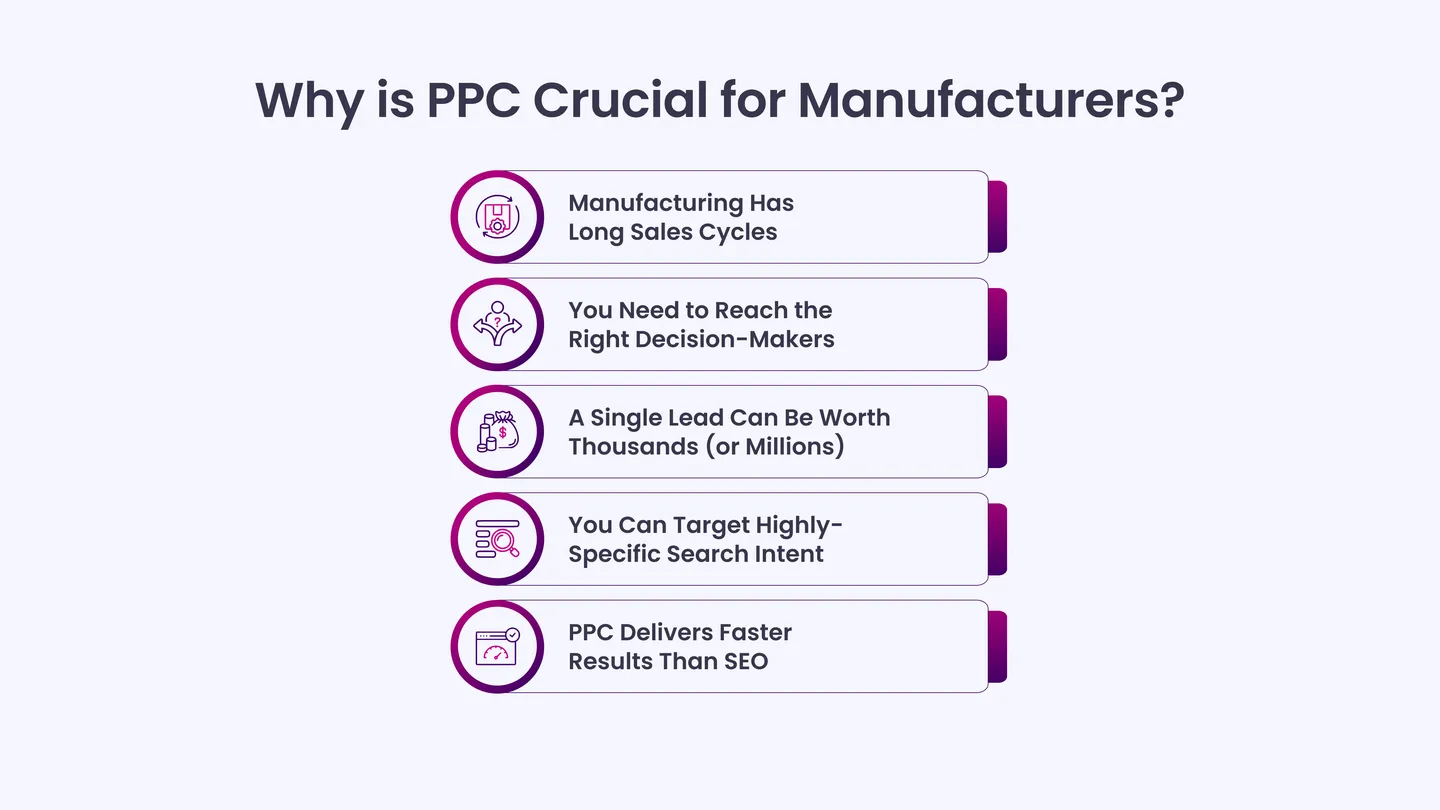
Manufacturers face unique marketing challenges that make generating leads and closing sales more complex than conventional B2C businesses. Here’s why PPC (Pay-Per-Click) advertising is necessary for manufacturers looking to scale their business.
1. Manufacturing Has Long Sales Cycles
Unlike consumer products that are purchased on impulse, manufacturing products involve research, approvals, and lengthy decision-making processes. PPC allows you to stay top-of-mind throughout this journey by retargeting potential customers and ensuring your brand is visible when they’re ready to buy.
2. You Need to Reach the Right Decision-Makers
In manufacturing, your target audience is engineers, procurement managers, and supply chain executives. PPC platforms like Google Ads and LinkedIn let you target these specific roles, ensuring your ad budget is spent on the people who make purchasing decisions.
3. A Single Lead Can Be Worth Thousands (or Millions)
One high-value contract can bring in six or seven figures in revenue. PPC ensures you invest in the most qualified leads, not just driving generic website traffic.
4. You Can Target Highly-Specific Search Intent
Manufacturing customers often search for exact solutions, such as “custom CNC machining services” or “industrial-grade 3D printing.” With PPC, you can bid on these high-intent keywords and show up right when potential buyers actively search for your solutions.
5. PPC Delivers Faster Results Than SEO
While SEO is a powerful long-term strategy, it takes months (or even years) to rank organically. PPC gives you instant visibility, allowing you to immediately compete against industry giants and reach potential customers.
PPC Marketing Guide for Manufacturers to Drive More Leads & Sales
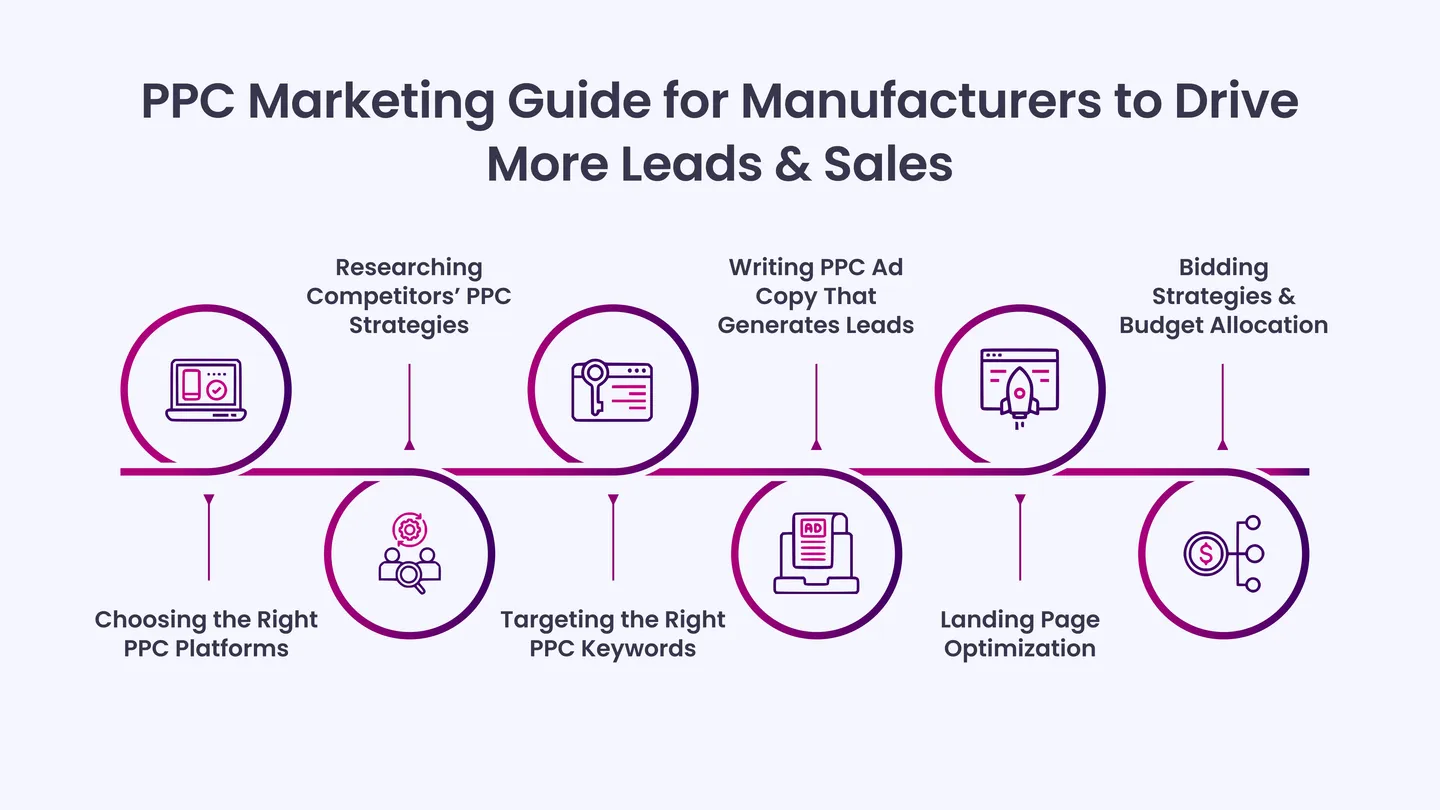
Before spending a dime on PPC ads, you should be clear on two things. Skipping these steps leads to wasted money and low-quality leads.
A. Know Exactly Who You’re Targeting
PPC works best when your ads reach the right people. In manufacturing, that means decision-makers like procurement managers, engineers, or business owners. The more specific you get, the better your ads will perform. If you try to target everyone, you’ll reach no one.
B. Set a Budget for Your Business
Throwing money at ads without a clear budget is like running a factory without tracking production costs. Decide how much you’re willing to spend, and more importantly, how much a qualified lead is worth. A planned budget helps you run ads efficiently without unnecessary spending.
Once you’ve sorted these two things out, PPC will work much harder for you. Now, let’s go on how to make it drive actual results:
I. Choosing the Right PPC Platforms
Not every PPC platform will suit manufacturers. The right choice depends on where your potential buyers are and how they search for your products. Here’s how each platform fits into a manufacturing-focused PPC strategy.
1. Google Ads - Best for Buyers Actively Searching
Works well for: Businesses selling industrial equipment, components, and B2B services where buyers search with clear intent.
- Ad Types: Search Ads, Display Ads, Shopping Ads.
- Why it works: When a buyer searches for “custom sheet metal fabrication” or “bulk industrial fasteners,” your ad appears at the top. This brings in serious inquiries from people ready to take action.
2. LinkedIn Ads - Best for Targeting Decision-Makers
Works well for: Manufacturers targeting engineers, procurement managers, and executives at specific companies.
- Ad Types: Sponsored Posts, Text Ads, Lead Gen Forms.
- Why it works: You can filter by job title, company size, industry, and more. This helps you reach the people who make purchasing decisions for large contracts.
3. YouTube Ads - Best for Product Demonstrations
Works well for: Complex products where visuals help explain features and benefits.
- Ad Types: Skippable and Non-Skippable Video Ads, In-Stream Ads.
- Why it works: If you manufacture high-tech machinery, industrial automation solutions, or custom manufacturing services, video ads help potential buyers understand your product in action, building trust before they reach out.
4. Meta Ads (Facebook & Instagram) - Best for Retargeting
Works well for: Staying in front of potential buyers who visited your site but didn’t reach out.
- Ad Types: Retargeting Ads, Carousel Ads.
- Why it works: If someone visits your website but leaves without taking action, retargeting ads remind them about your product. This is especially useful for longer sales cycles where buyers need multiple touchpoints before deciding.
II. Researching Competitors’ PPC Strategies
Instead of starting from scratch, copy your competitors’ Ads. If a manufacturing company like yours consistently runs PPC ads, it’s because its campaigns generate results. Studying their strategies gives you insights into what’s working, saving time, and ad spend.
Here’s what you should analyze:
What Products or Services Are They Advertising?
Are competitors focusing on custom CNC machining, bulk metal fabrication, or precision plastic molding? Identifying where they invest their ad budget helps you uncover high-demand service areas. If multiple competitors run ads for the same type of service, it’s likely a profitable niche.
How Are They Positioning Their Ads?
Look at their headlines, offers, and calls to action (CTAs). Are they emphasizing fast turnaround times, ISO certifications, or specialized capabilities? If a competitor consistently highlights “24-hour prototyping” or “aerospace-grade CNC machining,” it signals what customers value most in their decision-making process.
What Does Their Landing Page Experience Look Like?
A strong PPC ad means nothing if the landing page doesn’t convert. Study how competitors structure their pages:
- Do they feature case studies or industry certifications to build trust?
- How simple is their contact form? Are they making it easy to request a quote?
- Are they using customer testimonials or trust badges?
Take notes and refine your approach if a competitor’s landing page smooths the buying process.
Tools to Research Competitor PPC Strategies
You don’t need to guess what’s working, use tools to analyze their campaigns:
- Google Ads Transparency Center: See active Google Search ads from any competitor.
- SpyFu / SEMrush / Ahrefs: Track competitor PPC keywords, ad copy, and landing pages.
- Facebook Ad Library: View their active ads on Facebook and Instagram.
III. Targeting the Right PPC Keywords
Your PPC success depends on targeting keywords that attract serious buyers, not just website visitors. In manufacturing, a well-chosen keyword can mean the difference between getting a high-value lead or wasting money on unqualified traffic.
Focus on High-Intent, Commercial Keywords
Your goal is to target search terms that indicate a buyer is actively looking for your product or service. These are often transactional or supplier-related queries.
Examples of strong PPC keywords for manufacturers:
- “Industrial CNC machines for sale” - Someone looking to buy, not just research.
- “Bulk metal fabrication supplier” - Indicates a business looking for a vendor.
- “Custom plastic injection molding services” - Shows a specific manufacturing need.
Keywords to avoid:
- “What is CNC machining?” - Likely a student or someone researching.
- “Metal fabrication process” - Informational rather than purchase-driven.
Use Data-Driven Keyword Research Tools
Instead of guessing, use tools to find search terms that have both high buying intent and manageable competition:
- Google Keyword Planner - See search volume and bidding costs.
- SEMrush & Ahrefs - Find what terms competitors are bidding on.
- Google Autocomplete & “People Also Ask” - Spot real buyer queries.
Target Long-Tail Keywords for Higher Conversions
Longer, more specific keywords often bring in better-quality leads at a lower cost. While they may have fewer searches, they attract people who know exactly what they want.
💡 Example:
Instead of bidding on “CNC machining” (too broad), target:
- “Custom CNC aluminum parts manufacturer”
- “CNC milling services for aerospace components”
IV. Writing PPC Ad Copy That Generates Leads
Your ad copy needs to do more than describe your product, it should make a strong case for why someone should choose you over competitors. Manufacturing buyers look for precision, reliability, and expertise, so your messaging should reflect that.
Make Your Headline Specific and Benefit-Driven
The headline is what grabs attention. A vague or generic ad will blend in with the rest, while a strong one will make potential buyers stop and take action.
- Weak: “High-Quality Metal Parts Available”
- Better: “ISO-Certified Metal Fabrication - Bulk Orders Ready”
Why? The second example instantly tells buyers what they’re getting, highlights quality assurance, and appeals to businesses needing large-scale production.
Use Clear Calls-to-Action (CTAs) That Guide Action
Your ad should tell the reader exactly what to do next. Vague phrases like “Learn More” don’t push action as effectively as direct CTAs.
- Weak: “We offer CNC machining services.”
- Better: “Request a Free CNC Machining Quote - Fast Turnaround!”
Why? The second version sets clear expectations and encourages immediate action.
Highlight What Sets You Apart
Manufacturers often compete on quality, certifications, production capacity, or specialization. If you have a strong differentiator, put it in the ad.
- “Custom Injection Molding - FDA & ISO 9001 Certified”
- “Aerospace-Grade CNC Machining - AS9100 Compliant”
- “Bulk Sheet Metal Fabrication - 24-Hour Turnaround”
These examples immediately build trust by showcasing industry standards and capabilities.
Keep It Concise - Every Word Should Earn Its Place
Space is limited, so avoid fluff. Buyers want quick, clear information.
- Too vague: “We make high-quality industrial parts for different sectors.”
- Stronger: “Industrial-Grade CNC Parts - Automotive & Aerospace Experts”
Your ad should answer a buyer’s most significant question in seconds, ”Is this the right supplier for me?”
V. Landing Page Optimization
Getting a potential buyer to click on your ad is the first step. If your landing page doesn’t give them what they need immediately, they’ll leave, and your ad budget goes to waste. A well-structured landing page makes the difference between losing traffic and gaining actual business inquiries.
Make Sure Your Headline Matches the Ad
The first thing visitors see should confirm they’re in the right place. If your ad promised “Precision Metal Fabrication - ISO Certified”, your landing page should reinforce that message, not introduce something different.
- Weak: “Welcome to Our Company”
- Better: “ISO-Certified Metal Fabrication - Request a Quote Today”
This keeps visitors focused and reassures them they’re in the right place.
Highlight Benefits, Not Just Features
Buyers don’t just need specs, they need reasons to choose you over competitors. Instead of listing machine capabilities, show how your service solves their problem.
- Weak: “We offer CNC machining with tight tolerances.”
- Better: “Tight-Tolerance CNC Machining - Faster Lead Times, Bulk Production Available.”
Clear, direct, and focused on what the buyer values most.
Keep the Contact Form Simple
A long, complicated form will drive potential leads away. Ask for the essentials, name, email, company, and project details, and remove unnecessary fields.
Ideal Form Fields:
- Name
- Business Email
- Company Name
- Project Requirements
Collect more details if you need more information after the lead is in your system.
Use Social Proof to Build Trust
Buyers need proof before making a decision. Adding testimonials, case studies, or industry certifications can motivate them to take action.
“XYZ Manufacturing helped us reduce costs by 20%, highly recommended.” - [Client Name, Company]
Case Study: “How Our Custom Injection Molding Helped a Medical Device Manufacturer Scale Production by 3X.”
Never Send PPC Traffic to Your Homepage
Your homepage serves many purposes, but converting PPC traffic shouldn’t be one of them. Always direct clicks to a dedicated landing page designed for the ad campaign.
Example: If your ad is about bulk sheet metal fabrication, don’t send visitors to your general company page, instead, send them to a page that speaks only about your sheet metal fabrication services, pricing, and lead times.
VI. Bidding Strategies & Budget Allocation
Spending money on PPC without a clear bidding strategy is like running a factory without cost controls, you’ll burn through cash without knowing what’s working. Manufacturers need a structured approach to bidding and budgeting to attract the right leads without overpaying.
Choose the Right Bidding Strategy for Manufacturing PPC
Not all bidding strategies work for manufacturers. The goal isn’t just to get clicks, it’s to get high-value leads at a sustainable cost.
- Manual CPC (Cost-Per-Click): This method gives you full control over bid amounts, helping you manage costs efficiently. It is best for campaigns with clear data on which keywords perform well.
- Target CPA (Cost-Per-Acquisition): Google sets bids to get conversions at your desired cost. Ideal if you know how much you’re willing to pay per lead.
- Maximize Conversions: Google automatically adjusts bids to bring in as many leads as possible within your budget. Best for campaigns that already have conversion data.
- Avoid “Maximize Clicks”: This can waste budget on unqualified traffic without guaranteeing leads.
How Much Should You Budget?
Manufacturing PPC isn’t about volume, it’s about quality. Your budget should be based on lead value and expected ROI, not just getting clicks.
Recommended Starting Budget:
- $1,000 - $5,000/month for initial testing.
- Scale up based on conversion rates and cost per lead.
Calculate Your Maximum Cost-Per-Lead
Before setting bids, determine what a single lead is worth to your business.
Example Calculation:
- Your average deal value = $50,000
- Your close rate from leads = 10% (1 in 10 leads converts to a sale)
- Your target cost per acquisition (CPA) should be $500 or less to maintain a strong ROI.
A/B Test Your Bidding Strategies for Better Performance
Bidding isn’t one-size-fits-all; testing different strategies helps refine what works best.
Test different bidding models: Run campaigns with Manual CPC vs. Target CPA and compare cost per lead.
Experiment with bid adjustments: Increase bids for high-performing times of day, locations, or devices.
Track impact on conversion rates: Ensure lower CPC doesn’t sacrifice lead quality.
Monitor & Adjust Weekly
Track conversion rates, cost per lead, and return on ad spend (ROAS) to make data-driven adjustments.
- Lower bids on underperforming keywords.
- Increase bids for high-converting keywords.
- Adjust budget based on sales pipeline needs.
You Build. You Innovate. Let PPC Experts Bring the Buyers.
Running a manufacturing business is already a full-time commitment. Managing production, ensuring quality control, and meeting client demands leave little room for learning the ins and outs of PPC. You didn’t build your expertise in precision engineering, CNC machining, or metal fabrication just to spend hours tweaking ad bids, researching search terms, and testing landing pages.
PPC is an ongoing process that demands constant monitoring, adjustments, and data analysis. Google’s algorithms change, bidding strategies evolve, and what worked last month might not work today. Instead of adding a marketing manager to your already full plate, let PPC experts handle it. Professionals specializing in paid advertising know how to optimize campaigns, manage budgets effectively, and ensure that every dollar spent brings real business value.
With the right PPC team managing your campaigns, you can focus on what you do best, manufacturing quality products, while experts ensure that paid advertising delivers the right leads to your business.
INSIDEA
Ready to put this into practice?
INSIDEA is an Elite HubSpot Partner rated 4.99 across 450+ verified reviews. Let's map it to your goals.



 How INSIDEA works