Spreadsheets don’t scare you. But writing a blog? That’s another story.
As a financial advisor, you can calculate returns, analyze risk, and optimize portfolios in your sleep. But when it comes to creating content that brings in clients? That’s a whole different equation.
Your expertise isn’t enough if no one knows about it. Clients don’t just hire the advisor with the best credentials, they hire the one they trust. And that trust starts with impactful content.
Most advisors either don’t have a content strategy or waste time on content that doesn’t work. And considering that financial content sees an average engagement time of 1 minute and 51 seconds, there’s a clear opportunity to capture attention, if you do it right.
In this blog, I’ll share a detailed content marketing guide for financial advisors, breaking down exactly how to create content that attracts, educates, and converts (without making you feel like a full-time writer).
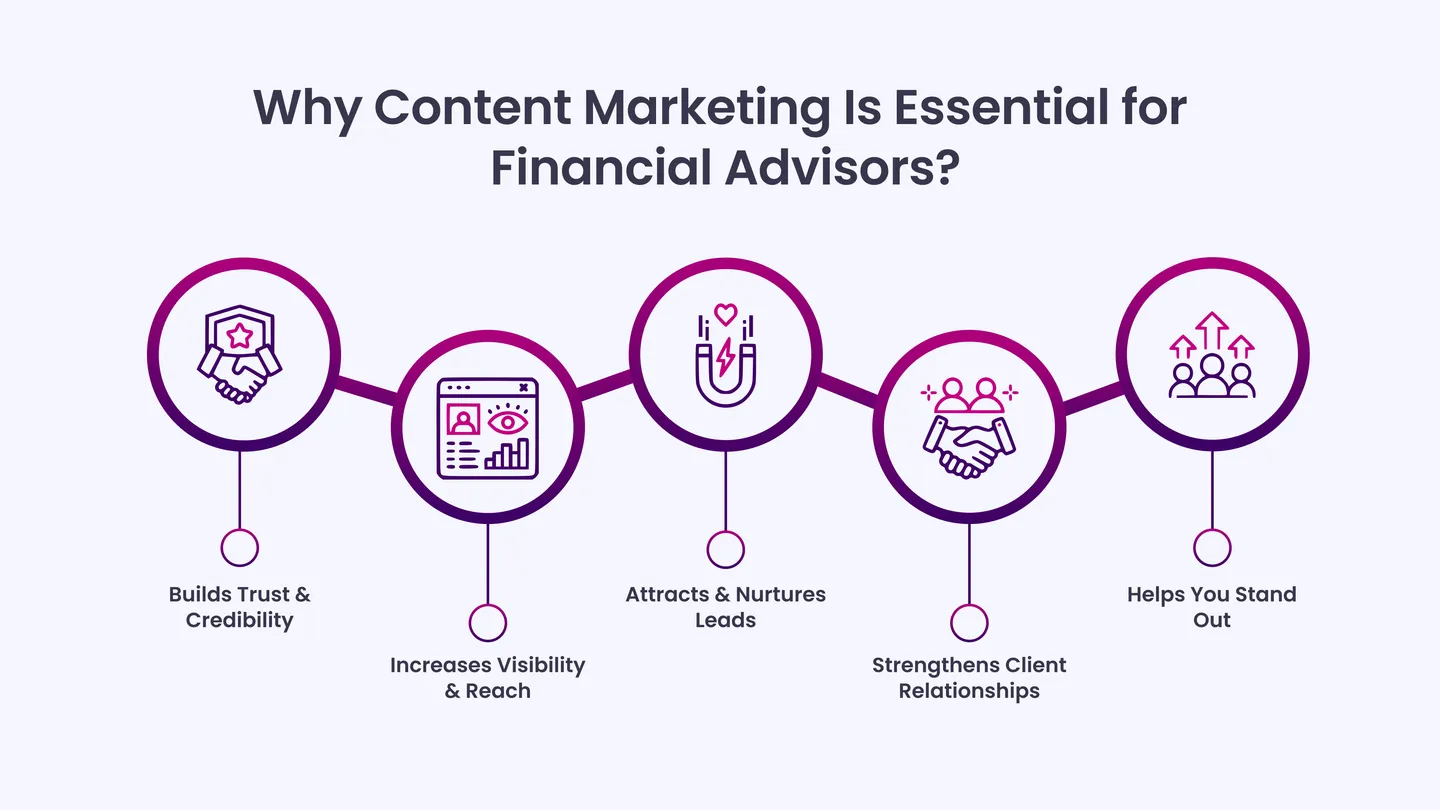
Why Content Marketing Is Essential for Financial Advisors?
Your best clients didn’t sign up with you overnight. They researched, asked questions, and took time to build trust before making a financial commitment. Content marketing accelerates this process by giving prospects value before reaching out
Here’s why it works:
1. Builds Trust & Credibility: Clients are likelier to work with advisors who educate them. When you consistently share insightful, accurate, and relevant content, you position yourself as a trusted expert, making it easier for potential clients to turn to you for advice.
2. Increases Visibility & Reach: A well-executed content strategy helps you rank higher on Google, putting your name in front of people actively searching for financial guidance. The more valuable content you publish, the easier it is for prospects to find you.
3. Attracts & Nurtures Leads: Not everyone is ready to invest or plan their financial future today, but that doesn’t mean they won’t be tomorrow. Educational content keeps you on their radar, so when they are ready, you’re the advisor they turn to.
4. Strengthens Client Relationships: Consistently publishing content, whether blog posts, videos, or newsletters, keeps your clients engaged and informed. It also encourages conversations, as clients may ask questions or share your content with others.
5. Helps You Stand Out: Most financial advisors rely on word-of-mouth or referrals, but content marketing gives you a scalable way to distinguish yourself. By sharing unique insights, real-world case studies, and actionable advice, you set yourself apart from others who simply blend into the background.
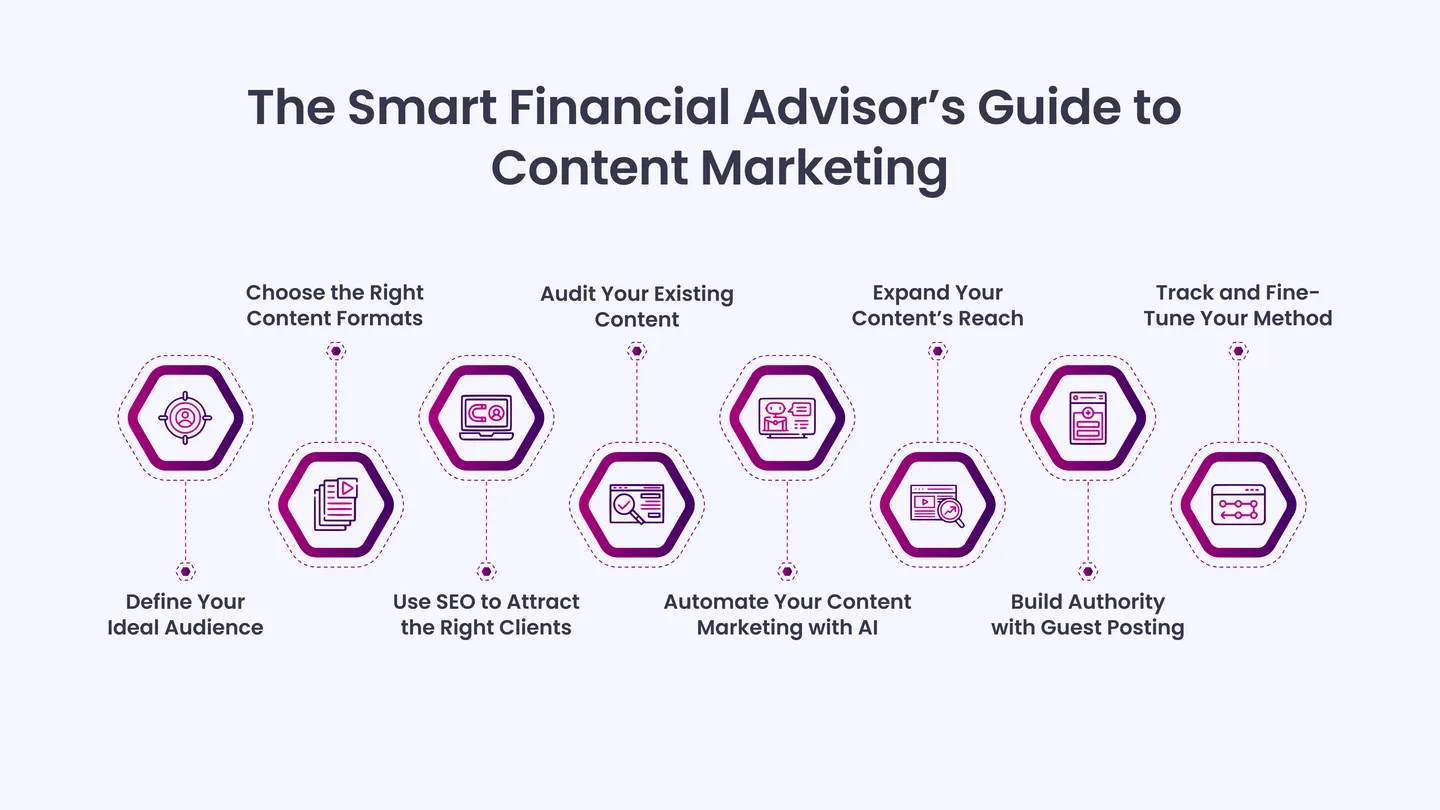
The Smart Financial Advisor’s Guide to Content Marketing
Building a content strategy for your financial advisory business isn’t just about cranking out blog posts and social media updates, it’s about creating content that connects with people, builds trust, and brings in the right clients.
Throwing content out there without a plan won’t get you far. You need a strategy to ensure your content is relevant, valuable, and seen by the people who need it most. Here’s how to make that happen:
I. Define Your Ideal Audience
Not all content resonates with all clients. A retiree planning a secure retirement has completely different concerns than a young professional trying to build wealth. To create content that actually connects, you need to get crystal clear on who you’re trying to reach and what matters to them.
Ask yourself:
Who is my ideal client? Are you targeting business owners, retirees, high-income professionals, or first-time investors? Each group has different priorities, financial worries, and levels of financial literacy.
What are their most significant financial concerns? Are they worried about outliving their savings? Reducing their tax burden? Making smarter investment decisions? Your content should provide solutions to their specific challenges.
What financial terms or concepts confuse them? The financial world is full of jargon. If your audience doesn’t understand key concepts, they won’t take action. Break things down in a way that makes sense to them.
Where do they look for financial advice? Are they searching for answers on Google? Watching YouTube videos? Following experts on LinkedIn? Knowing where they consume content helps you show up where they’re already looking for answers.
If you skip this step and create generic content, you’ll end up blending in with every other financial advisor. But you become their trusted go-to advisor when you customize your content to your audience’s needs.
II. Choose the Right Content Formats
Many financial advisors assume content marketing just means blogging, but that’s only part of the equation. Different people consume content differently, so relying on a single format means missing potential clients. The best strategy is to use a mix of formats, some prefer reading, others videos, and some direct interaction, to reach your audience in multiple ways.
Here’s how you can mix it up:
1. Blog Posts: Establish Authority & Boost SEO
Blogs can answer common client questions, build trust, and improve your Google rankings. When people search for financial advice, your well-optimized blog posts position you as an expert.
Examples
- How to Save for Retirement in Your 40s
- Stock Market vs. Real Estate: Which Is the Better Long-Term Investment?
- Understanding Roth IRAs: What They Are and How They Work
2. Videos: Build Connection & Simplify Complex Topics
Not everyone wants to read long blog posts; some prefer to watch and listen. Short, informative videos allow you to explain complex financial topics simply and engagingly. Plus, seeing your face and hearing your voice helps build trust faster than text alone.
Examples
- What’s a Roth IRA and Should You Get One?
- 3 Common Investing Mistakes to Avoid
- How to Reduce Taxes in Retirement
3. Email Newsletters: Stay Top of Mind
A well-composed email newsletter keeps you in front of your audience without being intrusive. You can use it to share financial insights, market updates, and actionable advice, ensuring clients and prospects think of you when they need financial guidance.
Examples
- Weekly market updates
- Monthly financial planning tips
- What’s Happening in the Economy? breakdowns
4. Social Media Posts: Reach & Engage Your Audience
Social media is a powerful resource for financial advisors, too. Regularly sharing bite-sized financial insights keeps you top of mind and helps you build your brand authority.
Where to Post?
- LinkedIn: Best for professional insights, long-form posts, and networking with potential clients.
- Twitter (X): Great for quick financial tips, industry commentary, and engaging discussions.
- Instagram: Ideal for younger audiences; use reels, carousels, and infographics to simplify finance.
Example Posts
- The 50/30/20 Rule: A Simple Way to Budget Your Money
- 3 Things to Do Before the Next Market Crash
- Why You Should Start Investing in Your 20s
5. Webinars & Live Q&As: Demonstrate Expertise & Interact with Clients
Hosting live Q&A sessions or educational webinars allows you to interact directly with potential clients. People appreciate the chance to ask questions and get real-time advice, which builds credibility and trust.
Example Topics
- How to Build a Tax-Efficient Retirement Plan (Live Q&A)
- Smart Investing Strategies for 2024 (Webinar)
- Common Financial Mistakes and How to Avoid Them (Live Discussion)
6. Glossary Pages: Make Finance Easier to Understand
Finance is full of jargon, and most clients don’t have the time (or patience) to Google every term. A glossary page with clear, simple definitions helps demystify complex financial concepts and keeps visitors on your website longer. It also boosts SEO, as people often search for definitions of financial terms.
Example Terms to Include
- Asset Allocation: What it is and why it matters
- Compound Interest: How it helps grow wealth over time
- Tax-Deferred Accounts: Which ones exist and how they work
III. Use SEO to Attract the Right Clients
You don’t need to be an SEO expert to make content work for your financial advisory business. However, understanding a few basic SEO principles can make a huge difference in how easily potential clients find you online.
SEO (Search Engine Optimization) ensures that your content shows up when people search for financial advice. You need to rank higher on Google so the right audience, people looking for your expertise, can discover you.
SEO Quick Wins for Financial Advisors
Use Keywords Clients Search For: Consider the financial questions your ideal clients ask. Those are the same terms they type into Google. Use those phrases naturally in your content to improve search rankings.
Examples
- Best retirement plans for self-employed professionals
- How to lower taxes before retirement
- Should I invest in real estate or stocks?
Use resources like Google’s “People Also Ask” section or free keyword research tools to find commonly searched terms in your niche.
Write Clear, Engaging Headlines: Your headline is the first thing people see, on Google, social media, and even emails. A vague or boring title won’t get clicks. Make your headlines clear, specific, and benefit-driven.
Examples:
Retirement Planning Tips → Too broad, not engaging
401(k) vs. IRA: Which One Is Right for You? → Clear, specific, and useful
Use numbers, questions, or direct benefits in your headlines. (Example: “5 Smart Investing Moves to Make Before 50”)
Answer Common Client Questions: Google favors content that directly answers user questions, especially in FAQ format. If you consistently answer common financial questions in your blog posts, you increase your chances of ranking in Google’s featured snippets (the box at the top of search results).
Example: Instead of just explaining “How a Roth IRA Works,” include a section titled “Is a Roth IRA Better Than a Traditional IRA?” since that’s a typical search query.
End each blog post with a mini FAQ section answering related questions to boost SEO.
Add Internal Links to Keep Visitors Engaged: Internal linking, adding links to your own blog posts, guides, or service pages, keeps visitors on your website longer. The more they explore your content, the more trust you build. Plus, Google rewards websites that keep users engaged.
Example: If you’re writing a post about “How to Retire Early,” link to related posts like “The Best Investment Strategies for Early Retirement” or “How to Avoid Running Out of Money in Retirement.”
Every piece of content you publish should naturally link to at least 2-3 other relevant pages on your website.
IV. Audit Your Existing Content
Before jumping into new content creation, take a step back and analyze what’s already working, and what’s not. A content audit helps you understand which topics resonate with your audience, where your gaps are, and how to refine your strategy for better results.
Why Does a Content Audit Matter?
Many financial advisors create content without a clear strategy, leading to random blog posts, outdated resources, or topics that don’t generate engagement. A content audit ensures that your efforts focus on what drives results.
How to Audit Your Content?
Evaluate Performance Metrics: Look at core analytics to determine which content pieces are effective and which need improvement. Pay attention to:
Page Views: Which articles or videos get the most traffic?
Bounce Rate: Are visitors leaving your content quickly or engaging?
Time on Page: Are readers consuming your content, or just skimming and leaving?
Engagement Rate: Are people commenting, sharing, or clicking on your CTAs (calls to action)?
Use resources like Google Analytics or social media insights to track these numbers.
Identify High-Performing vs. Low-Performing Content: Go through your blog posts, videos, and social media content to see what’s getting attention and being ignored. Double down on what works and improve or remove what doesn’t.
Example: If a post about “Mutual Funds Explained” has low engagement, it may be too complex. Break it down into a simpler format, like an infographic or FAQ.
Repurpose high-performing content into other formats (e.g., turn a popular blog post into a LinkedIn thread or video).
Check for Content Gaps: Are there critical financial topics you haven’t covered yet? A content audit helps you identify missing areas, potential clients might be searching for.
How to Find Gaps?
- Look at client FAQs: What questions do clients repeatedly ask?
- Check competitors: What topics are they covering that you aren’t?
- Analyze search trends: Use Google’s “People Also Ask” feature or keyword tools to find in-demand topics.
What to Do Next?
Once you’ve audited your content, categorize each piece:
Keep & Optimize: High-performing content that can be updated with fresh stats or insights.
Repurpose: Transform older content into new formats (e.g., turn a blog into a video or email newsletter).
Remove or Revamp: Low-performing content that’s outdated or irrelevant.
V. Automate Your Content Marketing with AI
Content marketing takes time, but that doesn’t mean you must do everything manually. Automation and AI-powered tools can help financial advisors stay consistent, create high-quality content, and engage their audience, without adding extra workload. AI and automation aren’t here to replace financial advisors, they’re here to make content marketing easier, more efficient, and more impactful.
How Financial Advisors Can Use AI & Automation in Content Marketing?
AI-Generated Content Ideas: It can be challenging to develop fresh content topics. AI-powered tools like ChatGPT, BuzzSumo, and SEMrush analyze trending topics and client search behavior, helping you create content that answers the right questions.
Use AI for brainstorming, but always add your own insights to keep content personal and authentic.
Automated Scheduling for Consistency: Consistency is crucial in content marketing, but daily posting is impractical. Scheduling tools like Hootsuite, Buffer, and SocialPilot let you plan and automate content distribution across social media and email campaigns.
Example
- Schedule blog posts, LinkedIn updates, and email newsletters weeks in advance so your marketing runs on autopilot.
- Set up automated weekly market insights emails that engage clients without extra effort.
AI-Powered Content Creation & Editing: AI tools can assist in drafting, refining, and improving content quality so you can focus on delivering value instead of staring at a blank page.
Best AI Tools for Content Creation
- Grammarly & Hemingway Editor: Improve readability and make content more engaging.
- Jasper AI: Generates financial content outlines and helps with writing ideas.
- Canva & Lumen5: Create professional visuals and video content quickly.
Automated Email & Drip Campaigns: Email marketing is still one of the most effective ways to nurture leads and stay top of mind. Automated email platforms like Mailchimp, ConvertKit, and HubSpot allow you to:
Send welcome emails to new subscribers
Automate follow-ups based on user behavior
Run “set and forget” campaigns with financial tips and updates
Tip: Create segmented email lists so clients get content customized to their specific financial interests.
VI. Expand Your Content’s Reach
Creating valuable content is just the starting point, it needs to reach the right people to drive engagement and build trust. A strong promotion strategy ensures your expertise doesn’t go unnoticed.
Ways to Effectively Promote Your Content
1. Direct Outreach to Warm Leads: Instead of relying solely on email blasts, personally share content with clients or prospects who would find it helpful. A well-placed article or video can spark conversations and move them closer to working with you.
2. Use Data to Find What Works: Track engagement metrics to see which content formats and platforms generate the most interaction. Focus on what resonates with your audience instead of wasting effort on channels that don’t deliver results.
3. Collaborate with Industry Experts: Cross-promote by featuring guest experts, appearing on podcasts, or co-hosting webinars. This expands your reach by tapping into established audiences already interested in financial insights.
4. Utilize Niche Paid Promotions: Instead of broad paid ads, run highly targeted promotions on platforms like LinkedIn, focusing on high-net-worth individuals or business owners actively seeking financial guidance.
5. Encourage Conversations: Engage meaningfully with your audience. Ask thought-provoking questions in your posts, reply to comments, and start discussions in finance communities. Engagement builds trust faster than passive content consumption.
VII. Build Authority with Guest Posting
Writing for established financial websites and blogs helps you reach a larger audience while building credibility in the industry. Instead of just promoting your services, focus on offering fresh insights and valuable expertise that align with the host site’s niche.
For example, if you contribute to a retirement planning blog, provide new angles on common challenges, such as case studies of successful retirement strategies, the impact of new tax laws, or tips for managing savings during market fluctuations. High-quality guest posts enhance the site’s content while positioning you as a trusted authority.
Where to Guest Post?
Consider submitting articles to reputable financial websites that align with your expertise:
- Investopedia: Covers personal finance, investing, and retirement planning.
- Forbes Finance Council: A platform for finance professionals to share expert insights.
- NerdWallet: Focuses on financial education and personal finance strategies.
- The Balance: Offers financial advice for individuals and small business owners.
- MarketWatch: Covers market trends and economic insights.
- Kiplinger: Specializes in wealth management, retirement, and investing.
VIII. Track and Fine-Tune Your Method
Content marketing isn’t about publishing and hoping for the best. Regularly reviewing performance helps you understand what resonates with your audience and where to improve.
How to Measure What’s Working?
1. Monitor Website Traffic: A steady increase in visitors means your content is attracting attention. Use tools like Google Analytics to see which pages drive the most traffic.
2. Analyze Engagement: Track comments, shares, and likes to see which topics spark interest. High engagement often signals that your content is hitting the right pain points.
3. Assess Lead Generation: Are people signing up for your newsletter or booking consultations? If not, refine your calls-to-action to make them more compelling.
4. Check SEO Rankings: Your content strategy will work if your blog posts increase Google’s search results. If not, tweak your keyword strategy and optimize older posts.
Content marketing is an ongoing process. Tracking results and making data-driven adjustments ensures you build a system that attracts and converts the right clients.
Smart Advisors Know When to Delegate, Content Included
I’m sure there’s a lot you can take away from this blog. But remember, content marketing isn’t a one-and-done deal, it’s an ongoing process. You’ll need to track, optimize, revamp, and adjust as you go to keep your content working for you.
You’re a pro at handling finances, not figuring out marketing strategies. Your expertise is in helping clients make smart financial decisions, not stressing over SEO, engagement rates, or content calendars. That’s where content experts come in. Let them handle the nitty gritty of the content while you focus on what you do best, delivering top-notch financial guidance.
INSIDEA
Ready to put this into practice?
INSIDEA is an Elite HubSpot Partner rated 4.99 across 450+ verified reviews. Let's map it to your goals.



 How INSIDEA works